Thunderbirds and Native Knowledge: Key Points
- Native traditions came first. The Anishinaabe animikii and Lakota Wakíŋyaŋ were sacred storm beings, not animals.
- Cryptozoology repackaged a religion. Twentieth-century writers stripped the context and turned a sacred being into a specimen.
- The famous barn photograph never existed. A real 1890 newspaper story plus a false 1963 magazine claim created a mass false memory.
- Lawndale, 1977 is the hardest case to dismiss. Seven witnesses, one lifted boy, and a family that got ridicule instead of fame.
- Modern sightings agree on the details, which proves little. Shared descriptions may reflect a cultural template rather than a real bird.
- Giant birds were real, but survivors leave traces. Teratorns reached seventeen feet, yet no nests, bones, or clear footage exist.

Introduction
Long before the first airplane crossed North America’s skies, people believed that the continent’s skies belonged to the domain of something entirely different. From the Great Lakes to the Great Plains, Native oral traditions tell of a creature whose wings cast shadows on the ground below, whose voice was thunder, and whose eyes split the air with lightning. For much of the modern age, historians dismissed these narratives as mythology and continued. But a persistent strand of testimony won’t remain hidden. Ranchers, pilots, mothers, and children have continued to see big dark birds no field guide mentions, and a handful of scientists have been asking for decades if a giant from the days of dinosaurs would have survived until its stated extinction date. The Thunderbird is at the crossroads of religious tradition, frontier journalism, and modern cryptozoology, and that intersection is much more intriguing than any single answer.
Thunderbirds in Indigenous Cosmology and Tradition
Thunderbirds are usually defined as those birds whose wingbeats cause thunder and/or whose eyes or flight is associated with lightning. This association of the bird with thunder/lightning is a common element in various traditions, including early ethnographic compilations and subsequent synthesis (Ingersoll, 1923; Slabbert & Viljoen, 2006). Discussions of thunderbirds as thunder figures, rather than ordinary birds, are common in North American contexts (Ingersoll, 1923; Blust, 2023).
According to Anishinaabe tradition, the animikii, or thunderbirds, are mighty beings of the above world that bring the storms that replenish the land and who impose moral order by fighting the underwater manitou of the lakes. They are not only big animals. They are agents of cosmic equilibrium, and people see their images on drums, birchbark scrolls, quillwork, and painted hides around the western Great Lakes. In Lakota tradition, Wakíŋyaŋ is a being of the west, of thunder, and of the wonderful and generative power of the storm. In some versions, Wakíŋyaŋ is purposely paradoxical, expressed in terms that are recalcitrant to conventional description. The concept is itself a hint to the method in which these entities were conceived. They are not biological but sacred. To treat them as a species to be caged and measured is to misunderstand the traditions that gave them their names.
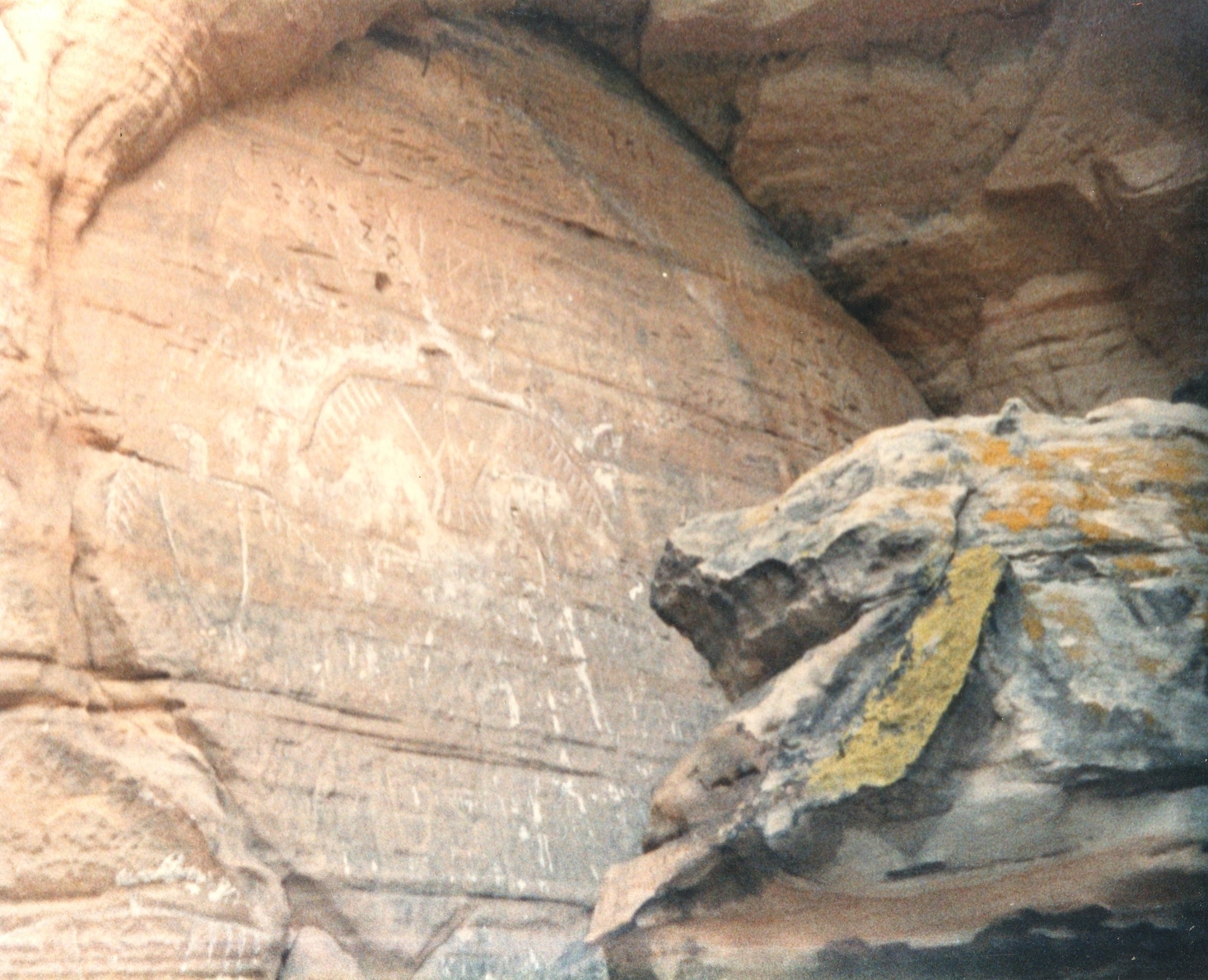
However, oral histories contain details that continue to draw cryptozoologists’ interest. Accounts tell of wings thundering as they beat, eyes flashing with lightning, and a body enormous enough to carry off a whale or a deer. Rock art and pictographs sometimes show a raptor-like profile with a hooked beak and a horizontal, outstretched-wing position, and interpreters have disagreed about whether certain aspects are the result of observation of actual birds, e.g., golden eagles or condors, or something dead. What occurred in the twentieth century was a subtle but significant change. Writers began to de-spiritualize and de-ceremonialize the Thunderbird, taking it out of its context and remaking it as a biological species, a relic waiting to be cataloged. That reinterpretation changed a sacred person into a cryptid, and it occurred mainly without input from the people whose traditions were being plundered.

The Missing Photograph and Nineteenth-Century Newspaper Wonders
The most renowned piece of purported proof in the entire area is an image that may never have existed. The narrative is commonly told like a legend: at some point in the late 19th century, cowboys in the Arizona desert shot a giant winged creature, carried it into town, and hung it on the wall of a barn, posing in front of it with arms outstretched to show its span. Thousands of people say they saw the resulting picture in a magazine or paperback. The mythology is based on a factual newspaper article. On April 26, 1890, the Tombstone Epitaph reported that two ranchers had slain a “winged monster” that resembled a giant alligator with leathery wings out on the desert between the Whetstone and Huachuca mountains (Tombstone Epitaph, 1890). That article didn’t have a picture. The claim that a photo existed seems to have originated from a 1963 article by Jack Pearl in the men’s adventure magazine Saga, which asserted that the Epitaph had published a photo in 1886; however, this date and detail do not withstand scrutiny (Pearl, 1963). Epitaph staff searched their archives in the 1960s but discovered nothing. Since then researchers have searched microfilm collections without success. The photo has become a classic example of communal false memory, a sepia-toned Mandela Effect, fueled by subsequent hoaxes, digitally changed barn pictures, and perhaps a confusion with a widely reproduced shot of a marabou stork. I think it’s fascinating how clearly people remember it. There’s just no proof that it’s a bird.
The Tombstone item was not an unexpected event. Copies of similar imports filled the American press in the middle and late nineteenth century. In January 1882 the Arizona Weekly Citizen announced the killing of a “monster eagle” that had attacked a man (Arizona Weekly Citizen, 1882). In March of that year, the Gridley Herald, picked up by journals as far away as New York, wrote of two lumbermen who shot at a crocodile-headed winged monster that yelled like a calf and a bear together (Gridley Herald, 1882). The Los Angeles Times, in May 1890, recalled earlier encounters by rancheros around Elizabeth Lake (Los Angeles Times, 1890). These stories have grammar and are read as a series. They highlight reptilian anatomy, membranous wings, and enormous size. That is to say, they read less like ornithology and more like the pterosaur images circulating in popular scientific publications. Nineteenth-century frontier journalism was likewise known for its taste for the tall tale, and publications often ran hoaxes for entertainment and circulation. These articles were compiled into cohesive narratives by mid-century pulp magazines and later writers like Mark A. Hall and Loren Coleman, and a dispersed archive of curiosities became a modern monster with a reading population.
Modern Sightings: Lawndale, Pennsylvania, and Alaska
Then Lawndale. It was the evening of July 25, 1977, and ten-year-old Marlon Lowe was playing in his family’s yard near Kickapoo Creek in central Illinois when, according to many witnesses, two huge dark birds swooped in low. One of them, the reports said, attacked the youngster from behind, grabbed his garment, and pulled him a foot or two off the ground before dropping him as his mother, Ruth, came screaming toward them. Seven people apparently described the same thing: black-as-coal birds with pale rings around their necks, hooked beaks, and ten-foot or more wingspans. Jerry Coleman interviewed the family within hours, and follow-up interviews proceeded for decades. The physical detail most frequently noted is a series of bruises, curled, over the boy’s shoulders. The case is difficult to dismiss due to the fallout. The Lowes were derided, not celebrated. Marlon was nicknamed “bird boy” by his classmates, and dead pigeons showed up on the family’s porch. They got nothing. Arithmetic makes it difficult to adopt. There is no North American bird known to be able to create the lift necessary to get a fifty-five-pound youngster off the ground, even for an instant, and the traditional suspects, turkey vultures and wayward condors, are way off.
Similar reports keep coming. The closest thing to a hotspot in the field has been Pennsylvania, notably the Black Forest area near Coudersport, the Pine Creek Valley in Clinton County, and Chestnut Ridge in the west. In the 1940s, writer Robert R. Lyman claimed to have seen a bird with a twenty-foot wingspan take flight from a road near Coudersport, while accounts from 2010, 2012, and 2013 depict long-beaked, bald-headed birds with wingspans estimated at between ten and fifteen feet. In October 2002, the Anchorage Daily News claimed that residents in Togiak and Manokotak, including pilot John Bouker of Bristol Bay Air Service, had spotted a raptor-like bird that Bouker estimated to be fourteen feet wing to wing, the size of his Cessna 207 (Anchorage Daily News, 2002). Federal raptor expert Phil Schempf dryly commented that he hadn’t heard of anything with a fourteen-foot wingspan being alive in the last hundred thousand years. Biologists suggested a vagrant Steller’s sea eagle, a bird around half again the size of a bald eagle. The regional coherence is indeed real. Witnesses consistently describe very dark plumage, unfeathered heads, a soaring rather than flapping style of flying, and size relative to aircraft. Consistency cuts both ways. It may be a real animal, or it may be the well-known inaccuracy of size assessment against an empty sky, enhanced by a common cultural template for what a thunderbird should seem like.
Biological Plausibility, Cosmological Dualism, and the Modern Search
The biological question demands a serious explanation, not a dismissive one. Giant birds did live in North America, yes. Teratornis merriami, known from thousands of bones at Rancho La Brea, had a wingspan of around eleven to twelve feet, while the bigger Aiolornis incredibilis may have been as much as sixteen or seventeen. Argentavis magnificens from South America, estimated to be over twenty feet. These animals were real, and the smaller teratorns survived until around the end of the Pleistocene, perishing along with the megafauna carcasses that likely fed them. The ‘relic population’ hypothesis is that a remnant exists in land that is too rough and desolate to have been properly explored, feeding on carrion in high mountain ranges. The issue is ecological, not merely geographical. Big flying scavengers need big foraging territories and a steady supply of carrion. That is why California condors almost disappeared and why their comeback has required intense management. A breeding population capable of surviving ten thousand years would mean hundreds of individuals spread over a huge area and would leave behind carcasses, feathers, droppings, nests, and bones. And then there’s the aerodynamics. Above a span of about twenty feet, the mass of a flying animal increases more rapidly than the wing area, takeoff becomes more and more dependent on cliffs, slopes, or sustained wind, and the structural demands on bone and muscle increase sharply. Such a monster is possible in concept. It would only be a specialist creature, limited to specific types of terrain and weather, making it predictable and simple to locate.
Thunderbirds are often associated with rain and weather control. In some cross-cultural accounts, the thunderbird is explicitly a rain-bringer or a rain-sharer, while in others its thunder heralds the arrival of rain or the changing of weather conditions (as part of the storm-cycle imagery) (Blust, 2023; Zawadzka, 2011). The Thunderbird is recurrently framed against other cosmological forces (namely horned water serpents or undersea serpents) in a dualistic cosmos of sky- and water-based energies in competition for dominance. This dualism is said to be ancient and ubiquitous in Native American lore, with the Thunderbird often playing the role of a storm-bringer or a snake hunter, depending on lineage or region (Blust, 2023; Blust, 2023; Zawadzka, 2011; Bender, 2017).
This dualism is why the search has become more technological, yet it remains inconclusive. Now, enthusiasts and a few academics employ commercial satellite photography to look for enormous stick nests on cliff faces and rock outcrops in the Pacific Northwest and the northern Rockies and drones to explore places no climber would casually visit. Trail cameras, thermal optics, and crowdsourcing flight tracking data have all been used. The challenges are real. Drones’ battery life, range, and legal constraints near wilderness and tribal territories limit their use. The challenges are real, including limitations imposed by battery life, range, and legal constraints near wilderness and tribal territory. The high-altitude terrain is fog-covered, wind-swept, and perilous. When we see a bird at two thousand feet against a bright sky, there are a few blurred frames without a scale of reference. And that is precisely why almost all the footage of Thunderbird breaks down under scrutiny into a vulture and an eagle, a heron, or a soaring pelican. But the very smartphone saturation that should have generated a decisive image after two decades has produced an ocean of ambiguity. That lack is data itself.
Conclusion
The Thunderbird persists, then, not because the evidence is compelling but because the question is complex. At its heart is a live body of Indigenous religious and cultural tradition that ought to be understood on its terms, not mined for monster legend. Here is a real fossil record of giant extinct creatures, a nineteenth-century newspaper collection of unreliable wonders, a missing photograph that a generation remembers seeing, and several cases like Lawndale that trouble skeptic and believer alike. The most likely explanation is by way of “braids of misjudged distance, cultural expectation, and vagrant large raptors” and the human ability for narrative. That verdict does not merely close the file; it reveals the true nature of the file, which concerns how memory, land, and sky combine to create a creature that no one has captured and that no one can fully relinquish. Up in the high country the shadow hangs back and we keep staring up.
References
Anchorage Daily News. (2002, October). [Report of a large raptor-like bird sighted near Togiak and Manokotak, Alaska].
Arizona Weekly Citizen. (1882, January). [Report of a “monster eagle” killed after attacking a man].
Bender, H. E. (2017). The Star-Beings and stones: Petroforms and the reflection of Native American cosmology, myth and stellar traditions. Journal of Lithic Studies, 4(4), 77–116. https://doi.org/10.2218/jls.v4i4.1918
Blust, R. (2023a). Dragons and thunder/lightning. 67–76. https://doi.org/10.1163/9789004678309_007
Blust, R. (2023b). The ethnology of the dragon. 77–129. https://doi.org/10.1163/9789004678309_008
Gridley Herald. (1882, March). [Report of two lumbermen firing on a crocodile-headed winged monster].
Ingersoll, E. (1923). Birds in legend, fable and folklore. https://doi.org/10.5962/bhl.title.5545
Los Angeles Times. (1890, May). [Recollection of rancheros’ encounters with a winged monster near Elizabeth Lake].
Pearl, J. (1963, May). The monster bird that carries off human beings. Saga.
Slabbert, M., & Viljoen, L. (2006). Sustaining the imaginative life: Mythology and fantasy in Neil Gaiman’s American gods. Literator, 27(3), 135–156. https://doi.org/10.4102/lit.v27i3.204
Tombstone Epitaph. (1890, April 26). [Report of a “winged monster” killed on the Arizona desert between the Whetstone and Huachuca mountains].
Zawadzka, D. (2011). Spectacles to behold: Colours in Algonquin landscapes. The University of Western Ontario Journal of Anthropology, 19(1). https://doi.org/10.5206/uwoja.v19i1.8905



Leave a Reply