The Chamrosh, Persian Cryptid Bird: Key Points
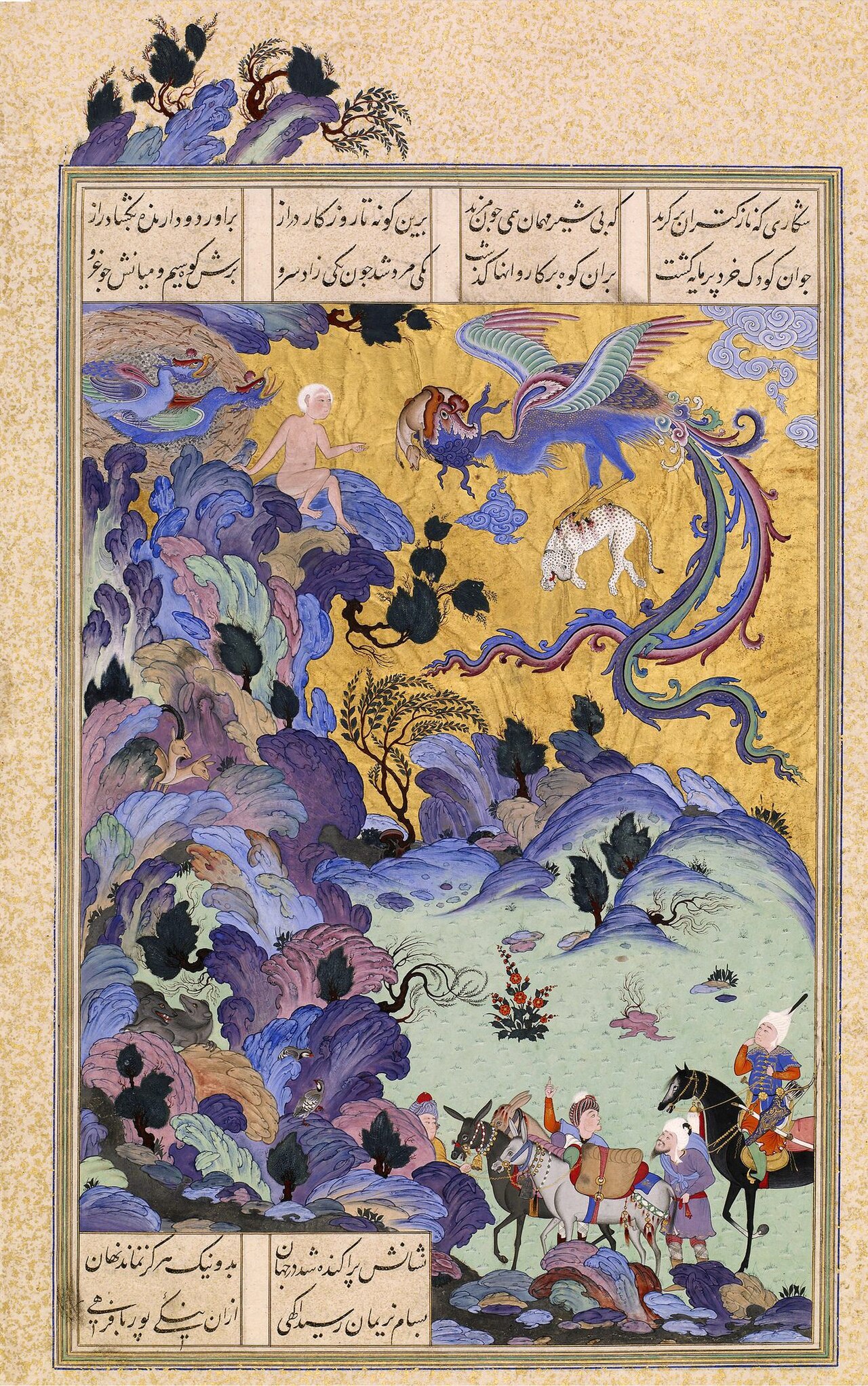
- The Chamrosh is a hybrid with the body of a dog or wolf and the head, wings, and tail feathers of an eagle, sometimes called a Cynogriffin for its resemblance to the griffin.
- It lives beneath the Harvisptokhm, the tree of all seeds, on Mount Alborz, where a greater bird shakes the seeds loose and the Chamrosh drives them out over the sea for the rain to scatter worldwide.
- It appears in the Avesta, the Bundahishn, and the Rivayats, which rank it second among all birds and describe it snatching up foreign raiders who plunder Iranian lands.
- Immortal and protector of all birds, it commands plant distribution and rain, but depends entirely on the greater bird and the clouds to complete its work.
- DeMello (2024) links the abundance of Near Eastern bird hybrids to bird divination, since birds fly between worlds, show visible agency, and were thought to carry human souls.
- Most theories hold that the Chamrosh and Simurgh were once a single creature, while others read the myth as agricultural allegory or as political theology defending Iranian abundance.

Introduction
One of the quieter wonders of ancient Iranian myth is the Chamrosh, a monster whose work is not conquest or riddles but sowing. It waits, half dog, half eagle, under the tree of all seeds on the slopes of Mount Alborz and bears the world’s harvest to the heavens. Compared with the dragons and demons that swarm the same tradition, it is a surprisingly mild figure, an agricultural machine rather than a monster, but then again it is also a furious defender of Persian land when foreigners come to loot. Its narrative is at the nexus of Zoroastrian cosmology, Near Eastern hybrid iconography and the long human practice of reading meaning into birds. To comprehend the Chamrosh is to understand something of the way the ancient world dreamed of fertility, protection, and the traffic between soil and sky.
Identifying the Chamrosh in the Sources
The Chamrosh, of Persian and Arab-Persian folklore, is mentioned in connection with mythic birds. in relation to mythic birds in Persian and Arab-Persian folklore. Its place is associated with mythic birds such as the Simurgh, Simorgh, and similar Avesta/Shahnameh symbolism. The Simurgh and kindred legendary birds Several sources discuss the Simurgh and other legendary birds as symbols with healing, protective, or cosmic aspects within Persian mythic narratives. The mention of the Chamrosh is found in the study of Bajau wood-carving, as part of an inventory of mythic birds that affect motif design through Islamic cosmology and Persian/Arab influences in Southeast Asia (Badaruddın et al., 2019). The link is that Chamrosh is one of the mythic birds mentioned within the framework of cross-cultural mythology that accompany Islamic culture and Persianate influence (Badaruddın et al., 2019).

Form and Behavior
The Chamrosh is a physical hybrid, and its hybrid nature is significant. Ancient and medieval depictions depict it as having the body of a dog, occasionally a wolf, attached to the head, wings, and tail feathers of a bird, most often an eagle. The outcome is a creature created for two elements at once, four-footed and grounded in the first half of its life, feathery and aerial in the second. That combination is so reminiscent of the Greek griffin, the hybrid of lion and eagle, that the Chamrosh has often been referred to as a Cynogriffin, a dog-griffin. Its wingspan is said to be vast, wide enough to blast clouds of seed out over an inland sea. A few of the Sasanian and Persian pictures feature a collared bird, which implies domestication or divine possession. Like, the animal belongs to someone. The creature is not like most others; it is hideous. Artists usually depicted it as a gorgeous, alert, well-proportioned animal, more like a hunting hound with feathers than a chimera assembled from bits and pieces.
Patience and repetition define its behavior. The Chamrosh lives in the peak or the lower slopes of Mount Alborz, the highest mountain in Iran and the axis of the Zoroastrian world, at the foot of the Harvisptokhm, the tree of all seeds, sometimes identified with the soma or haoma tree, which grows by the fabled sea, Vourukasha. On it sits a larger bird, named Amrosh in the Persian Rivayats and Senmurv or Simurgh elsewhere. That bird settles on the boughs or leaps from them, and the jar of its weight causes every seed that is ready to fall. Then the Chamrosh does its work. It takes the fallen seeds, beats them with its wings and sides, and forces them over the water, where they are carried up into rain clouds and sown worldwide. This version says the Chamrosh first walks through every field of barley and every stand of trees. Some set the cycle on an annual rhythm; others assign it a three-year interval. The division of work is tidy, one bird loosening, one bird carrying. And it goes on and on.
Textual History and Scholarly Limits
The creature’s historical record is not found in any single tale but in the complex textual heritage of Zoroastrianism. The Avesta, the earliest of the Zoroastrian scriptures, has references to the big bird and the all-healing seed tree, but it is in the Middle Persian works of the ninth and tenth centuries and the much later New Persian Rivayats that the Chamrosh itself begins to be brought into clarity. The Pahlavi Bundahishn and the Menog i Khrad say that Chamrush or Chinamrosh is the second most valuable of all the birds of land and sky because worth is determined by deeds and its deed is magnificent, rated just below the Sen bird. The Rivayat of Darab Hormazyar has the most complete and most quoted story, where the creator, Ohrmazd, that is, Ahura Mazda, creates on the beaches of Vourukasha a tree and two immortal birds. The Chamrosh is also known to be aggressive. According to Zoroastrian tradition, whenever non-Iranians loot the Iranian lands every three years, the divine entity Burz, connected with agriculture, awakens the Chamrosh at the peak of Alborz, and the bird seizes the raiders in its talons like a bird does grain. The Simurgh is recounted in the Shahnameh, the magnificent Persian epic, as a mountain bird who raises the outcast prince Zal and guides him onto his throne, but the two figures overlap so consistently that the story is often also applied to the Chamrosh.
None of the sources on the list provide a comprehensive, self-contained ethnography or philology focused solely on the study of the Chamrosh. Instead, the Chamrosh is woven into larger conversations about Persian mythic birds, Persian impact on art, and the spread of myths across cultures. Therefore, exact statements on Chamrosh’s characteristics (habitat, role in myth, ritual use) must be strictly confined to what the given sources say expressly about Chamrosh (typically in a list of mythic birds or in a diffusion story). The strongest, explicit connections to Chamrosh in the supplied materials are in the Bajau artifact discussion (source: Badaruddın et al., 2019), where Chamrosh is named among Arab-Persian mythic birds that influence local design motifs in Bajau parang hilt and sheath artistry, plus the general discussion of Simurgh/Chamrosh in Persian myth sources (Kościelniak, 2023; Yuyukin, 2024; Alizadeh et al., 2017; Khoshdel & Lashkari, 2013) that provide background on the broader pantheon to which Chamrosh is loosely connected.
Powers, Kinship, and Interpretation
Its powers flow from its function. According to the Rivayat narrative, the Chamrosh is deathless and immortal and is characterized as the prototype of all birds and ruler and protector of the birds of the earth. It rules the dispersal of plant life and is therefore a first-rate fertility power, sharing in the rain cycle with Tishtar, the star Sirius, who catches the seed-filled waters and sends them down. Its claws are strong enough to pick up human raiders. The wings beat at speed, like the wind beats chaff. Vulnerabilities are harder to find, which is telling in itself, because the creature belongs to a cosmos in which the forces of order are supposed to win out. The Chamrosh is not weak but dependent. Its power is completely relational, because it cannot begin its labor until the larger bird rattles the tree, and it cannot complete it without rain. Tradition points to eventual retirement as well. In one Pahlavi book at the resurrection, when the world is made flat and the waters stand still, the great bird nests in the forest and the age of seed-scattering is over. There is also a darker note. One verse has the bird withering the tree, not just shaking it, which some readers associate with the searing sun, so the same figure that nourishes the world may also parch it.
In Persian mythological repertoires, Chamrosh is sometimes mentioned in relation to Simurgh (the phoenix-like thrush/mystical bird). The Simurgh (Si murgh) is a figure of immense symbolic value in Persian literary and mythological traditions. Its importance: Several sources discuss its importance, including its appearance in Attar’s Conference of the Birds (Maqāmaat al-ṭuyūr) and in Shahnameh contexts. The sources distinguish between Simurgh and Chamrosh, both of which are part of Persian mythological avifauna and are mentioned in discussions of mythic birds and their symbolic meaning (rebirth, healing, leadership, etc.) (Kościelniak, 2023; Yuyukin, 2024; Alizadeh et al., 2017; Khoshdel & Lashkari, 2013).
In broader folklore, the Chamrosh has a crowded family tree. A veritable menagerie of bird hybrids was spawned by the ancient Near East and Mediterranean: the Jewish lion-bird Ziz, the Arabian phoenix, the biblical cockatrice, the Greek sphinx and griffin, the horse-rooster hippalectryon, the Assyrian lamassu, the Sumerian Anzu, the Islamic Buraq, the Egyptian hieracosphinx, the Indian Sharabha, and, far beyond, the feathered serpent of pre-Columbian Mesoamerica. Jewish tradition occasionally openly identifies the Chamrosh with the Ziz. As Fehlmann (2024) observes in a review of Margo DeMello’s global encyclopedia of legendary monsters, this profusion of avian hybrids is no coincidence, for in the ancient Middle East, birds played a key part in divination. Ornithomanteia, or divination from birds, was an early scientific technique that may have originated five thousand years ago in Mesopotamia. Birds fly and therefore they are natural intermediates between this world and the world of spirits. A common belief was that a human soul might be reborn in the body of a bird. Birds too were showing clear intention, choosing their flight path, and that choice could be read as a message from the gods. Greek and Roman generals never went to war without such readings. Because of all these factors, DeMello (2024) points out that birds are still among the most common motifs in ancient, pre-Islamic Arabian, and Islamic art.
Theories of the Chamrosh have been concerned with the subject of its link to the Simurgh. The most common theory suggests that the Chamrosh and Simurgh were originally a single being, with their functions becoming divided as the tale evolved. Both are dog-bird hybrids, both live on Alborz, both are connected to the seed tree and both are characterized as bringing fertility. Philologists say the names Amrosh and Chamrosh come from Avestan personal names, amru and camru, which were also bird names, suggesting that the pair may have been created through linguistic doubling. Another interpretation is that the entire episode serves as an allegory for agriculture, with the tree representing the source of species diversity, the two birds acting as mechanical agents of seed dispersal, and the rain serving as the means of delivery; this myth may be an early attempt to explain the appearance of plants in areas where no one has sown them. A third view reads the raiding myth as a political theology, where the bird’s seizing of foreign crops legitimizes Iranian claims to wealth and agricultural prosperity as divinely defended territory. Some academics have also hypothesized that the Chamrosh became less important because of its closeness to older gods like Mithra and Apam Napat and became a residual figure in art and cosmology instead of a focus of worship.
Conclusion
The Chamrosh persists because it does one thing that few mythical monsters do. It works. At its most basic, the creature is a dog with the head of an eagle that waits under a tree for seeds to fall; this seemingly lowly job makes it responsible for the greenness of the entire world, and its secondary function as the talon that pulls invaders from the Iranian fields makes it a national guardian as well. Its hybrid body shows a Near Eastern visual language where blending animals was a way of expressing mixed powers. Its bird half depicts a culture that looked to the sky for instructions. Be it a twin of the Simurgh, a language accident, or an agricultural allegory with feathers, the Chamrosh is a survival of an ancient and attractive idea: that fertility is not spontaneous but born and that there is something patient and careful doing the bearing.
References
Alizadeh, A. H., Moghadam, S. M. A., & Radfar, A. (2017). Comparison of resistance symbols in poems of Kaiser Aminpoor and Ayyed Hassan Hosseini with poems of Ali Ahmad Sa’id and Jabra Ibrahim Jabra (Adonis). Journal of History Culture and Art Research, 5(4), 345–354. https://doi.org/10.7596/taksad.v5i4.610
ʿAṭṭār, F. (1986). The conference of the birds (A. Darbandi & D. Davis, Trans.). Penguin Books. (Original work composed ca. 1177)
Badaruddın, M. I., Soon, S., Lee, L., Sahibil, Z., & Tarmizi, M. S. H. A. (2019). Bird as a subject in wood carving motifs: An observation on Bajau traditional weapons. Borneo Research Journal, 13(1), 115–138. https://doi.org/10.22452/brj.vol13no1.7
Darmesteter, J., & Mills, L. H. (Trans.). (1880–1887). The Zend-Avesta (Sacred Books of the East, Vols. 4, 23, & 31). Clarendon Press.
DeMello, M. (2024). Bigfoot to Mothman: A global encyclopedia of legendary beasts and monsters. Bloomsbury Academic.
Dhabhar, E. B. N. (Trans.). (1932). The Persian Rivayats of Hormazyar Framarz and others. K. R. Cama Oriental Institute.
Fehlmann, M. (2024). Buchrezension: Margo DeMello (2024). Bigfoot to mothman: A global encyclopedia of legendary beasts and monsters [Book review: Margo DeMello (2024). Bigfoot to mothman: A global encyclopedia of legendary beasts and monsters]. Journal of Anomalistics, 24(2), 511–515. https://doi.org/10.23793/zfa.2024.511
Ferdowsi, A. (2006). Shahnameh: The Persian book of kings (D. Davis, Trans.). Viking. (Original work composed ca. 1010)
Khoshdel, A., & Lashkari, M. H. (2013). From the Persian ancient dramas, Jamm and Simurgh toward the modern military medicine. Journal of Archives in Military Medicine, 1(1), 1–5. https://doi.org/10.5812/jamm.15082
Kościelniak, K. (2023). The Neoplatonic roots of apophatic theology in medieval Islam on the example of Maqāmāt aṭ-ṭuyūr/Manṭiq aṭ-ṭayr (The conference of the birds) by ʿAṭṭār Nīšāpūrī (ca. 1145–1221). Verbum Vitae, 41(3), 647–672. https://doi.org/10.31743/vv.16185
West, E. W. (Trans.). (1880). Pahlavi texts, Part I: The Bundahis, Bahman Yast, and Shâyast lâ-shâyast (Sacred Books of the East, Vol. 5). Clarendon Press.
West, E. W. (Trans.). (1885). Pahlavi texts, Part III: Dînâ-î Maînôg-î Khirad, Sikand-gûmânîk Vigâr, and Sad Dar (Sacred Books of the East, Vol. 24). Clarendon Press.
Yuyukin, M. A. (2024). On the mythological background of the bylina “Ilya Muromets and Nightingale the Robber.” Revista de Etnografie și Folclor / Journal of Ethnography and Folklore, 2024(1–2), 20–31. https://doi.org/10.59277/jef.2024.1-2.02


Leave a Reply