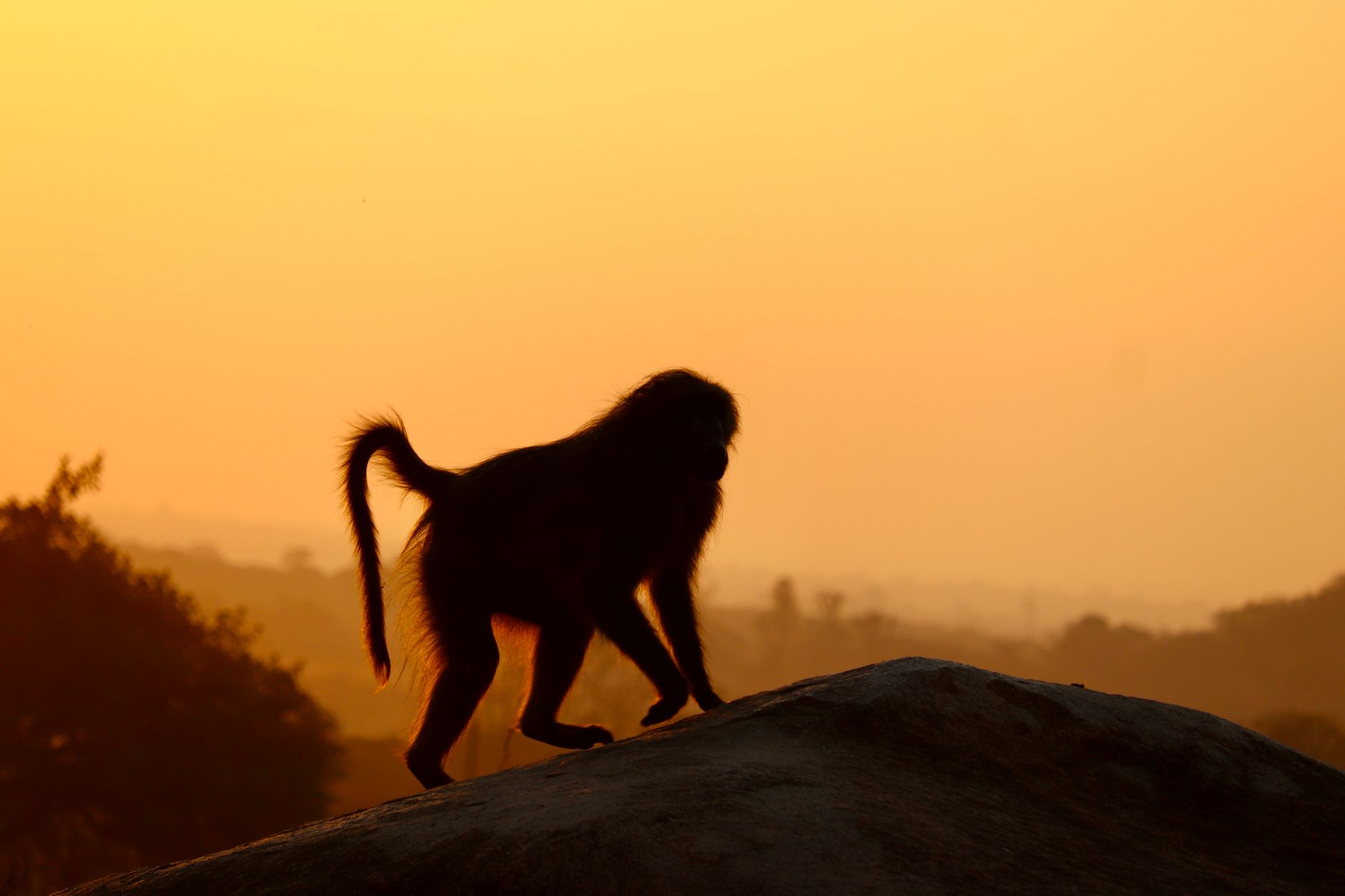
Babi, Ancient Egyptian Baboon God: Key Points
- Babi was a violent, sexually powerful baboon god in ancient Egyptian religion. He appears mainly in funerary texts, where he acts as both a destroyer and a protector.
- He was based on the dominant male hamadryas baboon, which has a silvery mane, a red face and long, dangerous canine teeth.
- Called the “bull of the baboons,” Babi stood for sexual power, which kings hoped to share in the afterlife. He was also bloodthirsty and was said to live on human entrails.
- In the Book of the Dead, he was one of the dangers waiting for souls who failed when their hearts were weighed against the feather of truth.
- Babi had no major temple. People called on him through funerary texts and protective spells to guard them from snakes, rough water and darkness.
- Scholars compare him with Thoth, another baboon god, and link him with Seth through the Greek figure Bebon. Some people think the word “baboon” comes from his name, but most linguists doubt it.
Introduction
Most of us imagine Egyptian gods as serene, stately beings: Osiris draped in white, Isis with her wings outspread, Thoth quietly writing with his reed-pen. Babi does not fit that image. He was a baboon god of aggression and sexual power who fed on human entrails and he seems to have pleased and scared the Egyptians in roughly equal measure (Hart, 2005). He is a recurring figure in the funeral texts that guide the dead through the afterlife, where he acts as a destroyer and defender. He also occurs in more unusual locations, such as a myth where he is misled, humiliated and put to death. Babi didn’t have a big temple or a famous festival, but he still had a lot to tell us about how the ancient Egyptians thought about aggression, masculinity, judgment and survival. His looks, his demeanor, the ways in which he was worshiped and the hypotheses historians have suggested, all add up to a god who was as disturbing as he was essential.

The Baboon in Egyptian Religion
The species of baboon is typically regarded as a sacred or ritually important animal in Egyptian religion and is commonly associated with the god of writing and knowledge, Thoth, and occurs in both elite and popular religious contexts. Several authors explain the major position of baboons in worship and myth in conjunction with divine activities in Egypt (Ottoni et al., 2019; Atkins, 2019; Ezzat, 2021). In particular, mummified baboons and their larger cultural value are associated with thoth-like connotations and ritual contexts (Ottoni et al., 2019; Atkins, 2019).
Babi’s Appearance and Nature
Babi, or Baba and Bebon, was the deified form of the hamadryas baboon (Papio hamadryas), an animal well known to the Egyptians (“Babi (mythology),” 2026). The male of this species is a really striking animal, particularly when dominating. He has a long mane of silvery gray fur over his shoulders and chest, which makes him look bigger and more fearsome than he is. His face is naked and pinkish-red, his snout long and dog-like. His lips are pulled back, revealing enormous canine teeth equal in length to a leopard’s. His backside is similarly bare and brilliant red, and baboons are well recognized for their obvious genital marks (“Babi (mythology),” 2026). In art Babi might be shown as a baboon or a man with a baboon’s head and was often depicted with an erection. One late tale even depicts him as a red dog with golden eyes. This is a reminder that the large, doglike muzzle of the baboon made them seem closely related (“Babi (mythology),” 2026). Ancient writers rarely describe him in detail, because they needed no further description. Babi resembled every other big male baboon that had shown his teeth before.
Babi’s looks suited his conduct. His name is most often translated as “bull of the baboons,” which approximately means chief of the baboons (Hart, 2005, p. 44). The title identifies him as the alpha male who leads the troop and governs the females. This suggests his most renowned characteristic, his sexual potency. Baboons have a compelling libido; hence, Babi became the god of virility for the dead (“Babi (mythology),” 2026). One burial ritual equates the dead man’s phallus to Babi so that he will be able to have sexual intercourse in the afterlife (Hart, 2005). Some paragraphs go even further. Babi’s erect phallus is the bolt that fastens the portals of the heavens and the mast of the ferry that delivers the virtuous dead to Aaru, the island paradise of the hereafter (Hart, 2005; “Babi (mythology),” 2026). For the modern reader, such imagery may sound weird or even humorous. It made sense to the Egyptians. Sexual potency represented life, creation, and rebirth, and a king who shared Babi’s power would never really die.
But his appetite was frightening. Baboons are very violent omnivores and Babi was considered bloodthirsty, a god who slaughtered on sight and fed on human entrails (Breasted, 1912/1972; Hart, 2005). His most famous part is in the Book of the Dead, where the judgment of the soul is described. It is he who feeds on the entrails of the mighty ones on the day of reckoning (Breasted, 1912/1972). The Egyptians thought that each person’s heart would be weighed against Maat, the truth and cosmic order. Babi was said to eat the souls of the sinful that failed this test and he stood beside a lake of fire, which represented their complete damnation (Curl, 2005). Judging the dead was so crucial to the underworld that some stories considered Babi the eldest son of Osiris, lord of the dead, making him a sibling of Anubis and Horus (“Babi (mythology)”, 2026). Baboons are dangerous animals, and they can kill you with their teeth. The Egyptians, knowing they had a terrible animal, turned it into the incarnation of divine punishment.
Worship, Magic, and Archaeological Evidence
But Babi was never an all-evil god. His violence could be used for good and there is where his worship comes in. As far as we know, he had no great cult center of his own or enormous temple with priests serving him every day. He was chiefly venerated and called upon by people through burial religion and protective magic. Spells were invoked to help him against harmful things, especially snakes and choppy water (Hart, 2005). Someone who ventured out onto the Nile may invoke Babi’s might for protection. But magic may be used against him as well. In the Temple of Edfu there is an inscription with a charm to restrict his sexual strength. A sentence in the Papyrus Geneva is a cure for dog bites. In it Isis tells the child Horus to keep clear from Babi, who is prowling the land with 77 hounds. One of the dogs bites Horus on the leg, and Isis heals the wound with a mystery plant named Sryw. The dog was fed the plant and died, symbolizing the eradication of the poison, and the patient being treated was identified with Horus (“Babi (mythology),” 2026). Such a twofold role is typical of the Egyptian religion. The most helpful powers people often needed to control the most frightening powers, which were also the most helpful.
One of the key empirical sources for our understanding of baboons in Egyptian religion and daily life is the Baboon Catacomb at Saqqara. Recent evaluations of archeological data conclude that baboons (Papio spp.) were interred in substantial numbers at this site, that baboons constituted a significant aspect of the assemblage, and that these creatures were highly valued as divine or protecting figures within Egyptian religious life. Vervet baboons and olive baboons are depicted in the Baboon Catacomb of Saqqara (Urbani, 2021). Urbani (Archaeoprimatology) also offers quantitative observations on the sex ratio and the prevalence of baboons amongst the interred primates. This evidence supports the idea of baboons as an important sacred animal in the late pharaonic and Greco-Roman periods, often associated with Thoth in the iconography of temples and necropolises (Urbani, 2021; Weshahy & Omran, 2014).

Theories of Babi’s Origins, Meaning, and Material Legacy
Scholars have proposed numerous ideas about Babi’s origins and meaning, the first of which surrounds his tie to Thoth. The deity of learning and writing, Thoth, might also appear as a baboon. Both gods were associated with the same animal, although they were very distinct aspects of it. Thoth’s baboon is calm and thoughtful and is generally seen sitting quietly with his hands on his knees. Babi is forceful, loud, and sexual. The Papyrus Jumilhac makes this contrast into a narrative. Babi accuses Thoth of robbery before Ra and the Ennead, but the gods dismiss the claim as no one observed the act. Babi continues to spread rumors and Thoth seeks retribution. He rubs Babi’s sleeping phallus with his writing reed and utters a charm over it that it may, in the act of intercourse, swell up and catch Babi with his companion. Then Thoth summons the gods together and ridicules Babi for his nakedness. Ra finds Babi guilty, and Thoth sacrifices him on a block. The verse appears to describe the practice of presenting a dog in honor of Thoth (“Babi (mythology),” 2026). The symbolism is plain: the reed of the scribe beats with unbridled vigor, while intelligence crushes uncontrolled craving.
In that account, the nature of Babi’s guilt is still questioned. This argument leads to a second theory of Babi’s relationship to Seth, the god of chaos and violence. Babi’s crime might have been rape, adultery, or simply too much sex. His lover is only described as “mnt,” meaning “someone,” which hints that her identity was either insignificant or intentionally suppressed (“Babi (mythology)”, 2026). Egyptians felt that written words had real power, and hence crimes against gods, like the murder of Osiris, were frequently portrayed in cautious euphemisms. The goddess in the above Edfu spell is a “God’s Wife” and also a lady who spurns relations with gods and men. The Mythological Manual of the Delta includes a similar account of Set raping a goddess by tying her up (“Babi (mythology),” 2026). These connections confirm the ancient identification of Babi with Seth. Greek sources mention a personage called Bebon, who is either another name for Seth or one of his associates. Bebon appears as one of Babi’s own names. Both the gods were aggressive, dangerous, and sexually heated. It seems incongruous that Babi could be both the son of Osiris and a partner of Osiris’s killer, but Egyptian mythology often permitted various versions of a god’s story to exist side by side.
Language is another topic of discussion. The English word ‘baboon’ has occasionally been thought to be derived from the name of Babi. The temptation is there, but most linguists track the baboon through medieval French and dispute any link to the Egyptian divinity. The similarity is perhaps an accident, but a pleasing one. More generally, Babi is typically understood by historians of religion as a representation of Egyptian ideas about male dominance. He is a symbol of strength, of dominance and fertility. He embodies the threat of unchecked aggression and passion, which Jumilhac‘s story condemns. The Egyptians may have found it beneficial to personify uncontrollable forces as a god for protection and judgment.
Large numbers of mummified baboons at locations associated with royalty and religion, especially from the New Kingdom and Greco-Roman periods, indicate domestication and ritual features. These mummies have been utilized to show the extent of baboon-related cult activities and their significance within temple and royal contexts (Ottoni et al., 2019). Baboons appear in several kinds of Egyptian art media, from wall paintings and reliefs to statues and amulets. Their iconography is associated with Thoth and with ritual settings in which the baboon imagery works symbolically in the solar and burial context (Ezzat, 2021; Ottoni et al., 2019). The corpus also includes faience baboon statuettes and other small-scale representations, illustrating the widespread use of baboon imagery in material culture across different periods, including later contexts where Egyptian influence persisted into Greco-Roman exchanges (عطـــــاالله, 2023; Ferrara et al., 2021), and Wolfson (n.d.) (where Greek depictions discuss baboon-derived iconography in broader Mediterranean contexts).
Conclusion
Babi is one of the more unusual members of the Egyptian pantheon and is worth a deeper look because he doesn’t sit easily next to more familiar gods. A form he had taken from the mighty male hamadryas baboon with his silver mane, his red face, and lethal teeth, but he could also take the form of a baboon-headed man or even a crimson dog. He was a sexual beast with an unquenchable lust and he stood by the lake of fire, ready to consume the souls of the unworthy. He was mainly worshiped not in magnificent temples but in funerary inscriptions and protective incantations. It was easy for people to create spells to bind him. Theories concerning him, from his rivalry with Thoth to his ties with Seth, reveal the intricate Egyptian perspective of nature. The same animal may symbolize wisdom or aggression; a god might be both the son of Osiris and a friend of his enemies. Babi reminds us that the ancient Egyptians did not try to erase the terrible side of existence. They assigned a face, a name, and a role in their cosmos to those forces. In so doing, they made danger something they could understand, call upon, and defeat if necessary.
References
Atkins, P. J. (2019). Praise by animals in the Hebrew Bible. Journal for the Study of the Old Testament, 44(3), 500–513. https://doi.org/10.1177/0309089219862824
Babi (mythology). (2026, March 25). In Wikipedia. https://en.wikipedia.org/w/index.php?title=Babi_(mythology)&oldid=1345372672
Breasted, J. H. (1972). Development of religion and thought in ancient Egypt. Charles Scribner’s Sons. (Original work published 1912)
Curl, J. S. (2005). The Egyptian revival: Ancient Egypt as the inspiration for design motifs in the West. Routledge.
Ezzat, A. (2021). Animals in Human Situations in Ancient Egyptian Ostraca and Papyri. Arts, 10(3), 40. https://doi.org/10.3390/arts10030040
Faulkner, R. O. (Trans.). (1990). The ancient Egyptian book of the dead (C. Andrews, Ed.). University of Texas Press.
Ferrara, S., Montecchi, B., & Valério, M. (2021). The Making of a Script: Cretan Hieroglyphic and the Quest for Its Origins. Bulletin of the American Schools of Oriental Research, 386, 1–22. https://doi.org/10.1086/716098
Hart, G. (2005). The Routledge dictionary of Egyptian gods and goddesses (2nd ed.). Routledge.
Massart, A. (1957). The Egyptian Geneva papyrus MAH 15274. Mitteilungen des Deutschen Archäologischen Instituts, Abteilung Kairo, 15, 172–185.
Meeks, D. (2006). Mythes et légendes du Delta d’après le papyrus Brooklyn 47.218.84. Institut français d’archéologie orientale.
Ottoni, C., Guellil, M., Ozga, A. T., Stone, A. C., Kersten, O., Bramanti, B., Porcier, S., & Neer, W. V. (2019). Metagenomic analysis of dental calculus in ancient Egyptian baboons. Scientific Reports, 9(1). https://doi.org/10.1038/s41598-019-56074-x
Urbani, B. (2021). Archaeoprimatology: The Longue Durée Interface Between Humans and Nonhuman Primates. Annual Review of Anthropology, 50(1), 379–401. https://doi.org/10.1146/annurev-anthro-101819-110130
Vandier, J. (1961). Le papyrus Jumilhac. Centre National de la Recherche Scientifique.
Weshahy, M. E., & Omran, R. (2014). Hypocephalus in Ancient Egyptian Religion. Journal of Association of Arab Universities for Tourism and Hospitality, 11(3), 1–28. https://doi.org/10.21608/jaauth.2014.57549
Wolfson, E. (n.d.). Pictorial representations of monkeys and simianesque creatures in Greek art. https://doi.org/10.32469/10355/66131
عطـــــاالله, ر. (2023). تمثالان غير منشورين لقرد البابون بمتحف الآثار التعليمي بكلية الآداب جامعة الإسكندرية رقم 270 (جرد: 727، 848). Bulletin of the Center Papyrological Studies, 40(1), 79–108. https://doi.org/10.21608/bcps.2023.306514

Leave a Reply