Haunted Roads: Key Points
- Haunted roads usually look alike: narrow, dark, and lined with trees, with sharp curves, fog, and roadside memorials that make drivers uneasy before any ghost story begins.
- Hauntings follow familiar patterns, including vanishing hitchhikers, phantom vehicles, figures on the roadside, electrical failures, and sudden feelings of dread.
- Clinton Road in New Jersey runs through isolated woods and is known for a drowned boy who supposedly tosses coins back from a bridge and for a phantom pickup truck that chases cars.
- Archer Avenue in Chicago is home to Resurrection Mary, a young woman in a white dress who reportedly accepts rides from drivers and then vanishes near Resurrection Cemetery.
- U.S. Route 666, known as “The Devil’s Highway,” was linked to phantom trucks, hellhounds, and frequent accidents until it was renumbered Route 491 in 2003.
- Believers explain haunted roads through residual or intelligent hauntings, while skeptics point to highway hypnosis, pareidolia, infrasound, dangerous road design, and the spread of legends by people who visit expecting to be scared.

Introduction
Most roads are there to transport people from point A to point B, and drivers ignore them the moment they arrive. Some routes linger with you long after. Some routes stay with you long after the journey ends. Travelers talk of cold spots on warm evenings, individuals standing on the shoulder, and headlights that come up in the mirror and go. These are the haunted highways, and nearly every stretch has one. Geography, tragedy, and storytelling come together where they sit, and their reputations tend to outlive the people who founded them. To figure out why some roads acquire this reputation, it helps to see what they look like, what people say happens on them, and why the legends keep flowing.
Hauntology and the Memory of Roads
Derridean hauntology is a way to understand the way that roads carry the past, twisting time and pulling the absent future toward us. Key discussions conceptualize haunting not only in terms of revenants but also as ethical calls to remembrance and duty (e.g., Derrida’s Specters of Marx; transgenerational haunting; phantom as transgenerational memory) (Lorek‐Jezińska & Więckowska, 2017; Barron, 2020). The idea of the phantom by Abraham and Torok and similar psychoanalytic readings sees haunting as the transmission of secrets and traumas over bodies and generations. This concept is a significant lens for infrastructure locations that stand as hauntings in public space. Lorek‐Jezińska & Więckowska, 2017; Barron, 2020;
The Look and Lore of Haunted Roads
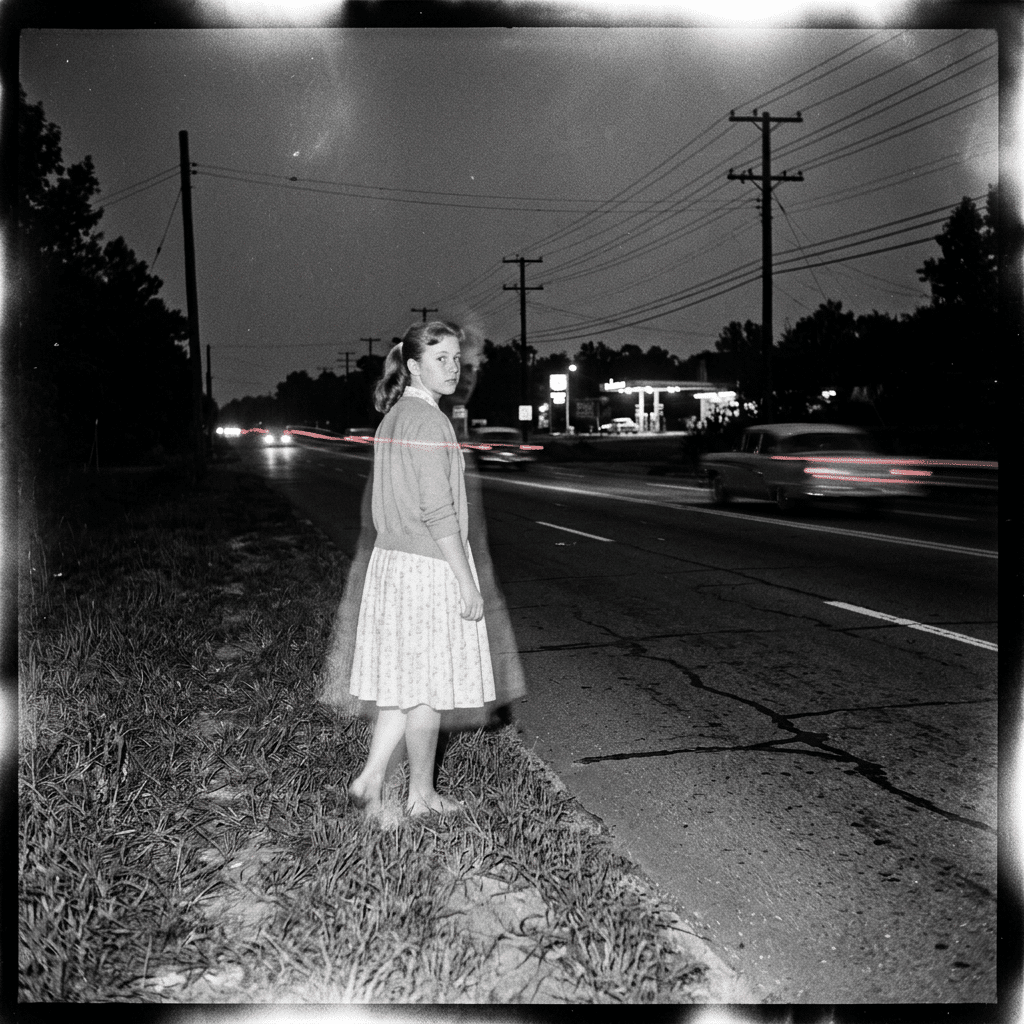
Haunted roads tend to look the same, and there’s no accident. Narrow two-lane sections of worn asphalt with faded center lines. Or no lines at all. There are trees closing in on either side and the branches converge overhead so the road feels like a tunnel. Shoulders are narrow or absent. The ditches are full of standing water, smelling of decay and wet leaves. Cars that have hit guardrails corrode and bend. Small roadside shrines of plastic flowers and rusted crosses mark where someone died. Fog fills the hollows. Streetlights are few and far between, and after dark the only illumination is the glare of a driver’s own headlights, which barely penetrate the blackness before it swallows them. The sharp turns, unexpected drops, and outdated one-lane bridges require the driver to slow down and pay attention. A route like that is physically uncomfortable even before considering the presence of a ghost.
The behavior that is described on these routes is patterned and repeated throughout civilizations. The most famous is perhaps the vanishing hitchhiker. A vehicle picks up a young woman, who is quiet and frequently dressed in old-fashioned clothes. She offers an address or requests to be let out near a cemetery. And then she vanishes from the moving automobile. Other reports tell of phantom vehicles: an ancient truck with blazing bright beams that tailgates aggressively, or a car that passes and is then gone. Some witnesses said they saw figures walking across the road, children standing beside bridges or animals with glowing eyes that do not act like any normal species. “These stories are full of electrical trouble. Every time they drive to the same bend, radios fill up with static, engines stall, and phones lose signal. Some drivers said they felt pressure on the car as if hands were pushing it or heard knocking on the windows. Others report feeling a sudden weight of fear that lifts when they reach the end of the path. This feeling lifts when the drivers reach the end of the path.
Three Infamous Haunted Highways
Clinton Road in West Milford, New Jersey, is one of America’s most haunted roads. It goes around 10 miles through dense, mostly vacant woodland and reservoir land and very few buildings along its boundaries. Its most famous folklore is about a little bridge over Clinton Brook. It is said that a boy drowned there, and if you throw a penny into the lake at night, it will be thrown back. Some versions have him in the water, along with the visitor’s own. Drivers frequently report a phantom pickup truck that pursues cars, only to vanish. The route has other dark stories too: the remnants of Cross Castle, whispers of bizarre rites in the woods and accounts of unusual animals, perhaps left over from the nearby, now-defunct Jungle Habitat wildlife park. The mythology of Clinton Road has been revived by Weird NJ magazine, but the road itself remains remote. Once the sun goes down, it is effortless to believe somebody is watching from the trees.
Resurrection Mary is one of the most well-known ghosts in American folklore and lives on Archer Avenue on the southwest side of Chicago. Legend claims she was a young blond woman in a white dress who spent her last night dancing, perhaps at the O. Henry Ballroom, subsequently known as the Willowbrook Ballroom. Died in an automobile accident on the way home. Since at least the 1930s, men have reported picking up a shy young woman either at a dance or on the roadside and giving her a ride. They pass Resurrection Cemetery in Justice, Illinois, and she requests them to stop, or else she simply disappears from the passenger seat. In 1976, the story took a physical turn when two bars of the cemetery gate were found bent and charred; some said they looked like the marks of small hands. The cemetery blamed it on work being done, but the legend continued to thrive. The cemetery attributed the incident to ongoing work, yet the legend continued to thrive. Archer Avenue is more metropolitan and bustling than most ghost roads. This makes Mary’s narrative even more bizarre, as she appears to haunt traffic and streetlights rather than empty woodlands.
U.S. Route 666, which passed through Utah, Colorado, New Mexico, and Arizona, was nicknamed “The Devil’s Highway” largely because of its number. Its areas of desert and mesa are huge and empty. There are long segments of road where a driver can see for miles and still feel utterly alone. Along the way, stories include a phantom black truck that runs motorists off the road, a pack of hellhounds that tear tires, and a ghostly young woman in a white gown who appears in the headlights and disappears when approached. Some versions draw on the skinwalker traditions of the region, which many Navajo consider serious and dangerous, not fodder for campfire stories. In some places the highway was also accident-prone, seemingly confirming its curse. Such was the reputation that people continued stealing the signs and in 2003 the road was renumbered U.S. Route 491. However, locals reported that the bad luck eased later. Others have experienced safety improvements about the same time.

Explaining the Haunting
There are different camps of explanations for haunted roads. Believers commonly use the residual haunting notion, sometimes in conjunction with the “stone tape” theory. This implies that violent or emotional events leave an impression on an area, which later plays again like a recorder. An intelligent haunting is distinct, for it is a spirit that appears to be cognizant of the living, such as a speaking hitchhiker or a youngster who returns a penny. Skeptics propose more practical explanations. Long night journeys might result in ‘highway hypnosis,’ a trance-like state where the mind wanders and may create fleeting hallucinations. When the brain gets worn out, it’s more prone to discern faces and other figures in shadows, a phenomenon called pareidolia. Studies have shown that low-frequency sound, or infrasound, caused by wind or traffic, can make people feel uneasy and a sense of dread. The roads themselves are sometimes dangerously curved and poorly lit, accounting for the high accident rates that give rise to the legends. Folklorists note that these stories are passed along via “legend tripping,” when teens and thrill-seekers visit a location because of its story. They come anticipating terror and they discover fear.
Ethnographies of absence, spectral ethnography, and the anthropology of vacant spaces provide ways to examine how hauntings are performed in infrastructures, highways, and public spaces, especially when violence or precarity has taken place or is remembered (Armstrong, 2010; Fruhauff, 2008). Film, literature, and television provide excellent laboratories for exploring the haunting of roads and transport-related spaces through narrative devices—phantom vehicles, ghostly journeys, and the affective atmospheres of mobility and stoppage (e.g., discussions of phantom vehicles in literature and film; uncanny televisual sequences along highways) (Briefel, 2022; Moylan, 2016; Stephenson, 1953).
Roads and highways are often areas of memory labor in which infrastructure spaces become locations for the propping and contesting of victims’ memories. Memorial practices along public roads and highways show how infrastructure may be a location of ritual commemoration and political critique (e.g., Gothic memorials along named routes). Brien, 2014; Roads and transport infrastructures can also be marked by violence or neglect in urban and regional contexts, leading to “haunting interruptions” where communities organize protests or disruptions that expose systemic injustices embedded in mobility networks (e.g., anti-racist interventions and road blockades that haunt governance through spatial interruption) Timmons, 2026 .
Haunting is often linked to state projects and post-conflict memory along important transport corridors, where roads bear the burden of historical traumas, displaced communities, and challenged sovereignties. These hauntologies call for an ethical re-engagement with memory and justice (Schwenkel, 2017; Lincoln & Lincoln, 2015; Janeček, 2023; Bayer, 2021; Laramee, 2008; Bergland, 1993; Lorek‐Jezińska & Więckowska, 2017).
Conclusion
Haunted roads persist because they function on multiple levels at once. They are places that are physically upsetting, tiny and gloomy, and marked by actual loss. They provide individuals a safe way to confront danger and death from behind a windshield. People who have had the experience say it feels real, whether the source is restless spirits, fatigued minds, or a compelling story skillfully presented. Clinton Road, Archer Avenue, and the ancient Route 666 are all examples of how a piece of pavement may become a collective memory handed down from one vehicle to the next. Ultimately, ghostly roadways may be less about the dead than the living. They illustrate how much people want to explain the dark areas they go through and how eagerly they fill the blank miles with stories.
References
Armstrong, J. (2010). On the Possibility of Spectral Ethnography. Culture Studies ↔ Critical Methodologies, 10(3), 243–250. https://doi.org/10.1177/1532708609359510
Barron, L. (2020). Ultraviolent Gothic Visions: Lucio Fulci’s ‘Gates of Hell’ Trilogy as Derridean Cinematic Haunted Spaces. Gothic Studies, 22(2), 197–213. https://doi.org/10.3366/gothic.2020.0049
Bayer, G. (2021). Specters of Mob in David Cronenberg’s Eastern Promises. Humanities, 10(4), 116. https://doi.org/10.3390/h10040116
Bergland, R. (1993). The National Uncanny: Indian Ghosts and American Subjects. https://doi.org/10.1349/ddlp.1541
Briefel, A. (2022). Ghost Speed: The Strange Matter of Phantom Vehicles. Victorian Literature and Culture, 50(4), 693–720. https://doi.org/10.1017/s106015032100005x
Brien, D. L. (2014). Forging Continuing Bonds from the Dead to the Living: Gothic Commemorative Practices along Australia’s Leichhardt Highway. M/C Journal, 17(4). https://doi.org/10.5204/mcj.858
Derrida, J. (1994). Specters of Marx: The state of the debt, the work of mourning and the new international (P. Kamuf, Trans.). Routledge. (Original work published 1993)
Fruhauff, B. (2008). Dickens’s Haunted Christmas: The Ethics of the Spectral Text. Forum University of Edinburgh Postgraduate Journal of Culture & the Arts, (07). https://doi.org/10.2218/forum.07.612
Janeček, P. (2023). Prague ghostlore of the late 19th century. Suburban ghosts between moral panic and vernacular spectacle. Estudis De Literatura Oral Popular / Studies in Oral Folk Literature, (11), 11–29. https://doi.org/10.17345/elop202211-29
Laramee, M. (2008). Maps of Memory and the Sea in Dionne Brand’s At the Full and Change of the Moon Anthurium a Caribbean Studies Journal, 6(2), 3. https://doi.org/10.33596/anth.121
Lincoln, M., & Lincoln, B. (2015). Toward a Critical Hauntology: Bare Afterlife and the Ghosts of Ba Chúc. Comparative Studies in Society and History, 57(1), 191–220. https://doi.org/10.1017/s0010417514000644
Lorek‐Jezińska, E., & Więckowska, K. (2017). Hauntology and Cognition: Questions of Knowledge, Pasts and Futures. Theoria Et Historia Scientiarum, 14, 7. https://doi.org/10.12775/ths.2017.001
Moylan, K. (2016). Uncanny TV. Television & New Media, 18(3), 269–282. https://doi.org/10.1177/1527476415608136
Schwenkel, C. (2017). Haunted Infrastructure: Religious Ruins and Urban Obstruction in Vietnam. City & Society, 29(3), 413–434. https://doi.org/10.1111/ciso.12142
Stephenson, L. W. (1953). Mollusks from the Pepper shale member of the Woodbine formation, McLennan County, Texas. https://doi.org/10.3133/pp243e
Timmons, R. A. (2026). Haunting Interruptions: Race, Infrastructural Violence, and Spatial Memory in Ferguson, Missouri, United States. Antipode, 58(2). https://doi.org/10.1111/anti.70132

Leave a Reply