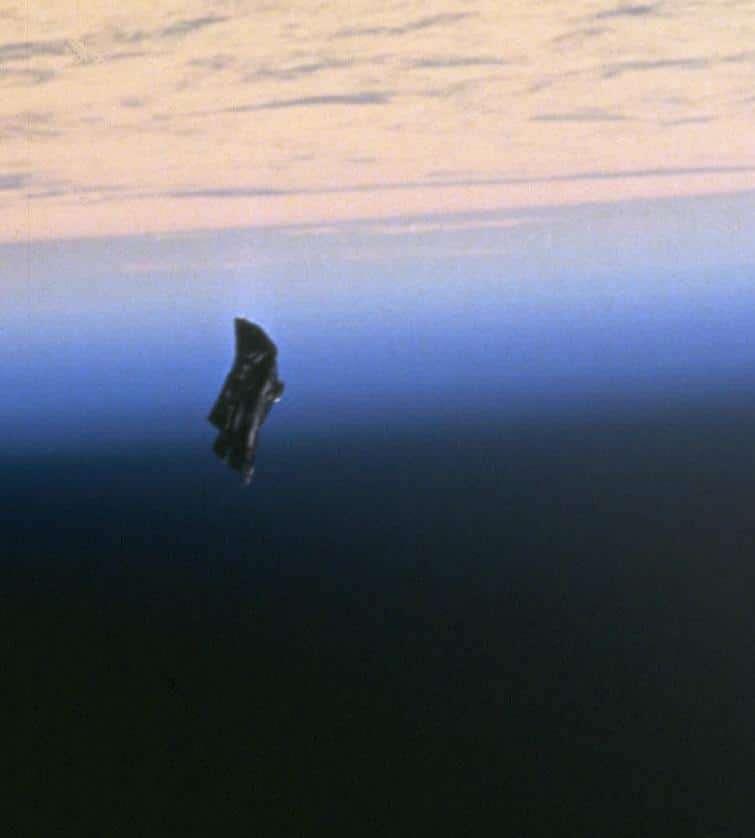
Black Knight Satellite: Key Points
- The Black Knight satellite is a conspiracy theory claiming that an alien probe has orbited Earth for about 13,000 years. In reality, it is a patchwork of unrelated events stitched together over decades.
- The object is known mainly from 1998 photographs that show a dark, angular shape, which believers see as an alien craft.
- The legend combines Tesla’s 1899 radio signals, strange radio echoes from 1928, and later reports of unknown satellites.
- Theorists claim that NASA is hiding the alien watcher and that a secret warplane shot it down in 2017.
- The 1998 object was a thermal blanket lost during a spacewalk, and natural causes explain the older signals.
- The legend lives on in videos, podcasts, digital art, and the band Pain’s 2016 song Black Knight Satellite. It lasts because it appeals to distrust of government and the hope that humanity is not alone.

Introduction
According to a persistent belief, somewhere above Earth, a dark alien machine has been circling the planet for almost 13,000 years. Looks. Some claim it sends out signals; some say it waits. The Black Knight satellite is one of the oldest lasting conspiracy theories of the space age (Crookes & Dobrijevic, 2025). The tale mixes real radio experiments, Cold War secrecy, fringe authors, a set of spectacular NASA images, and a great many people consider it convincing. But look attentively and the Black Knight is not one mystery. It’s a patchwork of individual events knitted together over decades (Black Knight Satellite Conspiracy Theory, n.d.). The physical description, the convoluted history, the ideas around it, the scientific explanation, and its role in popular culture all attest to how a modern myth is constructed and why it endures.
Cold War Fears and UFO Culture
Early Cold War fears helped foster an expanded ecology that could interpret unexplained aerial phenomena (UAP/UFO) via the lenses of national security, conspiracy, and myth-making. The literature describes how political and media actors interacted with UFOs as cultural icons in the mid-20th century, including the use of Project Blue Book and related public discussions (Gabilliet, 2012; Skidmore, 2008). Such dynamics help to explain how a “Black Knight” narrative may evolve as the consolidation of long-standing UFO iconography into a single enigmatic item.
Physically, the Black Knight is known virtually exclusively from a handful of images taken in December 1998 (Crookes & Dobrijevic, 2025). In them the item looks dark, almost black, against the light curve of Earth or the empty background of space. It is angular and uneven in form. Some observers detect a long, thick body with a tapering, twisted extension trailing off one end. The edges look jagged and crumpled and in some frames the surface catches the light in a way that suggests metal. It’s been called sleek, purposeful, and obviously artificial, somewhat like a spacecraft with a fuselage and appendages. There hasn’t been a definitive measurement of its size from these photographs and the object seems to change shape from one frame to the next, and no one has ever gotten one. That matters, because a solid, constructed ship wouldn’t be expected to shift and collapse as it tumbles. In the legend, the satellite is in a near-polar orbit, which would have it over almost every point on the Earth (Black Knight Satellite Conspiracy Theory, n.d.).
Origins and Development of the Black Knight Myth
The history of the mythology goes back well before the space age. In 1899 Nikola Tesla was conducting radio experiments at his laboratory in Colorado Springs when his receiver began to intercept repetitive messages. Tesla asked himself whether they had arrived from another universe. Decades later believers would claim he had picked up the first broadcasts of the Black Knight (Margaritoff, 2025). In 1928 Norwegian radio engineer Jørgen Hals made a strange observation: that radio signals were returning as echoes many seconds after they were sent out (Black Knight Satellite Conspiracy Theory, n.d.). Serious experts researched these “long delayed echoes,” which were real but unrelated to satellites at the time. In 1954, various American newspapers printed reports based on the assertions of Donald Keyhoe, a retired Marine officer and well-known UFO writer. Keyhoe said the United States Air Force has discovered two mysterious spacecraft circling Earth. At that time, no country had the technology to launch a satellite; therefore, the notion was astounding (Crookes & Dobrijevic, 2025). Skeptics have highlighted that Keyhoe was advertising a book about UFOs at the time and that the stories were likely not meant to be taken seriously (Black Knight Satellite Conspiracy Theory, n.d.). Sputnik didn’t go up until 1957.
The plot took shape in the early 1960s. In February 1960, Time magazine claimed that the United States Navy had identified a black object in orbit that was believed to be a Soviet spy satellite. A follow-up article revealed that it was the remains of an Air Force Discoverer 8 satellite gone astray (Black Knight Satellite Conspiracy Theory, n.d.). The Discoverer missions were a cover for the covert Corona spy program; thus, the complete narrative could not be presented publicly and that gap provided room for speculation. In 1973, the Scottish writer Duncan Lunan suggested that the long-delayed echoes of the 1920s may be deciphered as a star map. He speculated that it was an indication of the star system Epsilon Boötis and that the signals could be from a 13,000-year-old alien probe (Margaritoff, 2025). Lunan then recanted his results, saying there were “outright errors” (Black Knight Satellite Conspiracy Theory, n.d.) and that the Black Knight narrative had “nothing to do with me” (De Abreu, 2025). By that time the notion was a life of its own.
The last and most famous work arrived in 1998. In December of that year, Space Shuttle Endeavor flew mission STS-88, the first American mission to build the International Space Station. During the journey, while in orbit, the crew photographed a dark, twisted object drifting by (Crookes & Dobrijevic, 2025). Now that these photographs have circulated on the Internet, they are considered the definitive “evidence” for the Black Knight. The circulation of these photographs on the Internet established them as the definitive “evidence” for the Black Knight. Finally, believers claimed that an image of the Black Knight existed.

Theories, Speculation, and Scientific Explanations
The object has generated a plethora of speculation. The main premise is that the Black Knight is an alien probe, which an alien civilization placed in orbit 13,000 years ago to watch humans (De Abreu, 2025). Some versions indicate it sends signals to Earth or sends information back to its makers. Some link it to old astronaut notions and propose that it has observed human civilization from the very beginning. Many of the believers insist that NASA is hiding the fact and origin of the object (Black Knight Satellite Conspiracy Theory, n.d.). By 1998, believers were ready to disbelieve everything NASA informed them, especially when it pertained to a photograph they could see with their own eyes (Margaritoff, 2025). Another version has the satellite being shot down. In 2017, a video of a dazzling ball of wreckage falling from the sky became viral on the internet, with conspiracy theorists claiming that a secret Illuminati warplane had destroyed the alien vessel (De Abreu, 2025; Margaritoff, 2025). Confusion has even arisen regarding the name. Between 1958 and 1965, Britain had a legitimate rocket program called Black Knight, but it never launched anything into orbit and has no connection to the mythology (Black Knight Satellite Conspiracy Theory, n.d.). Some reports connect the moniker to a novel by Russian author Alexander Kazantsev, in which aliens send a satellite to watch the human race (De Abreu, 2025). The Black Knight was not mentioned in any of the original reports at the time of writing. The label “observation” afterward indicates that the tale was created in retrospect (Black Knight Satellite Conspiracy Theory, n.d.).
The scientific answer is not so dramatic. The 1998 object was a thermal blanket lost during a spacewalk to place insulation on a space station module, astronaut Jerry Ross said. “Jerry, one of the thermal covers got away from you,” mission commander Robert Cabana warned Ross, and it was quickly evident that the cover was gone for ever (Crookes & Dobrijevic, 2025). Space journalist James Oberg arrived at the same conclusion, citing a blanket con; therefore, by Ross and James Newman during a spacewalk (Black Knight Satellite Conspiracy Theory, n.d.). Thermal blankets are insulating wraps that are designed to protect equipment from the severe temperatures of space. A few days later, NASA classified the object as space trash, catalog number 025570, burning up in Earth’s atmosphere (Crookes & Dobrijevic, 2025). The features that struck so many viewers have basic reasons. Depending on the illumination and camera angle, a reflective sheet can appear black in one shot and metallic in the next. The apparent change of shape is precisely what you’d anticipate from a loose, flexible sheet falling through orbit. The oldest parts of the mythology have normal explanations as well. Skeptic Brian Dunning says that Tesla’s signals were pulsars, which were not discovered until 1968 (Black Knight Satellite Conspiracy Theory, n.d.). Long-delayed echoes are a real phenomenon that has to do with how radio waves interact in the high atmosphere of the Earth, but that is not yet fully understood (Margaritoff, 2025). The item found in 1960 was American satellite trash. Martina Redpath from the Armagh Planetarium in Northern Ireland put it well when she described the Black Knight as a jumble of completely unrelated stories that had been chopped up, stirred together, and stewed on the internet into one inconsistent dollop of myth (Black Knight Satellite Conspiracy Theory, n.d.).
Several works address the “ancient astronauts” and related claims as elements of a continuum of myth-making about extraterrestrials embedded in scientific and pseudo-scientific claims, showing how symbolic narratives (e.g., ancient visitations, transdimensional or interstellar hypotheses in some cases) come with UFO discourses (Wojcik, 2022; Alschuler, 2022; Fike, 2022). The Black Knight motif can be considered a modern digital era interpretation of these elements, with mystery, secrecy, and lost technology playing a key role in the tale. The literature on misinformation and the control of scientific communication underlines the threat posed by dramatic unvetted claims that can spread through media and open-access channels, particularly in areas of significant public interest such as space phenomena. This literature underlines the necessity of careful examination of any claims associated with Black Knight and contextualizing them within the framework of proven observational datasets and peer-reviewed analyses (Boslough et al., 2026; Skidmore, 2008).
The Black Knight in Popular Culture
The crime was solved but the Black Knight has left a big impression on popular culture. Its disturbing photos still pop up in online forums and tabloid headlines (Crookes & Dobrijevic, 2025) and in movies, podcasts, and documentaries regarding UFOs and ancient mysteries. It’s a concise way of expressing that something inexplicable is clearly visible, right above us. It has also been utilized by musicians. On their 2016 album Coming Home, the Swedish metal band Pain released a song called “Black Knight Satellite” (Black Knight Satellite Conspiracy Theory, n.d.). Images of the item, rendered by digital artists as a frightening, angular machine hanging over the Earth, often travel farther than the facts. The 2017 shoot-down footage illustrated how rapidly the myth can be revived, as a single viral video became viral over the internet years after the riddle was solved (De Abreu, 2025). The name helps. The name Black Knight has a fascinating, even slightly menacing, ring to it, like some silent guard of a medieval legend transferred to orbit. The story also echoes larger cultural fascinations, from mistrust of official opacity to the notion that humanity is not alone.
Conclusion
The Black Knight satellite is a prime example of how modern myths are built. Add a Tesla experiment, mysterious radio echoes, a dramatic newspaper story, a classified spy program, a speculative notion, and a misplaced piece of insulation. Each has its own familiar reason. They come together as a story of an old alien watcher. Science has ripped the narrative apart, piece by piece, and the evidence overwhelmingly favors space debris and natural events over visitors from another star. But the myth endures because it satisfies a basic human desire to know what is in the sky. The fundamental lesson of the Black Knight is not so much about aliens as about us: how badly we want secrets, how easy it is to join unrelated dots, and how crucial it is to look carefully before we believe.
References
Alschuler, L. R. (2022). Conspiracy theories and flying saucers. Psychotherapy and Politics International, 20(3), 1–11. https://doi.org/10.24135/ppi.v20i3.07
Black Knight satellite conspiracy theory. (n.d.). In Wikipedia. Retrieved September 28, 2026, from https://en.wikipedia.org/wiki/Black_Knight_satellite_conspiracy_theory
Boslough, M., Brown, P., Bruno, A., Chodas, P., Collins, G. S., Daulton, T. L., Harris, A., Koeberl, C., Losiak, A., Morrison, D., Popova, O., Robertson, D., Silber, E. A., & Ginneken, M. V. (2026). Preventing and correcting spread of misinformation about near‐Earth objects, impacts, airbursts, and planetary defense: Case studies. Meteoritics and Planetary Science, 61(7), 1122–1145. https://doi.org/10.1111/maps.70140
Crookes, D., & Dobrijevic, D. (2025, June 10). The “Black Knight” satellite: A 120-year-old conspiracy theory. Space.com. https://www.space.com/what-is-the-black-knight.html
De Abreu, K. (2025, January 6). Exploration mysteries: Black Knight satellite. ExplorersWeb. https://explorersweb.com/exploration-mysteries-black-knight-satellite/
Fike, M. A. (2022). Jung’s letter to Major Donald E. Keyhoe. Journal of Jungian Scholarly Studies, 17(1), 32–56. https://doi.org/10.29173/jjs176s
Gabilliet, J. (2012). Making a homefront without a battlefront: The manufacturing of domestic enemies in the early Cold War culture. European Journal of American Studies, 7(2). https://doi.org/10.4000/ejas.9549
Margaritoff, M. (2025, March 4). Why some say the Black Knight satellite is a 13,000-year-old alien spaceship (J. Kuroski, Ed.). All That’s Interesting. https://allthatsinteresting.com/black-knight-satellite
Pain. (2016). Black Knight satellite. On Coming home.
Skidmore, J. (2008). Roswell: Communicating fact and fiction in popular culture. Popular Culture Review, 19(2), 81–88. https://doi.org/10.1002/j.2831-865x.2008.tb00770.x
Wojcik, D. (2022). UFO mythologies: Extraterrestrial cosmology and intergalactic eschatology. Traditiones, 50(3). https://doi.org/10.3986/traditio2021500302


Leave a Reply