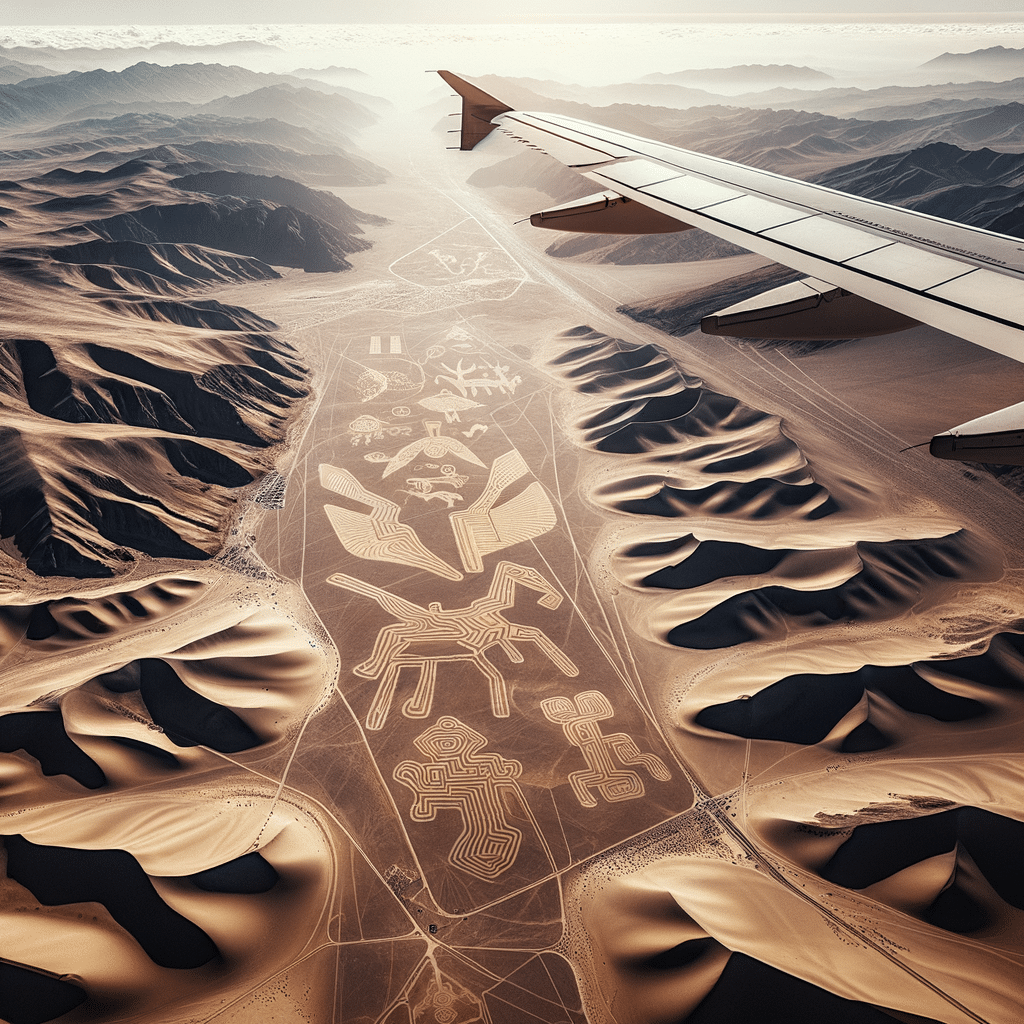
Stretching almost 1,000 square kilometers of desert plateau between the cities of Nazca and Palpa, the Nazca Lines in southern Peru are among the most persistent puzzles in archaeology. Made between 500 BC and 500 AD, these ancient geoglyphs feature hundreds of distinct figures featuring geometric forms, animal representations, and straight lines spanning kilometers. The sheer size and accuracy of these designs, which can only be fully seen from very high above the ground, have led to a huge number of theories about their purpose and construction, ranging from scientific ones to those involving aliens.

Overview
Removing the reddish-brown iron oxide-coated stones covering the surface to expose the lighter-colored earth beneath, the lines themselves comprise shallow trenches in the desert floor. The biggest figures span almost 1,200 feet, and the longest straight lines run several kilometers. For more than two millennia, the particular natural conditions of the desert—low rainfall and mild winds—have maintained these delicate marks. Along with geometric forms and trapezoids, the figurines comprise many animals, including hummingbirds, spiders, monkeys, and lizards (Silverman & Browne, 1991).
Archaeological data points to the Nazca people using somewhat basic but successful methods over several centuries to produce these lines. They could produce quite accurate curves and straight lines with wooden stakes and rope. Research of the region’s pottery and other relics reveals that the Nazca culture had advanced understanding of geometry and astronomy. Although some may date to the earlier Paracas civilization, the carbon dating of ceramic remnants and organic material discovered near lines places their creation mostly in the Nazca period.
Many scientific ideas have developed to explain the lines’ intent. Archaeologist Johan Reinhard’s most well-known theory holds they were produced as part of water and fertility ceremonies given the limited resources of the desert. Other studies suggest they were markers or astrological calendars for subterranean water supplies. While some academics contend the lines were gathering sites for ceremonial events, others contend they were ceremonial paths used for walking as part of religious processions (Mardon & Lenfesty, 2021).
Aliens
Originally popular in the 1960s, the extraterrestrial theory about the Nazca Lines has since been among the most often discussed alternate explanations for these prehistoric geoglyphs. Suggesting that the lines acted as landing strips for extraterrestrial spacecraft and the animal representations were messages seen from space, Erich von Däniken’s 1968 book Chariots of the Gods? offered the first thorough case for alien involvement. He maintained that only aerial direction and sophisticated technology could allow the lines’ magnitude and accuracy.
Advocates of the ancient astronaut theory cite a number of particular Nazca Line characteristics as proof of extraterrestrial influence. They contend that the flawlessly straight lines spanning kilometers, the big trapezoid forms reminiscent of contemporary runways, and the fact the figures are best seen from above imply they were intended for aerial view. Some thinkers also see the humanoid figure known as the astronaut, with what seems to be a big helmet, as showing an alien visitor or space-suited being. The belief holds that ancient people made these marks either as a means of communication with alien visitors or under their guidance (Aveni, 2000).
Additional alien-related theories propose that the lines form an intricate astronomical map or star chart, potentially revealing the origins of extraterrestrial visitors. Some supporters say that some line designs fit star patterns as they would have seen thousands of years ago. Others propose that the geometric patterns reflect mathematical relationships the Nazca people would not have known without outside help, maybe from intelligent alien civilizations.
More extreme forms of the hypothesis propose that advanced technology given by aliens generated the lines. These thinkers draw attention to the lines’ perfection and the difficulty in producing such large-scale artwork without aerial observation capacity. Some even suggest that the lines signal sites of buried alien technology or underground bases or contain codes meant for future alien contact.
Other alien ideas link the Nazca Lines to other ancient sites all around, implying they comprise a worldwide network of alien-influenced monuments. Proponents of their creation under alien direction as part of a greater interplanetary communication or navigation system frequently connect them to the pyramids of Egypt, Stonehenge, and other ancient sites. Some theories propose that the animal representations reflect star systems or constellations from which these claimed visitors originated.
Over recent years, the alien ideas have developed to include contemporary UFO events. Unusual airborne events reported near the Nazca area, according to some theorists, offer proof of ongoing alien curiosity for the site. They say that the lines could still be used as navigational aids or as landing zones for extraterrestrial ships because of reports of UFO sightings and electromagnetic anomalies in the area (Ryback, 2001).
But scientists and archaeologists have methodically shown how the Nazca people could have produced these lines with very basic tools and mathematical understanding at hand. Enough wooden stakes, rope, and simple surveying methods would have produced even the longest straight lines. The constant temperature and unusual geological composition of the desert helped to preserve the marks; the figures’ designs closely correspond with those of Nazca ceramics and textiles. Archaeological evidence shows that the process of making lines changed slowly over time and that they were made in a specific cultural setting. This makes it less likely that they were made by aliens.
These ideas enthrall popular imagination and inspire travel to the area even if there is no scientific data proving alien participation. Ancient astronaut beliefs connected to the Nazca Lines remain popular today because of mankind’s ongoing curiosity about extraterrestrial existence and our need to credit otherworldly influences with amazing ancient successes. Although these ideas might not be able to withstand scientific examination, they have surely added to the mystery of the lines and maintained interest in this amazing archaeological site.

Tourism
While concurrently greatly boosting the local economy, tourism has been instrumental in both the preservation and possible destruction of the Nazca Lines. Since their 1994 UNESCO World Heritage Site status, the lines have become one of Peru’s most popular attractions, drawing hundreds of thousands of people yearly who support the local economy with tours, lodging, and related businesses worth millions of dollars (Cigna & Tapete, 2018).
Aerial excursions are the main way one sees the lines; tiny aircraft leave Maria Reiche Neuman Airport in Nasca. These 30-minute to 2-hour flights provide visitors the ideal view position to enjoy the geoglyphs’ grandeur and complexity. Operating a fleet of tiny aircraft, especially for these trips, local airlines generate a sizable business employing pilots, guides, ground crew, and support personnel. Standardized safety procedures and diverse price points resulting from tour operator rivalry have made the experience available to many kinds of visitors.
Over time, ground-based tourism infrastructure has changed greatly. Building the Mirador observation tower along the Pan-American Highway lets frugal visitors see part of the figures without flying. Recent additions are cultural institutions highlighting Nazca civilization, museums honoring the lines’ heritage, and visitor centers. These facilities provide the local people extra income sources and significant educational background.
Still, tourism has provided major obstacles to the preservation of the lines. Despite security measures, several figures have been damaged due to foot traffic, car tracks, and illegal access. The growing number of visitors has resulted in the construction of infrastructure and roads close to the monuments, therefore possibly influencing the delicate desert ecosystem. Natural erosion and climate change aggravate these pressures caused by humans, therefore posing continuous conservation difficulties.
To strike a mix between tourism and preservation, the Peruvian government has put several policies into effect. These comprise tight rules for tour companies, restricted access to some locations, and specific observation points. Local authorities monitor the sites and create sustainable tourist plans in collaboration with both international conservation specialists and UNESCO. Educational initiatives seek to increase visitor awareness of the need to maintain these historic marks for future generations.
Furthermore, impacting local cultural identity and economic growth is tourism. Many Nazca inhabitants have switched from conventional farming to jobs connected to tourism. Inspired by the lines’ images, local artists create handicaps; hotels and restaurants adopt Nazca ideas into their architecture and operations. Both positive and negative impacts of this cultural commercialization include financial opportunities and potential influence on authentic local customs.
Documentary films on the lines and media coverage help to generate global interest and travel increase. With guests sharing aerial pictures and experiences online, social media has become ever more crucial since it generates natural marketing, drawing in new visitors. While it presents fresh difficulties for controlling visitor expectations and experiences, this digital presence has helped keep the world aware of the lines.
At the Nazca Lines, the future of tourism depends on striking a sensible mix between accessibility and preservation. This balance is guiding plans for upgraded tourist facilities, more viewing platforms, and more educational opportunities. Together, virtual reality and augmented reality technology could give people new ways to experience the limits while limiting their impact on the sites, which could mean a change in archeological tourism.
Conclusion
Appearing in many movies, TV shows, and literature, the Nazca Lines have permanently changed popular culture. While science fiction shows frequently feature the lines, Indiana Jones movies draw on them in foreign conspiratorial plots. They are somewhat common in video games, usually as story devices implying ancient secrets or alien links. Thousands of people visit the lines every year from tiny aircraft or recently built viewing towers, and they have also inspired many artistic creations (Ruggles & Saunders, 2012).
Regardless of their intended use, these amazing desert designs remain among the most amazing ancient creations of humans. The accuracy and scope of the Nazca Lines highlight the amazing powers of past societies and their capacity to plan major enterprises without contemporary tools. Although their exact use is still under discussion, their construction is an amazing accomplishment of ancient engineering and artistic expression that enthralls people all around almost two millennia after they were created.
References
Aveni, A. F. (2000). Between the lines: the mystery of the giant ground drawings of ancient Nasca, Peru. University of Texas Press.
Cigna, F., & Tapete, D. (2018). Tracking human-induced landscape disturbance at the nasca lines UNESCO world heritage site in Peru with COSMO-SkyMed InSAR. Remote Sensing, 10(4), 572.
Mardon, A., & Lenfesty, C. (2021). The Nazca lines. Golden Meteorite Press.
Ruggles, C., & Saunders, N. J. (2012). Desert labyrinth: lines, landscape and meaning at Nazca, Peru. Antiquity, 86(334), 1126-1140.
Ryback, C. (2001). Between the Lines: The Mystery of the Giant Ground Drawings of Ancient Nasca, Peru. Astronomy, 29, 96-96.
Silverman, H., & Browne, D. (1991). New evidence for the date of the Nazca lines. Antiquity, 65(247), 208-220.


Leave a Reply