The Legend of Axe Murder Hollow: Key Points
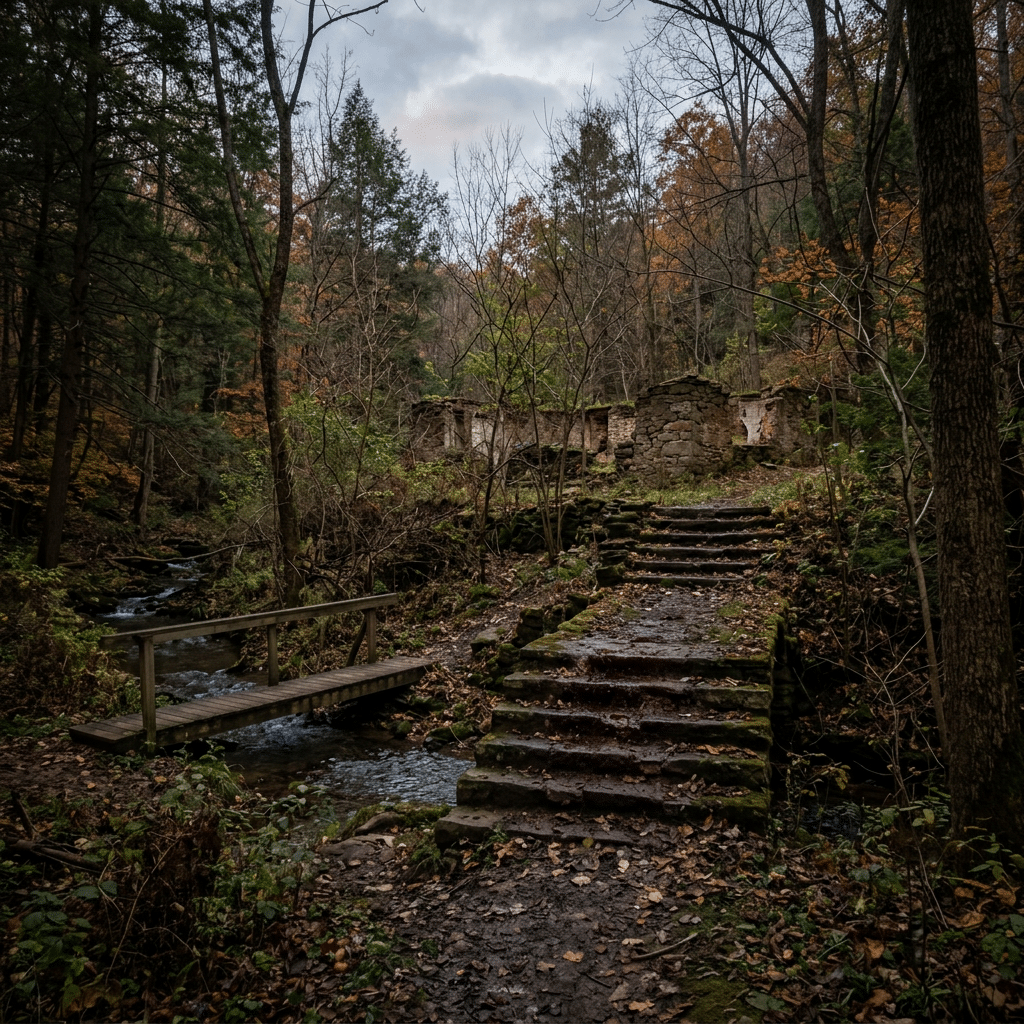
- Axe Murder Hollow is a wooded area along Thomas Road in Millcreek Township, Erie County in Pennsylvania and it was once isolated and remote. Much of it has since been replaced by homes, a library, and private property.
- The best-known version of the story tells of a farmer who killed his unfaithful wife and children with an axe. A second version blames a Romani leader who beheaded his wife and buried her head near Thomas and Sterrettania Roads.
- Visitors reported the farmer’s ghost, the mutilated spirits of his family, and cars losing power with blood appearing on the road. Other features included bloodstained steps that changed in number, a strangely lifeless side of the road, and a deadly third bridge.
- No evidence of an axe murder has ever been found. Researchers suggest the legend grew out of a “lover’s lane” setting, moral warnings to teenagers, and possibly a solitary local butcher named William Gack.
- The Romani version reflects old distrust of outsiders. The real murders of Mary Lynn Crotty in 1963 and Christine Watson in 1966 later blurred into the legend as false “evidence.”
- The legend led to vandalism and trespassing in the area, and today it lives on through the internet and even a local escape room. It shows how communities turn their fears into stories.

Introduction
Some places have frightened men so long that the terror seems to outlive the earth. One of these is Ax Murder Hollow, in Erie County, Pennsylvania. Since the 1950s, residents of Millcreek Township have been telling stories of bloody murders and a furious ghost along Thomas Road, a sleepy road in the northern tip of the state (White & Lavorgne, 2015). For decades, youths would drive out to the hollow at night and dare each other to confront the ax-wielding spirit said to live in the woods. Careful inquiry has never revealed any evidence of an ax murder occurring there. But the legend says a lot about how societies handle fear, crime, and outsiders. The essay details the physical environment of the hollow, relates the major variants of the murder story, explores the alleged paranormal activity, assesses theories of the legend’s origins, and reflects on the legend’s ongoing effects on the area.
The Physical Setting of the Hollow
The hollow is located in the woods off Thomas Road in southwest Millcreek, just south of Sterrettania Road. It lies downstream of Walnut Creek and its smaller tributaries at the border with McKean Township (Phillips, 2021). For most of the twentieth century, the area remained isolated. For most of that time, a wooded dip in the ground just beyond the more populous portions of the county. White and Lavorgne (2015) call it a “liminal space,” a barrier between the settled and the wild. Legend trippers told of a fascinating ancient farmhouse on a hill. They also recounted a series of steps near where that home formerly stood, and the steps were reputedly stained with blood that would never wash away (Wincik, as cited in White & Lavorgne, 2015). There were three minor bridges over the streams on or near the route. There is also an old freestanding stone foundation in the woods that Phillips (2021) describes as the ruins of a farmhouse that burnt in the winter of 1917. The setting seems extremely different today. Much of the hollow has been cleared for new homes and community structures in the area around the Weis Library, and the remaining land is privately owned (Phillips, 2021; White & Lavorgne, 2015).
Versions of the Murder Legend
There are two major versions of the account of the murder and several minor variants. The best-known version has a farmer who lives on Thomas Road with his wife and children. His wife was not satisfied in the marriage and began dating another man. When the farmer heard about it, he went insane. He took his ax and chased his wife and children down into the hollow, and there he dismembered them. Then he disappeared, most likely by suicide, and since that day his ghost has been haunting the road to locate his wife’s lover and do the job (White & Lavorgne, 2015). One popular internet version identifies the trigger as the farmer’s daughter, who has secretly married a man that her father disapproves of. In his wrath, he killed the wife who was sewing the daughter’s wedding dress behind the farmer’s back (White & Lavorgne, 2015).
The second major change replaces the farmer with a roving band of Romani people, whom older tellings call “Gypsies,” a term many Romani people consider a slur. When they were camped in the hollow, the leader of the company realized that his wife had been unfaithful. He chopped off her head with an ax and buried it near the corner of Thomas and Sterrettania Roads (Wincik in White & Lavorgne, 2015). In another version of the same story, he concealed the head in the Weis Library building at that junction (Wincik, quoted in Phillips, 2021). Both versions leave an enraged ghost behind. The ghost is constantly searching for another victim.
Reported Paranormal Activity
The restless spirit is the subject of the paranormal tales of the hollow (2014, Tales of Ax Murder Hollow). Wincik logged sightings of the farmer, his wife, and children. It is supposed that their maimed ghosts wander the woods hunting for body parts among the trees (White & Lavorgne, 2015). The most popular version is of a young couple who stop on the road to try out the legend. The car stalls and the lights go out. They hear odd sounds outside and a terrible gurgle. Finally the power comes back, and the headlights reveal puddles of blood on the road. In darker versions, the boyfriend goes out to inspect the engine and then vanishes. Later the girlfriend finds his mutilated body in the road or hanging from a tree above the car (White & Lavorgne, 2015). Other variations include engines stalling and temperatures dropping suddenly (Phillips, 2021).
The soil itself is also supposed to behave weirdly. Visitors said that the ancient steps had thirteen stairs going down but only twelve coming back up. People said the side of the road where the farmhouse stood was quiet and dead, with no flowers and only sickly, half-dead plants. Flowers sprouted across the road, grass grew, and birds sang, they stated (Wincik, in White & Lavorgne, 2015). The bridges have their regulations. You could stop at the first two safely. If you stopped on the third, the killing spirit would come for you (White & Lavorgne, 2015).

Origins and Effects of the Legend
The hypotheses concerning the origin of the legend are in many respects more intriguing than the legend itself. To begin with, there is no evidence of an axe murder on or around Thomas Road. Several scholars have sought to investigate the legend, and local law enforcement has validated it on more than one occasion (White & Lavorgne, 2015). One reason is the place itself. The ghost may have been a convenient reason for young lovers to drive out to a lonely, creepy hollow with an ancient house nearby that created an ideal “lover’s lane” (White & Lavorgne, 2015). The parked-car story is one of the most common urban legends in America, told in hundreds of locales. Similarly, it had a moral message for the teens of the 1950s and 1960s against premarital sex, during a time when cars gave young people more mobility and youth culture became more rebellious, as in the famous Hook Man story (White & Lavorgne, 2015). The mythology of the bridge is more like a ceremony. It provided a location to go and something to do for guests. White and Lavorgne (2015) propose that it may have become more popular after the previous house disappeared, in part because it provided a destination not located on private land.
The second theory is that of a genuine person. According to Phillips (2021), the mythology might have stemmed from the story of William Gack, a German immigrant who arrived in Millcreek as a youngster in 1891 and farmed the area with his parents. After his family’s farmstead burned down in 1917, Gack went to work as a butcher at the Brown Brothers Slaughterhouse. In 1922 he apprehended two fourteen-year-old boys burgling his home and detained them until police arrived at his distant acreage. Phillips imagines what the boys had to have seen: a large, lonely man with bloody aprons, cleavers, and bone saws. Their story of that night could have been the start of “Billy the Butcher” and, subsequently, the ax killer. Phillips (2021) is keen to make the point that Gack was presumably a common working man. He married late, had a son, and died in 1954 with his family still living.
The Romani version suggests a darker origin related to discrimination. Romani groups traveled to Pennsylvania. They weren’t always wanted. For example, in 1927 authorities in neighboring Warren expelled a group of tourists from town (White & Lavorgne, 2015). At the beginning of the twentieth century, such organizations of mischief and even child abduction were filling local newspapers with stories that cast fear from parents to youngsters (Phillips, 2021). Others say the Romani version is considerably more modern. It may have begun with local teens confusing a Hungarian immigrant family that had lived on the road for years (White & Lavorgne, 2015). Each time an outside party was blamed for a crime that had not happened.
The mythology has had concrete impacts, some of them terrible. Married man Daniel Roy Biebighauser raped and strangled 20-year-old college student Mary Lynn Crotty following a blind date in 1963. He then deposited her body in the woods of Ax Murder Hollow, where he slit her throat and stabbed her to mask how she died. Within an hour of questioning, he admitted guilt and was condemned to life (Swope, 2015, as reported in White & Lavorgne, 2015). In 1966, 10-year-old Christine Watson was abducted and murdered in Walnut Creek. Her killer, Eugene Patterson, was not convicted until 1989 (White & Lavorgne, 2015). As the years passed, the specifics of these tragedies became fuzzy, serving as “proof” of the ghost story. Fantasy ensnared real victims.
The mythology also had an impact on the neighborhood. Sometimes visitors who went into the woods came back to smashed headlights and broken windows. People accused “Gypsies,” yet the perpetrators were likely youngsters or locals fed up with trespassers (White & Lavorgne, 2015).
The mythology continues on today in other shapes. It is commonly shared as a brief kernel tale and is kept circulating by online recollections (White & Lavorgne, 2015). It has even been commercialized: a local escape room is based on the axe-wielding farmer (Escape Game Erie, n.d.).
Conclusion
Ax Murder Hollow is a spot where no ax murder seems to have taken place, but its story has lived on for almost seventy years. The actual hollow is basically gone. It’s been replaced by residences, a library, and private land. The mythology endures because it has never been solely about a ghost. The mythology originates from a lonely landscape and warnings directed at restless youths. From distrust of foreigners to local crime gossip, there’s much speculation. Perhaps a lonely butcher, misinterpreted by terrified lads, also fueled this fear. It also absorbed real atrocities, a sobering reminder that folklore can obscure the memories of real victims. Ultimately, the hollow is a reflection of how a group processes its worries and transmits them. The ax may be fictitious, but the tale it conveys about the people who told it is genuine.
References
Escape Game Erie. (n.d.). Our game themes: Axe Murder Hollow. https://www.escaperoomerie.com/
Phillips, E. (2021, October 6). Exhuming the hollow: Digging up a long-lived local legend. Erie Reader. https://www.eriereader.com/article/exhuming-the-hollow
Tales of Axe Murder Hollow continue. (2014, October 24). Erie Times-News. https://www.goerie.com/story/news/2014/10/24/tales-axe-murder-hollow-continue/24763940007/
White, T., & Lavorgne, T. (2015). Haunted roads of western Pennsylvania. History Press Library Editions.


Leave a Reply