New Salem Ghost Sightings: Key Points
- New Salem was founded around 1828 as a mill town on the Sangamon River, abandoned after about twelve years, and later rebuilt.
- Abraham Lincoln arrived in 1831 after freeing a stuck flatboat and lived there for six years.
- In 1833, Elizabeth Herndon was shot and killed when her husband’s rifle went off, and some believed it was no accident.
- Visitors report a woman in white, a man in a tall hat, cold spots, and phantom footsteps, though guides deny any haunting.
- Her story fits White Lady folklore, and theories range from a restless spirit to suggestion or community memory.
- The legend draws attention to an ordinary frontier woman and adds to Illinois’s haunted tourism.

Introduction
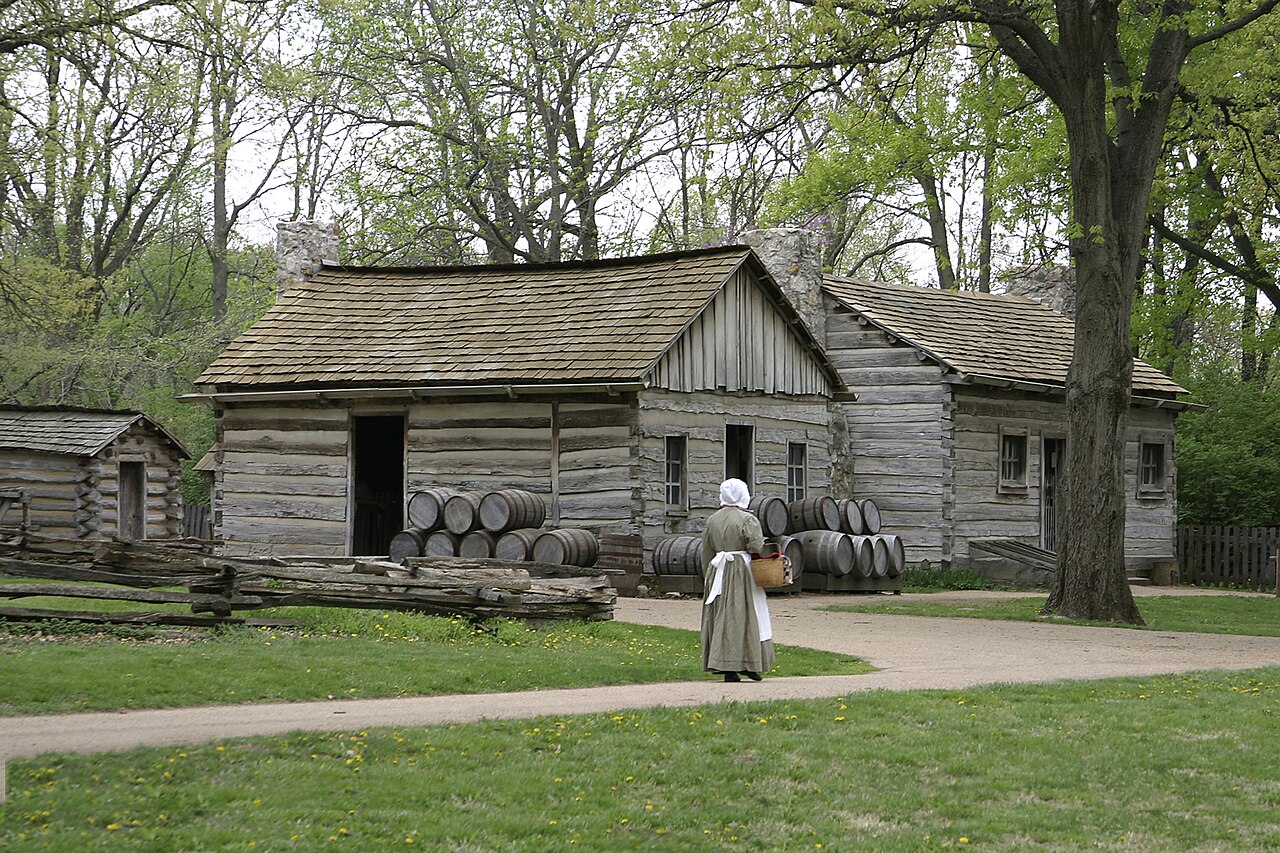
In central Illinois, a community of log houses, split rail fences, and dirt walkways rests on a wooded bluff overlooking the Sangamon River. It appears virtually exactly as it did when a young Abraham Lincoln roamed its streets in the 1830s. Many visitors to Lincoln’s New Salem State Historic Site leave with the impression that they have traveled back in time to pay homage to the future president. Some believe they’ve also met someone from that time. People still describe seeing a woman in white, a towering figure in dark attire, cold patches, and footsteps with no source. The most popular hypothesis relates these sightings to a horrific death in 1833. This essay will look at the history of New Salem, the tragic narrative behind its most famous ghost, recent sightings, the relationship to White Lady folklore, the hypotheses that attempt to explain the haunting and the impact the legend has had on the location and on those who visit there.
The Rise, Fall, and Rebirth of New Salem
New Salem was established as a risky venture along the river. On July 19, 1828, John Cameron purchased a plot of land along the Sangamon and petitioned the state legislature for the right to construct a dam across the river at a site known as Fish Trap Ford, situated near the only main road in the region (Tremeear, 2013). Cameron and his business partner James Rutledge were savvy businessmen. They built their mill at a critical crossing on the main overland route and sold town lots to settlers who saw wealth in steamboat traffic (Tremeear, 2013). The dam was started on January 22, 1829. Local farmers brought in roughly a thousand wagonloads of gravel from local streams to fill wooden bins in the riverbed, and a combined grist and sawmill was built on a platform over the water (Tremeear, 2013). Locals stated that on its busiest days as many as forty horses may be seen tied to trees on the steep mountainside, standing with “their heads forty-five degrees above their hams” (Tremeear, 2013).
The village’s most renowned resident came by mistake. In April 1831 a flatboat was caught on the mill dam and its crew fought to keep it from sinking. A young man in blue denim, rolled up at the cuffs, and wearing a cheap buckeye-chip hat, appeared to be in distress. He jettisoned most of the cargo and took the rest to the stern. Then he borrowed an auger from the local cooper, punched a hole in the bow to allow the water to drain, filled it, and the boat slid over the dam (Tremeear, 2013). In July of that year, he went back to work at a store for the owner of the flatboat, Denton Offutt, and introduced himself as Abraham Lincoln (Tremeear, 2013).
Lincoln lived at New Salem from 1831 to 1837. In those years he worked as a laborer and store clerk, served in the Black Hawk War, lost his first election for the state legislature, and entered a retail partnership that, in his words, “winked out” (Illinois Department of Natural Resources [IDNR], n.d.). The town didn’t last much longer than his own. It was platted in 1829 and barely survived about twelve years until it was abandoned and turned to pasture (IDNR, n.d.). From 1840 to 1917 it was a cow field, until the Illinois Centennial revived interest. The Old Salem Lincoln League was established by Petersburg locals and the site was donated to the state in 1918 (University of Illinois Library, n.d.). During the Great Depression, the Civilian Conservation Corps reconstructed the village based on historical studies and archeological inspections of the original foundations (University of Illinois Library, n.d.). Today the property includes twenty-three historically furnished buildings, including homes, stores, a tavern, a school, and a running mill (IDNR, n.d.).
The Death of Elizabeth Herndon and Her Lingering Presence
One of those houses is the start of a ghost story. Rowan “Row” Herndon was an early immigrant, a cousin to Lincoln’s future legal partner William Herndon, and the person who sold Lincoln and William Berry their ill-fated store. Lincoln even stayed with the Herndons after the Black Hawk War (Abraham Lincoln Online, n.d.). Row was married to Elizabeth Graham, sister of the local schoolmaster Mentor Graham (Abraham Lincoln Online, n.d.).
In January 1833, Lincoln was fixing a broken bed at Rutledge Tavern and needed a tool, so he dispatched ten-year-old Nancy Rutledge to the Herndon cabin for one (Tremeear, 2013). Nancy later reported what she had seen. Row was packing his gun to go hunting when it went off and Elizabeth, who was seated nearby conversing with Nancy, “was shot right through the neck. I saw either side of her neck gush out blood, her hands fluttering a while, then I fled out of the house, hurried home, and told Annie and Mr. Lincoln what had happened” (N. Rutledge, as recounted in Tremeear, 2013). Elizabeth died. The Sangamo Journal described the shooting as a “melancholy catastrophe” and stated that the community “deeply sympathize[d]” with the mourning spouse (Sangamo Journal, 1833, as reported in Tremeear, 2013). Not everyone in town was quite so convinced. Soon after, Row left town, and people were saying that his wife’s death was far from accidental (Tremeear, 2013).
That doubt may be the reason Elizabeth is still remembered and perhaps the reason why she never left. People mention a woman in a pristine white garment or covered in white (Tremeear, 2013). Especially children mention seeing a woman in lovely clothing. She often turns up at the far end of the village, takes a few steps and then vanishes. Occasionally she carries a broom as if she were still scrubbing her cabin floor (Tremeear, 2013). She is not the only thing people call her. Visitors have also reported sightings of a man in dark clothes and a tall hat with his foot caught in mid-air as if he were resting it on a fence post or stool that is no longer there (Tremeear, 2013). These encounters are punctuated by disembodied footfall, sudden cold spots, and the sense of being watched. Park officials don’t buy any of these claims (Tremeear, 2013). Visitors are advised not to ask the park guides whether the village is haunted for the guides will deny it. Yet the stories keep coming.

New Salem’s Ghost and the White Lady Tradition
Elizabeth’s story is one of the most common varieties of ghost stories and one of the earliest. A white lady, or woman in white, is a female ghost usually dressed in white. She is often found in rural locations connected to a local tragedy. These traditions typically include a sudden or violent death, frequently including betrayal by a husband or lover (“White Lady,” n.d.). Versions appear all over Europe and the Americas. In some Brazilian stories, the woman in white is said to be the soul of a young wife killed by her husband or father (“White Lady,” n.d.). In German tradition, white ladies haunt the castles of noble families, sometimes as a punishment for horrific sins (“White Lady,” n.d.). Illinois has one of its own. A white lady, known at times as the Madonna of Bachelor’s Grove, shows herself to visitors to Bachelor’s Grove Cemetery, near Chicago, holding a baby (Barnes, 2026). The New Salem ghost ticks practically every box. She was viciously killed at home; as a young wife accused by her husband, her life ended, and she is now shown in white. The broom in the story has a frontier-like quality. The traditional White Lady pattern seems homey because she is not a noblewoman haunting a castle but a settler’s wife still doing her tasks.
A White Lady is a female ghost, usually with a tragic or betrayed love tale. She is often associated with a certain location (castle, river, hillside, or house) and a history of tragedy or violence. The literature is replete with discussions of “white ladies” as iconic spirits associated with certain locales and histories (e.g., studies of Branca/Branca Dias and parallel white-dame motifs in Lusophone folklore and literary traditions) (Felipe, 2024; Moura et al., 2023; Núñez & García, 2017). While not all tales utilize the precise title “White Lady,” they share the core attributes of female ghosts: white or bridal clothing, sites of recollection, and emotionally charged backstories that anchor haunting in space and time (Bragaia, 2023).
There are several sources on the cross-cultural mobility of white-dressed female spirits (damas brancas) in European and American mythology. There are references to “dama de branco” and comparable figures in several localities (River-nymphs, water-damed spirits, etc.). Núñez & García (2017) talk about feminine figures related to water (lavanderas, water dams) in Iberian-influenced traditions, which are part of a common symbolic register for female spirits associated with water and generative forces, reminiscent of White Lady themes. Campara (ghost on the third floor) focuses on Gothic translation and reception, illustrating the way that Gothic ghosts travel across languages and cultures, sometimes conforming to local spectral conventions. Although the emphasis is on Jane Eyre, the methodological point is that spectral figures migrate and are reinterpreted in different cultural markets, informing the way in which White Lady ghosts might be rendered in different literary ecosystems (Campara, 2024).
Explaining the Haunting and Its Legacy
There are various theories as to what a tourist sees at New Salem. The simplest answer is the supernatural one. The abrupt death of Elizabeth Herndon, along with an unrectified injustice, links her spirit to the site of her death. Supporters say children who don’t know the background often describe the same woman dressed up. The man in the tall hat has sparked a lot of guesswork of his own. Some visitors have thought that the hat and casual attitude are Lincoln himself, although no source identifies who the figure may be. Skeptics suggest psychological and environmental reasons. In a well-known study at Hampton Court Palace and the South Bridge Vaults in Edinburgh, researchers discovered that people reported much more strange events in sites with a haunted reputation. These reports were consistent with normal factors such as variations in local magnetic fields and lighting levels (Wiseman et al., 2003). The researchers concluded that some purported hauntings may be the result of people responding to natural elements of their environment (Wiseman et al., 2003). There are numerous of these features in New Salem. It has drafty log structures, wooded hillsides, shifting shadows, and costumed interpreters in period dress that at a distance could easily be mistaken for something odd. A third, cultural interpretation, considers the ghost as a sort of collective memory. The town disbelieved Row Herndon’s claim but never proved a thing, and that unsettled uncertainty lives on through a ghost.
The mythology has had a tremendous impact on how people experience the location. The rebuilding of New Salem intended to recreate the story of Lincoln’s early years. The ghost story is about a different kind of history: that of an average woman whose death would, ordinarily, be a mere line in an old newspaper. Officials’ denial and the people’s belief also shape the location. Interpreters deal in documented history, but tourists deal in stories that never appear on placards. The mythology has permeated the region’s culture as well. Local author Mark Russell, who used to be an interpreter at New Salem, just released a middle-grade ghost tale set in a fictional town with a historic hamlet that mimics New Salem (Eccles, 2026). More broadly, haunting history has become a recognized heritage tourism attraction in Illinois. One national index lists 156 recorded sites in the state with claimed paranormal activity (Barnes, 2026). For some, Elizabeth’s narrative is incentive enough to make the trek, and it’s a sobering way to contemplate how fragile frontier life may be.
Conclusion
New Salem began life as a bet on river trade on the frontier, became the location where Abraham Lincoln grew up and then almost faded into pasture before being painstakingly reassembled. But there is a darker story beneath its well-tended cabins. In 1833 a young wife was shot in her own home and her neighbors never quite believed it was an accident. Elizabeth Herndon’s narrative parallels White Lady legends from Europe to Brazil to Chicago. She may be the restless spirit of a woman in white, a trick of the light and suggestion, or a memory the community never let go, but she has become part of New Salem’s identity. The park guides may tell you the village is not haunted. The story still lives on and reminds visitors that history is not just about future leaders but also people who left only a few lines in the record.
References
Abraham Lincoln Online. (n.d.). Herndon home in Lincoln’s New Salem. https://abrahamlincolnonline.org/lincoln/newsalem/herndon.htm
Barnes, R. (2026, October 13). Illinois’ most haunted places revealed in new rankings. Patch. https://patch.com/illinois/across-il/illinois-most-haunted-places-revealed-new-rankings
Bragaia, F. A. D. (2023). A invenção do Brasil pós-Brasília: História de homens brancos. PosFAUUSP, 30(57), e206596. https://doi.org/10.11606/issn.2317-2762.posfauusp.2023.206596
Brontë, C. (1847). Jane Eyre. Smith, Elder & Co.
Campara, G. C. (2024). O fantasma no terceiro andar: Como o gótico em Jane Eyre foi traduzido para o português brasileiro. Caligrama: Revista de Estudos Românicos, 29(2), 173–187. https://doi.org/10.17851/2238-3824.29.2.173-187
Eccles, R. (2026, April 29). Haunted school adventure set in central Illinois from the mind of Mark Russell. NPR Illinois. https://www.nprillinois.org/arts-life/2026-04-29/haunted-school-adventure-set-in-central-illinois-from-the-mind-of-mark-russell
Felipe, C. V. do A. (2024). In the wake of midnight: Frame and parody of Gothic in Pinheiro Chagas. Revista USP, (140), 89–106. https://doi.org/10.11606/issn.2316-9036.i140p89-106
Illinois Department of Natural Resources. (n.d.). Lincoln’s New Salem State Historic Site. https://dnrhistoric.illinois.gov/experience/sites/site.lincolns-new-salem-state-historic-site.html
Moura, C. H. R., Lapa, T. de A., & Araujo, F. M. H. (2023). Nos matizes da memória e da história: Uma discussão sobre o folclore fantástico do Recife e seus lugares. Risco Revista de Pesquisa em Arquitetura e Urbanismo (Online), 21, 1–17. https://doi.org/10.11606/1984-4506.risco.2023.196052
Núñez, E. M., & García, A. M. (2017). Literatura, folclore y medio ambiente: El caso de las lavanderas. Textura – Ulbra, 19(39). https://doi.org/10.17648/textura-2358-0801-19-39-2716
Tremeear, J. (2013). Illinois’ haunted Route 66: Ghosts from Chicago to St. Louis. The History Press.
University of Illinois Library. (n.d.). “Here I have lived”: Recreating the land of Lincoln. Illinois History and Lincoln Collections. https://publish.illinois.edu/ihlc-blog/exhibits/here-i-have-lived-recreating-the-land-of-lincoln/
White Lady. (n.d.). In Wikipedia. Retrieved October 14, 2026, from https://en.wikipedia.org/wiki/White_Lady
Wiseman, R., Watt, C., Stevens, P., Greening, E., & O’Keeffe, C. (2003). An investigation into alleged “hauntings.” British Journal of Psychology, 94(2), 195–211. https://doi.org/10.1348/000712603321661886

Leave a Reply