Fairies of Iberia: Key Points
- Iberian fairy traditions include many regional supernatural beings connected with nature, water, caves, ancient ruins, and hidden treasure.
- Galician mouras are beautiful enchanted women associated with caves, springs, ancient monuments, magical powers, and guarded treasure.
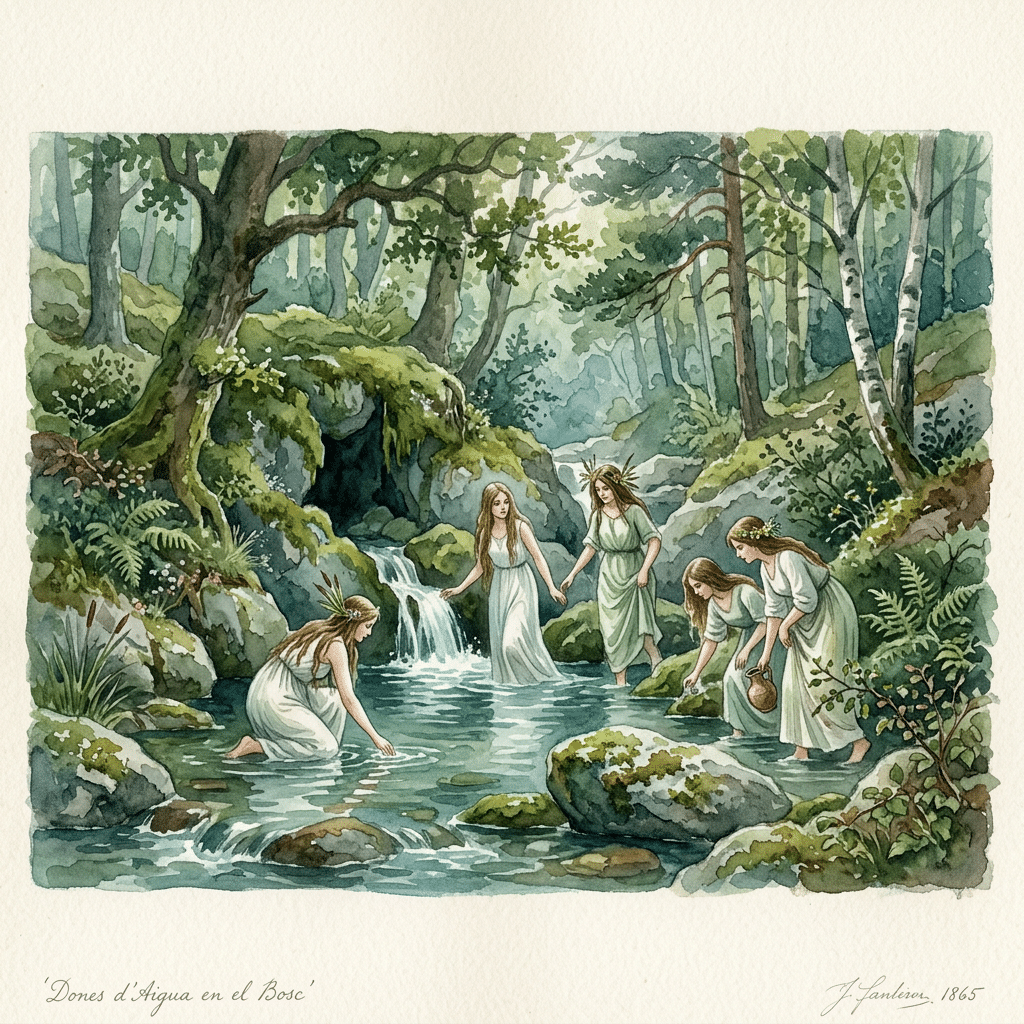
- Asturian xanas, Cantabrian anjanas, Basque lamiak, and Catalan dones d’aigua are fairy-like beings often connected with rivers, springs, forests, and other natural places.
- Many Iberian fairy stories involve enchantments, hidden treasure, supernatural marriages, mysterious disappearances, and rewards or punishments based on human behavior.
- Theories suggest Iberian fairy traditions may combine pre-Christian beliefs in nature spirits and deities with later Roman, Christian, Islamic, and regional folklore.
- Iberian fairy lore remains important because it preserves regional identities, explains mysterious landscapes and ancient sites, and continues to influence literature, tourism, folklore, and modern paranormal culture.

Introduction
The Iberian Peninsula has one of the greatest and most diversified traditions of supernatural creatures related to nature, water, caves, old ruins, and hidden wealth in Europe. The English word ‘fairy’ is commonly used as a convenient description, although the Iberian tradition does not contain a single, united race of fairies. Spain and Portugal are rich in regional customs created by distinct languages, geography, religions, and histories. Galicia has its mouras, Asturias has its xanas, Cantabria has its anjanas, the Basque Country has its lamiak, Catalonia has its dones d’aigua, and other regions have tales of encantadas, which are otherworldly women tied to specific sites or spells. These tales present a complex supernatural environment in which beautiful and sometimes dangerous beings link the human world with water, wilderness, ancient monuments, and an enchanted realm just beyond ordinary awareness (Callejo, 1994; Pedrosa, 2023).
In Iberian cultures, “fairies” might map onto a family of entities often referred to as damas de agua (lady of the water), mouras (mouras), xanas (Asturian water-spirit nymphs), donas d’aigua (water women), mouras gallegas, and associated house-spirits such as “casas de fées” (houses of fairies). Many of these figures have been interpreted by some as water-related nymphs or fairy women associated with caves, rivers, and wells, with themes of enchantment, wealth, and domestic or ceremonial labor (e.g., washing at the river). These figures serve as omens, guardians of places or test subjects for intruders, and they are spread all over Iberia and the wider Atlantic rim (García & Núñez, 2014; Núñez & García, 2017; Núñez & García, 2012; García & Molina, 2023; Cleminson, 2012; García & García, 2018). Not all sources use the same labels, and some name regional varieties (e.g., xanas in Asturias, mouras in Galicia, damas de agua in Portugal and Galicia) (Vidaurre, 2018; Núñez & García, 2017; García & García, 2018; Núñez & García, 2012).
Regional Traditions and the Iberian Landscape
The Iberian fairy traditions are unusually varied, as the peninsula itself has long been culturally diverse. Its folklore emerged through the interaction of pre-Roman peoples, Roman civilization, Christianity, medieval Islamic and Jewish cultures, and regional traditions reflected in Portuguese, Galician, Asturian, Leonese, Castilian, Catalan, Basque, and other languages. Hence, efforts to identify a unique Iberian fairy tradition are deceptive. Other supernatural beings are named differently, and the same name may have a somewhat different meaning in different regions (Pedrosa, 2023). What they have in common for many of them is a tight bond to the terrain. Springs, rivers, caves, mountains, old civilizations, megaliths, ruins, and lonely areas are often gates or boundaries between the world of the ordinary and the supernatural.
The best known of the fairy-like beings of Galicia and northern Portugal are the mouras or mouras encantadas. They are often depicted as beautiful supernatural women connected to caves, springs, rivers, rocks, archeological sites, and underground regions. Many have magnificent valuables like gold. Some traditions tell about mouras combing their long hair, spinning or weaving, guarding wealth, commanding the forces of nature, or waiting for a human being who can break an enchantment. Even Galician traditions attribute to the mouras the transportation of gigantic stones and the construction of old monuments, giving supernatural explanations for puzzling constructions left by former peoples (Freán Campo, 2015). They are particularly strongly linked with riches, and stories of hidden wealth occasionally link the supernatural world directly to real archeological sites.
The Asturian xana is similar in many respects to the Galician moura. Xanas are lovely female spirits of springs, rivers, fountains, caves, and other areas where there is water. They might have treasure, appear while combing their hair, or interact with humans entering their realm. The comparison between the Galician mouras and the Asturian xanas has raised the question among researchers as to whether these figures belong to a wider tradition that would stretch through the Atlantic areas of western Europe (Alberro, 2002; De Milio Carrín, 2020). Their stories are similar to myths about magical women connected with water, hills, and old monuments elsewhere in Europe, but similarity alone does not show that all such myths came from a single ancient society.

Fairy Women, Water Spirits, and Enchanted Beings
Cantabria has another famed magical woman—the anjana. The Anjana is often depicted as a kindly fairy associated with nature, who may assist travelers, the poor, or the lost. The figure matches a typical fairy pattern of a supernatural woman who is a guardian of wild or secluded locations. Like other Iberian fairies, the anjana belongs to a specifically localized tradition, not just a Spanish equivalent of the little winged fairies common in modern popular culture. Generally, Iberian fairies are considered enigmatic women related to certain sites and powers, rather than small winged creatures (Callejo, 1994).
Basque folklore has a particularly unique set of otherworldly entities. They include the lamiak, generally known in Spanish as lamias. They are often attractive women who are connected with rivers, springs, caverns, and bridges. In many myths, however, their beauty hides a magical trait, such as birdlike or animal feet. Mouras, Xanas, and Lamiak may comb their hair and engage with humans near water. They can reward virtuous conduct, but encounters with them can also become harmful. Their stories highlight one of the repeating ideas of Iberian fairy lore: the supernatural cannot readily be divided into good and evil. How they treat people often relies on how people treat them or the regions where they live (Callejo, 1994).
Analogous figures of water nymphs are described in several studies in Iberian regions, such as Galician mouras and Portuguese damas de água, with common features such as the connection to gold-adorned hair, caves, castles, or sacred springs, and the motif of enchantment that can be broken through specific formulas or actions (e.g., invocación, ofrenda) (García & Molina, 2023; García & García, 2018; Núñez & García, 2012). Catalonia also has its water women traditions, notably the dones d’aigua, literally “women of water.” They live in springs and pools and caves and lakes and other watery places and are often said to be quite lovely. Stories about these beings sometimes include relationships between supernatural ladies and human males. Such partnerships can be successful for a while but are often under a prohibition or condition. When the human being defies the rule, the supernatural woman departs or returns to her world. This motif is part of a much larger family of European tales of weddings or liaisons between humans and supernatural ladies, but its Iberian variants are tailored to local settings and beliefs (Callejo, 1994).
Another common category is the encantada, or enchanted women. Encantadas are spoken of in stories spanning much of Spain, and they are particularly associated with caverns, castles, springs, ruins, and other sites deemed mysterious. The encantada might be a supernatural being, but she can also be defined as a human lady who is under a spell. She’s usually guarding riches, or waiting for someone to free her. Some only come out on certain nights or on specific dates. The difference between an enchanted human woman and a fairy who is supernatural by nature is often unclear, which means that traditions have combined throughout generations (Callejo, 1994). Some encantada narratives may represent ancient fairy traditions that later religious and historical storytelling has reinterpreted (Sánchez Ferra, 2025).
The evening of Saint John, held on 23 and 24 June, is particularly significant in several Iberian mystical traditions. There are legends about supernatural beings, charmed women, treasures, and strange things that happen during this period. Galicia, like other regions of the peninsula, firmly links the traditions of the mouras to Saint John. The Christian feast occurs at the time of the summer solstice, and the timing has led to Christian rites being woven together with previous beliefs about seasonal change, water, fertility, fire, and supernatural activity. Such mixing is a sign of how fairy customs might endure even as the religious climate around them altered.
Origins and Cultural Layers
Various explanations have been presented to account for the origin of Iberian fairy lore. Some traditions may have preserved parts of pre-Christian beliefs about local spirits, water divinities, ancestors, or supernatural guardians of the landscape. In many ancient European tribes, springs, rivers, caves, and mountains were sacred or symbolically important. Later generations may have made earlier supernatural beings into mouras, xanas, lamiak, encantadas, and others. The fairy traditions of northwestern Iberia and other Atlantic European countries share similarities that inspire notions of a shared cultural legacy or long-standing interchange (Alberro, 2002; De Milio Carrín, 2020). But these relationships are difficult to verify, because folklore is constantly changing as people pass on stories.
The alternative viewpoint looks to cultural layering rather than to survival from a single old religion. Iberia was the site of centuries of migration, invasion, religious conversion, linguistic change, and cultural contact. So new explanations might be given to stories, with the original narrative structures being retained. The mysterious supernatural woman could be of different types, depending on the historical conditions of the group that tells the story: a Moorish princess, a pagan spirit, an enchanted Christian woman, or a guardian of riches. Christianity also took up or reworked several elements of the previous supernatural geography. In some Galician legends, the Virgin Mary or female saints were linked to features or sacred sites of the mouras (Secretaría Xeral de Política Lingüística, n.d.). And the older stories might survive in different versions rather than disappear.
The word “moura” highlights the challenge of historically understanding these narratives. Later tellers frequently associated the mouras and related entities with the historical Muslim presence in Iberia, including stories of Moors who reportedly buried treasure while departing an area. Folkloric mouras, however, tend to behave more like supernatural entities than like historical individuals. They inhabit impossible subterranean regions, possess supernatural powers, guard enchanted objects, and are related to monuments that predate the medieval Islamic presence in Iberia (Freán Campo, 2015). Thus, researchers have attempted to ascertain whether the apparent historic identity of these characters is in fact a later interpretation placed on much older supernatural traditions.
Archaeology, Culture, and Modern Influence
Fairy stories also used to illuminate old monuments and archeological relics for societies. A prehistoric tomb, wrecked settlement, inexplicable stone building, or cave may be the abode or creation of otherworldly entities. In Galicia, the history of mouros and mouras is so strongly linked to archeological sites that academics have taken the folklore as a source to understand the way local inhabitants interpreted the ancient landscape (Freán Campo, 2015). Folklore does not provide a literal historical narrative of who erected such monuments, but it is full with important information about how generations of people understood them and related to them.
Iberian fairy lore extends beyond the belief in supernatural beings. These stories maintain regional identity, traditional place names, oral history, and cultural links with the natural environment. A spring where a xana lives, a cave with an enchanted moura, or a river where a lamia is present becomes more than just a physical place. It is woven into a cultural landscape of memory and meaning. Stories can also reinforce behavioral expectations. Supernatural entities typically suffer the consequences when humans treat them with greed, contempt, dishonesty, or carelessness. If you are kind or respectful, you may receive help or treasure.
The customs have also impacted literature and modern pop culture. Romantic and subsequent writers used legends of charmed women, aquatic spirits, and otherworldly settings. In his version of La cueva de la mora, Gustavo Adolfo Bécquer employed the motif of the charmed Moorish woman, for example. Mouras, xanas, anjanas, lamiak, and other beings are still brought to audiences far beyond the regions where their traditions originated today via literature, tourism, folklore festivals, documentaries, websites, and paranormal interpretations. At the same time, these traditions have been increasingly used by academia as evidence to analyze cultural identity, archeology, religious change, and the interactions between the community and the landscape (Freán Campo, 2015; Pedrosa, 2023).
Conclusion
The fairies of Iberia are therefore more complex than a Spanish or Portuguese version of the common fairy of English-language popular culture. They are a disparate array of magical women, water creatures, guardians of treasure, charmed humans, spirits of nature and mystery, and residents of old places. The mouras of Galicia, the xanas of Asturias, the anjanas of Cantabria, the lamiak of the Basque Country, the dones d’aigua of Catalonia, and the widespread encantadas have key things in common but keep their own regional identities. We cannot be sure that they originated with a single group or religion. Instead, they appear to retain layers of cultural memory, influenced by ancient beliefs, Christianity, medieval history, local topography, and centuries of narrative. Their continued popularity demonstrates how mythology can turn caverns, rivers, ruins, and ancient stones into places where the ordinary and supernatural worlds appear only a few steps apart.
References
Alberro, M. (2002). La mitología y el folklore de Galicia y las regiones célticas del noroeste europeo atlántico. Garoza: Revista de la Sociedad Española de Estudios Literarios de Cultura Popular, 2, 9–30.
Bécquer, G. A. (1871). Obras de Gustavo Adolfo Bécquer: Tomo primero.
Callejo, J. (1994). Hadas: Guía de los seres mágicos de España. EDAF.
Cleminson, R. M. (2012). Felipe Alaiz, Federalismo Ibérico y la Formación del Intelectual Anarquista. Social and Education History, 1(2), 153–171. https://doi.org/10.4471/hse.2012.10
De Milio Carrín, C. (2020). Xanes, Mari, Fées: Triangulando las hadas atlánticas. Revista de Folklore, 463.
Freán Campo, A. (2015). El imaginario de la alteridad como fuente de conocimiento arqueológico e histórico: El caso del noroeste peninsular. Gallaecia, 34, 249–276.
García, A. E. M., & García, A. M. (2018). Poética del agua en las narraciones tradicionales textos y contextos. Literatura Y Lingüística, (32), 41–62. https://doi.org/10.29344/0717621x.32.1500
García, A. E. M., & Molina, G. N. (2023). Lecturas ecocríticas del patrimonio. Contextos Educativos Revista De Educación, (32), 127–146. https://doi.org/10.18172/con.5634
García, A. M., & Núñez, E. M. (2014). OJOS VERDES: IMAGINARIOS FEMENINOS Y NARRATIVAS TRANSTEXTUALES. Acta Literaria, (49), 123–138. https://doi.org/10.4067/s0717-68482014000200007
Núñez, E. M., & García, A. E. M. (2012). Los Imaginarios del agua y sus lecturas pansemióticas. Alabe Revista De Investigación Sobre Lectura Y Escritura, (6). https://doi.org/10.15645/alabe.2012.6.3
Núñez, E. M., & García, A. M. (2017). Literatura, folclore y medio ambiente: el caso de las lavanderas. Textura – Ulbra, 19(39). https://doi.org/10.17648/textura-2358-0801-19-39-2716
Pedrosa, J. M. (2023). Iberia: Moors, Gentiles and Encantadas. In S. R. Knight & S. Ó Catháin (Eds.), The Exeter companion to fairies, nereids, trolls and other social supernatural beings: European traditions (pp. 122–137). University of Exeter Press.
Sánchez Ferra, A. J. (2025). El mito de la Tragantía: Análisis comparativo. Revista de Folklore, 525.
Secretaría Xeral de Política Lingüística. (n.d.). O país da moura. Portal da Lingua Galega.
Vidaurre, E. Á. (2018). Leyendas, mitos y creencias populares: otras vías de aproximación al fenómeno megalítico. Cuadernos De Arqueología De La Universidad De Navarra, 11, 91–108. https://doi.org/10.15581/012.11.27760
Leave a Reply