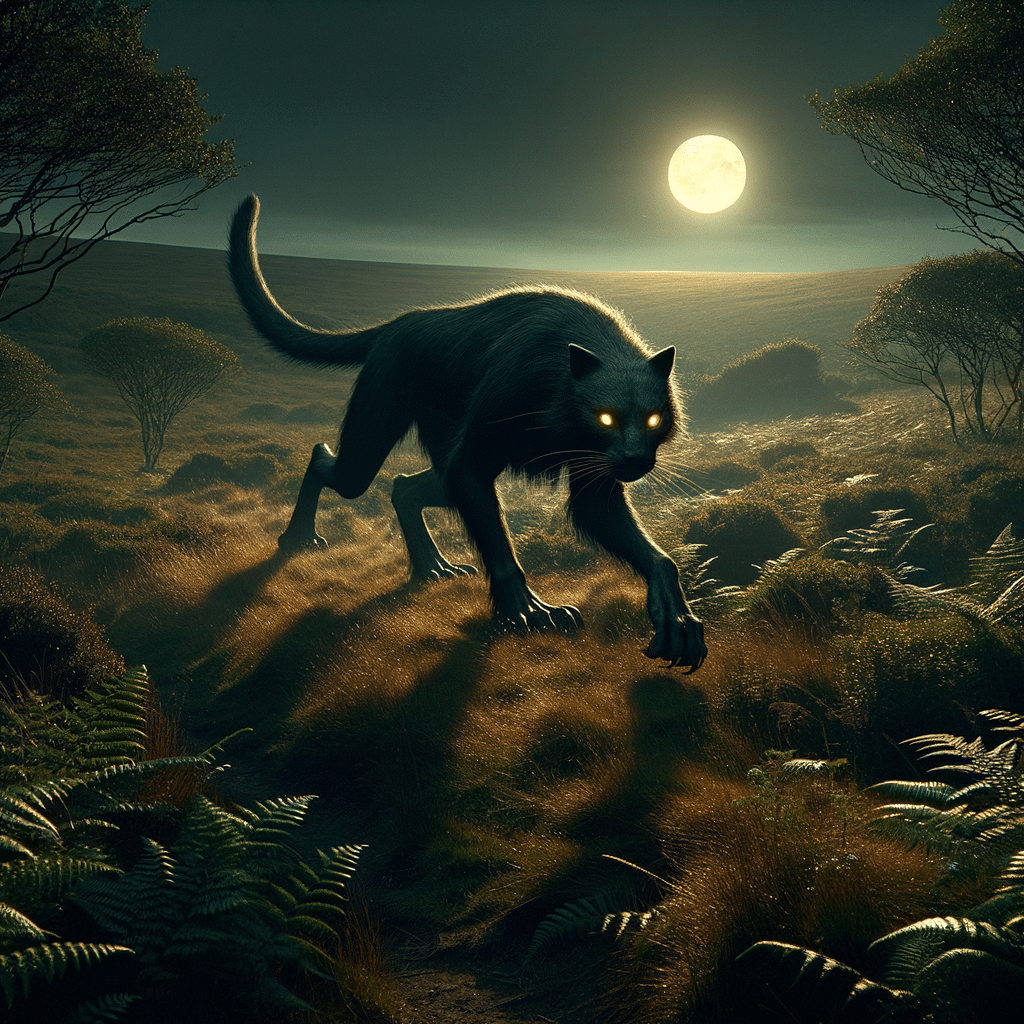
Bodmin Moor is an 80-mile stretch of untamed territory in the center of Cornwall, England, where the wind howls and the surrounding scenery whispers ghost stories. Here, against this barren and beautiful natural setting, a legend has taken hold about a ghost wild cat that people claim still roams the hills. Since it was originally reported in the late 1970s, this creature—often described as a beast resembling a panther—has posed a mystery and a source of fascination. The cryptid known as the Beast of Bodmin Moor represents more than just the ongoing conflict between the known and the unknown, science and mythology, and fascination and terror.
Beast Appearance
The legend’s genesis can be found in accounts of animals being mutilated and discovered with the marks of an alien predator. The locals, who were familiar with the area’s wildlife, thought that the attacks’ peculiar character pointed to a much bigger and more dangerous culprit than any local species. Only reports of seeing a large, panther-like animal fuelled the panic and speculation.
When the BBC2 show “In Search for the Beast” debuted in 1994, the Beast of Bodmin Moor became more than just a whisper. Rosemary Rhodes, one of the community members interviewed for the show, gave what many believed to be unambiguous footage of the elusive big cat. The show also displayed the horrifying outcomes of the beast’s alleged attacks: carcasses of sheep with deep, cat-like gashes and no flesh remaining. The locals’ worries were validated when reports of seeing the creature were received by the Cornwall Police Office from officers.

Hypotheses and Research
The large cat’s enigmatic presence in this hostile environment baffled many people. There was a commonly held belief that these “alien big cats” might have come from collections or private zoos. Because of the possible illegality of their importation, it was believed that the creatures may have escaped or been purposefully released into the wild, going unnoticed throughout their existence.
In 1995, the Minister of Agriculture, Fisheries, and Food ordered an official study into the possibility of a large cat living on the moors, demonstrating how seriously the government took the fears of the residents. That being said, the conclusion was one of doubt. According to the study, there was no substantial hazard to cattle and no concrete evidence of the existence of such a monster. The goal of this inquiry was to conclude the subject, but the Beast of Bodmin Moor’s tale was far from finished.
The Skull and Ongoing Belief
Strangely enough, not long after the government’s disingenuous report, a small boy along the River Fowey found the skull of a big cat. The skull sparked a new round of discussion and was eventually determined to be from a real leopard by specialists at the Natural History Museum in London. The skull was enough to keep the mythology alive in the minds of the people who lived there, even though it was connected to a leopard-skin rug in England rather than a real animal.
The story of the Beast endured decades later. Livestock kills were still being reported, and big, strange droppings that had no known connection to any local animal were found. Something appeared to be a picture of a pregnant jaguar captured using binoculars near the village of St. Austell. It fueled the tale once more, whether it was evidence of the beast or just another chapter in the mystery surrounding the moor.
Conclusion
The appeal of the unsolved mystery and people’s curiosity about the paranormal are perfectly captured in The Beast of Bodmin Moor. The narrative persists despite scientific skepticism and a dearth of hard data, changing with each sighting and passing along the legend from generation to generation. The Beast of Bodmin Moor, whether a relic of the past or a creature of the imagination, is an enduring symbol of Cornwall’s cultural legacy and a warning that certain riddles are unsolvable. The ghost cat mythology endures, a shadow in the mist, forever woven into the fabric of Cornwall’s ethereal environment as the moor whispers its ancient mysteries.
Further Reading
Holiday, F. W. (1978). The Goblin Universe. St. Paul, MN: Llewellyn Publications.
Shuker, K. P. (1995). Mystery Cats of the World: From Blue Tigers to Exmoor Beasts. London, UK: Robert Hale.
Boardman, P. (1985). The Beast of Exmoor: Fact or Legend? Exeter, UK: Exmoor Press.
The selection of these books is based on their relevance to the topic of the Beast of Bodmin Moor and their contributions to the field of cryptozoology and local folklore.
The Goblin Universe by F. W. Holiday provides a broad examination of various unexplained phenomena, including cryptic creatures similar to the Beast of Bodmin Moor. Holiday’s work is a compelling place to start for those who are interested in the meeting point of myth and reality because of his explorations into the unknown.
Karl Shuker’s Mystery Cats of the World is a comprehensive study of unclassified and mysterious cat sightings around the globe. This book provides context and comparison for understanding the Beast of Bodmin Moor as part of a larger global pattern of phantom feline sightings, offering a zoological perspective on the subject.
The Beast of Exmoor: Fact or Legend? by Peter Boardman gives readers a closer look at another famous British cat cryptid. This book was chosen for its thematic similarity and its exploration of the issues surrounding the existence of mysterious big cats in the UK, providing readers with a broader understanding of how such legends persist and evolve over time.



Leave a Reply