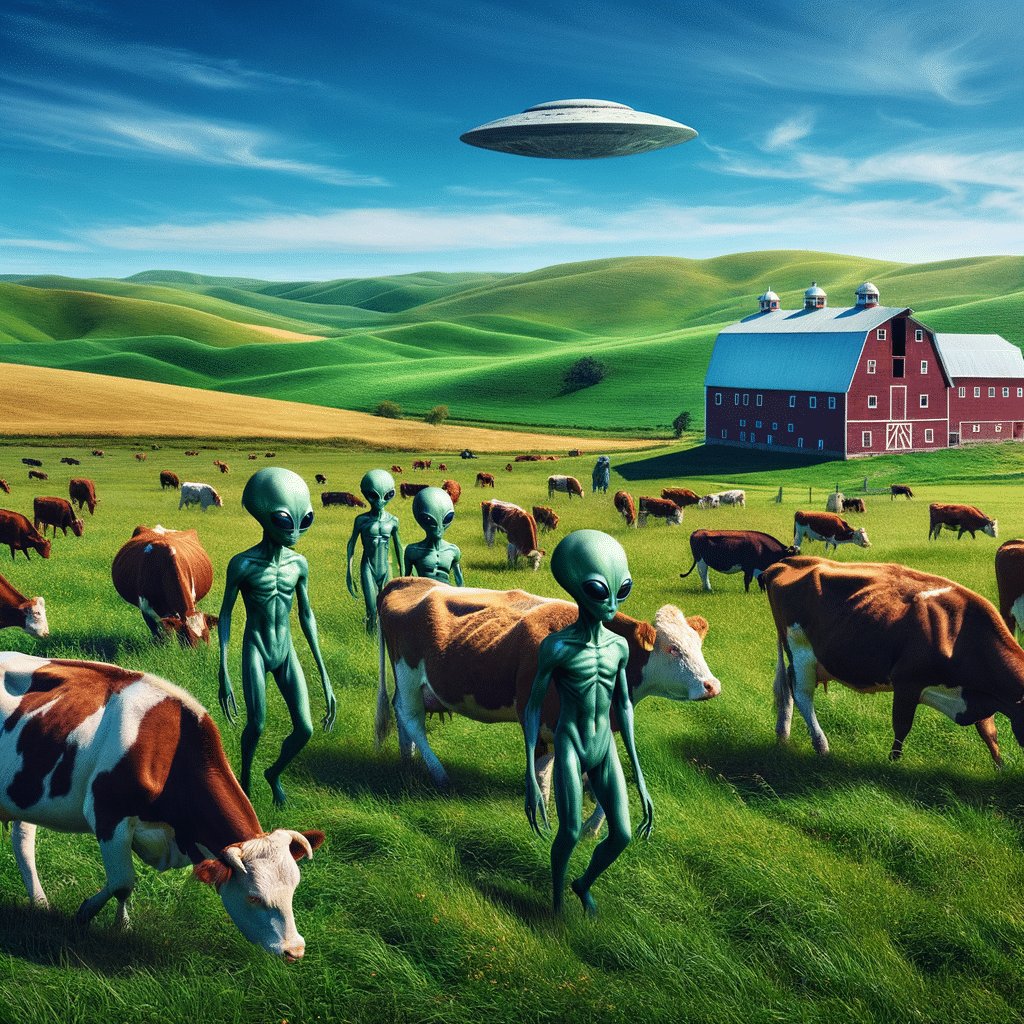
The term cattle mutilation refers to the mysterious and frequently horrific deaths of livestock, particularly cattle, with various body parts removed in a seemingly precise manner. This phenomenon has interested and perplexed people for decades. People have proposed various ideas, ranging from natural predators to alien participation, to address this global problem. Notable cases have occurred in the United States, South America, and parts of Europe.
Cases of cattle mutilation are unusual in that they usually include the removal of sensitive parts such as tongues, udders, eyes, and sexual organs. Some theorize that the offenders, who frequently remove these pieces with surgical precision, may possess highly skilled knowledge or technology. The absence of vehicle tracks or footprints at the scene, the absence of blood, and the sporadic reports of an exceptionally quick decomposition process in the impacted areas further compound the mystery.

History
When a wave of mutilations spread over the American Midwest in the 1970s, it was one of the first and most well-known examples. Ranchers discovered dead and disfigured animals, frequently without any indication of fighting or proof suggesting traditional predators. For instance, rancher Alexander Hamilton claimed to have discovered a dead cow in 1974 that had had its udder, anus, and genitalia surgically removed. Law enforcement and agricultural officials, among others, conducted investigations, but the justifications provided were frequently inadequate. Although some speculated that scavengers or natural predators might be to blame, the accuracy of the wounds and the lack of blood refuted these theories. This gave rise to a number of other explanations, such as cult activities, covert government experiments, and even abductions by aliens.
Investigative journalist Linda Moulton Howe gained notable recognition for the phenomenon in 1980 with her documentary, A Strange Harvest. In addition to documenting multiple occurrences, Howe questioned law enforcement, ranchers, and vets who were perplexed by the mutilations. Howe (1989) provided evidence in her book An Alien Harvest that suggested the mutilations were probably carried out by alien beings due to their apparent precision and the technology needed to carry them out. Howe claims that a number of witnesses saw unexplained flying objects or unusual lights close to the mutilation sites, which added to the conjecture.
The lack of tangible evidence linking human or animal offenders to the extraterrestrial notion contributed to its rise in popularity. The accuracy of the mutilations, according to ufologists, may point to sophisticated extraterrestrial technology. For example, there have been multiple incidents in which the incisions appeared almost laser-like, indicating a technology much beyond human capabilities at the time. Mainstream science, however, continues to be dubious about these assertions due to a dearth of empirical support.

Theories
There are many different theories as to why aliens might mutilate cattle, and these theories frequently speak to larger worries about the environment and human-animal relationships. According to one theory, aliens may be using cow biology as a stand-in for human biology. Because of their many physiological parallels to humans, cattle are a suitable choice as subjects for comparative study. This might entail studying genetics, disease, or even the effects of environmental contaminants, which would provide vital biological information to extraterrestrials.
Aliens may be interested in using cattle’s genetic material for cloning or hybridization, according to a different notion. According to some ufologists, extraterrestrial societies may be experimenting with genetics to improve their own species or produce a hybrid. The accuracy of the mutilations, which frequently include the removal of reproductive organs and other tissues rich in genetic information, lends credence to this idea.
An even more wild notion contends that aliens may be taking particular biological components from cows. Some soft tissues, like the eyes and organs, contain high concentrations of hormones, enzymes, and other biochemicals, potentially of interest to extraterrestrial entities for reasons currently unknown to humans. These specific bodily parts are frequently mutilated, which supports this theory.
Alternate Explanations
However, some scholars provide hypotheses that are more grounded. They speculate that the mutilations might be the result of covert government operations, possibly connected to chemical or biological warfare experiments. According to this notion, the government may be utilizing cattle as test subjects for different kinds of research, which would account for the mutilations’ accuracy and the secrecy surrounding them. In his 1992 book Silent Invasion, Philip J. Imbrogno explores the possibility of government involvement, highlighting reports of unmarked helicopter sightings in the area and the proximity of some mutilation sites to military bases.
Another explanation takes into account the role of ambient elements and natural scavengers. For example, some biologists argue that small animals like insects and birds may have carried out the precise removal of soft tissues. Additionally, natural decomposition processes and environmental factors could explain the observed absence of blood and sometimes quick disintegration. Loren Coleman discusses natural explanations, such as the actions of carrion feeders, in Mysterious America (2007), but he notes that these explanations do not account for all reported details, particularly those involving apparent surgical precision.
Additionally, other voices have been crucial in forming the conversation around cattle mutilation. For instance, pathologist Dr. John Altshuler observed peculiar incisions and a lack of blood in some disfigured animals that he could not account for using standard techniques (Howe, 1989). In a similar vein, patterns in Dr. Howard Burgess’ statistical examination of mutilation cases indicated the use of advanced methods or tools.
It is impossible to ignore the cultural and psychological effects of cow mutilation. The phenomenon is most common in rural settings, where ranchers have a substantial financial and emotional commitment to their livestock. The unexpected and unexplained death of cattle can cause increased worry and anxiety, which can magnify reports and encourage the propagation of wild notions. Media coverage and popular culture frequently highlight the more enigmatic and dramatic elements of the phenomenon, shaping public opinion.
Conclusion
There is still no clear explanation for the majority of documented occurrences of cattle mutilation, which makes the practice mysterious. The truth most likely lies somewhere in the middle, maybe incorporating a combination of natural, human, and probably even unknown elements. Theories range from the ordinary to the spectacular. Until solid proof is discovered, the enigma surrounding cattle mutilation will continue to enthrall and confound anyone who comes upon it.
References
Coleman, L. (2007). Mysterious America. Gallery Books.
Howe, L. M. (1989). An Alien Harvest. Linda Moulton Howe.
Imbrogno, P. J. (1992). Silent Invasion: The Shocking Discoveries of a UFO Researcher. Paragon House.




Leave a Reply