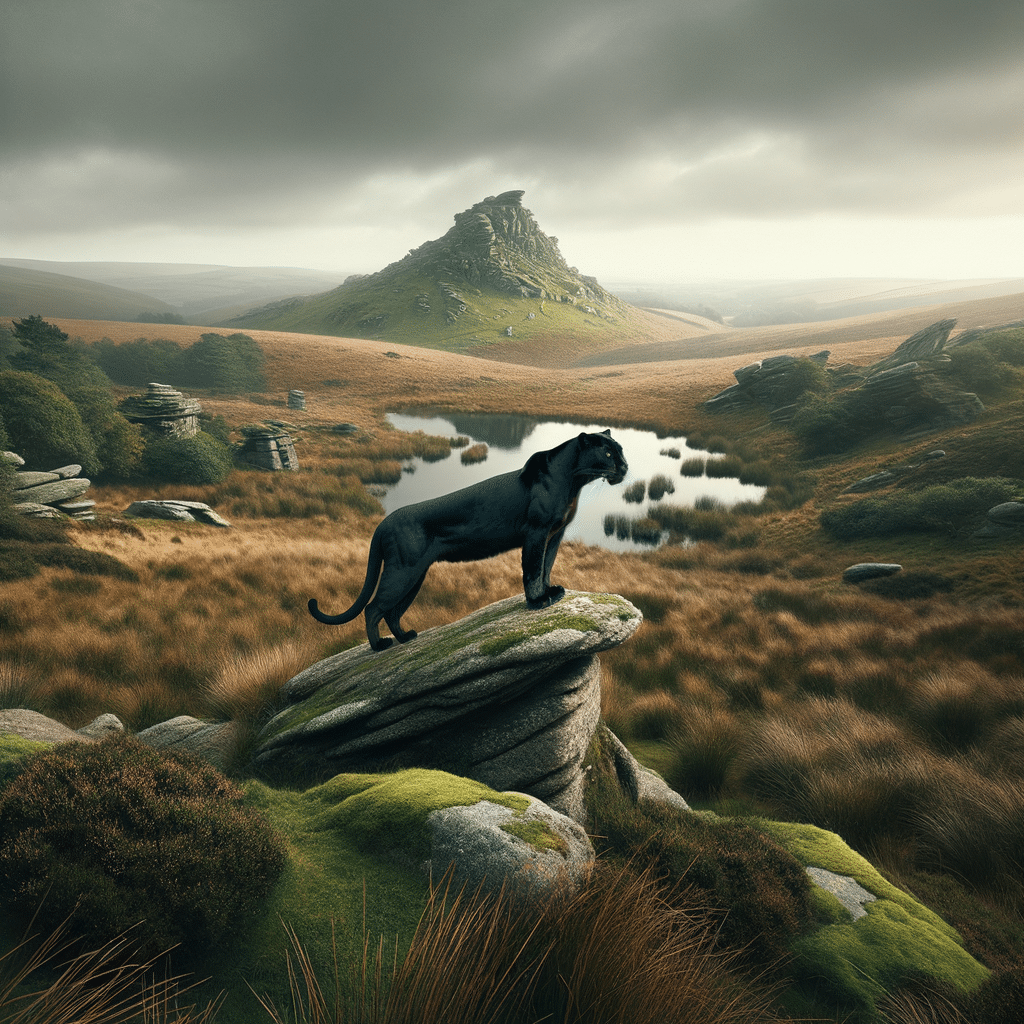
It is 1995 in Cornwall, England. A woman is driving in her car. The following is reported in the newspaper the next day: “Local resident, Mrs. Jane Tollard, claims to have witnessed the legendary Beast of Bodmin Moor last night. According to Mrs. Tollard, she was driving home from a friend’s house when she spotted a large, black creature crossing the road in front of her car. She described the creature as having piercing yellow eyes and a long, slender tail. Mrs. Tollard stated that she was so shocked by the sight that she pulled over to the side of the road and watched as the creature disappeared into the woods. She reported the sighting to the authorities, who have yet to comment on the matter.”
What did Mrs. Tollard see?
The Beast
The Beast of Bodmin Moor is a possibly mythical creature believed to inhabit the Bodmin Moor in Cornwall, England. Reports of the Beast of Bodmin date back to the 18th century and sightings have continued into the present day. When numerous sightings and livestock attacks were reported in the 1990s, it became well-known. As a result, there was a great deal of discussion about what might be causing these occurrences, and the Beast of Bodmin Moor gained widespread attention.
The Beast of Bodmin is the source of many a local legends and myths. Depending on who is narrating the tale, the Beast is typically described as a huge cat with black fur and piercing yellow eyes. Reports also mention its pointed teeth which add to its intimidating appearance. Some people assume it’s a panther while others speculate that it could be an escaped pet or even some kind of giant wildcat such as a jaguar or cougar. There have been multiple accounts since the late 18th century with descriptions ranging from large cats to small foxes, however most witnesses agree that it was big, strong, and definitely frightening!
Many explanations have been proposed over time to account for the existence of the Beast of Bodmin Moor. Others suggest it might be an escaped pet that has adapted to life in the wild, while some think it’s a cross between a domestic cat and a wildcat. Some have even speculated that it might be a supernatural being, like a ghost or a black dog.
It has long been believed that any alien big cats roaming free in the United Kingdom may have first been brought in as part of private collections or zoos and then escaped or were released. Due to the illegality of owning and importing the animals, a big cat escape would not be reported to the authorities. Following the closure of her Plymouth zoo in 1978, it has been asserted that animal trainer Mary Chipperfield released three pumas into the wild, and that subsequent sightings of the creatures sparked tales of the Beast.
Of course, it’s also possible that the animal is a wild cat species that was once considered to be extinct in Britain but is now reported to be thriving on Cornwall’s moors.

Werepanther?
Over time, speculation about the creature’s identity has ranged from an escaped exotic pet or wild animal to something much more sinister – a werewolf. While it is impossible to prove either way what kind of beast may be living on the moor, some people believe that it cannot be a big cat because its behavior does not fit with any known species. They claim instead that whatever lurks in Bodmin Moor must have supernatural origins and is likely a werewolf rather than any other type of animal.
If it is lycanthropy, it could be that the beast is actually a werepanther and not a werewolf. This could explain why the beast continues to disappear and is never found. It also explains how it could survive in the environment. In general, scientists reject claims about the beast because to the absurdly high numbers required to maintain a breeding population as well as the likelihood that such said species could survive in the environments claimed for them due to climate and food supply difficulties. But if the beast is a lycanthrope, this is irrelevant.
The Ministry of Agriculture, Fisheries, and Food took the allegations of the Beast of Bodmin Moor seriously enough to launch an investigation into any cattle assaults in the 1990s. While they found no concrete evidence that would prove beyond a doubt that such a creature exists, reports of sightings have continued to pour in over the years.
Evidence
A young boy was out on a walk by the River Fowey when he made a startling discovery – a sizable cat skull. It was missing its lower jaw, but three sharp and prominent canines suggested that it could have been from a leopard. The skull measured roughly 4 inches long and 7 inches wide, making it larger than most domestic cats. This discovery came just less than a week after the government released their report denying any evidence of alien giant cats in Bodmin Moor, which soon became headline news across the country.
The Natural History Museum in London received the skull for inspection and soon determined that it was authentically that of a young male leopard. The team of entomologists and zoologists from the museum also discovered that the cat had not actually passed away in Britain and that the skull had been brought as part of a leopard-skin rug. Upon further examination, they found evidence to suggest this theory – namely, the skull’s back was neatly severed in the manner sometimes used to mount a head on a rug. Additionally, when examining the contents inside of it, they found an egg case laid by a tropical cockroach which is not likely to be found in Britain. Further investigation showed cut marks on the skull indicating that flesh had been removed with a knife; all combined with recent signs showing it had just recently been submerged in water before decay set in suggested someone had brought this animal’s remains into Britain from elsewhere.
In 1998, film footage that was obviously of a black animal, most likely a huge cat, measuring about three and a half feet long, was made public. The Newquay Zoo curator and a wild cat expert referred to the footage as “the finest proof yet” that big cats do in fact roam Bodmin Moor when it was a part of yet another batch of data given to the government.
Conclusion
Many locals remain adamant that some kind of large cat-like creature is still stalking Cornwall’s moorlands. The Beast of Bodmin Moor has become a well-known cultural figure, providing inspiration for songs, movies, and literature. A lot of people travel to the area in the hopes of seeing the enigmatic monster, making it a popular tourist destination.
There is a great deal of debate over whether or not the Beast of Bodmin is real, with some people believing that the creature is a myth and others insisting that the Beast of Bodmin is a real animal with undetermined origins.
In summary, there are numerous reports and eyewitness accounts which suggest that the Beast of Bodmin may be real. However, there is no scientific evidence or physical proof to support these claims. Proposed theories range from mundane explanations involving escaped big cats and other animals to more far-fetched explanations involving ancient species and supernatural creatures. Ultimately, it is impossible to prove or disprove the existence of the Beast of Bodmin. However, due to lack of evidence, it is likely that any reports of sightings are either misidentifications or fabrications.
The debate over whether or not the Beast of Bodmin exists will likely continue for years to come. It is possible that further evidence may surface in support of either side, but until then, the mystery surrounding the Beast of Bodmin will remain unsolved.


Leave a Reply