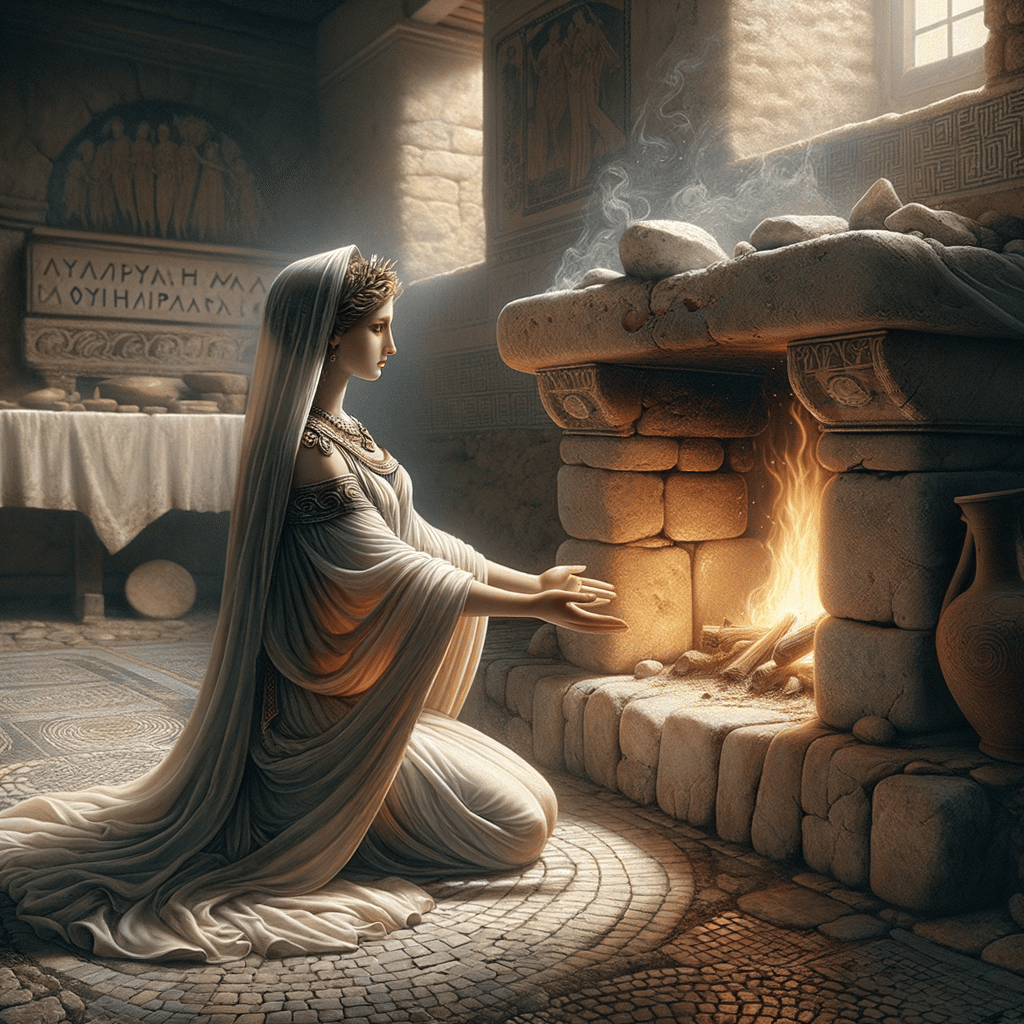
Greek folklore is full of gods and goddesses who are often showy and dramatic. Hestia stands out because she is calm and caring. She is the goddess of the hearth, home, and family. She is the oldest daughter of Cronus and Rhea. She was very respected in ancient Greek society because of how calm she was and how important she was to both daily life and religious practices. This essay delves into the meaning, symbolism, and broader aspects of Hestia’s worship.
The Symbolism of the Hearth
In ancient Greek homes, the hearth was both the physical and spiritual center of the space. The hearth served as the hub for food preparation and family gatherings, thereby becoming the focal point of all household activities. Hestia, the goddess of the hearth, stood for the fire that was at the center of every home. Her presence brought stability, warmth, and food, all of which are necessary for life. The hearth wasn’t just a place to cook; it was also a holy place where people could pray and spend time with their families. This is why Hestia was so important.
Not only in the home, but also in the city-state, the hearth played a crucial role, with community hearths serving as the focal point of public life. At these public hearths, holy fire burned all the time, symbolizing the community’s eternal nature. Hestia, the protector of both family and community peace, demonstrated this stability and the uniting power of the hearth.

Cultural and Religious Practices
Hestia was not included in many myths or great stories, like other Olympian gods. Instead, she was important because she was always present in everyday life and had an effect on religious rituals. In Greek homes, every meal and sacrifice started and finished with an offering to Hestia. This showed how important she was to keeping the home holy and healthy. This religious observance of Hestia shows how important she was to Greek society as a whole.
In more general religious customs, Hestia had a big impact. Many temples and public buildings reserved a hearth for Hestia. These places never extinguished the holy fire. This continuous flame was a sign of how strong and united the community was. A well-known expert on Greek religion, Jane Ellen Harrison, wrote that Hestia’s steady presence and the rituals that surrounded her worship showed how much the Greeks needed stability and order in a world that they saw as chaotic.
Hestia, in her role as guardian of the holy hearth, was also in charge of keeping the divine fire going on Mount Olympus. This part stood for both the unity of the gods and the strength of the city-state. As a community spirit, Hestia demonstrated the need for a central place where people could meet and connect. The fact that the fire was always on in her temple was a metaphor for how the community would last forever, which was important to the Greeks, who valued tradition and continuity.

Personality Traits and Virginity
Hestia is calm and gentle, which is different from the characters of other gods and goddesses, who are often dramatic and active. She stood for stability, modesty, and the sanctity of the home, making her an important goddess in a society that highly valued family and home harmony. In the wild world of Greek mythology, Hestia’s calm and caring personality stood out, giving people a feeling of stability and peace.
Hestia, along with Athena and Artemis, is one of the three goddesses who have never married. Being a virgin is a sign of her independence and complete dedication to the home and hearth. She doesn’t go on romantic adventures or chase after lovers like other goddesses do. This is because her job is to be neutral, stable, and bring people together. This part of her personality demonstrates how dedicated she is to the health of the family and the community, without any personal issues that could impede her holy tasks.
Analysis
The universality of Hestia’s worship is a testament to the fundamental nature of what she represents. No matter how rich or important a Greek was, every home had a fire, which is how Hestia got to be there. Because she was everywhere, she was one of the most revered and all-pervasive gods in Greek worship. The ancient Greeks had a lot of respect for Hestia. The frequency with which they invoked her in oaths and prayers underscores her role as the guardian of individual and collective purity.
In his important book Greek Religion, Walter Burkert talks about how Hestia is different from the other Olympian gods. He asserts that whereas other gods were associated with specific aspects of life or natural occurrences, Hestia’s domain encompassed the home and the hearth, serving as the fundamental pillars of society. Because she was so important, her worship was a daily, almost boring, but deeply meaningful ritual that helped keep the community together.
Conclusion
As a symbol of the warmth and stability of the family unit and the community, Hestia held a central and cherished place in both the private and public spheres of ancient Greek life. Her She stood for the family’s and community’s security and warmth. Her calm and caring presence kept things stable in a story that was full of chaos and drama. Hestia demonstrated the important values of stability, modesty, and devotion through her heart’s meaning and the way she was involved in religious and cultural activities. Hestia is one of the most important and feared figures in Greek mythology. Everyone worships her because she represents the basic human need for a sense of home and community.
References
Burkert, W. (1985). Greek Religion. Harvard University Press.
Harrison, J. E. (1903). Prolegomena to the Study of Greek Religion. Cambridge University Press.




Leave a Reply