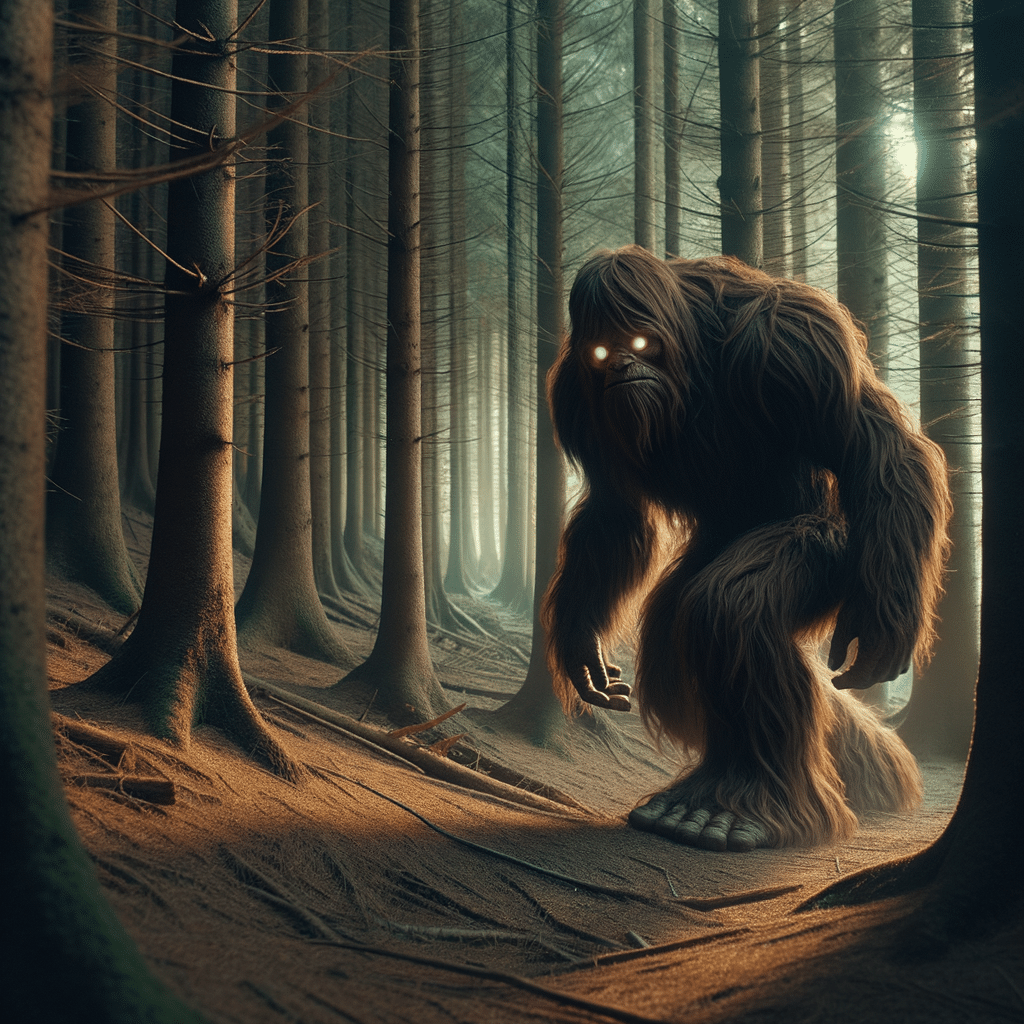
The Bigfoot legend has captivated and perplexed people for many years. A deeper and more evil viewpoint links Bigfoot to ancient and malevolent beginnings, despite the fact that many see him as a benign, even friendly, giant of the forest. These hypotheses explore the worlds of aliens, dark fairies, demons, and the Nephilim, among other supernatural beings, and they raise the possibility that Bigfoot is not the harmless but elusive monster that many people think it is.

Dark Origins
One of the most fascinating and ancient beliefs is the connection between Bigfoot and the Nephilim, a race of giants described in the Bible. People portrayed the Nephilim as powerful and terrifying beings, descended from the “sons of God” and the “daughters of men.” These creatures were supposed to have existed before the Great Flood, which was supposed to rid the planet of all impurities.
However, interpretations of apocryphal and biblical texts suggest that the Nephilim may have survived the deluge. There were other options for survival, such as chance, emigration to distant places, or perhaps divine intervention. If they survived, the Nephilim may have multiplied and evolved into Bigfoot over millennia. The ages have passed down their enormous size, power, and possibly even spiritual corruption, resulting in the enigmatic and frequently terrifying monsters reported today.
A different theory explores the subject of demonology. Demons represent malevolent supernatural entities historically associated with chaos, hostility, and destruction. According to certain scholars and folklorists, Bigfoot could be a demonic being or a creature controlled by evil energies. Numerous accounts and folklore support this theory, detailing experiences with Bigfoot that involve an overwhelming sensation of dread, inexplicable anxiety, and even physical assault. Witnesses have said that these entities have attacked, harassed, and pursued them, suggesting that their intentions may not be totally good. According to demonology, some entities have been known to take on hideous and horrifying bodily appearances in an effort to terrorize and subjugate people. If Bigfoot is a demonic apparition, its main goal may be to create chaos and panic in the minds of people who come across it, which would be in line with the usual plans of demonic spirits.
The concept of dark fae provides an even more terrifying explanation for the Bigfoot phenomenon. Tradition frequently portrays fairies, or fae, as erratic and occasionally evil entities. In particular, dark fae are renowned for their cunning, malevolence, and willingness to harm humans. The Unseelie Court is a subset of especially dangerous and malevolent fae that reside within the world of dark fae. The Unseelie Court is well-known for its animosity toward people and for enjoying horror and mayhem. Some people believe that the dark fae, or a type of them, may have influenced Bigfoot. Stories from different civilizations support this notion, describing meetings with hairy, humanoid beings that exhibit supernatural abilities, such as controlling the thoughts and emotions of those they encounter or disappearing into thin air. If Bigfoot’s presence in human-inhabited locations may represent a continuation of the evil fae’s ongoing attempt to scare and disturb human lives, if it is actually tied to the Unseelie Court.
The field of extraterrestrial hypotheses concerning Bigfoot is very broad; some speculate that Bigfoot may be associated with malevolent aliens. This theory posits that malevolent alien beings may transport Bigfoot to Earth, not as a terrestrial creature. Bigfoot sighting reports frequently correspond with UFO activity, which has led some people to theorize that these animals may be extraterrestrial experiments or perhaps alien beings themselves, sent to monitor or obstruct human activity.
Malevolent aliens may be genetically altering or manipulating these animals for purposes other than survival, according to the terrifying theory that they use Bigfoot for biological surveillance or as a tool. This viewpoint raises the possibility that Bigfoot may have interstellar roots and that its existence on Earth is a part of a darker, more nefarious scheme carried out by highly developed species with unidentified goals. This hypothesis blends the more general and equally enigmatic occurrence of extraterrestrial contacts with the Bigfoot mythology, adding yet another level of intrigue and terror.

Bigfoot Violence
Beyond these paranormal notions, a plethora of violent Bigfoot encounter accounts support the idea of its sinister beginnings. In the Pacific Northwest, for example, accounts of big, hairy animals following hikers and campers aggressively have surfaced. Occasionally, these encounters have led to physical harm; victims have reported the creature striking, biting, or throwing them. These tales depict a monster that is far from the kind of forest protector that some people think of; rather, they point to a creature that is violent and territorially aggressive.
A number of people have stated that bigfoot-like creatures have abducted them against their will. These reports describe the monsters as using a combination of strength and stealth to overwhelm their victims. The phenomenon of Bigfoot sightings is already mysterious, but the dread and intrigue these supposed abductions have caused among people who think these elusive creatures exist is much more so. Each year, numerous individuals vanish in the forests, often blaming Bigfoot for their disappearance.
Furthermore, indigenous traditions from diverse countries frequently portray bigfoot-like creatures as dangerous and wicked. Fearsome, hairy giants are part of the rich fabric of lore passed down by Native American tribes, in particular. For example, the Wendigo mythology describes a hideous, cannibalistic creature who is driven insane and has ravenous appetites. Some people have drawn comparisons between the Wendigo and Bigfoot, despite their differences in appearance and habits. In a similar vein, the Cherokee people revered and dreaded the Tsul ‘Kalu, a giant possessing extraordinary strength and skills that allowed him to kidnap both adults and children. In the Hoopa tribe’s oral tradition, there are stories about the Oh-Mah, a big, hairy animal that lives in the mountains and forests and frequently acts violently against people who invade its domain. These myths serve as a sobering reminder that we should not romanticize or dismiss every experience with the unknown.
Conclusion
Whatever his background, Bigfoot has a lot of traits that make him seem like a villain. The more esoteric tales about Bigfoot give it a variety of supernatural powers that make it more than just an unidentified primate. People attribute Bigfoot’s incredible strength and speed to its possible ties to the Nephilim, demons, and dark fairies. These attributes allow it to achieve extraordinary physical feats. A supposed capacity to disappear at will, potentially through teleportation, shapeshifting, or cloaking, explains its elusiveness.
It’s also believed that the creature can make witnesses feel intense terror, which suggests that it has the ability to manipulate people’s minds. Some legends hint at an alien origin, describing astonishing intelligence and cunning that go far beyond animal instinct. Finally, if Bigfoot is indeed supernatural, it may be immune to traditional types of injury, which would only heighten the mystery surrounding it and the fear these dark theories arouse.
Despite the widespread perception of Bigfoot as a benevolent and magical creature, a substantial amount of evidence and mythology point to a far darker past. Whether linked to the ancient Nephilim, demonic influences, dark fairies, or simply an expression of primordial savagery, we should not disregard the darkest aspects of Bigfoot lore. Like many legends, the truth might lie at the boundary between myth and reality; therefore, we should approach the unknown with care as well as interest.


Leave a Reply