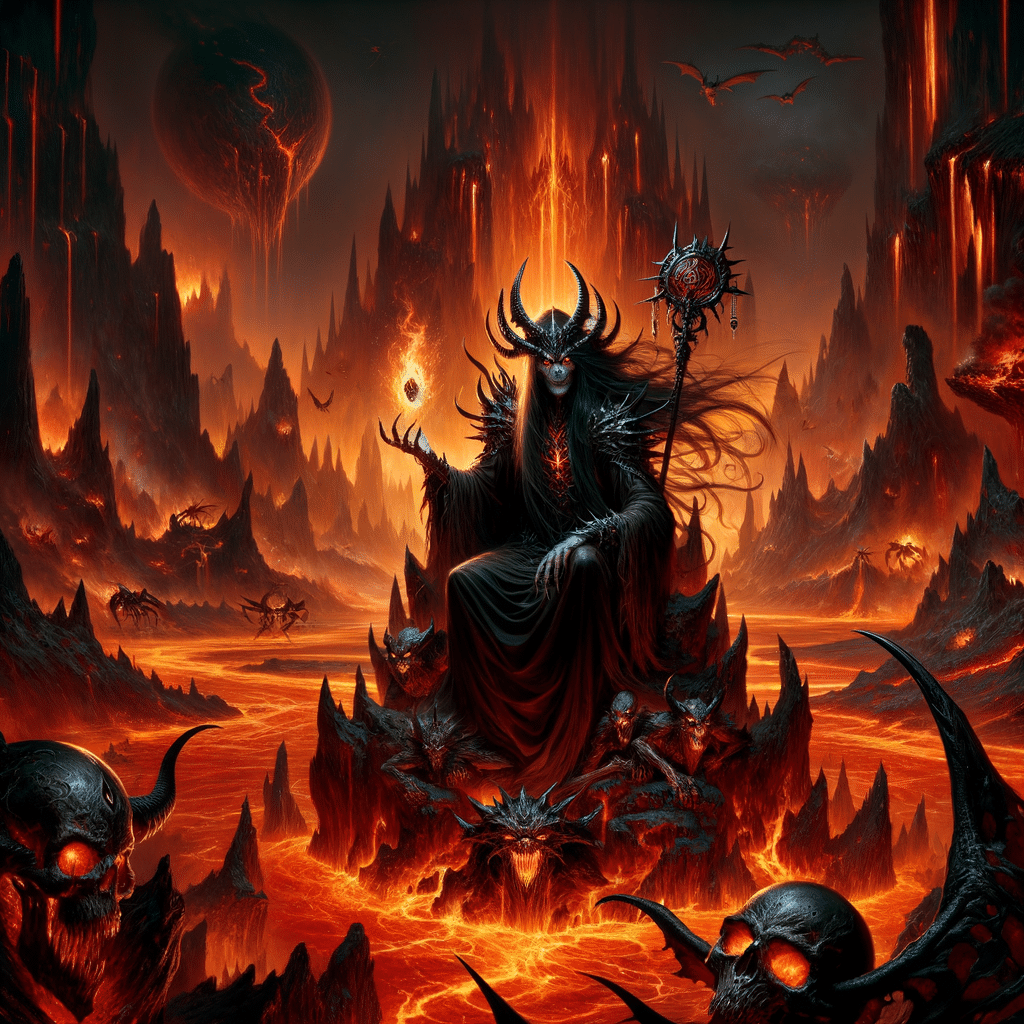
Throughout history, various religions and countries have depicted and understood Lilith in diverse ways. Lilith’s story is still fascinating to both scholars and fans, from her beginnings as a wind and storm goddess in ancient Mesopotamian myths to her part as Adam’s first wife in Jewish folklore. Many women now see Lilith as a symbol of strength because she defied societal norms for men and was associated with sexuality and freedom. Lilith’s complexity contributes to the study of mythology and demonstrates the evolving interpretation of stories over time.
Early writings, like the Sumerian Epic of Gilgamesh, talk about Lilith as a spirit that brings sickness and death. Jeffrey Burton Russell wrote in 1987 that Lilith represented old fears of out-of-control natural forces and the threats they posed to society. These myths often depict her as a terrifying creature, emerging only at night and prowling the wild in search of victims. This is a reflection of old fears that scary things lurk in the dark.
Jewish mythology tells Lilith’s story in greater detail and emphasizes its importance. In 1974, Gershom Scholem wrote that the Alphabet of Ben-Sira, an ancient book, mentions her as Adam’s first wife. This book delves deeper into the story of Lilith’s creation from the same earth as Adam, establishing her as his equal. But their relationship quickly falls apart because she won’t follow Adam’s rules, especially when it comes to sexual relations. Lilith’s demand that she not always lie under Adam while they are making love is a strong statement of freedom and equality that leads to her leaving Eden. Scholem says that her exit by speaking the Ineffable Name of God shows how strong and rebellious she is, making her different from other women in biblical and mythological stories.

Lilith and Demons
Kabbalistic books detail Lilith’s connection to demons in greater detail. In 1990, Raphael Patai noted that these mystical works depict Lilith as married to Samael, the angel of death. They are said to rule over many evil spirits together, and Lilith is often presented as a seductive witch who targets men and babies. This picture comes to life in books like Zohar, which see her as a queen of devils who represents the dangers of sexuality gone wild and the fear of the unknown. Patai says Lilith’s job in these writings is to question the established order and stand for the chaotic forces that are against God’s creation. Because she does things at night and tries to seduce sleeping men, she is similar to the image of the succubus, which is a demon who sleeps with men and has sex with them.
Medieval Christian demonology also views Lilith as a powerful and dangerous seductress, frequently confusing her with other female demons or spirits. These stories, reflecting societal fears about women’s sexuality and independence, heighten her power to seduce and corrupt. We learn about the dangers of unchecked desire and the misuse of female power through her role as a succubus, a monster who enters men’s dreams to engage in sexual relations.
Islam has fewer direct references to Lilith, but they are still there in the form of similar nighttime spirits or jinn, called “Qarinah” or “Ghul.” These entities bear similarities to Lilith, such as their association with darkness, seduction, and harming children. Even though they are not exactly the same, the similarities demonstrate how common and long-lasting these classic fears are, as well as how different cultures have given them personalities.
Current feminist interpretations view Lilith as a symbol of women’s power and resistance against male hierarchies. When taken back, she transforms from an evil figure into a strong and independent one. Feminist writers and thinkers, like Judith Plaskow, have said that Lilith’s refusal to give in to Adam is an example of strong self-assertion. This new version challenges old stories and gives us a different picture of what women can do and how they should act.

Lilith and Vampires
In later versions and readings, the link between Lilith and vampires becomes more clear. Bruce F. Kaplan discusses in his 2002 book how modern writing and horror genres often portray Lilith as the mother of all vampires. This portrayal of Lilith stems from her nocturnal activity and penchant for hunting, a trait reminiscent of the succubus image. Modern books and movies often portray Lilith as the mother of vampires, imbuing them with her restless spirit and insatiable hunger. The TV show True Blood and the comic book series The Sandman portray Lilith as a formidable vampire leader who commands her fellow vampires. Kaplan says that this new version of Lilith’s story adds a new layer to her legend and makes her a sign of the constant battle between light and dark, order and chaos.
Typically, people depict Lilith as a threat to children, particularly infants. This perspective stems from historical concerns about childbirth and infant mortality. People often used amulets and spells to protect themselves from Lilith’s evil influence. People often wrote these safety measures with the names of angels or other gods, demonstrating their concern and willingness to go to great lengths to safeguard their families. This makes Lilith an even greater symbol of the risks that lie in the dark, uncharted areas of life and death.
Conclusion
Lilith’s story is a complex tapestry with themes of rebellion, freedom, and the darker sides of being a woman. Modern culture perceives her story, which is constantly evolving, as a symbol of strength and resistance. Judith Plaskow wrote in 2005 that Lilith’s lasting impact is her ability to question traditional gender roles and show how complicated it is to be a woman on your own. Plaskow says Lilith is the most strong example of a woman’s independence and refusal to give in to male authority, which makes her a key figure in feminist interpretations of myth. Lilith’s story continues to move and inspire people, and it serves as a lesson in how myths can shape and reflect the human experience.
Reference List
Kaplan, B. F. (2002). Midrashic Women: Formations of the Feminine in Rabbinic Literature. Brandeis University Press.
Patai, R. (1990). The Hebrew Goddess (3rd ed.). Wayne State University Press.
Plaskow, J. (2005). The Coming of Lilith: Essays on Feminism, Judaism, and Sexual Ethics, 1972–2003. Beacon Press.
Russell, J. B. (1987). The Devil: Perceptions of Evil from Antiquity to Primitive Christianity. Cornell University Press.
Scholem, G. (1974). Kabbalah. Keter Publishing House.




Leave a Reply