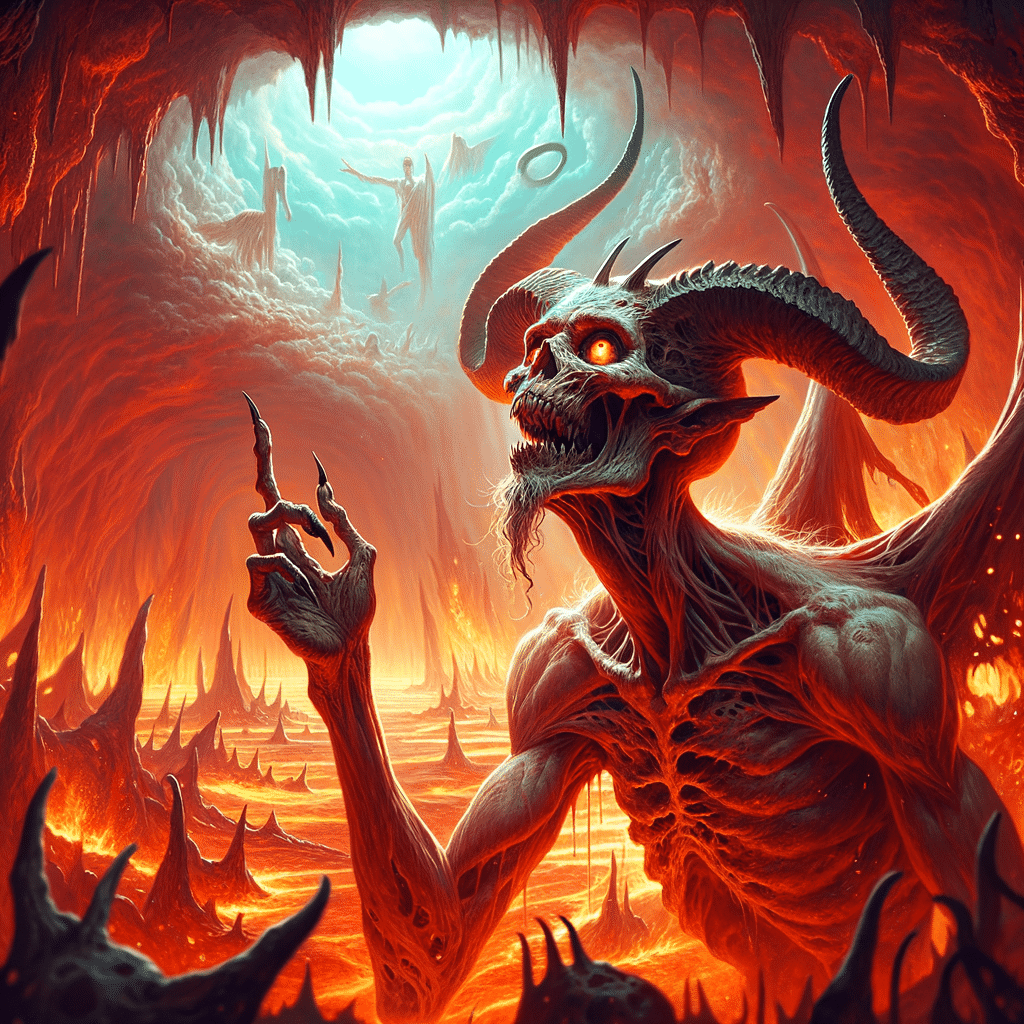
As conceived in diverse cultural and theological contexts, demonic creatures constitute a nuanced and multidimensional component of the paranormal. People usually portray these entities as strong, evil, and non-human spirits that interact with the human world, often for destructive purposes.
History
Numerous myths and faiths have addressed the idea of demonic creatures, and each has offered its own interpretations and stories. Books such as the Book of Isaiah and Revelation typically understand demons in Christianity as fallen angels led by Lucifer, who rebelled against God and faced expulsion from heaven. Their evil and defiance of divine will stem from their fall from grace. According to theologian Peter Kreeft, demons are angels who chose to reject God and his love, and their main purpose now is to lead humans away from God.
The genesis of devils, or jinn, is slightly different in Islam. The Quran asserts that jinn, made of smokeless fire, possess free choice akin to humans, despite some being evil (known as shayatin). Iblis (Satan), a well-known example of their interactions with humans, can range from playful to downright malicious; Allah expelled him after he refused to submit to Adam. The jinn possess the ability to affect human beings in various ways, and understanding their nature is crucial to comprehending their impact on our world, noted Islamic scholar Bilal Philips.
Demonic entities were also present in ancient societies’ mythologies. Mesopotamian mythology, for instance, speaks of beings such as Pazuzu, a wind demon who is capable of both causing and repelling harm, especially to unborn children and pregnant women. Historian Stephanie Dalley asserts that ancient Mesopotamian beliefs invoked Pazuzu in both protective and harmful contexts, highlighting the dual nature of demonic entities. In contrast, asuras and rakshasas are demonic creatures in Hinduism who frequently oppose the gods (devas) and destroy the cosmic order.
Abilities
Demonic beings are frequently associated with a variety of paranormal abilities, such as possession, telekinesis, and the capacity to cause extreme terror or mental suffering. They are frequently characterized as being incredibly crafty, relying on falsehoods and deceit to further their objectives. In contrast to human spirits, who may exhibit lingering traits or feelings associated with their life on Earth, demons are typically portrayed as possessing a more strategic and wider objective centered around corruption, destruction, or discord.
Possession, one of the most feared demonic abilities, involves an entity gaining control over a person’s body and behavior. Narratives of demonic possession, like those found in the Bible’s New Testament or in the case studies of various exorcists, depict drastic shifts in behavior, voice, and physical strength, along with knowledge of hidden things, as indicators of demonic control. According to psychiatrist M. Scott Peck, who has researched possession cases, true demonic possession is rare, but it presents with distinct characteristics that set it apart from mental illness.

Cultural Differences and Interpretations
Diverse cultural perspectives exist regarding the nature of demonic entities and their interactions with the outside world. Western traditions, primarily influenced by Christian theology, frequently associate demons with hell and eternal damnation. People make these associations in opposition to God’s plan for humanity. People frequently use prayers, exorcisms, and holy water as rituals of protection and expulsion to ward off these beings. Exorcist Father Gabriele Amorth emphasizes that exorcism is a spiritual battle, and the rituals aim to restore the person to God’s grace.
Non-Western civilizations, on the other hand, might view demonic creatures through a different lens of cosmology. African and Caribbean traditions, for instance, frequently embrace a more complex understanding of spirits, one in which entities may hurt people not because they are inherently evil but rather because of mistreatment, disregard, or unsolved concerns. Here, there is a more reciprocal interaction between humans and spirits, and rituals frequently center on restoring equilibrium, showing respect, and appeasing the spirits. Spirits in Voodoo are complex beings that interact with humans in various ways, according to anthropologist Wade Davis, who has researched Haitian Voodoo. He claims that understanding their motivations requires a deep knowledge of cultural practices.

Modern Perspectives
The nature and existence of demonic beings are still up for debate in contemporary paranormal research and demonology. From a psychological standpoint, several scholars tackle the subject, speculating that accounts of demonic activity might reflect unconscious anxieties or mental health problems. Richard Gallagher, a clinical psychologist who has worked on cases of purported possession, asserts that while psychological factors can explain many cases, there are instances where the evidence suggests something beyond the natural.
Modern movies and popular culture’s portrayals of demonic entities have greatly influenced how people view these evil creatures today, frequently emphasizing their horrifying and otherworldly qualities. Horror films and other media portray demons as the embodiment of evil and terror, bringing their dark sides to life.
Movies frequently depict demons with terrible physical characteristics, such as warped faces, strange bodily motions, and terrifying vocalizations, to arouse terror and anxiety in viewers. In addition to their remarkable storytelling, horror movies such as The Exorcist, Insidious, and The Conjuring trilogy have gained notoriety for their eerie portrayals of demonic possession and otherworldly warfare. While these depictions frequently borrow from religious and historical writings, they also heighten the tension to produce a visceral watching experience.
These cultural representations feed into people’s innate anxiety about the unpredictable and the unknown. A dark, evil force subjugates or contaminates us, appealing to our innate fear. In these movies, the idea of possession and spiritual malevolence is a powerful source of terror because of the use of suspenseful music, ominous settings, and unexpected shocks that heighten the sense of dread associated with demonic creatures.
In addition, contemporary television shows and movies have investigated the psychological aspect of demonic experiences, obfuscating the distinction between supernatural influence and mental illness. This not only gives the story another level of intricacy, but it also mirrors current discussions concerning the nature of demonic experiences in psychology and paranormal research.
It is nonetheless imperative to distinguish between the various cultural and theological conceptions of demons and the theatrical portrayals of these beings in the media. Traditional beliefs and practices surrounding demons are typically more nuanced, emphasizing protection, healing, and balance rather than just conflict and terror. This is in contrast to films, which frequently depict demons as almost unstoppable forces of darkness.
Students and paranormal researchers must critically approach the topic of demonic entities, acknowledging the impact of cultural representations while attempting to comprehend the diverse and intricate beliefs surrounding these spirits throughout various historical eras and cultures. Like any investigation into a paranormal occurrence, studying demonic entities calls for striking a balance between reasonable skepticism and open-minded curiosity in order to gain a deeper understanding that goes beyond the sensationalized portrayals of these phenomena in the media.
References
Amorth, G. (199). An Exorcist Tells His Story. Ignatius Press.
Dalley, S. (2009). Myths from Mesopotamia: Creation, the Flood, Gilgamesh, and Others. Oxford University Press.
Davis, W. (1985). The Serpent and the Rainbow. Simon & Schuster.
Gallagher, R. (2020). Demonic Foes: My Twenty-Five Years as a Psychiatrist Investigating Possessions, Diabolic Attacks, and the Paranormal. HarperOne.
Kreeft, P. (1995). Angels and Demons: What Do We Really Know about Them?. Ignatius Press.
Peck, M. S. (1983). People of the Lie: The Hope for Healing Human Evil. Simon & Schuster.
Philips, B. (2008). The Exorcist Tradition in Islam. Al-Hidaayah Publishing.


Leave a Reply