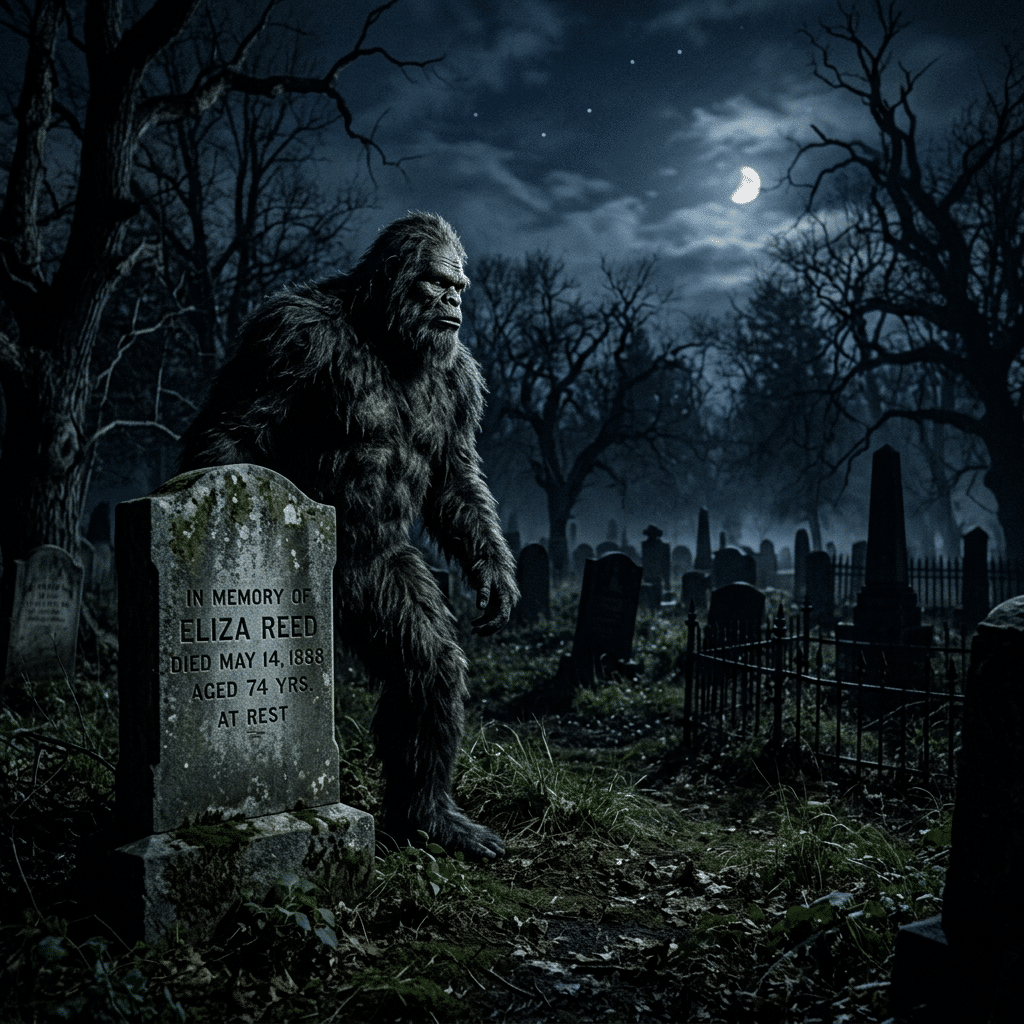
Bigfoot in Cemeteries: Key Points
-
Bigfoot, a large bipedal primate covered in dark hair and standing up to ten feet tall, is associated with behaviors such as wood knocking, rock throwing, howling, and the construction of stick structures and remains unclassified by mainstream science despite thousands of consistent eyewitness reports (Meldrum, 2006).
-
Cemeteries have long been central to supernatural folklore as liminal spaces associated with ghosts, cryptids, and paranormal activity, making them frequent destinations for investigators who have increasingly reported Bigfoot-related evidence at these sites (Belanger, 2009).
-
At Cumberland Sugar Creek Cemetery in Illinois, two paranormal investigators found three barefoot footprints measuring 14 inches long pressed into soft clay, along with a snapped tree nearby, after learning that another group had recently been pelted with thrown rocks at the same location (Courtney, 2012).
-
Near Cartersville, Georgia, a paranormal investigator and his colleagues directly observed two adult Bigfoots and a baby near a remote cemetery, with the larger adult standing approximately seven feet tall and described as dark brown with human-like facial features and arms reaching to the knees (Monteith, 2012).
-
At Bachelors Grove Cemetery in Illinois, a witness discovered a 15.5-inch footprint with a seven-foot stride trackway, along with handmade tree structures in the surrounding woods, at one of America’s most famous paranormal investigation sites (Courtney, 2011).
-
Researchers have proposed that cemeteries attract Bigfoot due to their undisturbed woodland surroundings and proximity to water, while others suggest the pattern may reflect the high concentration of nighttime human observers that paranormal investigation of graveyards naturally produces (Courtney, n.d.).

Introduction
The intersection of two of America’s oldest mysteries—the legend of Bigfoot and the age-old fascination with haunted cemeteries—has yielded a surprisingly rich trove of eyewitness reports and physical evidence indicating the creature sometimes known as Sasquatch may be a frequent occupant of graveyards and the woods around them. For most of the history of Bigfoot research, the focus has been on wilderness, impenetrable forests, and mountain ranges. But there are growing numbers of accounts, collected by groups such as the Bigfoot Field Researchers Organization (BFRO), of encounters near rural and urban cemeteries in several states. The focus of this essay will be describing the creature itself, reviewing the folkloric tradition of supernatural encounters in graveyards, analyzing three specific BFRO reports from Illinois and Georgia, and considering the theories researchers have proposed to explain why ancient burial grounds might attract such an enigmatic being.
Bigfoot, Cemetery Folklore, and the Paranormal-Cryptozoological Intersection
Bigfoot, or Sasquatch, is the best-known cryptid in North America, depicted in thousands of eyewitness stories as a large, bipedal, hairy primate generally standing between six and ten feet tall and weighing an estimated 500 to 800 pounds (Krantz, 1992). The most common description is dark brown, reddish brown, or black hair all over; a broad, flat face; a prominent brow ridge; and a characteristic cone-shaped or pointed skull. Behavioral traits typically attributed to Bigfoot include wood knocking, the rhythmical striking of trees with branches or rocks, the throwing of stones and debris, the production of loud howls and whooping calls, the construction of stick and branch structures, and the emission of a powerful, foul odor often compared to that of a wet dog or rotting organic matter (Meldrum, 2006). Mainstream science has studied Bigfoot for decades, yet it remains officially unclassified. The sheer volume and geographic consistency of reports, however, have led several researchers to argue that the creature represents a viable, undiscovered species of large primate living in the remote forests and wetlands of North America.
Cemeteries have always held a special place in the folklore and supernatural beliefs of almost every culture throughout the world. People believe that cemeteries are places where the dead are close to the living or where the veil between them is thin. The Western tradition has long linked graveyards with ghostly apparitions, shadowy figures, orbs of light, disembodied voices, and a host of other paranormal events that have been recorded by amateur investigators and serious folklorists for centuries (Belanger, 2009). In addition to ghosts, American legend commonly links cemeteries with a range of cryptids, including black dogs and ghostly hounds, phantom cats, and strange two-legged creatures that witnesses describe in ways that closely resemble Bigfoot sightings. Cemeteries are isolated, overgrown, and psychologically charged with the presence of death, which makes them particularly fertile ground for unusual experiences, and this may be one of the reasons why paranormal investigators who regularly spend nights in these places are some of the most consistent reporters of Bigfoot-related phenomena in graveyard settings.
The correlation of Bigfoot sightings to cemetery settings is well documented enough that BFRO investigator Stan Courtney wrote an article particularly addressing the phenomenon entitled “Cemeteries and Squatches,” which is cited in BFRO Report 33985 (Monteith, 2012). Courtney, who has spent decades recording wildlife audio and conducting field investigations, observed that many rural cemeteries share important environmental characteristics with preferred Bigfoot habitat, including proximity to water sources, dense surrounding woodland, and the absence of regular human activity (Courtney, n.d.). The pattern is bolstered by the fact that a disproportionate number of reports mentioning rock throwing, wood knocks, howls, and track discoveries have come from paranormal investigators visiting cemeteries at night, suggesting these individuals may be inadvertently entering active Bigfoot territories. The intersection of paranormal inquiry and cryptozoological fieldwork has produced an odd but fruitful study subfield that has yielded several accounts of physical evidence and direct encounters that might otherwise have gone unreported.
Three BFRO Cemetery Encounter Reports
The first of the three BFRO reports that we will be examining deals with incidents that occurred at Cumberland Sugar Creek Cemetery in rural Sangamon County, Illinois, about two miles west of Glenarm and was filed in January of 2012 (Courtney, 2012). On the evening of June 28, 2011, two paranormal investigators arrived at the cemetery knowing that another set of investigators had been bombarded with pebbles or dirt clods thrown from the adjacent tree line, an incident they knew was consistent with typical Bigfoot behavior. The investigators, while walking around the cemetery, found three large barefoot prints in soft clay near the southeastern corner of the property. The prints measured as long as 14 inches and 6 inches across at the ball of the foot, with all the toes clearly visible (Courtney, 2012). About 75 feet north of the prints was a little tree, 3 to 4 inches in circumference, that had been snapped and twisted over, another action often linked with Bigfoot activity. BFRO investigator Stan Courtney visited the site and interviewed both witnesses in person, verifying the physical details of the prints. He also noted that the surrounding landscape of open farm fields, corn and soybean crops, and wooded creek corridors match the known patterns of Bigfoot habitat in the Illinois region (Courtney, 2012). This report is significant because the investigators had prior knowledge of possible Bigfoot activity in the area and were specifically searching for evidence of it; the case demonstrates how the paranormal investigation community and the cryptozoological research community are becoming more and more information and technique sharing.
The second case discussed here, BFRO Report 33985, is among the most vivid and detailed Bigfoot encounters near a cemetery in the BFRO database, in which a Bigfoot family unit was directly observed at a remote rural cemetery near Cartersville in Bartow County, Georgia (Monteith, 2012). The lead witness, founder of a paranormal investigation group out of Calhoun, Georgia, began investigating the cemetery in the summer of 2011 and, over a period of months, experienced a progression of classic Bigfoot activity, including rocks being thrown and wood knocks and howls that were captured on audio recordings. The dramatic climax to these investigations came one morning when the witness and his colleagues were walking toward a rock outcropping at the edge of the cemetery and came upon two large, dark brown Bigfoot adults, the larger one standing approximately seven feet tall, staring at the group for about two minutes before retreating (Monteith, 2012). As the witnesses tried to approach, the smaller adult reached into the long grass, pulled out a baby Bigfoot that was reported to be about the size of a human three-year-old, placed the infant on its shoulder, and then the family proceeded fluidly into the woods with no apparent concern. Later, the witnesses gave investigator R. Monteith detailed physical descriptions of the three, saying they were all dark brown, not black; that the larger adult had a pug nose and human-like facial features; that the head was more pointed than round; and that the arms reached down to the knees (Monteith, 2012). What is important about this report is that it does not document the presence of a lone Bigfoot near a cemetery but what appears to be an entire family group. This suggests that cemeteries and their adjacent habitats may indeed be established territory for Bigfoot social units, rather than just temporary thoroughfares.
The third report, BFRO Report 30601, was filed in September 2011 and discusses evidence found near Bachelors Grove Cemetery in Cook County, Illinois, one of the most famous and intensively studied reputedly haunted sites in the United States (Courtney, 2011). The main witness and a companion went to the cemetery along the abandoned stretch of Midlothian Turnpike on September 7, 2011, and found footprints in the muddy soil near the trail at 143rd Street. The best print measured 15.5 inches long by 6 inches wide at the ball of the foot with clear toes and an apparent trackway of additional heel prints at a stride of about seven feet (Courtney, 2011). Witnesses also noted tree pyramids, an X-arrangement, and a nearby arched tree, all of which were considered man-made creations, not the work of natural processes, as the logs showed no signs of originally rooting there and several had clearly been moved from other places. A probable vocalization comparable to a siren or howl was detected coming from a southwesterly direction at a time when no other man-made sounds were heard. BFRO investigator Stan Courtney validated the characteristics of the footprint and observed that similar stick and tree structures have been found all over northern Cook County and southeastern Lake County, showing a broader pattern of activity in the area (Courtney 2011). The Bachelors Grove report is particularly intriguing because it adds to one of the most heavily documented locations of paranormal activity in America with physical evidence of Bigfoot, leading to the provocative question of whether witnesses at such locations over many previous decades may have been describing Bigfoot activity in a purely supernatural sense without knowing it.

Folklore, Belief, and the Cemetery as Cultural Space
Bigfoot (Sasquatch) endures in global mythology as a rugged, contemporary creature that blurs the edges of traditional myth, contemporary legend, and tourist-oriented tale. Empirical and ethnographic research across regions illustrates the long-standing existence of Yeti-like figures (the Himalayan counterpart to Bigfoot) in local lore, with academics viewing such beings as persistent symbols of sacred or liminal spaces that promote belief and transmission of narratives (Baltabayeva et al., 2019). More generally, creatures like Sasquatch are integral to cultural narratives and the human tendency to classify the strange (Bullard, 2023).
Moreover, in the current tourism context, Bigfoot-related stories are included in the conversations about paranormal tourism, when tourists search for experiences of strange occurrences (including Sasquatch) as part of larger “dark” or paranormal itineraries (Obradović et al., 2021). But not all monster collections treat Bigfoot the same way. Some well-known anthologies don’t focus much on this figure, which supports current debates about which monsters move well across cultures and media (Kusumohastuti, 2023). This variation in treatment highlights the differing cultural significance and interpretations of Bigfoot compared to other legendary creatures. Together these sources demonstrate that Bigfoot is positioned in the nexus of folklore, belief, and tourism, rather than in an empirically or scientifically grounded register (Baltabayeva et al., 2019; Bullard, 2023; Obradović et al., 2021; Kusumohastuti, 2023).
In cemeteries, we find recurrent sites where legend, horror, and memory collide. Academic study identifies cemeteries as “legend landscapes” or liminal areas where narrative elements can exaggerate and mediate the fear of the dead. For example, cemetery settings are depicted as sites where taboo elements (e.g., the hazards of sleeping in a graveyard or entering after sunset) mold local storytelling and cautionary tales and illustrate how communities negotiate death and terror through ritualized narrative practice (Carrassi, 2023). Cemeteries are cultural vantage points for memory and heritage beyond fear. Studies on cemetery tourism highlight the social and emotional appeal of funeral sites as cultural attractions and sites of memory and aesthetic/historical interest (e.g., ghost stories, architectural tombs, and the landscape around the graves) in urban and rural contexts (Millán et al., 2019; Alchikov & Nagayeva, 2021; Pécsek, 2015). Meanwhile, cemeteries are not merely locations of grief but also areas where practices of remembering, landscape design, and ritual plantings reflect long-standing cultural meanings around death and commemoration (Padilioni, 2022). The mood and affect induced by trips to cemeteries, as solemn or spectatorial encounters, are increasingly documented in the dark-tourism study, including studies exploring the psychological implications of visits to mausoleums and sacred burial sites (Upadhyay, 2016). Finally, several regional studies broaden the discussion of cemeteries to the conflict between preservation and new development, highlighting cemeteries as dynamic cultural landscapes that intersect with tourism, history, and urban planning (Alchikov & Nagayeva, 2021).
Theoretical Explanations for Cemetery-Associated Sightings
Various explanations have been put out to illustrate Bigfoot’s repeated near-presence in cemetery settings, from the purely ecological to the downright speculative. From a habitat perspective, many rural and semi-rural cemeteries share some key characteristics with preferred Bigfoot territory. Cemeteries are usually surrounded by or adjacent to wooded areas, situated near water sources, and receive infrequent human foot traffic. Cemeteries are naturally quiet and undisturbed locations where a large, wary animal might move or forage with minimal risk of detection (Meldrum, 2006). Some researchers have observed that cemeteries are often located on older parcels of land that have not been cleared for agriculture or development, preserving habitat corridors that connect larger forested areas and potentially acting as waypoints in a Bigfoot’s territorial range (Courtney, n.d.). A more speculative line of reasoning, common in the larger paranormal research community, is that Bigfoot may be attracted to the energetic or environmental characteristics of sites where large numbers of humans have been interred and that this attraction could account for the consistent pattern of sightings in geographically varied cemetery locations. This overlap between Bigfoot sightings and cemetery investigations has been suggested by some to be, in part, due to increased human activity at night in remote wooded areas. Paranormal investigators often visit isolated rural cemeteries and are thus more likely than casual hikers to encounter and document unusual activity. Whatever the explanation, the consistency of reported behaviors across the three BFRO reports reviewed here (rock throwing, howling, wood knocks, track evidence, and stick structures) suggests that something more than coincidence links the presence of Bigfoot-like creatures to graveyard environments and that continued focused investigation of this specific intersection is warranted.
Cemeteries are full of monster-related folklore and the public visualization of dread and the unknown. The cemetery as a narrative landscape enables the transmission of stories about the dead, hauntings, and evil presences, which can include monsters or cryptid characters in local storytelling traditions. Academics discuss how terrifying experiences or “anti-legends” about cemeteries become social knowledge and cultural performances that impact community identity and memory, especially when stories are set at night or in ceremonial settings related to burial ceremonies (Imamova, 2020). Simultaneously, cemetery tourism and the more general phenomenon of dark tourism situate mausoleums and graveyards as sites of cultural heritage where legends (ghosts, cryptids, and other supernatural beings) are incorporated into the visitor experience, usually within an educational or commemorative context rather than a purely sensational one (Meleiseā & Schoeffel, 2016; Alchikov & Nagayeva, 2021).
Empirical studies of mausoleum visitation in Central Asia have revealed that the mood dimension of visiting cemeteries and mausoleums ranges from awe to contemplation or excitement and illustrates how dark sites can impact tourist affect and engagement with history, memory, and religion (Upadhyay, 2016). Folklore-informed cemetery studies also examine how different traditions (e.g., Wotgaleh tomb stories in Indonesia) embed myths in the material landscape, contributing to place-branding and the growth of tourism (Carrassi, 2023). These ideas together portray cemeteries as spaces of ritual and memory and as dynamic stages where monster and paranormal stories can be enacted, recalled, and commodified (Imamova, 2020; Alchikov & Nagayeva, 2021; Carrassi, 2023; Upadhyay, 2016).
Conclusion
The conclusion is that the Bigfoot sightings at cemeteries are a fascinating sub-genre of cryptozoological research that blends physical evidence, behavioral observation, and the rich folkloric tradition of graveyard encounters to suggest that America’s most famous unknown creature may have an unexpected fondness for burial sites. The three BFRO reports discussed here, from Cumberland Sugar Creek Cemetery, Illinois, a rural cemetery near Cartersville, Georgia, and Bachelors Grove Cemetery, Illinois, collectively offer a pattern of physical evidence and eyewitness testimony that is difficult to simply dismiss, especially when the behavioral signatures described in each case closely match what has been described as established patterns of Bigfoot activity in thousands of other reports around the world. The fact that many of these findings were made by paranormal investigators who weren’t initially looking for Bigfoot evidence adds to their credibility. There was no incentive for these witnesses to interpret confusing encounters via a Bigfoot lens. As cryptozoological research and paranormal investigation both move toward more rigorous methodologies and start sharing their findings more and more, the cemetery connection may ultimately be one of the more productive avenues for gathering verifiable evidence about Bigfoot’s habitat preferences and behavioral patterns. Whether Bigfoot is attracted to cemeteries because of ecological, territorial, or completely unknown causes, the increasing number of consistent sightings from graveyard settings throughout the United States requires serious and sustained scholarly research.
References
Alchikov, R. and Nagayeva, Z. (2021). EARLY CRIMEAN KHANATE SETTLEMENTS AS THE PRECURSORS OF THE TOWN OF BAKHCHYSARAI. Architecture and Engineering, 6(3), 42-48. https://doi.org/10.23968/2500-0055-2021-6-3-42-48
Baltabayeva, А., Yesbalayeva, R., Shaikhystamova, M., Yildiz, N., & Beskempirova, A. (2019). DEVELOPMENT OF TURKESTAN FROM THE GREAT SILK ROAD. Bulletin of the National Academy of Sciences of the Republic of Kazakhstan (the Bulletin), 6(382), 24-33. https://doi.org/10.32014/2019.2518-1467.142
Belanger, J. (Ed.). (2009). Encyclopedia of haunted places: Ghostly locales from around the world (Rev. ed.). New Page Books.
Bullard, E. (2023). North American Monsters: A Contemporary Legend Casebook, edited by David J. Puglia. Journal of Scientific Exploration, 36(4), 816-824. https://doi.org/10.31275/20222723
Carrassi, V. (2023). The Cemetery and the Fear of the Dead. Literatura Ludowa, 67(1-2), 153-168. https://doi.org/10.12775/ll.1.2023.011
Courtney, S. (2011). BFRO report #30601: Possible vocalization and footprint found near Bachelors Grove Cemetery. Bigfoot Field Researchers Organization. https://www.bfro.net/GDB/show_report.asp?id=30601
Courtney, S. (2012). BFRO report #32634: Two paranormal investigators find possible evidence at Cumberland Sugar Creek Cemetery. Bigfoot Field Researchers Organization. https://www.bfro.net/GDB/show_report.asp?id=32634
Courtney, S. (n.d.). Cemeteries and Squatches, Pt. 2 – Stan Courtney
Imamova, Z. (2020). Modern methods and training methods foreign language. International Journal on Integrated Education, 3(1), 74-76. https://doi.org/10.31149/ijie.v3i1.276
Krantz, G. S. (1992). Big footprints: A scientific inquiry into the reality of Sasquatch. Johnson Books.
Kusumohastuti, F. (2023). Revealing the historical side of the Yogyakarta Wotgaleh Tomb: Mataram Prince Jaka Umbaran. Gema Wiralodra, 14(3), 1292-1300. https://doi.org/10.31943/gw.v14i3.519
Meldrum, J. (2006). Sasquatch: Legend meets science. Forge Books.
Meleiseā, M. and Schoeffel, P. (2016). The work of the dead in Samoa: Rank, status and property. Journal of the Polynesian Society, 125(2), 149-170. https://doi.org/10.15286/jps.125.2.149-170
Millán, M., Rojas, R., & García, J. (2019). Analysis of the Demand of Dark Tourism: A Case Study in Córdoba (Spain). Mediterranean Journal of Social Sciences, 10(1), 161-176. https://doi.org/10.2478/mjss-2019-0015
Monteith, R. (2012). BFRO report #33985: Daylight sighting by paranormal investigators at a rural cemetery near Cartersville. Bigfoot Field Researchers Organization. https://www.bfro.net/GDB/show_report.asp?id=33985
Obradović, S., Pivac, Т., Besermenji, S., & Tešin, A. (2021). Possibilities for paranormal tourism development in Serbia. Eastern European Countryside, 27(1), 203-233. https://doi.org/10.12775/eec.2021.008
Padilioni, J. (2022). A Flowering of Memory. Environment and Society, 13(1), 11-26. https://doi.org/10.3167/ares.2022.130102
Pécsek, B. (2015). City Cemeteries as Cultural Attractions: Towards an Understanding of Foreign Visitors’ Attitude at the National Graveyard in Budapest. Deturope – The Central European Journal of Tourism and Regional Development, 7(1), 44-61. https://doi.org/10.32725/det.2015.004
Upadhyay, P. (2016). Anthropological Perspectives On Folklore: Underpinnings on Some Nepali Folklore. Tribhuvan University Journal, 29(1), 149-160. https://doi.org/10.3126/tuj.v29i1.25966


Leave a Reply