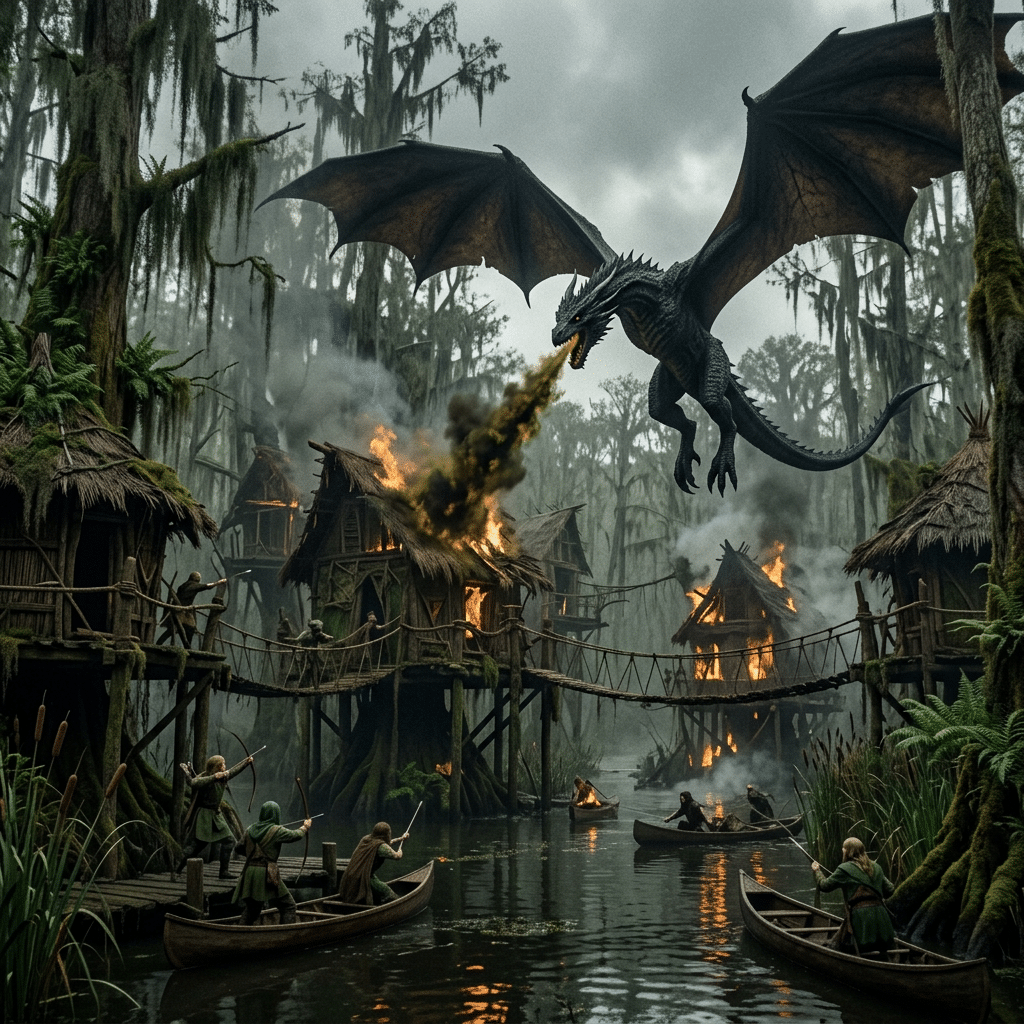
Nature of Draconic Evil: Key Points
-
Dragons have served as symbols of evil across ancient mythologies worldwide, with cultures like the Babylonians and Norse peoples casting them as primordial forces of chaos opposed to divine and human order.
-
Medieval and classical literature, particularly Beowulf and Tolkien’s works, established the psychologically rich template of the dragon as an intelligent, ancient being that actively chooses greed and destruction rather than simply causing it mindlessly.
-
Modern popular culture, from A Song of Ice and Fire to Dungeons and Dragons, has inherited and expanded this tradition, codifying evil dragons as a cornerstone archetype of the fantasy genre.
-
One major theory holds that the dragon is a literalization of hoarding greed, representing wealth and power accumulated purely for possession, divorced from any social or humane purpose.
-
Psychoanalytic theory suggests the evil dragon functions as a projection of the human shadow self, embodying suppressed instincts like appetite and aggression, which is why defeating it serves so consistently as a moral rite of passage.
-
Eastern traditions and contemporary fantasy authors have complicated or subverted the archetype, revealing that draconic evil is ultimately a cultural construction and a deliberate artistic choice rather than an inevitable feature of the creature itself.

Introduction
The dragon is possibly the most resistant icon of evil in the mythical imagination of humans. For millennia and across cultures and narrative traditions, the huge serpent beast has represented the greatest incarnation of destructive power, greed, and evil. To interpret the dragon as a symbol of evil is to recognize something basic about how human beings have long thought about the monstrous, the menacing, and the morally corrupt.
Ancient and Medieval Foundations of the Evil Dragon
Dragons were the original foes of order in the old world. In the Babylonian creation story, the god Marduk kills the chaos dragon Tiamat, whose body then becomes the substance of the universe itself. Civilization was founded on the defeat of draconic evil. In Norse mythology, the enormous serpent Nidhogg gnaws forever at the roots of Yggdrasil, the world tree, symbolizing a patient, endless drive toward destruction and entropy. In these religions, the dragon was not just dangerous; it was cosmically antagonistic to the good order sought by gods and humans.
Medieval European literature continued this tradition, giving it a highly moral aspect. The dragon that ends the Old English epic Beowulf is not named but is an old and hoard-guarding entity who destroys the whole land of the Geats in response to the theft of a single cup. Tolkien, who was one of the most perceptive readers of Beowulf, noted that this monster is a form of evil, a kind of greed so absolute that it cannot even bear to lose a small thing but will bring utter ruin on the innocent. The Beowulf dragon is not evil in any complex or nuanced sense; it is concreteness, antiquity, and inexorable enmity incarnate.
In the medieval Christian and Gothic imagination, dragons are figures of evil chaos, in opposition to the order of God. Dragons are potent figures of postlapsarian evil, the overcoming of which stands for grace, faith, or divine intervention, as in the case of Voragine’s Golden Legend and its later adoption in Tolkien’s mythopoeia. Peralta notes how Voragine’s work uses dragons as a symbol for strong evil and their destruction is used to show faith and God’s love, foreshadowing Tolkien’s eucatastrophe in modern myth (Peralta, 2023). This framing places dragons on a coercive continuum of evil that required either steady virtue or miraculous assistance to overcome. Miller’s examination of dragon-slaying in biblical theology, where the dragon is an archetype of chaos and evil chained to the sea, resonates with the general debate of dragons as archetypal evils in religious and literary traditions (Miller, 2019). Together, these sources suggest that in many traditional Christian-inflected narratives, the dragon’s evil is real and dangerous, and it is often defeated by supernatural or heroic agency.
Tolkien and the Literary Dragon
J.R.R. Tolkien painted some of the most psychologically complex pictures of draconic evil in all literature. Glaurung, the first of the mighty dragons in Tolkien’s legendarium, is an animal of premeditated cruelty, using his captivating gaze not just to kill but to ruin the minds and hearts of his foes; he twists the fate of Turin Turambar via manipulation and falsehoods. The dragon Smaug in The Hobbit is probably even more unforgettable because Tolkien imbues him with wit, conceit, and the power to talk, which make his underlying greed and murder all the more terrible. Tolkien’s dragons are not evil just for their destructiveness but for their intelligence and their choice of destruction and hoarding and the ruin of others as an expression of their very character.
In current popular culture, dragons have flourished in fantasy literature, cinema, and games, and wicked dragons remain a dominating archetype. In George R. R. Martin’s A Song of Ice and Fire series, dragons are less morally autonomous agents and more weapons of mass destruction, but their destructive power is directly tied to the moral character of those who wield them, and the “Doom of Valyria” suggests an entire civilization brought low by its own draconic hubris. Dungeons and Dragons, the tabletop roleplaying game, formalized a taxonomy of draconic alignment in which chromatic dragons were generally evil and metallic dragons represented good—a framework that has informed how millions of players and writers have thought about these animals. Even in films like Reign of Fire or Dragonheart, the wicked dragon is a force that must be vanquished or redeemed, emphasizing the moral weight carried by the archetype.
Draconic evil is a compelling theory that literalizes greed’s terrible end. The image of a dragon sleeping atop a mountain of riches and treasure, which it will never spend and will never really enjoy, is a potent emblem of acquisitiveness utterly divorced from any human or social purpose. Tolkien expressly linked Smaug’s evil to this disease, and academics such as Tom Shippey have suggested that the dragon’s treasure is an example of dead and sterile wealth, wealth that exists solely to be had and defended, not used, shared, or celebrated. In this sense, the dragon is the spirit of pure accumulation incarnate, a beast so possessed by the need to possess that it has forgotten all other virtues.

Psychological and Cultural Dimensions of Draconic Evil
In many cultures, dragons are often used as tests of heroism and expressions of community ethics. The dragon-snake motif in Armenian and South Caucasian sculptural iconography is associated with chthonic powers and hero-consecration, the dragon’s slaying often being accompanied by boundary-crossing and the hero’s maturing (the dragon as a rite of passage) (Mikayelyan, 2021). Georgian folklore, in the same way, portrays dragons as dangerous antagonists, and the defeat of the dragons by a heroic person symbolizes the restoration of order and fertility (Sikharulidze, 2018). Here the dragon’s evil is associated with drought, with chaos, or with the guarding of perilous information, and the hero’s triumph is a social moral event rather than merely a personal win.
Another theory is that the dragon’s evil is basically a function of the dragon’s age and the corrupting influence of nearly infinite power over a very long period of time. Dragons in most traditions are old entities, survivors of centuries past, and this age is rarely shown as a time that gives them wisdom or compassion but rather as a time that hardens whatever greed or cruelty was in them from the beginning. Chromatic dragons in Dungeons & Dragons are literally the children of Tiamat, carrying her divine hatred as part of their ontological makeup, such that their evil is not a matter of choice but of being. In her Earthsea cycle, Ursula K. Le Guin provides a more subtle counter-reading, in which dragons are ancient and dangerous but truthful by nature, incapable of lying. This complicates the simple equation of age with moral corruption and invites readers to consider whether the dragon’s evil is inherent or imposed by human fear and projection.
Psychoanalytic and archetypal critics have suggested that the dragon is a projection of the shadow self, the elements of human nature that civilization demands we repress: sheer appetite, territorial aggression, and the urge to dominate. Carl Jung’s model of the shadow, which serves as a container for rejected psychological material, perfectly aligns with the dragon as a creature that embodies everything the heroic ideal opposes; thus, the hero who slays the dragon is, in this context, battling not an external monster but an internal one. And this is why dragon-slaying is so universally taken up as a rite of passage tale in Western culture, from Sigurd slaying Fafnir in Norse myth to Saint George defeating his serpent, since the struggle against the dragon represents a struggle for moral and psychological self-definition. In this view, the dragon must be bad, since we need the dragon to be evil to know what good looks like.
Cross-Cultural Perspectives and Contemporary Reimaginings
It is also worth mentioning that draconic evil has been complicated or subverted at times in ways that show how culturally created the archetype really is. Eastern traditions, especially in Chinese mythology, have traditionally associated dragons with benevolence, imperial knowledge, and good fortune, a fundamentally different cultural encoding of the same species. Western contemporary fantasy authors such as Robin Hobb (Rain Wild Chronicles) and Christopher Paolini (Inheritance Cycle) have portrayed dragons as morally complicated beings with their cultures, loyalties, and codes of honor that are not easily reducible to human moral standards. These counter-narratives don’t eliminate the legacy of draconic evil but rather show that the evil dragon is a choice, a cultural and creative decision to project a certain set of fears and moral cautions onto a mythological creature.
Cross-cultural comparisons show that dragon imagery and moral valence vary as a function of cultural contexts. For instance, Yuan and Sun (2021) compare Chinese and Western dragon cultures, pointing out the different ways in which dragons are perceived externally (e.g., in contemporary Chinese contexts, dragons are noble and peace-loving, whereas dragons are perceived as a dragon-slaying enemy in Western lore) and suggesting that cross-cultural communication should take such divergences into account to avoid generalizing dragons as inherently evil. Mammadov’s research shows that the motifs affected by Avesta in European and Caucasian folklore mix several cultural layers in dragon iconography, including good and evil, depending on the storytelling tradition and historical period (MAMMADOV, 2023). What these works show is that “evil” is not a fundamental character of dragons but a role that narrative function and cultural script have given them.
Contemporary media reimagine the dragons in ways that complicate or soften the classic malevolent polarity. According to Tanasić, the current narrative has dulled the moral edge of stories by transforming hellish dragons into more benign or sympathetic beings, a change he describes as the “Oblivion of Evil” and says poses societal and political concerns (Tanasić, 2024). On the one hand, Lee’s cross-cultural study of dragon symbolism finds that Oriental dragons can signify auspicious powers and cosmic order, while Western dragons are often shown as malevolent forces. On the other hand, modern media (e.g., Raya and the Last Dragon) reconfigure dragon-human relations around social and environmental harmony, portraying dragons as agents whose sacrifice enables renewal rather than mere conquest (Lee, 2013; Wulan et al., 2023). These contemporary reimaginings present a range of depictions, from the explicitly wicked to the complex and even the beneficent, frequently linked to greater moral or ecological themes.
The presence of wicked dragons in so many cultures and forms of media suggests something profound about the human relationship to the idea of monstrous power. Dragons represent some of our most primitive fears: the predatory monster, the devouring fire, the miserly hoarder, the ancient and uncaring power that sees human existence as unimportant. They are terrible in a way that seems comprehensive and irreducible, and it is precisely that totality that makes them so valuable to storytellers in need of a villain whose defeat feels morally unambiguous and cosmically momentous. The dragon acts evil not out of misunderstanding or misfortune, but because most traditions recognize that as its nature.
Conclusion
Ultimately, the essence of draconic evil is a mirror held up to the human moral imagination, reflecting back our deepest worries about greed, power, destruction, and the indifference of the universe to human existence. From Tiamat to Smaug, from Nidhogg to the chromatic dragons of Dungeons & Dragons, the evil dragon has been one of the most enduring and compelling figures in literature, precisely because it provides substance and magnitude to evils that are otherwise abstract. Tales teach us that slaying the dragon affirms moral order, that heroism and virtue can triumph over ancient malevolence, and that the world’s disorder can be conquered, if only temporarily. The dragon remains because we will always need something large enough to represent all that we dread and resist.
References
Beowulf. (2000). (S. Heaney, Trans.). Farrar, Straus and Giroux.
Bowman, R. (Director). (2002). Reign of Fire [Film]. Spyglass Entertainment.
Cohen, R. (Director). (1996). Dragonheart [Film]. Universal Pictures.
de Voragine, J. (1948). The Golden Legend (G. Ryan & H. Ripperger, Trans.). Arno Press.
Gygax, G., & Arneson, D. (1974). Dungeons & Dragons [Game]. Tactical Studies Rules.
Hall, D., & Logue, C. (Directors). (2021). Raya and the Last Dragon [Film]. Walt Disney Animation Studios.
Hobb, R. (2009). Rain Wild Chronicles [Book series, Vols. 1–4]. Harper Voyager.
Le Guin, U. K. (1968–2001). Earthsea cycle [Book series]. Atheneum.
Lee, M. (2013). The Dragon: The Principle of Cosmos. Journal of Symbols & Sandplay Therapy, 4(2), 70-76. https://doi.org/10.12964/jsst.130010
MAMMADOV, S. (2023). “AVESTA” MOTIFS IN GERMAN AND AZERBAIJANI FOLKLORE. Humanities Science Current Issues, 2(67), 214-225. https://doi.org/10.24919/2308-4863/67-2-31
Martin, G. R. R. (1996). A Song of Ice and Fire [Book series]. Bantam Books.
Mikayelyan, L. (2021). Various Aspects of the Image of a Dragon-serpent in Armenian and South-Caucasian Sculpture of the 7th–14th Centuries. Actual Problems of Theory and History of Art, 11, 232-243. https://doi.org/10.18688/aa2111-02-19
Miller, R. (2019). Dragon Myths and Biblical Theology. Theological Studies, 80(1), 37-56. https://doi.org/10.1177/0040563918819812
Paolini, C. (2003). Inheritance Cycle [Book series, beginning with Eragon]. Alfred A. Knopf.
Peralta, C. (2023). On the Symbolic Use of Dragons by Jacobus de Voragine and J. R. R. Tolkien. Religions, 14(4), 552. https://doi.org/10.3390/rel14040552
Sikharulidze, K. (2018). Image of Dragon in Georgian Mythology. HUM, 6(2), 55-58. https://doi.org/10.31578/hum.v6i2.363
Tanasić, N. (2024). They Slay Dragons, Don’t They? On Taming of Dragons and the Oblivion of Evil in Modern Storytelling., 33-48. https://doi.org/10.18485/ips_film_politics.2024.ch2
Tolkien, J. R. R. (1937). The Hobbit. George Allen & Unwin.
Wulan, S., Nurhasanah, N., & Sahri, Z. (2023). Ecocritcism On Kumandra as Environmental Sustainability in Raya And The Last Dragon. Metathesis Journal of English Language Literature and Teaching, 7(1), 74-85. https://doi.org/10.31002/metathesis.v7i1.339
Yuan, L. and Sun, Y. (2021). A Comparative Study Between Chinese and Western Dragon Culture in Cross-Cultural Communication.. https://doi.org/10.2991/assehr.k.210121.015

Leave a Reply