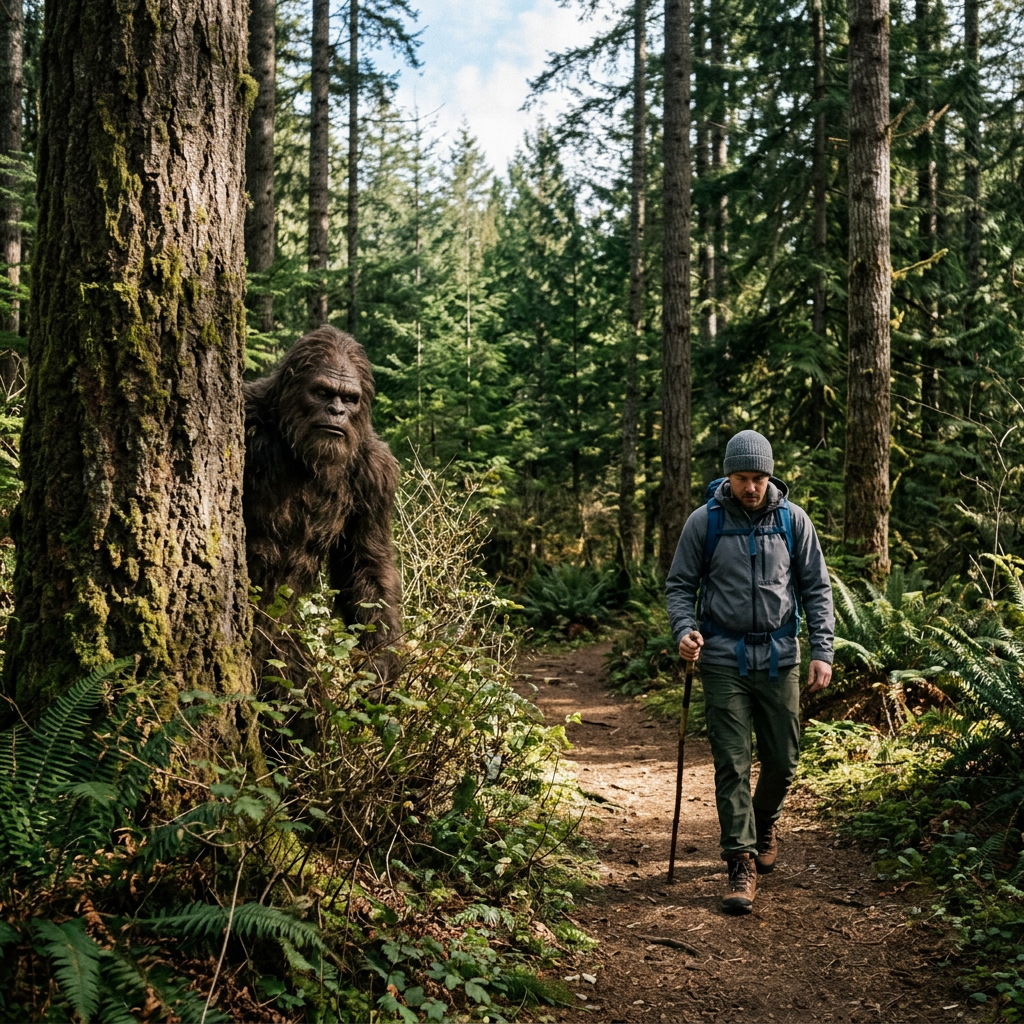
Invisible Bigfoot: Key Points
-
Bigfoot is described as a massive, bipedal, fur-covered creature standing up to ten feet tall, often accompanied by a powerful odor and an overwhelming sense of fear in those who encounter it.
-
Despite millions of trail cameras and modern smartphones, no clear photographic evidence of Bigfoot has ever been produced, which is strikingly unusual compared to other large, elusive animals that are regularly captured on camera.
-
One theory suggests Bigfoot possesses a genuine paranormal or biological ability to turn invisible or become undetectable, with some witnesses reporting the creature simply vanishing with no cover to hide behind.
-
A more grounded explanation is that Bigfoot is an exceptionally intelligent creature that has spent thousands of years learning to avoid humans, recognizing and evading cameras, scent trails, and human movement patterns with remarkable skill.
-
Some researchers propose that Bigfoot is a fae or liminal entity rather than a biological animal, existing partially between our world and another, which would explain why it leaves so little lasting physical evidence despite being widely encountered.
-
The mainstream scientific view holds that Bigfoot is simply not real, supported by the absence of bones or verified DNA, and explained by misidentifications of known animals, human pattern-seeking psychology, and our cultural desire for wilderness to still hold deep mystery.

Introduction
One of the most intriguing and maddening riddles in North American folklore and cryptozoology, for decades, has been the near-total lack of unambiguous, verifiable evidence proving Bigfoot’s existence. Despite thousands of reports over more than a hundred years, no one has ever caught Bigfoot or Sasquatch, found a dead one, or taken a clear enough picture to satisfy a suspicious scientific community. This ongoing elusiveness has prompted academics and enthusiasts and curious minds alike to pose a profoundly unusual question: is Bigfoot not only hidden but, in some significant sense, invisible?
Bigfoot is usually described as a large, bipedal primate, seven to ten feet tall and weighs an estimated 500 to 800 pounds or more. Witnesses have described the creature as having thick shaggy hair ranging in hue from dark brown or black to reddish or even gray and possessing a big flat face with a strong brow ridge and wide-set eyes that occasionally seem to glow in the dark. It is claimed to move with unexpected swiftness and elegance for its size, leaving large footprints, sometimes exceeding 15 to 24 inches in length, among the most often stated physical evidence for its existence. Witnesses often mention an overwhelming stench, a potent musk, or a sulfurous fragrance, and many describe a sensation of being watched or of basic, instinctive terror in the presence of the monster.
The Cryptozoological Evidence Debate
Bigfoot, a creature frequently reported in North America, is at the center of long-standing discussions regarding what constitutes sufficient evidence for unknown or contested taxa. Eyewitness sightings are the main data routinely cited in Bigfoot investigations and are the backbone of cryptozoological inquiry. Yet the discipline has long been divided over what constitutes credible evidence and how to separate out genuine signals from noise, hoaxes, or misidentifications (Foxon, 2024; Schembri, 2011; Cressey, 2013; Milks et al., 2023). Most of the data in cryptozoology is from eyewitness testimony, and the field has often been criticized for the reliability of such reports and for the absence of physical specimens or independently verifiable material to substantiate the claims (Cressey, 2013; Foxon, 2024; MacLeod, 2014; Milks et al., 2023).
Bigfoot is reported to be big and abundant; thus, it is amazing that there is no outstanding picture or physical evidence. The best-known visual evidence is the Patterson-Gimlin film of 1967, a brief and fuzzy piece of footage filmed near Bluff Creek, California, showing a big, hairy creature walking away from the camera. Today, with millions of trail cameras in North American forests, smartphones in everyone’s pocket that can record high-resolution video, and drones with cameras routinely surveying wilderness areas, the complete lack of a single clear, undeniable image is difficult to dismiss as mere coincidence. Even elusive apex predators such as mountain lions and wolves are often photographed by trail cameras and caught in wildlife surveys, say biologists who study large mammals, making Bigfoot’s lack of photographic evidence even more striking.

Evaluating Bigfoot Evidence
The literature also notes that eyewitness sightings have traditionally fueled cryptozoological claims, including Bigfoot. Foxon observes that eyewitness reports have formed the basis of Bigfoot literature and that there are thousands of alleged sightings, which, when evaluated using formal standards, nonetheless yield inconsistent, heterogeneous evidence (Foxon, 2024). This over-reliance on testimony is in stark contrast to the limited amount of corroborative physical material and leads to continued problems over trustworthiness and interpretability (Cressey, 2013; Milks et al., 2023). Environmental factors and social amplification can make eyewitness evidence more complex, as well as cognitive biases. Various studies have attempted to statistically model sightings to examine consistency, distances, and reporting trends, showing that the use of even well-meaning eyewitness data to infer population phenomena can lead to unclear or controversial findings (Foxon, 2024). The Bigfoot literature highlights the promise and the peril of translating eyewitness accounts into testable evidence.
There are no physical specimens, such as bodies, bones, or durable tissue, to prove the existence of Bigfoot. This forces cryptozoology to rely on indirect sorts of evidence (such as hair, tracks, scat, and tissue) and inconsistently conclusive results. MacLeod’s broader point is that the physical evidence for cryptozoological claims is generally weak or unclear, and when it is available (e.g., hair samples), it often cannot be definitively distinguished between unknown taxa and known ones (MacLeod, 2014). This pattern of confusing physical evidence is a common subject in the cryptozoological literature (MacLeod, 2014; Cressey, 2013). Tests on hair or tissue from alleged abnormal primates have yielded varied findings. Crucially, assessments of alleged “Yeti” hair samples in the published literature have often failed to show that the samples come from unknown species, illustrating a key problem that evidence that is suggestive in isolation may not satisfy the diagnostic criteria for new taxa without either higher-quality specimens or other lines of converging evidence (MacLeod, 2014). This raises the issue of the difficulties of using cryptozoological hair DNA to provide definitive evidence for a cryptid.
Photos and videos are often cited, but rarely conclusive. The cryptozoological record is often one of ambiguity, misidentification, or intentional deception, and even the most well-known photos or pieces of footage can be disputed or attributed to mundane occurrences (logging equipment, animals, weather effects, or pranks) under detailed analysis (Cressey, 2013). The literature highlights that even powerful images frequently fail close evidential scrutiny. At other times, hoaxes or dramatic media campaigns have accompanied alleged field evidence. Cressey (2013) argues that the heavy criticism of the quality of evidence in cryptozoology has a long history, with many cases of false or exaggerated claims. Cryptozoologists have responded to these criticisms by claiming that absence of evidence does not disprove their claims, but it still shows how fragile the evidential status of the field can be. The Loch Ness and other cryptid instances are commonly mentioned as examples of public excitement and evidentiary frailty.
Theories of Bigfoot’s Elusiveness
One of the explanations put forward to illustrate this invisibility is that Bigfoot has a genuine biological or paranormal ability to become visibly undetectable. Some advocates of this theory believe the monster is capable of bending light about itself, creating an optical illusion by some mysterious biological mechanism, or perhaps transforming into a state that cameras and the naked human eye simply cannot register. Sometimes researchers in the paranormal field would cite tales where witnesses claim to have seen a Bigfoot disappear in an area where there was no cover large enough to hide such a big body as if it dematerialized rather than running away. Mainstream science has no framework in which to place such an ability in any known biological organism. Advocates would say that if Bigfoot were an unknown species, it may operate by rules we have not yet discovered, and that to dismiss the possibility simply because it contradicts current understanding is itself a form of intellectual closed-mindedness.
A much more reasonable hypothesis is that if Bigfoot exists, he is simply adept at avoiding discovery by traditional techniques. In numerous Native American cultures across North America, Sasquatch is identified as an ancient and highly intelligent being, one that has lived alongside human groups for thousands of years by acquiring the ability to elude them with a craftiness that exceeds that of most animals. With its lengthy life span, vast range, low population density, and sensitive sense of human smell, sound, and behavior, a creature could easily wander through even the most heavily traveled woodlands without being observed or captured on film. After all, trail cameras have restricted fields of view, limited triggers, and predictable placements, and a large-brained ape that has learned to recognize and avoid them would not be the first animal known to demonstrate such adaptive, tool-aware behavior.
A third and intellectually richer explanation is that Bigfoot is not a biological species at all but rather belongs to the class of entities known in global mythology as the fae or faerie folk. Some researchers in the field of paranormal anthropology take this theory seriously, suggesting that Bigfoot exists in a liminal space between the physical world and some other plane of being, appearing and disappearing according to rules that have more in common with folklore than with zoology. In many cultures, the beings depicted in faerie tales are famously difficult to photograph, leave no lasting physical evidence, and are claimed to interact with humans in ways that seem to purposely blur the line between the ordinary and the impossible. Within this framework, the smell, the eye shine, the massive tracks, and the sudden vanishing all become consistent not with an undiscovered animal but with a class of entity that humanity has encountered throughout history and struggled to categorize, one that inhabits our world partially but never fully.
The most popular theory among scientists, of course, is that Bigfoot does not exist as a flesh-and-blood creature. The argument here is simple and carries a lot of weight. No body has ever been recovered; no bones have ever been authenticated; no DNA gathered from purported hair or scat samples has ever produced a result that could not be attributed to a known species; and the Patterson-Gimlin film, the cornerstone of visual evidence, has been argued by many analysts to be a person in a suit. Population biology complicates the case for Bigfoot even further, because a species large enough to account for the number of tracks and sightings reported would require a breeding population of hundreds to thousands of individuals, and such a population would inevitably produce deaths, skeletal remains, and other biological evidence that the wilderness would preserve and eventually produce. Bigfoot is a cultural phenomenon, skeptics say, born of misidentifications of familiar animals such as bears, of human psychological tendencies to recognize patterns and to manufacture meaningful experience, and of a deep human need to believe that the wild world still contains real mystery.
Toward Rigorous Cryptozoological Practice
The Bigfoot literature indicates that good evidentiary procedure is more than a series of dramatic claims. This requires high-quality, independently verified data, thorough evaluation of alternative interpretations (e.g., misidentifications, hoaxes), and transparent communication of techniques and uncertainty. The literature cautions that cryptozoology must tread a fine line between legitimate scientific inquiry and pseudoscientific or sensational discourse or risk being dismissed by mainstream science, whether some lines of inquiry eventually lead to credible discoveries (Schembri, 2011; Cressey, 2013; Fallon & Guimont, 2024; Bubandt, 2019). At the same time, some scholars have argued the potential of the discipline to contribute to natural history should not be dismissed out of hand (Foxon, 2024) when integrated with mainstream methodologies, and historical examples of cryptid-related discoveries (e.g., giant squid) demonstrate the value of rigorous evidence in the long run (Schembri, 2011).
Conclusion
What makes the Bigfoot phenomena so lasting and so fascinating is that it refuses to die, even as the proof stays forever just out of grasp. Every generation brings new sightings, new sets of footprints, and new reports from credible witnesses, including law enforcement personnel, park rangers, and skilled outdoorsmen with no apparent motive to make up their claims. Whether Bigfoot is a real creature with impressive evasion abilities, a paranormal entity bridging the physical and the metaphysical, or a powerful cultural myth telling us something important about the human connection to wilderness and the unknown, the question of why Bigfoot remains so stubbornly invisible is worth taking seriously. Ultimately, the riddle of Bigfoot is a mirror, reflecting our beliefs about what the natural world may hold, what qualifies as evidence, and why we are so consistently drawn to the thought that something big and unusual is watching us from the tree line.
References
Bubandt, N. (2019). Of wildmen and white men: cryptozoology and inappropriate/d monsters at the cusp of the Anthropocene. Journal of the Royal Anthropological Institute, 25(2), 223-240. https://doi.org/10.1111/1467-9655.13023
Cressey, D. (2013). Cryptozoology: Beastly fakes. Nature, 499(7459), 406-406. https://doi.org/10.1038/499406a
Fallon, R. and Guimont, E. (2024). Introduction: Conceptualising heterodox palaeoscience. Interdisciplinary Science Reviews, 49(3-4), 307-315. https://doi.org/10.1177/03080188241275300
Foxon, F. (2024). Heuvelmans the Heretic and Hidden Animals. Interdisciplinary Science Reviews, 49(3-4), 332-348. https://doi.org/10.1177/03080188241233107
MacLeod, N. (2014). Molecular analysis of ‘anomalous primate’ hair samples: a commentary on Sykes et al.. Proceedings of the Royal Society B Biological Sciences, 281(1789), 20140843. https://doi.org/10.1098/rspb.2014.0843
Milks, K., Cloud, F., Petto, A., Artiga-Oliver, L., & Mayr, M. (2023). The Search for Sasquatch. The American Biology Teacher, 85(6), 356-357. https://doi.org/10.1525/abt.2023.85.6.356
Patterson, R., & Gimlin, R. (1967). Patterson-Gimlin film [Short film].
Schembri, E. (2011). Cryptozoology as a Pseudoscience: Beasts in Transition. Surg Journal, 5(1), 5-10. https://doi.org/10.21083/surg.v5i1.1341



Leave a Reply