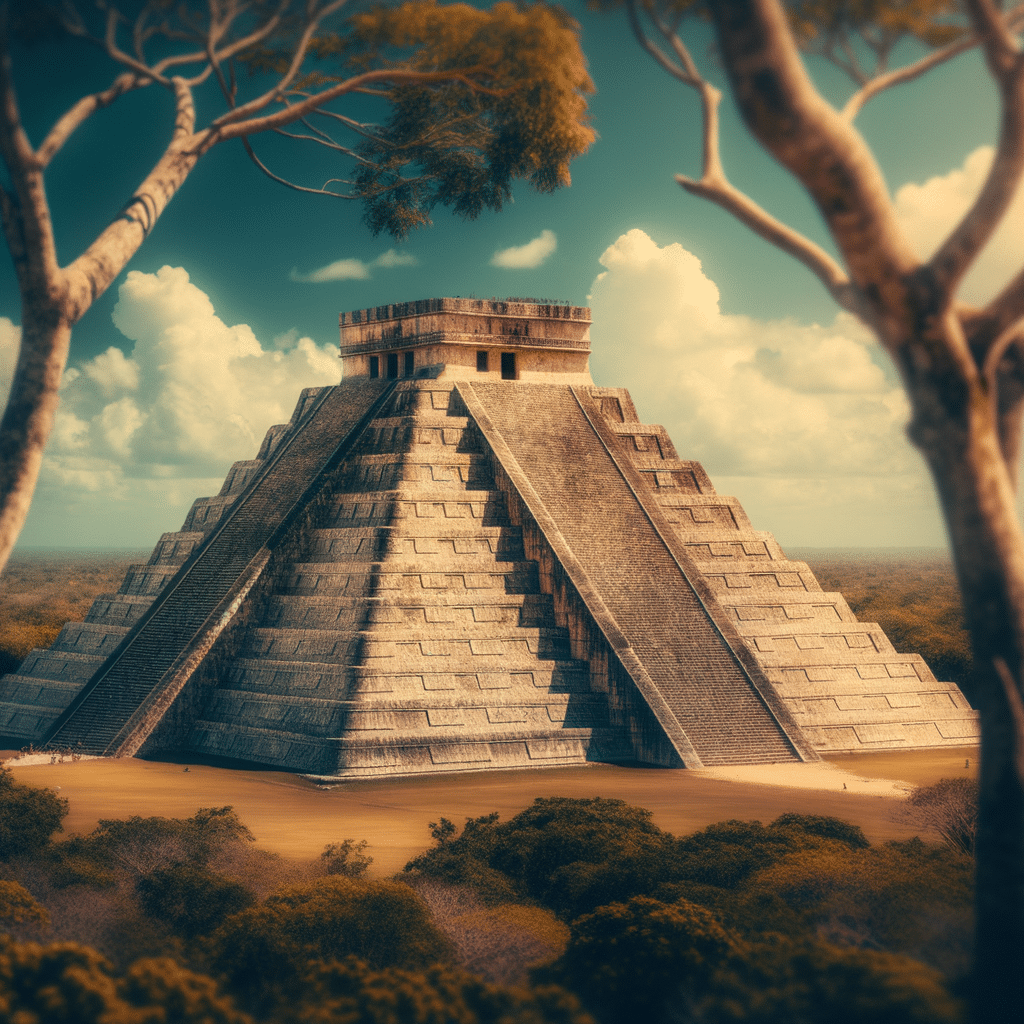
Chichen Itza, an ancient Maya city on Mexico’s Yucatán Peninsula, exemplifies the sophisticated and resourceful Maya culture. This city, which thrived in the Late Classic era (600–900 AD) and continued to be an important hub even after the Maya collapse, is well-known for its magnificent buildings, which include the Kukulkan Pyramid, the Temple of the Warriors, and the Cenote Sagrado. Emerging theories suggest that Chichen Itza may have served as an agricultural research station in addition to its classic narratives that center on it as a religious, political, or economic center. This essay examines the strong evidence for this theory, illuminating the sophisticated farming techniques and environmental awareness of the prehistoric Mayans.

Origins
According to local legend, Quetzalcoatl, the Feathered Serpent god, was the one who founded Chichen Itza. He was a cultural hero who taught the people. Some people think that around the tenth century, the Toltecs, a culture from central Mexico, had a significant influence on the city or possibly took it over. It is thought that rather than being a heavily inhabited urban center, Chichen Itza was largely a site for religious events and pilgrimages, honoring various deities.
Another widely accepted view maintains that multiple Mesoamerican cultures, rather than a single culture or era, constructed and evolved Chichen Itza over many years.
Atlantis and extraterrestrial creatures are other fringe hypotheses, but few people really believe in them.
Chichen Itza’s function is still up for dispute among academics. According to some, it was a political or economic hub, while according to others, it was a religious center. On the other hand, a growing body of evidence suggests that Chichen Itza may serve as an agricultural research station.

Agriculture
Chichen Itza’s geographical and architectural setting lend credence to the notion that it was an agricultural research center. The Mayans had to come up with creative ways to manage and harness water resources in order to survive because they lived in an area that was primarily composed of a limestone plateau with little surface water. The cenotes, or natural sinkholes strewn all across Chichen Itza, provided a consistent supply of water. These would have been essential for keeping any agricultural experiments going.
The fact that Chichen Itza was located in an area perfect for farming supports the concept of the agricultural research station. There is a long growing season in the tropical Yucatán Peninsula. Limestone contributes to the soil’s high nitrogen content.
The existence of several agricultural features at Chichen Itza serves as one piece of evidence for this theory. These features include several raised fields as well as a network of canals and reservoirs. Raised fields would have given farmers a place to cultivate crops, and canals and reservoirs would have assisted in gathering and storing water.
Numerous agricultural implements and artifacts found at Chichen Itza provide more support for the agricultural research station theory. Axes, grinding stones, and hoes are some of these items. These tools’ existence implies that the Chichen Itza people were involved in agriculture.
The architectural layout of Chichen Itza suggests the intricate agricultural calendar of the Mayans, demonstrating a profound awareness of solar and celestial movements. For example, on the equinoxes of spring and fall, El Castillo receives a shadow from the sun that gives the impression of a serpent descending the pyramid. This event may have helped the ancient Mayans maintain an efficient agricultural cycle by indicating important planting and harvesting times.
The variety of plant species found on the Yucatan Peninsula further supports this notion. At the site, archaeologists have found crop fragments from a variety of crops, including cacao, chili peppers, beans, squash, and maize, indicating a well-rounded agricultural practice. The Mayans could have tested crop variations, improved agricultural practices, and created robust types for various climatic situations at Chichen Itza if it had been an agricultural research station.
Looking at Chichen Itza as a study station for agriculture provides unique insights into the ancient Mayans’ way of life and social structure. It first highlights their deep awareness of and comprehension of their surroundings, which allowed them to thrive in difficult climatic and geographic circumstances. By conducting agricultural research, they could develop sustainable, productive, and environmentally friendly farming methods.
Second, this argument suggests that Mayan civilization may have had a hierarchy and a division of labor. If Chichen Itza were indeed a center for intensive agricultural research, this would necessitate a highly structured society with responsibilities for farming, research, and possibly even information sharing. The Mayans’ ability to successfully adjust and maintain their resilience in the face of societal and environmental changes may have depended on this hierarchy.
Finally, taking into account Chichen Itza as a study center for agriculture highlights the significance of agriculture in Mayan mythology and religion. Agriculture is closely associated with numerous Mayan deities, suggesting that cultivating crops was not just a way of life but also a deeply rooted religious practice in their culture. With its elaborate water management systems and agricultural calendar, Chichen Itza may have been considered a sacred place where the human and divine worlds come together to guarantee abundant harvests.
Although there is ongoing disagreement on the validity of the agricultural research station theory, there is mounting evidence that suggests Chichen Itza may have played a significant role as a center for agricultural study. The city’s geographic position, its agricultural characteristics, and the existence of agricultural artifacts and tools support this opinion.
Conclusion
Apart from its role in agricultural research, Chichen Itza might have functioned as a political, religious, and commercial hub. The numerous temples and pyramids in the city serve as evidence that it was a significant religious center. A ball court indicates that it was also a hub for athletics and games. Furthermore, the city’s location along a major trade route implies that it was a major commercial hub.
Although the theory that Chichen Itza was an agricultural research station is still conjectural, it presents a fascinating hypothesis that contradicts common perceptions of this ancient Mayan metropolis. According to this view, civilization is highly developed and inventive, with a deep awareness of its surroundings, and it uses this understanding to create sustainable farming methods. Theories like this one serve as a reminder of the complexity of historical sites and the amount of information that is still unknown as we research and comprehend Chichen Itza. We might still be able to learn from the agricultural methods and understanding of the ancient Mayans, who were able to live in peace with their surroundings, as contemporary society struggles with environmental issues.
References
Andrews, A. P. (1970). Balankanche, Throne of the Tiger Priest. Tulane University Press.
Coe, M. D. (2019). Mexico: From the Olmecs to the Aztecs (8th ed.). Thames & Hudson.
Milbrath, S., & Peraza Lope, C. (2003). REVISITING MAYAPAN: Mexico’s last Maya capital. Ancient Mesoamerica, 14(1), 1–46. doi:10.1017/S0956536103132178
Sharer, R. J., & Traxler, L. P. (2006). The Ancient Maya (6th ed.). Stanford University Press.
Turner, B. L., & Sabloff, J. A. (2012). Classic Period collapse of the Central Maya Lowlands: Insights about human–environment relationships for sustainability. Proceedings of the National Academy of Sciences, 109(35), 13908-13914.




Leave a Reply