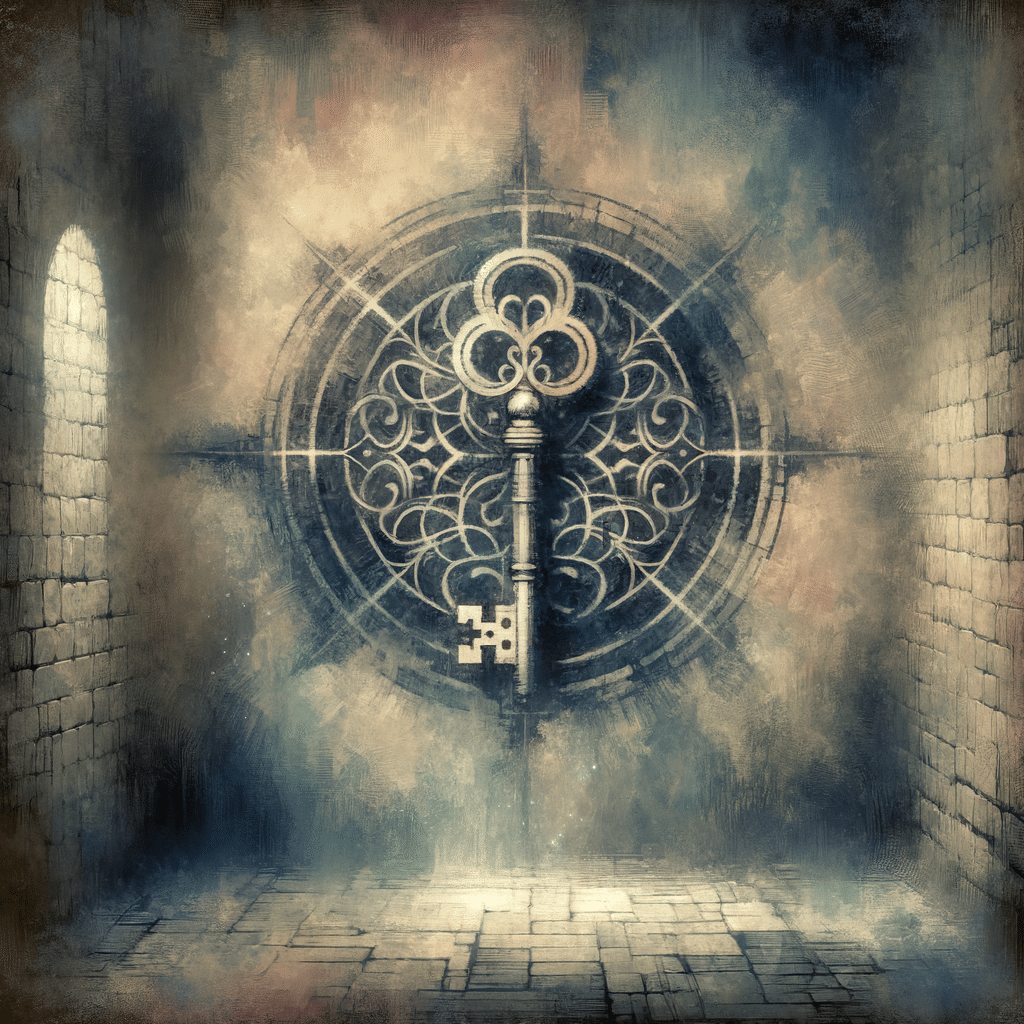
Ghosts and Keys: Key Points
-
Keys serve practical functions and symbolic purposes, representing power and transitions, making them significant bridges between the living world and the realm of the dead.
-
Ghost stories frequently feature mysterious sounds of jingling keys or locks turning in empty buildings, particularly in historic locations like prisons and hospitals.
-
The legend of the Phantom Jailer of the Tower of London tells of a dead jailer whose spirit wanders corridors with clanking keys, unable to rest.
-
The stone tape theory suggests emotional events can be recorded in materials and replayed, while the intelligent haunting theory proposes spirits manipulate keys to communicate.
-
Other theories include psychic imprints absorbed by keys and the idea that locks represent dimensional thresholds between physical and spiritual realms.
-
Ghost and key stories impact culture through real estate values, tourism, and appearances in art and literature, tapping into anxieties about death and the afterlife.

Introduction
The connection between ghosts and keys is one of the most interesting ways that the paranormal and everyday objects come together. Keys have always held profound symbolic significance, serving as portals, preserving secrets, and demarcating boundaries between various realms. In the world of ghosts and other supernatural things, keys are even more important. They show up in a lot of ghost stories, paranormal investigations, and spiritual traditions as things that seem to connect the living and the dead.
Overview
Keys are fascinating things that have both practical and symbolic uses in society. Keys are tools that open and close locks, which allow or block access to places, things, and information. Keys have always been more than just tools; they have also been symbols of power, knowledge, and change. In many cultures, giving or getting a key is a big deal. For instance, it is significant when a teenager receives their first house key or when a new homeowner receives the keys to their property. These small metal objects hold a lot of personal and cultural meaning.
The paranormal includes many things that science and natural law don’t yet understand. This term covers things like seeing ghosts, hearing strange sounds, seeing objects move on their own, and other types of spiritual manifestations. People who study the paranormal, whether they are serious investigators or just curious fans, often look into places with sad histories, unsolved deaths, or strong emotional echoes from the past. The paranormal realm posits that consciousness or energy may endure beyond death, facilitating interactions between the living world and the unknown.
When we look closely at the link between ghosts and keys, we see a wide range of reported events and cultural beliefs. In a lot of ghost stories, keys make strange sounds when no one is around, or they disappear and reappear in places that don’t make sense. People often hear the sound of keys turning in locks in old buildings with long histories, especially in old prisons, hospitals, and grand old homes where keys were important tools for everyday life. Some paranormal researchers think spirits are drawn to keys because they were important in life. For instance, keys could symbolize their previous authority, their residence, or a location they yearned to reach.
The Tower of London’s Phantom Jailer is a fascinating folklore example. It has existed for hundreds of years in a location well known for numerous ghost hauntings (Abbott, 2020). The story says that a mean head jailer who worked at the Tower during Henry VIII’s reign died suddenly while doing his rounds at night, still holding his big ring of iron keys. Guards and visitors to the Tower have said that late at night they can hear the distinct sound of heavy keys clanking and scraping along the stone corridors, along with the sound of heavy footsteps. Witnesses say that when they seek the source of the sound, they find the hallways completely empty. However, some have said they saw a shadowy figure in old prison guard clothes disappearing around corners. The story says that the jailer’s ghost can’t rest because he forgot to lock one cell the night he died. He keeps going around and around trying to finish that last task.
Theories
The link between ghosts and keys in the context of the paranormal brings up bigger ideas about memory, belief systems, and how people interpret things that are thought to be supernatural. Ghosts, frequently regarded as beings associated with the deceased, elicit a diverse array of interpretations that converge with memory and individual beliefs. The theoretical framework for understanding these entities can be grounded in the concept of “disruptive memory activists,” as discussed by Kent, where ghosts serve to impact an individual’s perception of the past and influence their interpretation of memories—positioning these spectral figures as pivotal in personal narratives and cultural lore regarding death and the afterlife (Kent, 2024).
Furthermore, Rogers and associates underscore the concept of “remarkable coincidence experiences,” encompassing events typically regarded as paranormal, such as discovering keys with personal significance linked to a deceased person (Rogers et al., 2016). The intrinsic vividness and intensity of these experiences result in paranormal interpretations, indicating a psychological framework wherein individuals seek explanations to reconcile the ordinary with the extraordinary. This need for meaning can be intensified in individuals with a greater propensity for paranormal beliefs, as evidenced by research investigating the relationship between schizotypy and paranormal beliefs (Dagnall et al., 2016).
Many paranormal theories try to explain why keys are such a big part of ghostly encounters and other supernatural events. One theory posits that items possessing significant emotional or symbolic ties to deceased individuals may function as anchors, binding spirits to the corporeal realm or acting as focal points for their energy. Another theory posits that the metallic composition of keys may interact with electromagnetic fields linked to spiritual entities, as suggested by paranormal researchers. Some researchers in the field think that locking and unlocking has such a strong psychological effect that it can leave a mark on a place, creating what they call a “residual haunting,” where the same action happens over and over again like a recording.
The stone tape theory is another intriguing way to explain why keys are so common in paranormal events (Young, 2003). This hypothesis posits that traumatic or emotionally significant events may be inscribed into the physical environment, especially in substances such as stone, wood, or metal that could function akin to magnetic tape. Supporters of this theory think that doing the same thing over and over again, like using keys, could make a kind of environmental recording. This concept is especially true when the situation is emotionally charged, like when prisoners are locked in cells or someone is trying to unlock a door to escape away from danger. These recordings might play again when the conditions are right, like when certain weather patterns or electromagnetic frequencies are present. Such situations could make people hear or even see phantom key-related activities. This theory tries to explain why the same paranormal events happen over and over in the same places and why they sometimes seem to be recordings rather than conscious spirits, as if they don’t know that people are watching.
The intelligent haunting theory posits that spirits maintain consciousness and deliberately engage with the physical realm. In this framework, ghosts may manipulate keys or locks to communicate with the living, possibly attempting to convey messages regarding their identity or the circumstances of their demise. Some paranormal investigators who believe in this theory think that spirits might have trouble with keys because these objects show how frustrated they are at being stuck between worlds and unable to fully access the living world or move on to whatever comes after death. People might think that the sound of locks clicking or keys rattling is a spirit trying to get their attention, show that they still care about a place, or show that they are there to help them find peace.
The psychic imprint theory posits that keys, being objects frequently manipulated with considerable emotional investment, can absorb and retain psychic energy from their users. From this perspective, a person’s strongest feelings, memories, and intentions can become part of the things they touch often, especially things that stand for important parts of their lives, like home, authority, or safety. If someone dies suddenly or violently while still emotionally attached to their work or trying to gain access to or protect something, that psychic energy might stay with their keys. Sensitive individuals or those in heightened emotional states might then perceive these imprints, experiencing them as ghostly sounds or visions. This theory is based on psychometry, which is the idea that you can read the history of things by touching them. It says that keys might be especially effective at holding these kinds of impressions because they are both useful and symbolic.
The dimensional doorway theory offers a highly conjectural explanation, suggesting that keys and locks may hold particular significance in paranormal phenomena due to their representation of thresholds and boundaries. Some theorists posit that the actions of unlocking or locking may induce ephemeral instances in which the demarcation between our physical dimension and spiritual realms becomes less distinct or more permeable. This idea says that spirits might be drawn to keys and locks because they could be places where worlds could cross. The sound of keys or locks appearing might mean that these dimensional boundaries are especially weak at that time. This theory seeks to elucidate the reasons behind the frequent occurrence of key-related phenomena at doorways and thresholds, which have historically been regarded as spiritually significant areas in numerous cultures globally.
The cognitive biases linked to paranormal beliefs play a role in the connection between ghosts and keys. Studies indicate that individuals possessing robust beliefs are predisposed to perceive significant patterns—such as a connection between lost keys and memories of the deceased—where none exist, a phenomenon termed “seeing meaningful patterns in visual noise” (Holloway, 2010). This phenomenon can significantly manifest in situations where individuals psychologically associate the act of searching for keys with a ‘supernatural’ presence that guides or influences their actions.
Furthermore, the interviews conducted by Drinkwater et al. offer commentary on self-reported paranormal abilities and the integration of these experiences into personal identity. In this context, individuals claiming a connection to spiritual realms often describe their encounters with keys as forms of communication or reunification with apparitions (Hadlaczky & Westerlund, 2011). These kinds of stories make keys more culturally significant as symbols of encounters with the supernatural.

Impact
The effects of ghost stories about keys go far beyond just being scary or fun to tell around campfires. These stories change how people perceive and interact with old buildings, which can affect everything from real estate prices to tourism at historic sites. Many people say they feel really uneasy when they hear keys or locks in empty buildings that they can’t explain, and some people won’t go into certain places because of these experiences. The psychological effects can be severe, making people doubt what they know about reality and what might happen after death.
From a cultural point of view, the link between keys and the supernatural has shaped art, literature, and movies for a long time. Writers and directors have used the image of ghostly keys or phantom lock-turnings to set the mood and show how thin the line is between life and death. The concept of a spirit striving to unlock a door, return home, or retrieve something left behind in life resonates with our apprehensions about unresolved matters and the possibility that death may not provide the tranquility or resolution we long for. These stories speak to fears that everyone has about loss, regret, and the unknown.
It is also essential to recognize how the environment affects how people feel about ghostly encounters. Ghost tourism and the infrastructures that enable these experiences cultivate an atmosphere that elicits emotional responses capable of distorting perceptions of reality—a notion examined by Holloway, who articulates how these “spooky spaces” can invoke sensations of fascination or dread (Bressan, 2001). This aesthetic of haunting suggests that everyday things, like keys, can take on deep cultural and personal meanings when seen through the lens of paranormal belief. This suggests a link between their everyday use and their symbolic importance in ghost stories.
Conclusion
The connection between ghosts and keys shows how normal things can have special meaning when seen through the eyes of the supernatural. In our physical world, keys stand for changes, limits, and access. This characteristic makes them natural symbols for the final change from life to death. Regardless of belief in ghosts or skepticism towards such phenomena, the enduring narratives connecting keys to supernatural occurrences signify profound insights into human psychology and our engagement with mortality. The simple sound of keys jangling in an empty hallway or the click of a lock turning that we can’t see will probably always send shivers down our spines and make us curious about what might be on the other side of death. These sounds remind us that even the most ordinary things in our lives can lead to mystery and wonder.
References
Abbott, G. (2020). Ghosts of the Tower of London. David & Charles.
Bressan, P. (2001). The connection between random sequences, everyday coincidences, and belief in the paranormal. Applied Cognitive Psychology, 16(1), 17-34. https://doi.org/10.1002/acp.754
Dagnall, N., Denovan, A., Drinkwater, K., Parker, A., & Clough, P. (2016). Toward a better understanding of the relationship between belief in the paranormal and statistical bias: the potential role of schizotypy. Frontiers in Psychology, 7. https://doi.org/10.3389/fpsyg.2016.01045
Hadlaczky, G. and Westerlund, J. (2011). Sensitivity to coincidences and paranormal belief. Perceptual and Motor Skills, 113(3), 894-908. https://doi.org/10.2466/09.22.pms.113.6.894-908
Holloway, J. (2010). Legend-tripping in spooky spaces: ghost tourism and infrastructures of enchantment. Environment and Planning D: Society and Space, 28(4), 618-637. https://doi.org/10.1068/d9909
Kent, L. (2024). The dead as memory workers. Memory Studies, 17(3), 500-514. https://doi.org/10.1177/17506980241240715
Rogers, P., Qualter, P., & Wood, D. (2016). The impact of event vividness, event severity, and prior paranormal belief on attributions towards a depicted remarkable coincidence experience: two studies examining the misattribution hypothesis. British Journal of Psychology, 107(4), 710-751. https://doi.org/10.1111/bjop.12173
Young, J. (2003). Killruddery: Listening to the archive. Sonic hauntings in a Big House (Doctoral dissertation, University College Dublin. School of Mechanical and Materials Engineering).

Leave a Reply