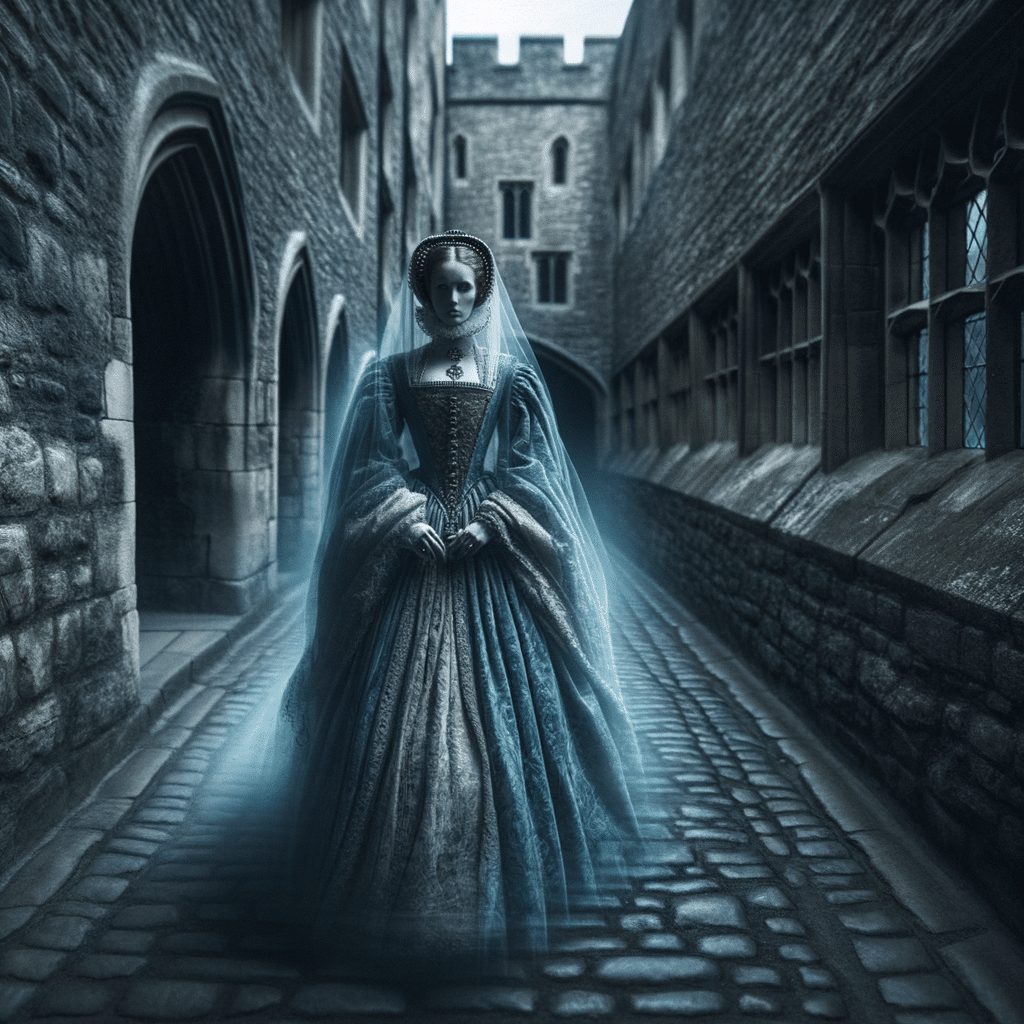
The Tower of London has a lengthy history of ghost sightings recorded by both visitors and Londoners, earning it the title of most haunted castle in Great Britain. Because of its infamous past and its location on the north bank of the Thames River, the castle has been the scene of several murders, tortures, and executions, all of which have contributed to its reputation as a hotspot for paranormal activity.
Among the countless ghost stories connected to the Tower, one very spooky one concerns a guard on duty on February 12. When he went to investigate the sound of hammering near the guardhouse, he saw a vague white apparition that some people think was the ghost of Lady Jane Grey, who was executed on that particular date in 1554. One of the most well-known people to be executed in the Tower, Anne Boleyn, is rumored to haunt the premises and is periodically spotted carrying her head under her arm.
Sir Walter Raleigh, Henry VI, Thomas Beckett, and the cruelly executed Countess of Salisbury are other historical figures on the spectral roster, according to legend.
The Tower is now a sophisticated stronghold with about 20 turrets, two concentric rings of walls, and a moat surrounding it. It displays a variety of architectural eras, illustrating how the style has changed over time. The Crown Jewels, which are made up of about 23,500 jewels, are currently housed there after serving as a prison, royal dwelling, treasury, public records office, observatory, zoo, mint, armory, and other varied functions.
William the Conqueror erected the White Tower, the first building in the complex, between 1066 and 1067. Originally intended to be a royal palace, it later stood as the highest structure in London for many years. Ironically, Ranulf Flambard, the first prisoner, was responsible for some of the Tower’s fortifications and was imprisoned there in 1100 on extortion accusations. In addition to 22 executions, the White Tower saw other animal deaths within its confines during the 13th-century zoo’s existence.
Religious dissidents witnessed the Tower’s more dark side firsthand, including its assortment of torture devices like The Rack and the Scavenger’s daughter, even though royal prisoners were frequently handled with great care. According to reports, the ghosts of the tormented frequently visit these torture devices.

Anne Boleyn, the second wife of Henry VIII, was one of the most famous inhabitants of the Tower. She was executed on May 19, 1536, for treason and adultery. The Yeoman Warders, or Beefeaters, and their families are the only surviving tenants of the Tower today. They live in the same quarters as the ghostly occupants.
Particularly terrible is the tale of Margaret Pole, the Countess of Salisbury. After insulting Henry VIII, her son hurried away to France to avoid the king’s fury. Henry VIII, unable to punish the son, commanded the 72-year-old Countess to be put to death. She refused to show up for her execution and was pursued and chopped to pieces despite her final act of defiance. Her ghost is said to still visit the Tower and escape the spectral executioner.
A former Yeoman Warder related a chilling story about his wife seeing two kids at the foot of their bed dressed in white pajamas. He did not see anything, but subsequently it was learned that their chamber had been constructed over a hidden Victorian fireplace, which was supposed to be the location of the children’s ghosts.
The tragic tale of the young princes Edward V and his brother Richard, Duke of York, adds to the Tower’s shady past. Their bodies were stored away, and it is thought that their uncle, Richard III, murdered them in 1483. Their terrible fate may have been confirmed centuries later when two tiny skeletons were discovered under a stairway close to the White Tower.
The custodian of the Crown Jewels, E.L. Swifte, and his family had an odd meeting in 1817 while having supper in the Martin Tower. Swifte threw a chair through a spectral cylinder that appeared and looked to approach his wife. It was a glass tube filled with bubbling blue liquid. In the same tower, a guard also claimed to have seen a ghostly bear emerge from the Jewel Room; when he attempted to stab it, his bayonet went through and became stuck in the door, causing the bear’s apparition to vanish.
These stories add to the strange legend surrounding the Tower of London, which makes it a location where history and the paranormal seem to converge and captivate the interest of both tourists and academics.
References:
Alford, Vincent (2012). Praeger, “Tower of London: England’s Ghostly Past.”
This book delves into the history of the Tower of London, examining the ghost stories and folklore that have endured over time.
Jones (2011) authored the work. Tower: An Epic Chronicle of London’s Tower. Published by St. Martin’s Press.
Nigel Jones provides a thorough history of the Tower of London while also contextualizing its significance in British history and the numerous ghost stories that surround it.
A. Weir (2009). The Fall of Anne Boleyn, as told in The Lady in the Tower. Cape Jonathan.
Providing insight into the life and death of one of the most well-known people rumored to haunt the Tower, Alison Weir explores the circumstances surrounding Anne Boleyn’s execution.


Leave a Reply