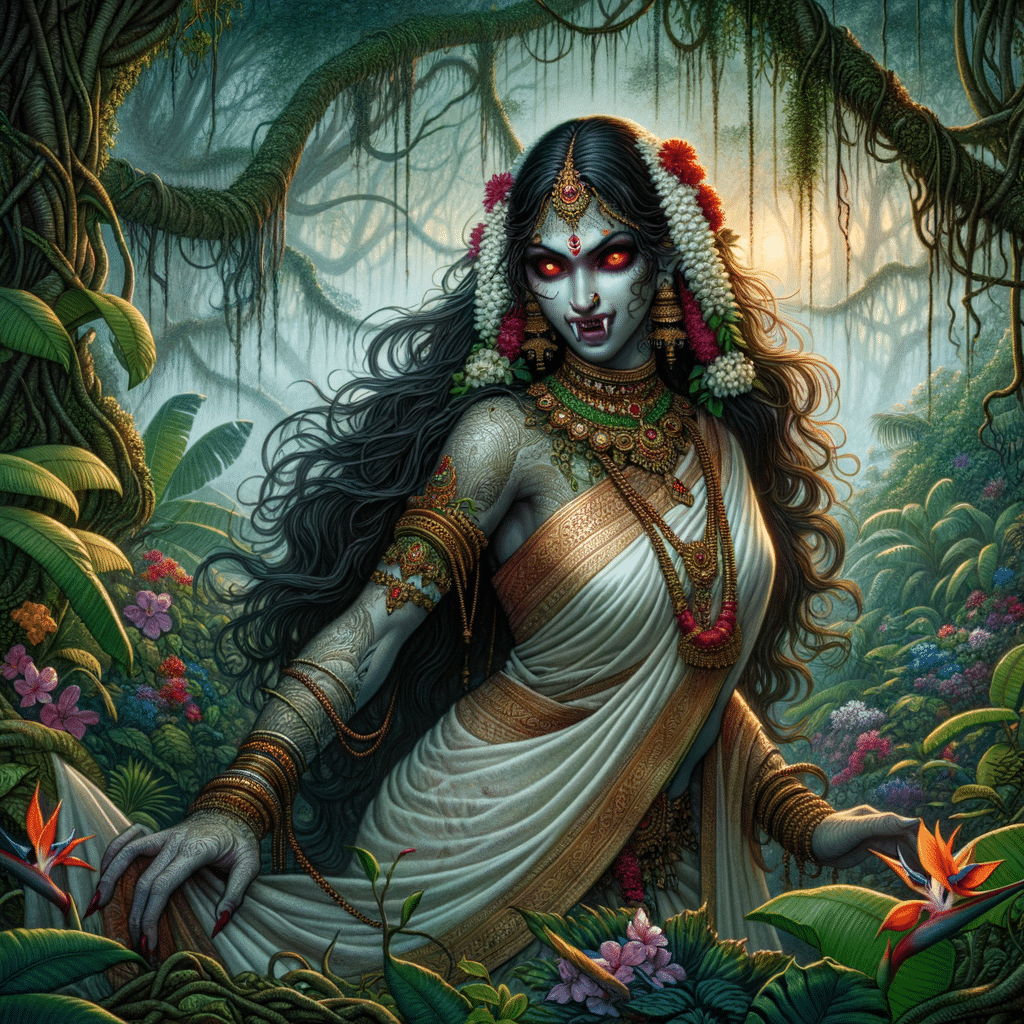
The Chedipe is an intriguing vampire that has its origins in the rich tapestry of Indian mythology, especially in the folklore of Andhra Pradesh’s Telugu-speaking districts. The Chedipe, also referred to as a prostitute witch, is a feminine creature that preys on the gullible through enigmatic and frequently malevolent tactics. Mythology portrays the Chedipe as a formidable, menacing figure, blending themes of sensuality, witchcraft, and vampires to distinguish her from more popular Western vampires.

Description
People believe the Chedipe to be the soul of a woman, usually a prostitute, who died in a terrible or violent accident and pursued a life of unrestrained sensuality and violation of social conventions. Death changes this ghost, bestowing upon it supernatural powers, transforming it into a terrifying apparition that prowls across towns. She may seem like a regular woman during the day, but at night, while she’s riding a tiger through the shadows, she shows her true self. This image alone sets the scene for her nocturnal activities, evoking feelings of wild savagery and primordial might. The tiger, an emblem of both monarchy and peril in Indian culture, further enhances her formidable reputation by emphasizing her authority over both the natural and supernatural realms.
Reputable mythologist Dr. Devdutt Pattanaik notes that the Chedipe is a special synthesis of regional beliefs and wider themes of transgression and retribution that are common in Indian folklore (Pattanaik, 2008). Her untamed nature and rejection of social standards, symbolized by her nocturnal activities and use of a tiger as a horse, are a recurring motif in the representation of female supernatural entities in Indian mythology.
The way Chedipe attacks is one of her most defining characteristics. In contrast to Western vampires, who usually bite victims in order to extract blood, Chedipes prey on men in a more subtle way. She sneaks into houses at night, frequently finding the slightest gaps, and uses a spell to render her victims helpless. She then extracts the victim’s toe’s blood, a detail that emphasizes the myth’s particular cultural setting. This deed not only saps the victim’s life force but also renders them feeble and vulnerable to other paranormal maladjustments. We can interpret the attack’s choice to target the toe as a symbolic reversal of the Western vampire’s bite to the neck, illustrating disparate cultural perspectives on the body and its weaknesses.
Dr. John Z. Wee, a comparative mythology expert, suggests that the Chedipe’s extraction technique could symbolize the subversion of conventional power dynamics and the inversion of social hierarchies (Wee, 1987). By targeting the toe, the Chedipe targets a less visible and more subservient body part, maybe expressing her intention to subvert the patriarchal system and establish her own brand of supernatural dominance.
The Chedipe’s power goes beyond injury to the body. People frequently hold her responsible for household conflicts and bad luck, viewing her existence as a portent of misfortune. Her mythology connects this facet to broader themes of fearing women who defy social norms and causing social disruption. Therefore, the Chedipe is both a figure of dark intrigue and a cautionary tale, embodying a complex junction of retribution, dread, and the supernatural. Her ability to sow division in families reveals deeper concerns about upholding societal order and the roles that women are required to play in these frameworks. One powerful narrative that highlights the value of conformity and the perceived risks of deviating from it is the notion that a woman who violates social rules in life may still be able to wield influence and wreak havoc after death.
Hindu mythology expert Dr. Wendy Doniger contends that the Chedipe’s function as a disruptor of household harmony is a reflection of larger societal anxieties about female autonomy and sexuality (Doniger, 1991). In this particular context, the Chedipe represents not just a supernatural predator, but also the disruptive power of women who defy social norms.

Contrast with Western Vampires
When one compares the Chedipe to the Western vampire, a number of significant distinctions become apparent, highlighting the ways in which cultural perspectives on vampire mythology differ. Western vampires often stand out due to their aristocratic demeanor, their fangs, and their ability to transform into bats or other nighttime creatures. This includes Dracula and more contemporary portrayals in literature and cinema. Typically, the desire for blood drives these vampires, symbolizing their sexual attraction, immortality, and sustenance. Their bite, which generally occurs in the neck, has strong sexual undertones and denotes both seduction and predation. The rich, gothic settings and the Western vampire’s link with aristocracy represent a separate set of cultural concerns, such as the friction between civilization and barbarism, the fear of degeneration, and the attraction of forbidden impulses.
On the other side, Chedipe functions within a framework that stresses witchcraft and social transgression, even while she embodies elements of sensuality and predation as well. Her technique of drawing blood from the toe, her use of spells, and her associations with tigers and nighttime prowling have deeply ingrained her in Indian mythology. Unlike the typically reclusive and noble Western vampire, the story of the Chedipe intricately links to social anxieties and the repercussions of breaking social standards. The tale of Chedipe is one of social and personal retaliation, with her paranormal pursuits serving as a direct reaction to her circumstances and treatment.
Furthermore, the Chedipe is a more ephemeral figure, with her hauntings associated with particular locations and times of disturbance, whereas Western vampires are usually portrayed as everlasting beings that live in opulent, frequently gothic environments. This distinction underscores the Chedipe myth’s immediate and specific sense of peril, in contrast to the existential fear often associated with Western vampires. The Chedipe directly threatens the town, her presence and deeds serving as a constant reminder of the paranormal threats lurking in seemingly familiar places. Because of her immediate impact, which upends the routine and infuses chaos into the ordinary, there is a tangible tension within the mythos.
According to Dr. Ruth Vanita’s research on gender and power in South Asian folklore, the story of the Chedipe is a potent indictment of social conventions that aim to marginalize and dominate women (Vanita, 2005). By embodying both terror and intrigue, the Chedipe pushes the boundaries of permissible behavior and draws attention to the effects of societal repression.
Conclusion
Overall, despite some surface-level parallels, the Chedipe and the Western vampire are products of their own social and cultural contexts. The mythology of the Chedipe creates a unique character that sets her apart from her counterparts in the West by reflecting her birth’s particular fears and moral norms. By seeing through the eyes of these animals, we are able to observe how many civilizations deal with the supernatural, the forbidden, and the unknown, each creating monsters that appeal to their most primal fears and wants. A rich and multidimensional counterpart to the more widely known Western vampire mythos, the Chedipe is a figure of both horror and intrigue in Indian folklore. She encapsulates the complicated dynamics of gender, power, and cultural conventions.
References
Bunson, M. (2000). The Vampire Encyclopedia. Gramercy.
Doniger, W. (1991). Why should a priest tell you whom to marry? A deconstruction of the laws of Manu. Bulletin of the American Academy of Arts and Sciences, 44(6), 18-31.
Pattanaik, D. (2008). Myth=Mithya: A Handbook of Hindu Mythology. Penguin Books India.
Vanita, R. (2005). Gandhi’s Tiger and Sita’s Smile: Essays on Gender, Sexuality, and Culture. Yoda Press.
Wee, J. Z. (1987). Comparative Mythology: A Study of Myths and Rituals. Oxford University Press.


Leave a Reply