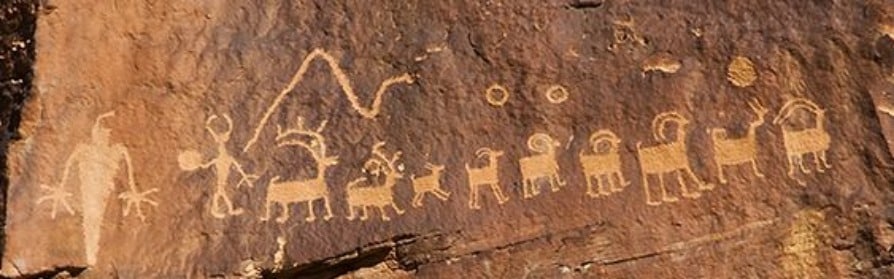
In North America, there is an apparent Santa petroglyph that dates back to ancient times. Some people claim that the ancient petroglyphs in Utah depict Santa Claus and his sleigh. Is it feasible that Native Americans were familiar with Santa Claus prior to the arrival of Europeans? Or could it be that a contemporary worldview, out of context with the original meaning, merely understands the petroglyph and others like it wrong?

Nine Mile Canyon
Fremont and Ute peoples carved the beautiful tapestry of ancient rock drawings known as the petroglyphs of Nine Mile Canyon in Utah, often referred to as the “world’s longest art gallery.” These carvings offer a wealth of information regarding the cultural practices, spiritual beliefs, and day-to-day activities enjoyed by these early tribes. The artwork of the canyon includes drawings of animals, portrayals of hunting scenes, and abstract symbols. Each of these works of art provides hints about the surroundings and the cultural practices of the people who created them.
When people talk about Nine Mile Canyon in Utah, they often refer to it as an open-air museum because of the extensive collection of petroglyphs and pictographs that it contains. The Fremont and Ute peoples created these rock carvings, offering a rich tapestry of ancient life and their spiritual beliefs. Petroglyphs portray a wide range of subjects, such as animals, hunting scenes, and abstract symbols. These petroglyphs provide insights into the daily activities that these early cultures engaged in, as well as the cultural practices they followed.
During the time period of approximately 300 to 1300 AD, the Fremont people lived in this area. They were famous for their characteristic artistic style. Their petroglyphs often feature humanoid figures with trapezoidal bodies adorned with elaborate jewelry or headdresses, indicating their significance in social or spiritual contexts. Animal themes such as bighorn sheep, deer, and lizards are quite common. These animals are most likely to represent hunting success or serve as spiritual totems.
After the Ute people arrived, they added their own layers to the rock art that they had created. Their depictions frequently incorporate horses and riders, which is a reflection of the fact that Europeans were the ones who brought horses to the surrounding area. This shift in iconography represents a substantial cultural revolution as well as an adaptation to recent technological advancements and lifestyle changes.

Santa and Alien Petroglyphs
One of the most intriguing interpretations is the so-called “Santa Claus” petroglyph. Those who are passionate about the subject assert that this particular picture is reminiscent of the contemporary depiction of Santa Claus, replete with a round body and a possible beard. In addition to that, it appears that there are reindeer and a sleigh. However, archaeological sites do not provide any evidence to support this interpretation. Rock art is more likely to depict key cultural figures, such as shamans or tribal leaders, as opposed to a figure like Santa Claus, which is a product of modern Western culture, according to Schaafsma (1986). This is because Santa Claus is a figure that is associated with modern Western tradition.
Similar to the assertions that certain petroglyphs depict extraterrestrial visitors, this hypothesis of a depiction of Santa Claus is evocative of such claims. We credit Von Daniken (1968) with popularizing the concept that ancient art reflected contacts with extraterrestrial beings. He did so by presenting unique shapes as evidence. In spite of this, knowledgeable individuals such as Keyser and Klassen (2016) contend that these interpretations frequently disregard the cultural and symbolic implications that these images possess. Similar to the “Santa” petroglyph, the so-called extraterrestrial petroglyphs do not provide any conclusive evidence to back up their outlandish assertions.
The concept of “they drew it because they saw it” implies that ancient peoples portrayed fantastical animals or alien entities in their artwork as a result of their direct encounters with them. Conversations about petroglyphs and cave art frequently raise this viewpoint, interpreting odd or abstract figures as evidence of interaction with extraterrestrial beings and humans. Nevertheless, this perspective fails to take into account the imagination and symbolic expression that are inherent in primitive art.
People who lived in prehistoric times were not only chroniclers of their surroundings, but also taletellers with vivid imaginations. The artwork that they create is a reflection of the intricate interaction between the real and the imagined, and it functions as a canvas for both literal renderings and symbolic representations. It is possible, for instance, that anthropomorphic figures with exaggerated features do not represent alien entities but rather spiritual leaders, deities, or mythological beings that are vital to the cultural narratives of the people creating them.
The present-day cultural lens significantly influences the interpretation of ancient art, exacerbating the situation. Many interpretations from the 20th and 21st centuries overlay modern concepts onto old works, and as a result, they frequently fail to take into account the original context and intent. Therefore, speculative ideas that are more in line with modern curiosity than historical truth may result.
When approaching these works of art, it is absolutely necessary to have a thorough comprehension of the cultural and spiritual landscapes that existed during that period. We are able to appreciate the petroglyphs as reflections of the worldview of these civilizations, not as literal documentation of their experiences but rather as reflections of the societal roles, spiritual beliefs, and environmental interactions that these communities engaged in.
While the argument that “they drew it because they saw it” can capture the imagination, it often oversimplifies the situation. To have a more nuanced view of the art of prehistoric societies, one must acknowledge their extraordinary artistic imagination and symbolic richness. From this perspective, we respectfully acknowledge the original meanings and cultural significance embedded in these ancient idioms.
We must contextualize these petroglyphs in their historical and cultural context to fully understand them. The Fremont and Ute peoples utilized these carvings as a medium of communication, spirituality, and storytelling, among other purposes. For instance, it’s possible that the images of animals held symbolic meanings or served as a component of hunting magic to ensure successful hunts (Whitley, 2016). Similarly, we can interpret abstract symbols and human forms as symbols of deities, ancestors, or visions achieved through spiritual rites (Mallery, 2022).
Understanding the cultural significance of these petroglyphs allows us to find the most plausible explanations for them. The author Schaafsma et al (1992) highlights the fact that these representations were most likely a component of a more intricate cultural and spiritual framework. The figures may represent deities or ancestors, reflecting the spiritual beliefs and practices of the time period.
Conclusion
The Nine Mile Canyon’s petroglyphs are extremely precious historical artifacts that provide a glimpse into the ways of life and beliefs of ancient peoples. Despite the fact that contemporary interpretations, such as Santa Claus or alien hypotheses, can capture the imagination, they sometimes represent contemporary biases rather than historically accurate facts. A respectful and well-informed approach is required in order to comprehend these petroglyphs. It is important to take into account the original cultural importance of these petroglyphs rather than attempt to impose contemporary narratives on ancient artwork.
References
Keyser, J. D., & Klassen, M. A. (2016). Plains Indian rock art. University of Washington Press.
Mallery, G. (2022). Picture-writing of the American Indians. DigiCat.
Schaafsma, P., Kernberger, K., & Schaafsma, C. F. (1992). Rock art in New Mexico. Museum of New Mexico Press.
Schaafsma, P. (1986). Indian rock art of the Southwest. UNM Press.
Von Däniken, E. (1968). Chariots of the gods? Unsolved mysteries of the past. G. P. Putnam’s Sons.
Whitley, D. (2016). Introduction to rock art research. Routledge.

Leave a Reply