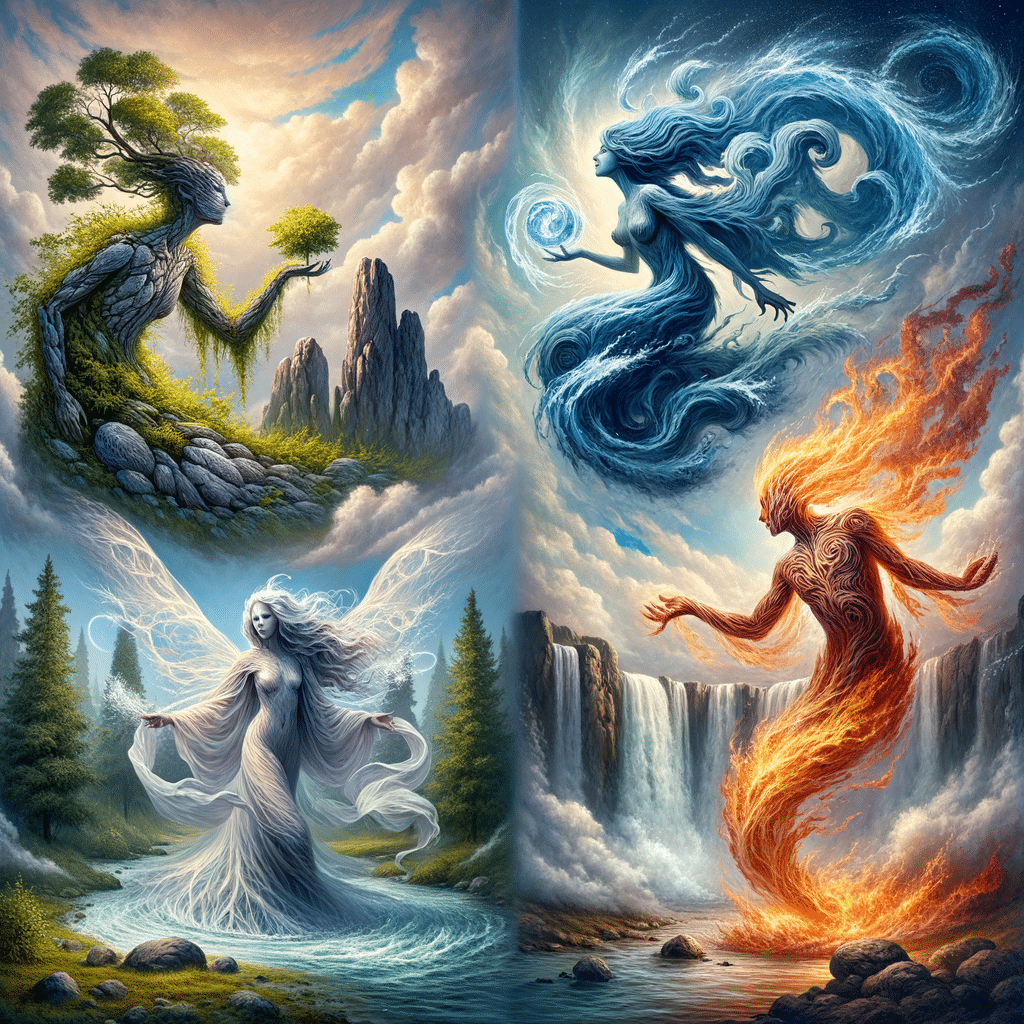
Folklore traditions around the world claim that the supernatural entities known as elementals represent or govern the four primary components of nature: earth, air, fire, and water. These mysterious beings, often depicted as possessing mystical powers related to their elements, have captured the human imagination for millennia. This essay will examine how they have been represented in folklore around the world.

Elemental Description
Folklore often depicts elementals as mysterious and ambiguous beings. They are forces that require acknowledgment and appeasement, neither completely benevolent nor completely malevolent. People believe that earth elementals, such as gnomes and goblins, dwell in caves, burrows, and hollow trees, vigilantly guarding underground valuables like gems, minerals, and treasures. It is thought that air elementals, such as sylphs and zephyrs, manifest themselves in the form of breezes, winds, and clouds. Fire elementals, like salamanders and ifrits, are associated with flames, smoke, and volcanic activity. Last but not least, it is believed that water elementals like undines, nymphs, and naiads live in various bodies of water, including lakes, rivers, and oceans (Andrews, 2012).
It is common practice to equate Earth elementals, which include gnomes, dwarves, goblins, and other such beings, with ideas like stability, fertility, riches, and the material world. Given their role as protectors of precious stones, minerals, and underground realms, they are a representation of the earth’s inherent stability and capacity to provide nourishment. Their connection to mining and metallurgy also binds them to the industry and the trade of workmanship.
Air elementals are ephemeral and intangible properties of the atmosphere, such as wind, clouds, and breezes. Sylphs, zephyrs, and other similar phenomena are included in the air elements. They can represent themes such as freedom, travel, and the transcendent or spiritual regions. Being fleeting gives them inconsistency, whimsy, and elusiveness.
Fire elementals, such as salamanders, ifrits, and other items, manifest the powerful yet potentially lethal force of flame and combustion. They embody vitality, ardor, devastation, and the potential for regeneration through consumption. The flickering essence of these creatures is symbolic of both creative and destructive qualities. A fire can be both a source of life and death.
Water elementals, including undines, nymphs, and naiads, among other similar entities, represent the attributes of fluidity, emotion, cleaning, and the subconscious mind. Because they live in water bodies such as rivers, lakes, and oceans, they suggest ideas about reproduction, healing, and the unending cycle of nature. In contrast, water can drown and overwhelm, indicating that emotional emotions can paralyze or envelope one.
The common human experience of dwelling in the midst of the tremendous and ever-flowing cycles of the natural world appears to be the source of these fundamental elemental symbols, which appear to emerge throughout civilizations. The ancient folklore incorporates the beauty and danger that are inherent to the primary elements of earth, air, fire, and water into an animistic mythology that is still captivating to the modern imagination. Personifying these elements as living forces throughout the centuries accomplishes this (Mayer, 2021).

Elementals in Folklore
The magical synthesis of all four elements produced the Philosopher’s Stone, which granted immortality and the ability to transform base metals into gold. This is one of the most well-known stories about the elementals. Harpies were believed to be winged elemental entities that embodied the destructive powers of storm winds in ancient Greek mythology. People frequently pictured harpies as having wings. According to popular belief, the Nordic dwarves were experts in the art of metalworking and custodians of the earth’s natural resources. In the past, there was a widespread belief that will-o’-the-wisps, which are mischievous fire elementals that are known to divert visitors off their intended path, existed across the British Isles (Pogacnik, 2012).
A variety of mythical and folkloric traditions from all over the world contain several examples of elemental entities. We discover Gaia, the primordial goddess who personifies the Earth itself, as well as the Anemoi wind gods, such as Boreas, Hephaestus, the god of fire and volcanoes, and Poseidon, the god who rules over the oceans. Greek mythology contains all these figures. According to Norse mythology, dwarves were expert subterranean miners and craftsmen who represented earth elements (Licauco, 2005). Norse mythology also featured magical Valkyries who rode the winds, the powerful fire giant Surtr, and malevolent water spirits like the Nokvan, residing in lakes and rivers.
Among the deities that appeared in Hindu mythology were Prithvi, the goddess of fertile lands; Vayu, the elemental deity of wind and cosmic breath; Agni, the immortal god of fire; and Varuna, the sovereign monarch over all aquatic things, who represented water. Native American folklore traditions depict Pele, the Hawaiian volcano goddess who embodies fire, Spider Grandmother, the strong Thunderbird spirit taking avian form in the air, and the dangerous Underwater Panthers haunting the bayous and seas. Native American folklore portrays Spider-Grandmother as a crucial creator of the lands, symbolizing earth. Ancient Chinese mythology personified the elements as creatures such as Tu Di Gong, the heavenly guardian of landscapes for earth; Feng Huang, the august celestial phoenix for air; Zhu Que, the fiery spirit of the southern realms; and Long Wang, the strong dragon monarchs who ruled over the waterways.
The symbolic representations of earth, air, fire, and water as sentient elemental forces, guided by deities, spirits, and other supernatural creatures, seem to be a deeply ingrained phenomenon that transcends cultural boundaries and is present in a wide range of mythologies and folklore traditions worldwide. These ancient traditions endowed the enormous natural forces that influence our planet and our lives with a numinous divine meaning and vivid personalities. Elementals provided our predecessors with the ability to revere, dread, and form mystical ties with the primal powers that existed throughout the cosmos (Raven, 2012).
Conclusion
Despite the decreasing acceptance of elements in modern times, their influence remains evident in contemporary fantasy literature, cinema, and video games. Ents, old tree-shepherds, and the flaming Balrog were some of the powerful elemental beings that appeared in J.R.R. Tolkien’s Middle-earth writings. Traditional tabletop roleplaying games like Dungeons & Dragons heavily emphasize the elemental realms of air, earth, fire, and water. The popular Pokemon franchise features elemental creatures such as Charmander, Squirtle, and Bulbasaur. Elementals continue to captivate our minds because they are mystical and primal representations of the immense power that the natural world possesses.
Elementals are a concept that originates from humanity’s deep and ancient need to endow the enormous elements of nature with spiritual significance and sentient agency. Although elementals may appear to be fantastical, people have always had this desire. Folklore that is based on elements indicates a continuous human yearning to establish mystical ties to the elementals that sustain all life on Earth. These folklores are expressions of both reverence and fear for the power of nature. Stories about enchanted countries and wondrous kingdoms, passed down through the ages, continue to serve as vivid reminders of the beauty of the natural world and our humble place within it.
References
Andrews, T. (2012). Enchantment of the faerie realm: Communicate with nature spirits & elementals. Llewellyn Worldwide.
Licauco, J. T. (2005). Dwarves and Other Nature Spirits: Their Importance to Man. Rex Bookstore, Inc.
Mayer, T. (2021). Answering the Call of the Elementals: Practices for Connecting with Nature Spirits. Simon and Schuster.
Pogacnik, M. (2012). Nature spirits & elemental beings: Working with the intelligence in nature. Simon and Schuster.
Raven, S. (2012). Nature Spirits-The Remembrance: A Guide to the Elemental Kingdom. Clairview Books.

Leave a Reply