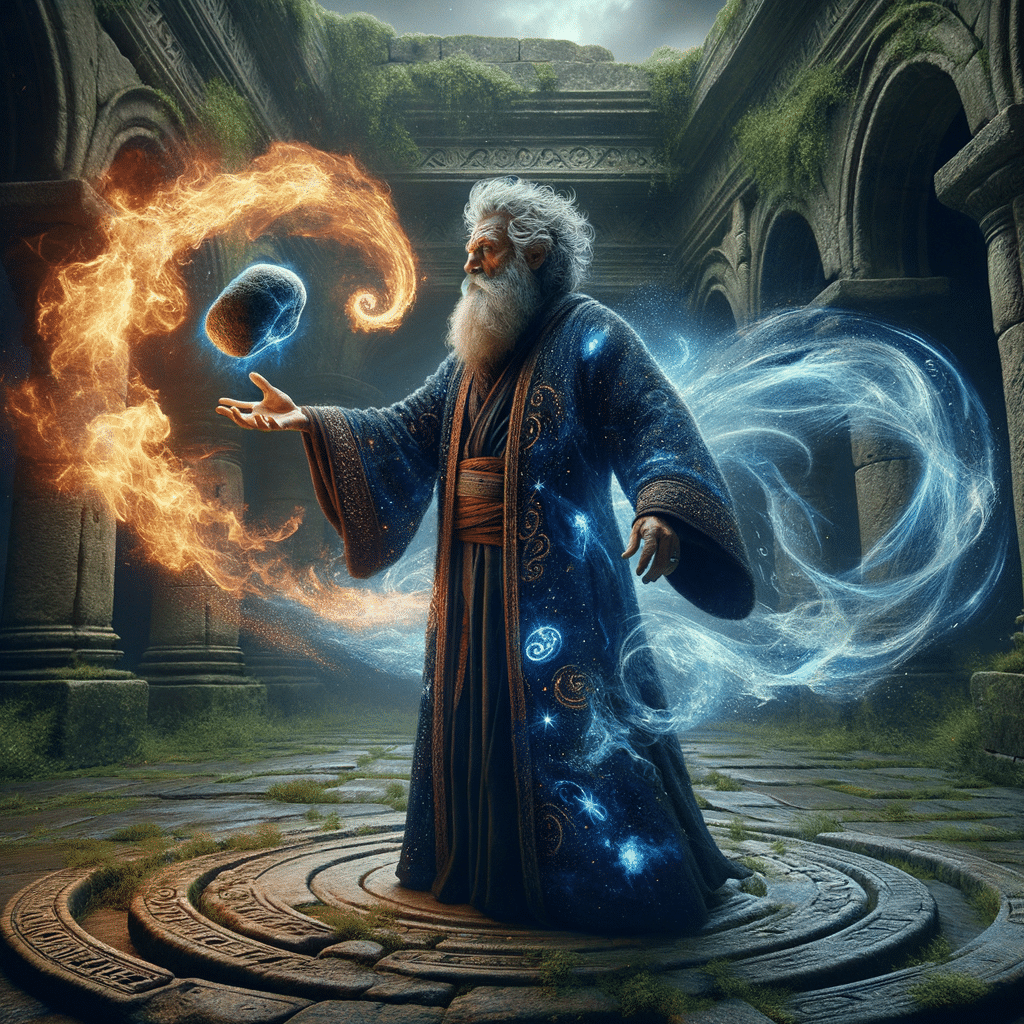
As a cornerstone of esoteric traditions throughout various times and countries, the idea of elemental magic is both ancient and deeply ingrained in many magical systems. This essay investigates the philosophical foundations of elemental magic, its historical development, and its ongoing impact on modern magical practices.
Elemental magic has a lengthy history of being connected to humanity’s attempt to comprehend and control the powers of nature, originating with the philosophy of ancient Greece and the sands of ancient Egypt. The cosmos itself was seen in Greek philosophy as consisting of four main elements: fire, water, earth, and air. These substances weren’t only physical; they also held the answers to solving the universe’s and the divine’s mysteries. The Greeks used these elements to create amulets, talismans, potions, and artwork that were charged with elemental meanings as a means of achieving communion with higher forces.

Empedocles of Acragas, a philosopher and Pythagorean student who lived in the fifth century BCE, is mostly credited with founding the field of elemental magic. Empedocles was one of the first philosophers to develop the idea of the four components, a theory that Plato and Aristotle would later develop. Particularly, Aristotle gave thorough descriptions of the elements, classifying fire as hot and dry, air as hot and moist, water as cold and moist, and soil as cold and dry. These attributions had a major impact on the formation of alchemy, a medieval synthesis of science and mysticism, as well as the practice of humoral medicine.
The famous person Paracelsus (1493–1541) made significant advances to the theory and practice of elemental magic during the Middle Ages. According to Paracelsus, elements existed that went beyond simple physicality and into the domains of spirit, emotion, and thought. By doing this, he developed the Spagyrics system, which aimed to promote personal development and metamorphosis by fostering the emergence of elemental traits in each person. Innovatively, Paracelsus connected the elements to particular spirits: Undines (water), Sylphs (air), Salamanders (fire), and Gnomes (earth). These terms have become widely used in many contemporary magical traditions, such as Wicca and other earth-based spiritualities.
With his theories on the spiritual nature of elements and their associated celestial and metallic connotations, Paracelsus had a major influence on magical activities. His claim that every element was associated with a certain metal and planet—Mars being associated with iron and the element of fire, for example—led to more potent uses in transformation and healing.

Elemental magic also had a strong influence on alchemy, since practitioners used the elements to turn base metals into gold, treat illnesses, and even become immortal. The mastery of elemental forces was seen to be a prerequisite for achieving both material and spiritual perfection, which could be attained through the alchemical process.
As the Renaissance drew nearer, individuals such as Giordano Bruno carried on the legacy of Elemental Magic, proclaiming their link to cosmic forces and employing elements in the creation of talismans. The 19th century also saw the emergence of the Golden Dawn, a magical order that combined Elemental Magic with a sophisticated system of correspondences that connected elements to different energies, colors, and symbols as well as to facets of the psyche and self.
In the 20th century, elemental magic found its way into contemporary occult practices like Wicca and Neopaganism. These movements place a strong emphasis on the elements in rituals and spells, giving each one a direction, a season, and a spiritual force inside a sacred circle. They also associate these energies with particular gender attributes, such as earth and water being feminine and fire and air being male.
To sum up, the diverse range of philosophical and practical applications of elemental magic indicates its fundamental significance in the development of esoteric traditions. Elemental magic is still an essential part of magical and spiritual practice, connecting the contemporary with the mystical and the material, as it did for the ancients who first thought about the four elements and for modern practitioners who are still investigating their meaning.
Further Reading
Greer, J. M. (2003). The Element Encyclopedia of Secret Signs and Symbols: The Ultimate A-Z Guide from Alchemy to the Zodiac. HarperElement.
Selected for its comprehensive exploration of symbols across various esoteric traditions, this encyclopedia provides an in-depth look at the historical and cultural context of symbols, including those related to the elements. It is a valuable resource for anyone interested in the language of symbols within the realm of Elemental Magic.
Regardie, I. (2007). The Golden Dawn: The Original Account of the Teachings, Rites & Ceremonies of the Hermetic Order. Llewellyn Publications.
This book is chosen for its detailed account of the Hermetic Order of the Golden Dawn’s system, which heavily incorporates Elemental Magic. Written by a former member, it offers an insider’s perspective on the rituals and teachings, making it an essential read for understanding the practical applications of Elemental Magic within a structured magical order.
Cunningham, S. (2002). Earth, Air, Fire & Water: More Techniques of Natural Magic. Llewellyn Publications.
Scott Cunningham’s work is a seminal text in natural magic, and this book, in particular, offers practical guidance on working with the elements in magical practice. It was selected for its easy-to-follow instructions, making it accessible to beginners, as well as its deep respect for the natural world, which is at the heart of Elemental Magic.

Leave a Reply