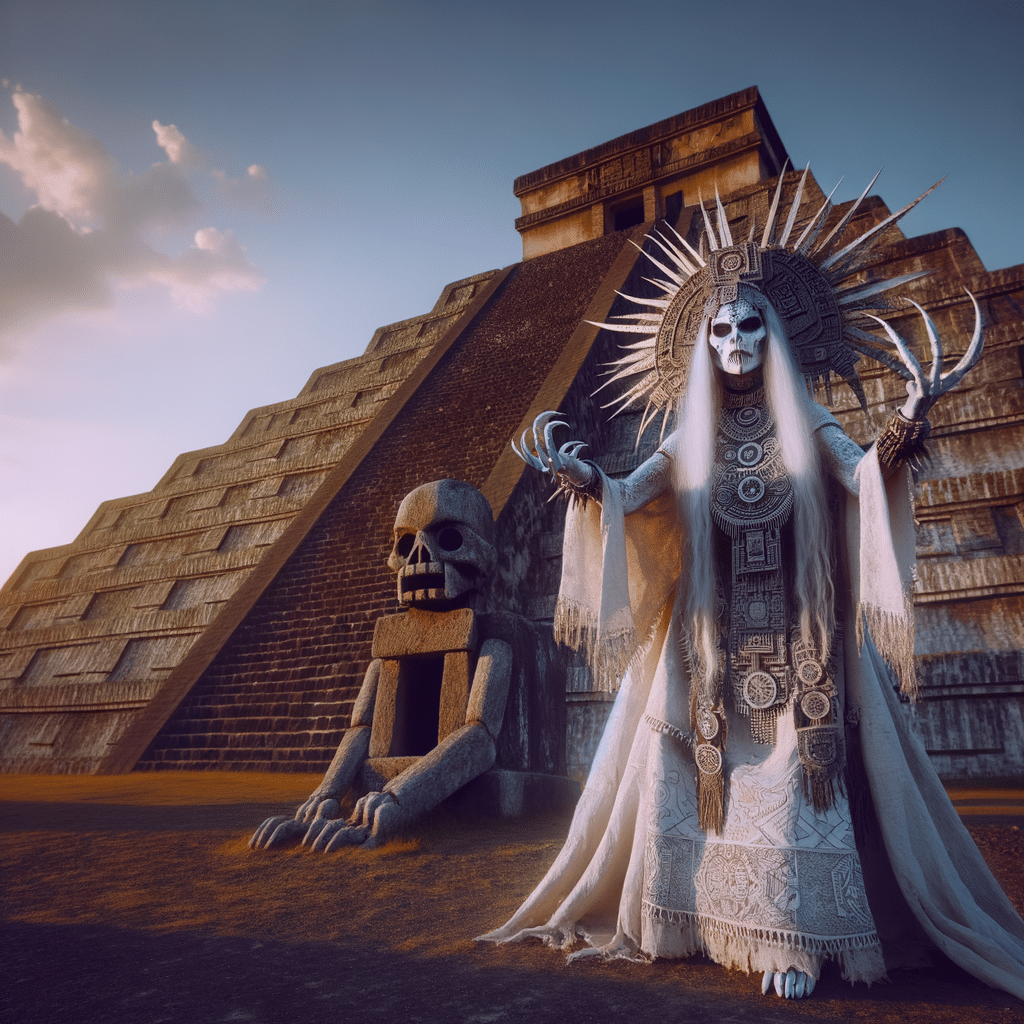
One of the most eerie and nuanced characters in Aztec mythology is the Cihuateteo, or divine women in Nahuatl. She serves as a warning story and a window into the culture’s perspectives on maternity, sacrifice, and the afterlife. Aztec society believed these otherworldly creatures, whose sacrifice equated to the death of warriors in combat, to be the spirits of women who died during childbirth, bestowing upon them a semi-divine status.

Description
People described these spectral beings as having skeletal features, chalk-white faces, and chalk dust on their hands and arms. Despite wearing the customary white Aztec women’s garb, descriptions depicted them with terrifying claws on their hands. They frequently wore the characteristic tzitzimime clothing, which featured fertility and death motifs and had wild, untidy hair. According to some tales, they wear skull masks or have skulls for faces (Barnes, 1997).
According to Aztec religion, the Cihuateteo resided in Cihuatlampa, the western portion of the skies, and were believed to accompany the sun from midday until dusk. On certain days of the Aztec calendar, particularly Ce Quauhtli (One Eagle), they were very active. People believed that they arrived on Earth at a critical juncture with the intention of harming children and seducing men. They were known to take children, induce convulsions in them, and paralyze or drive people insane (Sigal, 2010).
Aztec Calendar
The Aztec calendar largely determined when the Cihuateteo were believed to descend to Earth, especially on certain days known as Ce Quauhtli (One Eagle). The 260-day ritual calendar (tonalpohualli) and the 365-day solar calendar (xiuhpohualli) were the two cycles of the Aztec calendar (Jiménez & Graeber, 2001). On certain days of the Tonalpohualli, the Cihuateteo were at their most active. They were thought to arrive on Earth on five days, each associated with one:
“One Deer,” or Ce Mazatl
“One Eagle” (Ce Quauhtli)
One Monkey, or Ce Ozomatli
One House (Ce Calli)
“One Rain,” or Ce Quiahuitl
Especially in the west, these days were dangerous. During these periods, parents would shield their kids from the Cihuateteo by keeping them inside. People would make offerings to temples honoring these holy ladies on these particular days, hoping to please them and ensure the community’s safety. The Cihuateteo, believed to follow the sun from noon to sunset, held the western direction (Cihuatlampa) in high regard. This complemented the duty of fallen warriors, who accompanied the sun from sunrise till noon.
The high newborn mortality rates in pre-Columbian Mexico are the primary source of these ghost stories. The Aztecs held that women who perished during childbirth became strong entities because they had defeated death, their adversary, in the struggle to give birth. This belief system compared these ladies to fallen soldiers, believing them to be with the sun from dawn till noon.

Evolution of the Ghost Story
The story of the Cihuateteo changed over time as cultures blended after the Spanish invasion. Their resemblance to La Llorona and other female spirits in Mexican tradition led to the entanglement of their story with Catholic beliefs. Though some tribes still saw them as guardian spirits for young children and women giving birth, the focus switched from their divine position to their more malevolent characteristics (Key, 2005).
The Cihuateteo have impacted many facets of Mexican and Latin American culture in the present era. Modern literature, art, and media frequently use them as symbols of feminine strength and the challenges of parenting. Graphic novels, computer games, and contemporary horror movies have all used their picture. Some feminist academics and artists have appropriated the Cihuateteo as representations of female bravery and selflessness, reading their tale as a critique of the past and present battles for women’s rights and motherhood.
While maintaining clear distinctions in their histories, customs, and cultural significance, the Cihuateteo and La Llorona have a number of important things in common. Both female spirits appear in Mexican folklore as warning tales, often associated with children and death. Typically dressed in white garments, people believe they appear at intersections or near bodies of water, particularly during the night.
But they have rather different roots. Aztec mythology depicts the Cihuateteo as warrior women who perished in the battle of childbirth, earning them a celestial status. On the other hand, La Llorona began as a mortal lady who, in a fit of vengeance against her unfaithful husband, drowned her own children, sentenced to spend all of eternity searching for them. The first death was noble, the second was not (Kearney, 1969).
They also exhibit distinct behaviors and motivations. The Cihuateteo appear on particular days of the Aztec calendar and behave purposefully as divine creatures. As part of their supernatural nature, they target men and children without distinction, not as a form of retaliation. Guilt and eternal retribution are the driving forces behind La Llorona’s deeds; she primarily looks for her own children, though she may use other kids as stand-ins.
These legends also serve a variety of social purposes. In addition to honoring women who perished during childbirth, the Cihuateteo narrative strengthened Aztec beliefs about death and the afterlife. The message of La Llorona’s story is mainly about familial responsibilities and the results of unbridled affection.
In contemporary interpretations, the Cihuateteo is still more strongly associated with traditional Mexican folklore and scholarly research on Aztec mythology, although La Llorona has gained prominence in popular culture. La Llorona’s story has undergone numerous reworks in literature and film, often aligning with modern narratives, while the Cihuateteo typically maintains their traditional role and traits. Both are still studied by scholars finishing dissertations or trying to get tenure or promoted in academia.
Conclusion
The Cihuateteo are more than just mythical creatures in Mexican mythology; they are symbols of intricate cultural perspectives on maternal authority, death, and femininity. They show how ancient myths can be both relevant and flexible, continuing to appeal to audiences today while preserving their ties to past customs and beliefs through their transformation from Aztec gods to contemporary cultural icons. Whether perceived as vindictive spirits or strong defenders, the Cihuateteo continue to capture imaginations, serving as a reminder of the deep linkages between life, death, and the divine in Mexican cultural tradition.
References
Barnes, W. L. (1997). Partitioning the Parturient: An Exploration of the Aztec Fetishized Female Body. Athanor, 15, 20-26.
Jiménez, R. C., & Graeber, R. B. (2001). The Aztec calendar handbook. Aztec Calendar Handbook.
Kearney, M. (1969). La Llorona as a social symbol. Western Folklore, 28(3), 199-206.
Key, A. (2005). Death and the divine: The Cihuateteo, goddesses in the Mesoamerican cosmovision. California Institute of Integral Studies.
Sigal, P. (2010). Imagining Cihuacoatl: Masculine Rituals, Nahua Goddesses and the Texts of the Tlacuilos. Gender & History, 22(3), 538-563.

Leave a Reply