Particularly from the border areas between Scotland and England, redcap goblins are among the most evil beings in European folklore. Through millennia of oral history, these evil beings have kept their terrible reputation; more lately, they have crept into modern popular culture. Redcaps have always been deadly and bloodthirsty in mythology, unlike many supernatural entities whose traits have softened over time; they have kept their unique traits and behaviors that set them apart from other goblin kinds. Their continuing existence across millennia of narrative reveals mankind’s obsession with the darker sides of the supernatural realm.

Overview
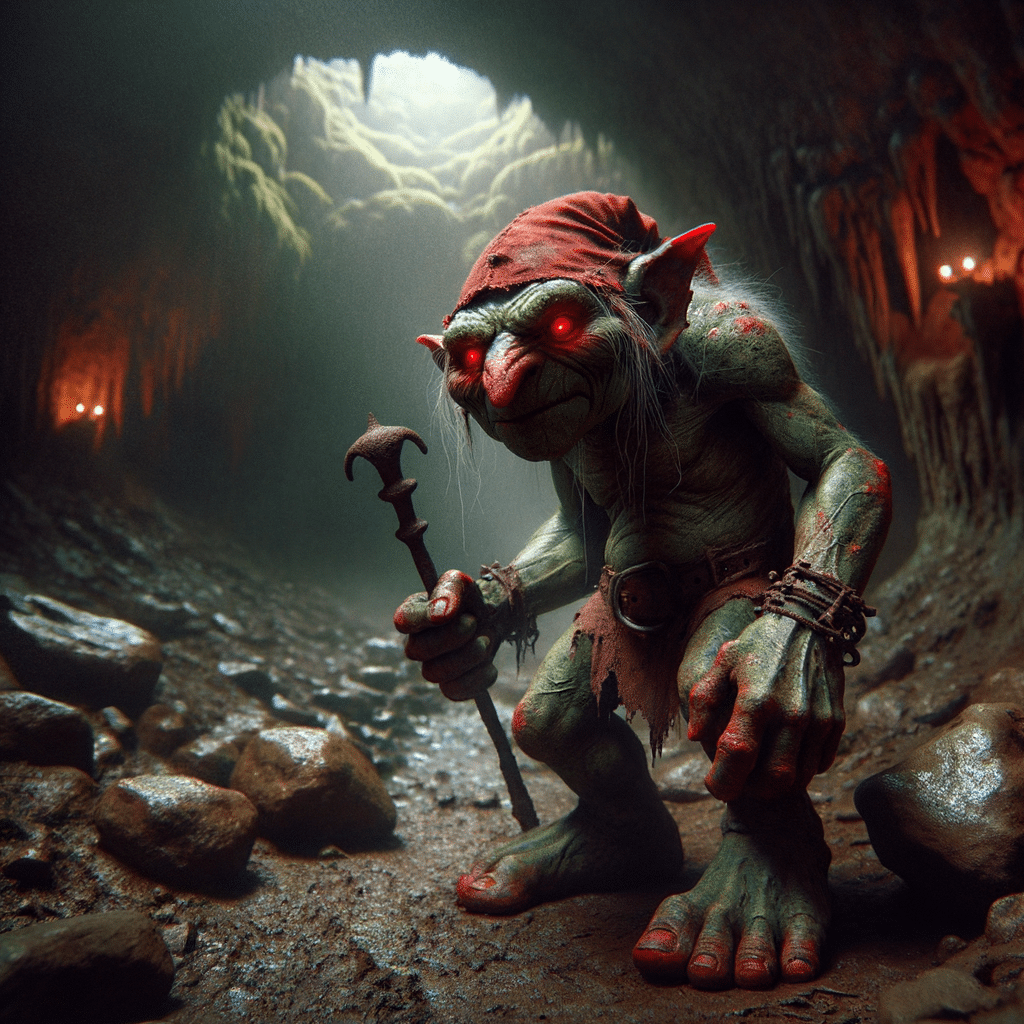
Redcap goblins in folklore have an obvious and central physical look that defines their identity. Usually standing two to four feet tall, these small animals have gaunt, old characteristics featuring long, gnarled fingers and sharp, yellowed teeth, suggesting their predatory instincts. Their most identifying feature is the unique red cap or hat from which they get their name; historically, this has been portrayed as being dyed or soaked in human blood that must be constantly refilled to prevent the cap from losing its color and triggering the death of the goblin. Redcaps are often shown sporting iron-shod boots and wielding a pike or other weapon, their brilliant red eyes piercing the darkness of their chosen habitats in abandoned border towers and castles where past violence has taken place (Klepeis, 2015).
Redcap goblins stand among the most hazardous of faerie beings since their demeanor is consistently hostile. They are claimed to live among ruins along the Anglo-Scottish border, especially areas where murder and violence have taken place; historic battles and decaying castles are therefore their favorite habitat. Using large stones or weapons to kill their victims, whose blood they use to color their hats a fresh red hue, redcaps are known to ambush visitors. Despite their heavy iron boots, their speed is renowned; once a Redcap marks its victim, escape almost seems impossible. Redcaps pursue pure murder, unlike many faerie entities who might indulge in mischief or cunning; hence, they are feared rather than merely respected by human populations near their territory (Sikes, 1880).
Redcaps distinguish themselves among other goblin forms seen in European mythology for their particular evil and lack of redeeming features. Redcaps exist just as predators of humans; regular domestic goblins like brownies might perform useful tasks in exchange for offerings, and hobgoblins might engage in annoying but finally benign pranks. Although they have the little stature typical of goblins-kind, they lack the possibility for beneficial interactions with humans that define many variations of the species. Redcaps cannot be placated or befriended, unlike the kobolds of Germanic legend who might help miners when treated well or the more neutral domovoi of Slavic mythology who guard families. Their ferocious temperament brings them closer to really terrible creatures than to the ethically dubious faerie folk that abound in most of European mythology.
Redcaps possess a particular ecological and mythological niche within folklore as inhabitants of the larger faerie realm. They stand for the perilous side of liminal spaces—ruins, abandoned buildings, and sites of violence existing at the nexus between the wild and civilized worlds. Redcaps are solitary hunters functioning outside faerie society, unlike the aristocratic Seelie and Unseelie courts of Scottish faerie mythology with their complicated social systems. Though mostly for sites contaminated by violence and death, they reflect the idea of genius loci, or spirit of place. Redcaps explain the residual evil people have long perceived in areas where horrible events have taken place and act as warnings against straying into unsafe territory in the moral geography of the faerie world.

Change in Folklore
Over millennia of folklore development, Redcap goblins have been portrayed subtly changingly. Early appearances in 13th-century border stories were clearly linked to certain ruins and castles, serving virtually as localized boogeyman characters to explain ancient violence and prevent study of dangerous buildings. Folklorists started methodically recording and classifying these beings by the Victorian era, occasionally reducing their representation to fit the romanticized picture of fairies. The blood-soaked cap stayed the same throughout these changes, although theories for its source differed; some later stories said Redcaps were formerly human murderers turned as punishment for their crimes. Unlike many other legendary figures that have been greatly cleansed throughout time, Redcaps are essentially malicious and dangerous and have stayed fairly stable (Hanson, 2010).
Redcap goblins have found fresh life in several mediums, so their impact goes much beyond conventional mythology into contemporary popular culture. These creatures have been included in fantasy books, role-playing games, and movie adaptations; occasionally they have been preserved in their violent impulses, and other times they have been reimagined for modern readers. Redcaps show up as especially deadly fey monsters with many of their conventional traits—including their blood-soaked headwear—in tabletop role-playing games like Dungeons & Dragons. Redcaps abound in the Harry Potter novel as dark creatures examined in Defense Against the Dark Arts, faithfully adapted for a younger audience while maintaining their perilous character (Kochová, 2015). Drawing on their mythological reputation for ferocity and their unique visual look that makes them easily identifiable to players, redcaps are often adversary types in video games.
Conclusion
Redcap goblins provide an interesting case study in the evolution of folklore ideas over millennia and their application into modern narrative. From their beginnings in the violent borders between Scotland and England to their debut in twenty-first-century entertainment, these bloodthirsty creatures have kept their basic traits while being reinvented for new audiences. Redcaps’ straightforward malevolence in a world where supernatural entities are progressively shown with moral depth is perhaps why they appeal always. They act as reminders of the darkest sides of folklore and the human inclination to invent monsters, reflecting our anxieties about violence and hazardous locations. Redcap goblins will probably prowl the borders of our collective imagination, their crimson hat as vivid a warning now as it was centuries ago, as long as we are captivated by the shadowy limits between the known and unknown worlds.
Refreences
Hanson, M. (2010). The Consumed Consumer: Business as Usual for Christina Rossetti’s Goblin Men. Merchants, Barons, Sellers and Suits: The Changing Images of the Businessman Through Literature. Newcastle: Cambridge, 57-94.
Klepeis, A. Z. (2015). Goblins. Cavendish Square Publishing, LLC.
Kochová, T. (2015). Legendary and Fairy Figures in Harry Potter Books (Doctoral dissertation, Masarykova univerzita, Filozofická fakulta).
Sikes, W. (1880). British goblins: Welsh folk-lore, fairy mythology, legends and traditions. Sampson Low.
Leave a Reply