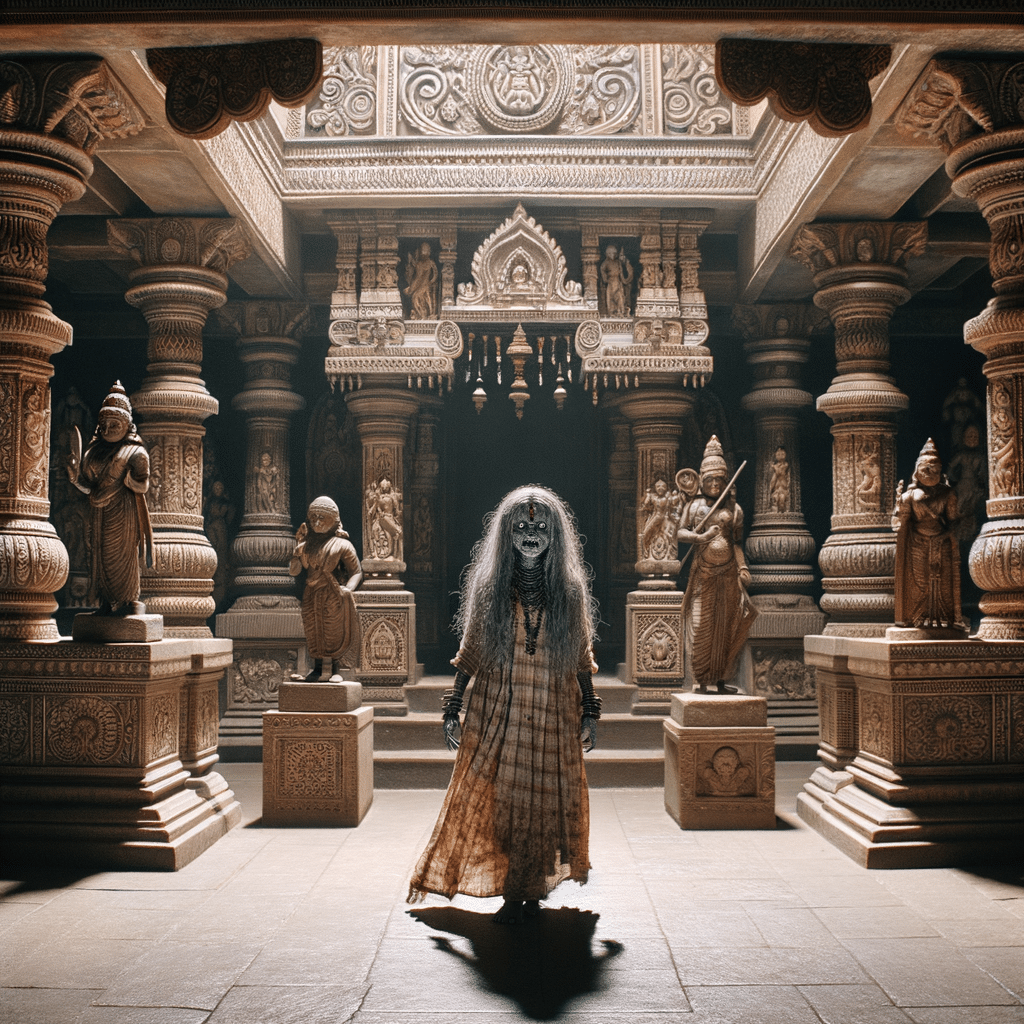
Many supernatural entities—from good gods to evil spirits—occupy the varied tapestry of Indian mythology and folklore. Among these spectral entities is the acheri, a lesser-known but especially terrifying spirit that has tormented people’s imaginations for millennia all throughout India. Particularly with regard to disease, childhood susceptibility, and the perilous wilderness, the acheri offers an intriguing case study in how spirits reflect cultural anxieties. The physical traits, behavior patterns, relationship to other Indian spirits, historical evolution, and limited but noteworthy presence in modern popular culture of the acheri are discussed in this essay.

Overview
Usually characterized as looking like a petite female child or young girl with clearly disturbing traits that define her supernatural character, the acheri in most stories show her with an artificially pale or ashen complexion that symbolizes death and decay, occasionally accompanied by obvious symptoms of the sickness that claimed her life in her former human incarnation. Her shadow, considered her most unique physical feature, serves as the primary conduit through which she transmits disease to her victims. The acheri is usually shown sporting a red gown or adornment, and in some depictions her hair hangs freely about her face, accentuating her sinister look. These physical characteristics taken together form an image that captures the liminal condition between life and death the spirit inhabits (Spaight, 1942).
The acheri’s conduct mostly reflects its evil intention toward the living, especially youngsters. Folklore holds that these spirits usually live in the mountains or forests during the day but descend to human communities at night to cast their lethal shadows upon sleeping youngsters, therefore bringing disease and occasionally death. Often linked to a need for vengeance or camaraderie, the acheri’s drive originates from the terrible events of their deaths as children. Some regional variants propose that as the color red is thought to attract and placate these spirits, acheri can be momentarily appeased or warded off with offers of red apparel or accessories. The nighttime activities of the acheri reflect larger societal concerns about the vulnerability of youngsters to unexplainable diseases in periods when medical understanding was limited (Khanna & Bhairav, 2023).
Unlike other spiritual entities found in Indian mythology, the acheri fills a unique niche in the pantheon of supernatural entities. Unlike the more well-known vetala, which has bodies and shows clever intellect in its contacts with humans, the acheri hardly speaks and functions via more rudimentary means of damage. Targeting adult men rather than children, the churel—another female spirit produced from the wrong death of a woman—is frequently driven by sexual vengeance. More often used in Indian folklore, the bhoot is a more generic term for ghost that describes a wider spectrum of restless spirits with different powers and drives. Unlike protecting home spirits such as the ghar-devata, the acheri represents pure menace rather than the moral complexity observed in many other Indian spiritual creatures; it has no positive interaction with humanity (Bane, 2016).

Red
Red takes a key role as both a protective talisman and a potent symbol loaded with several layers of psychological and cultural relevance. This one color feature is consistent across regional variations of acheri traditions. It creates an interesting point of symbolic convergence in a body of folklore that is otherwise very diverse. The predominance of red in these stories reflects deeper cultural links with this vivid color while also revealing much about how conventional societies saw defense against supernatural threats.
In the pragmatic sense of acheri folklore, red functions mostly as an apotropaic tool—a defense mechanism used to neutralize evil effects or calm the demonic spirit. Often as a preventive against the acheri’s fatal shadow, parents would put crimson ribbons, clothes, or decorations on their children. This protection feature works through a complicated system of symbols. The color is meant to either satisfy the acheri’s need for it or take the spirit’s attention away from the child’s body, making it less necessary for it to cast its disease-causing shadow. The general acceptance of this notion reflects the great cultural conviction in red’s spiritual power, which turns an everyday color into a barrier separating safety from supernatural risk (McClintock, 1990).
Red’s symbolic significance in Acheri folklore gains great power from the color’s universal connection with blood and life energy. Red stands for vigor and the living state in sharp contrast to the deathly pallor of the acheri itself; therefore, it establishes a chromatic opposition between life and death that supports the protective function assigned to the color. This link with lifeblood makes crimson a particularly suitable symbolic counterpoint to a spirit whose main threat is the spread of wasting disease. The bright color red stands out against the acheri’s dark, nighttime nature, suggesting that the strong intensity of the color may either cancel out or banish the darkness the spirit represents and uses as a weapon through its shadow.
One cannot ignore the gender aspects of red symbolism in Acheri folklore. They link these ideas to more general cultural systems about female identity and transitions. Red is especially important for women in many Indian cultural traditions; it shows up often in bridal clothing, marriage symbols, and feminine decoration. Red specifically may appeal especially to the acheri, a female soul who died before attaining womanhood, since it symbolizes the feminine social transformations and rank she was deprived of in life, according to certain anthropological readings. The presence of red objects in the acheri symbolically gives the ghost components of a normal female identity that death prevented her from achieving, therefore addressing the social incompleteness that drives her destructive activity.
In the Indian cultural setting, the symbolic link between red and religious activities enhances their importance even more in acheri folklore. Red is especially important in Hindu ceremonial settings, particularly in the application of vermilion powder (sindoor or kumkum) as a holy element marking religious benediction and heavenly protection. Red’s use suggests a possible syncretism between indigenous protective practices and components of Hindu ritual symbolism, therefore paralleling these religious uses and proposing a kind of prevention against the acheri idea. Many local protective ceremonies against the acheri combine aspects that reflect how conventional spiritual practices sometimes mix formal and informal religious elements when fighting supernatural concerns. These elements also evoke formal religious ceremonies.
Red symbolism’s historical development in acheri mythology shows shifting meanings reflecting more general social and cultural changes. In past tribal settings, red may have been more closely associated with natural colors and their scarcity or complexity of manufacture, so presenting valuable gifts that showed reverence for spiritual forces. Early medical theories concerning color therapy or visual stimulation occasionally sought to justify the protective use of red in terms of colonial era perspectives. Recent academic readings have placed the red symbolism within larger systems of color symbolism across Indian cultural traditions, looking at how such beliefs form part of whole symbolic frameworks for comprehending and managing relationships with the supernatural realm.
Modern readings of the red symbolism in acheri mythology. Some stress its psychological aspects, implying that the color acts as a visual center for anxiety displacement. Applying a red protection offers communities agency against otherwise incomprehensible and uncontrollable hazards like childhood disease, therefore empowering them. The striking visible presence of the protective red item serves as a physical reminder of the precautions taken, therefore possibly lessening psychological tension via the impression of active intervention. Suggesting that they satisfy emotional demands beyond their apparent supernatural uses, this psychological function helps explain the wonderful endurance of color-based protective beliefs throughout nations and historical periods.
Red in acheri mythology is emblematic of how color serves as a potent symbolic language inside ancient belief systems, able to convey difficult-to-convey vulnerability, protection, and spiritual negotiation. Through generations of use and reinterpretation, the hue functions simultaneously as practical protection, symbolic opposition, gender marker, religious signifier, and psychological comfort, so displaying the wonderful multivalence that cultural symbols may accomplish. One of the most constant features of regional variations of acheri beliefs, the protective function of red offers a useful thread through which to view how ancient societies evolved symbolic systems to conceptualize and challenge the terrifying uncertainty of disease and child death.
Folklore Over TIme
Over antiquity, the stories about the acheri have changed to reflect changing socioeconomic circumstances and the impact of several religious traditions all around India. According to previous narratives, especially those from highland tribes, the acheri was more closely associated with nature spirits and environmental hazards, therefore symbolizing the wild wilderness endangering established settlements. As Hinduism grew, elements of karmic punishment started to show up in various stories; the acheri was sometimes depicted as souls of children who had sinned in a former life. Colonial framers brought more modifications; some European records try to explain acheri stories as misinterpretations of malaria or tuberculosis. Some modern interpretations of acheri legends emphasize their social aspects, interpreting them as illustrations of the high child mortality rates in pre-modern societies or as evidence of the marginalization of tribal people within society.
Comparatively to more mainstream entities in Indian folklore, the acheri has had a quite limited but significant influence on modern popular culture. In literature, the acheri sometimes shows up in collections of ghost stories and folklore anthologies; authors can stress the sad elements of the spirit’s origin to provide more complex depictions than just basic deformity. While they typically combine their traits with other supernatural beings for dramatic effect, several Indian horror movies have featured acheri-like entities. Modern paranormal research occasionally references the acheri when investigating haunted sites on the Indian subcontinent, typically emphasizing their connection to inexplicable childhood diseases. With the spirit appearing in video games based on worldwide mythologies and in online groups dedicated to sharing and debating supernatural stories from all around the world, digital media has also helped the acheri to be subtly culturally present (Guiley & Taylor, 1992).
Conclusion
Ultimately, the acheri offers a remarkable illustration of how spiritual beliefs encode communal anxieties, especially those related to childhood fragility and inexplicable disease. With its unique look and conduct, this evil spirit represents the uncertainty and threats that have historically beset societies all throughout India. The development of acheri folklore over time shows how supernatural ideas change to fit evolving societal circumstances while keeping fundamental aspects that appeal to basic human concerns. Though less well-known in modern popular culture than some other mythological figures, the acheri has a presence that speaks to the ongoing power of traditional folklore to articulate common anxieties about death, vulnerability, and the unknown. Like many components of conventional belief systems, the acheri provides a window into both the shared psychological terrain of human experience across countries and times and cultural distinctiveness.
References
Bane, T. (2016). Encyclopedia of spirits and ghosts in world mythology. McFarland.
Guiley, R., & Taylor, T. (1992). The encyclopedia of ghosts and spirits (pp. 277-279). New York: Facts on File.
Khanna, R., & Bhairav, J. F. (2023). Ghosts, monsters and demons of India. Watkins Media Limited.
McClintock, W. (1990). Demons and ghosts in Indian folklore. Missiology, 18(1), 37-47.
Spaight, W. M. (1942). Gurkha ghosts. Journal of the Royal Central Asian Society, 29(2), 136-140.

Leave a Reply