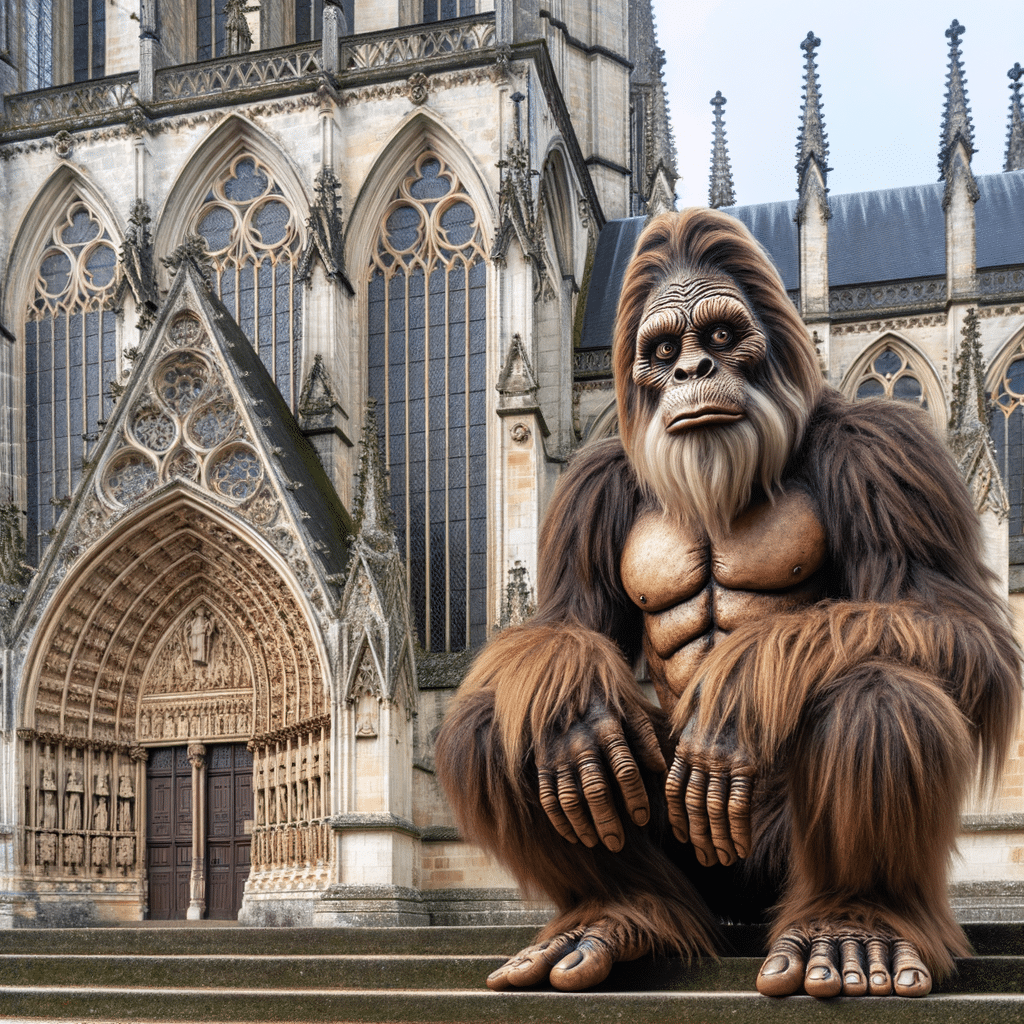
Combining religious belief with cryptozoology has produced amazing cultural events throughout American history. Among these intriguing convergences is the connection between the ideas of The Church of Jesus Christ of Latter-day Saints, sometimes known as the Mormon Church, and Bigfoot lore. This unusual combination has created a rich folklore legacy that exposes much about Mormon theology as well as the human inclination to combine spiritual ideas with inexplicable mystery. The development of this folklore over many years shows how religious groups modify their ideas to fit modern cultural influences.

Overview
Described in North American legend as a big, hairy, bipedal humanoid creature that supposedly lives in forests all throughout the continent, especially in the Pacific Northwest, Bigfoot, sometimes known as Sasquatch, Witnesses usually describe an ape-like creature that stands between six and nine feet tall, is coated in dark brown or reddish fur, and has a clear brow ridge along with a strong, bad smell. Though alleged evidence such as footprints and even allegedly video proof like the well-known 1967 Patterson-Gimlin film, the scientific world usually sees Bigfoot as a blend of legend, misidentification, and hoaxes rather than a true biological organism. However, the creature remains a prominent figure in American popular culture, inspiring everything from humorous beef jerky advertisements to significant research projects (Bowman, 2007).
Under the direction of Joseph Smith, who asserted to have received divine revelations including the Book of Mormon, the Church of Jesus Christ of Latter-day Saints first arose in the early 19th century. It established original theological stances, including the concept that God has a corporeal form, that humans might reach godhood by moral living, and that Native Americans came from ancient Israelites who traveled to the Americas. The church evolved a hierarchical priesthood structure and unique rituals, including temple ceremonies, proxy baptisms for the dead, and historically, polygamy. With over 16 million members worldwide, the church today upholds rigorous behavioral requirements, including abstention from alcohol, nicotine, and caffeine, and stresses family values, missionary activity, and genealogical research, especially.
Particularly in relation to their connection to the biblical character of Cain, Mormon mythology about Bigfoot has a unique place in the cultural story of the church. Some Mormon stories hold that Bigfoot is not only an unknown primate but possibly Cain himself, cursed to roam the planet as a black, hairy creature. This view stems in part from an 1835 story by early church leader David W. Patten, who claimed to have come into a black, hairy man identifying as Cain. Particularly after being incorporated in Spencer W. Kimball’s 1954 book The Miracle of Forgiveness, which helped validate the narrative inside church circles, the story became rather popular in Mormon folk belief. By linking the cryptid to biblical stories and divine wrath, this interpretation offered a theological justification for Bigfoot sightings and included the creature in the Mormon perspective (Van Wagenen & Reeve, 2011).

Bigfoot in Mormon Culture
Beyond only the Cain connection, Bigfoot and Mormon culture have a relationship. Particularly throughout Utah, Idaho, and portions of the Mountain West, many Bigfoot reports have come from places with notable Mormon populations. With some believers speculating that holy Mormon places could draw the creature or that Bigfoot sightings could be considered spiritual manifestations, these regional links have helped solidify Bigfoot’s position in Mormon cultural consciousness. Stories of encounters with unusual entities while serving in far-off locations abound in Mormon missionary legend; some of them resemble classic Bigfoot descriptions. Usually serving a pedagogical role in society, these tales strengthen religion and the belief that supernatural powers—both divine and otherwise—remain active in contemporary society.
The development of Mormon Bigfoot stories exposes more general trends in how religious groups fit evolving cultural settings. Early Mormon history reflected the theological atmosphere of the 19th century, which stressed supernatural explanations for inexplicable events; therefore, inexplicable events were more easily ascribed to divine or satanic involvement. Mormon Bigfoot mythology included increasingly pseudoscientific aspects as scientific knowledge developed over the 20th century, with followers trying to combine conventional religious explanations with contemporary cryptozoological models. Modern Mormon debates on Bigfoot sometimes recognize several interpretive choices, allowing people to reject the Cain link yet still uphold fundamental theological principles. This adaptability shows how folklore functions as a cultural buffer where official doctrine and popular belief can interact without calling for official institutional positions (Paddison, 2019).
Generally speaking, the church leadership has been neutral about Bigfoot mythology, neither supporting nor denouncing these ideas formally. This approach captures the church’s larger plan for many folkloric components found at the margins of official teaching. Although certain church leaders have occasionally mentioned the Patten-Cain narrative, usually they view it as a historical curiosity rather than necessary dogma. This deliberate placement helps the folklore to remain a cultural phenomenon while avoiding questioning institutional power or key theological beliefs. The unofficial character of these ideas helps them to develop naturally inside Sunday school musings, community conversations, and campfire stories at church youth events, augmenting a rich legacy alongside but apart from official religious instruction (Craig, 2012).
Mormon Bigfoot mythology now travels in the twenty-first century rather differently thanks to technology and the internet. Online forums, social media groups, and YouTube channels devoted to Mormon folklore have generated fresh venues for sharing, discussion, and preservation of cultural customs. While increasing diversity and personal interpretation, digital communication has simultaneously standardized some story aspects. When Mormons argue about Bigfoot today, they often use non-Mormon studies and sightings to help them figure out what the creature is. This shows that they are more aware of larger cryptozoological arguments. Modern believers might simultaneously mention the Patten story, highlight the most recent scientific Sasquatch studies, and discuss Indigenous traditions about wild men of the woods, so illustrating how religious folklore changes to integrate several epistemological strategies (Mould & Eliason, 2014).
The continuance of Bigfoot mythology inside Mormon society exposes significant new perspectives on the nature of belief and group identity. These tales have several purposes: they support moral teachings about divine punishment, link modern events to scriptural accounts, offer supernatural explanations for inexplicable events, and help to create cultural individuality. Particularly, the Bigfoot-Cain link shows how religious societies may incorporate more general cultural ideas into their individual theological systems, generating distinctive interpretive traditions. Many Mormons see these stories as being somewhere between literal belief and metaphorical interpretation. This lets them interact with the folklore at the level of devotion that works best for them without having to agree with the doctrine.
Conclusion
The interaction between Bigfoot mythology and Mormon mythology offers an intriguing case study in how religious traditions embrace and change more general societal myths. Despite remaining on the periphery of official theology, Bigfoot has carved out a distinct place in Mormon folk belief, thanks to the Cain connection and numerous documented encounters. Both Mormon religious beliefs and Bigfoot can seem cult like to many further complicating this. Reflecting shifting attitudes toward the supernatural, advances in scientific knowledge, and new means for story sharing, this folklore has changed dramatically throughout time. Church leadership keeps strict neutrality toward these ideas; however, they flourish in informal community environments and show the ongoing human need to balance religious perspective with inexplicable secrets. The continuing attraction of Mormon Bigfoot mythology finally relates to the ability of the story to establish significance at the junction of faith, culture, and the future.
References
Bowman, M. (2007). A Mormon Bigfoot: David Patten’s Cain and the Conception of Evil in LDS Folklore. Journal of Mormon History, 33(3), 62-82.
Craig, T. E. (2012). Between Pulpit and Pew: The Supernatural World in Mormon History and Folklore.
Mould, T., & Eliason, E. A. (2014). The State of Mormon Folklore Studies. Mormon Studies Review, 1, 29-51.
Paddison, J. (2019). The mystery of everything out there: Bigfoot and religion in the 21st century. In The Paranormal and Popular Culture (pp. 78-91). Routledge.
Van Wagenen, M. S., & Reeve, W. P. (2011). Between pulpit and pew: The supernatural world in Mormon history and folklore. Utah State University Press.




Leave a Reply