Emerald Dragons: Key Points
-
Emerald dragons are gem dragons with crystalline green scales, formidable psionic abilities, and a deep obsession with knowledge and historical lore.
-
These scholarly dragons collect artifacts and texts in historically significant lairs, maintaining an intellectually detached temperament unless threatened.
-
Emerald dragons possess devastating telepathic and psionic abilities that attack minds directly, including memory manipulation, mental domination, and psychic breath weapons.
-
Relations with other dragons are marked by wariness, with metallic dragons uncomfortable with their amoral approach and chromatic dragons avoiding confrontation due to vulnerability to mental attacks.
-
First appearing in early D&D supplements, emerald dragons were expanded in Third Edition, sidelined in Fourth, and triumphantly returned in Fifth Edition’s Fizban’s Treasury of Dragons.
-
Emerald dragons impact campaigns by forcing moral complexity and non-combat solutions, serving as versatile narrative tools that influenced broader psionic game design.

Introduction
Emerald dragons are some of the most mysterious and intelligent creatures in the Dungeons & Dragons multiverse. They are a rare mix of draconic strength and psychic skill. These gem dragons, which have crystalline scales that shine with green light, are important in the game’s mythology because they respect knowledge, history, and mental discipline above all else. Emerald dragons are different from their metallic and chromatic siblings since they empower the mind itself. This power makes them just as lethal in conversation as they are in battle. Adventurers encounter not only physical threats, but also intellectual puzzles and psychological warfare that have the power to alter the fundamental structure of reality, frequently necessitating them to outsmart the emerald dragons or risk severe repercussions.
Physical Characteristics and Appearance
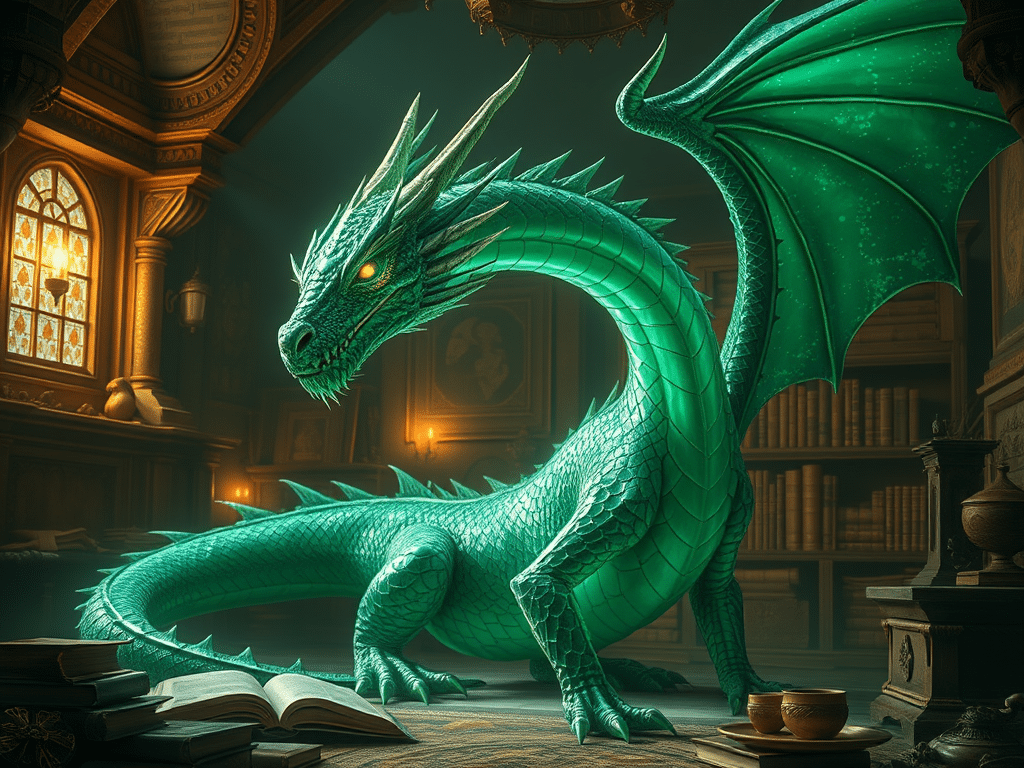
Emerald dragons have scales that range from light jade in hatchlings to deep forest green in ancient wyrms. This indicates that they are connected to both the earth and the realm of thinking. Compared to chromatic dragons, whose forms are more brutish, their bodies are sleek and exquisite. Their necks and heads are long and taper to fine points, which makes them look nearly like snakes (Dungeons and Dragons Wiki, 2024). The scales don’t just have a green color; they’re actually made up of crystals that capture and bend light in beautiful patterns. When the dragon moves, they almost look like they’re hypnotizing you. Their eyes shine with an inner light that changes from emerald to amber, and people who look into their eyes often say they feel like the dragon is reading their minds. When the sun or a magical light shines through the edges of an emerald dragon’s wings, they seem nearly like stained glass.
Intellectual Nature and Hoarding Habits
Emerald dragons are essentially intellectual beings who dedicate their elongated lives to the gathering and organization of information, particularly ancient stories and lost documents. They build their homes in places that have historical importance, such as old ruins, abandoned libraries, or places where important events happened hundreds or thousands of years ago. Unlike chromatic dragons, who hoard riches for their material value, emerald dragons acquire objects, manuscripts, and relics that are important to history or that connect them to important events in their lives. They tend to be scholarly and objective, looking at mortal matters with the same impartial interest as a researcher analyzing specimens. However, their intellectual curiosity should not be confused with kindness. When faced with threats or when their collections are in danger, emerald dragons excel at eliminating them. They use both their physical strength and their powerful cerebral skills to do this (DnD content, 2022).
Telepathic and Psionic Abilities
Emerald dragons are different from almost all other types of dragons because they have telepathic powers. They are also some of the most feared mental fighters in the world. Emerald dragons have natural telepathic powers that let them talk to each other across long distances and break through mental barriers that would stop other psychics. As they get older, their telepathic powers grow to include assaults that go right through physical armor and hit their opponents’ minds and souls. Ancient emerald dragons can control the thoughts of many beings at once, rewrite memories with perfect accuracy, create illusions that look real, and even momentarily cut off the connection between mind and body. Their breath weapon is a cone of confusing psychic energy that scrambles thinking, makes people paranoid, and can leave them catatonic or temporarily insane. The most powerful emerald dragons can create permanent psychic networks that connect many minds and allow them to spy on and control each other. These networks can span continents without anyone ever having to say a word (Forgotten Realms Wiki, n.d.).
Emerald dragons and other dragons have a complex relationship that is more about being wary of each other than being openly hostile or friendly. Metallic dragons, especially gold and silver dragons, appreciate emerald dragons for their intelligence but are also uncomfortable with their lack of morals when it comes to getting knowledge and their readiness to use weaker species. Chromatic dragons usually stay away from emerald dragons because they know that being stronger physically doesn’t mean much against an opponent who can turn your mind against you or even shut down your consciousness before the fight starts. Emerald dragons are somewhat more distant and fixated on the past than other gem dragons, such as sapphire, amethyst, topaz, and crystal dragons. However, they do get along better with emerald dragons. Red dragons especially hate emerald dragons because their pride makes them especially vulnerable to being humiliated by mental domination, which can lead to intense rivalries and conflicts between the two types of dragons. There have been many legendary feuds between ancient reds and ancient emeralds that have changed whole areas via their fights, such as the infamous battle at the Crystal Peaks, which resulted in the alteration of the landscape and the creation of new territories for both dragon types.

Taxonomic Position Within D&D Lore
Dragons are a big part of the D&D world, and they are grouped by color (for example, chromatic dragons and metallic dragons). Emerald dragons and other gem dragons are shown to be a separate group with biology and preferences that set them apart from the more common chromatic and metallic lineages (Callison-Burch et al., 2022). Callison-Burch et al. position D&D as a comprehensive, multilingual dataset, highlighting its function as a fantasy realm characterized by a distinct internal logic and a diverse creature catalog, encompassing non-chromatic species that a Dungeon Master may utilize in gameplay scenarios. This notion fits with the idea that emerald dragons are a type of gem dragon that is more often linked to psionic or gem-based themes than the more common fire-based chromatic dragons.
Emerald dragons were added to Dungeons & Dragons history as the game grew more complicated and offered more draconic alternatives than only the usual chromatic and metallic types. The original Fiend Folio and the Monstrous Compendium for Second Edition both had gem dragons. They were described as neutral dragons from the Inner Planes with telepathic powers, giving Dungeon Masters other options outside the usual good vs. evil dragon types. Emerald dragons were especially put in charge of being the historians and loremasters of the gem dragon types. This position gave them the role of protecting information and changing people’s minds. In the Third Edition, jewel dragons got more attention in several supplements. For example, emerald dragons got more thorough lists of their psionic abilities and clearer links to the historical parts of their nature. The Fourth Edition of Dungeons & Dragons mostly omitted gem dragons in favor of making the main sorts of dragons easier to understand, but the community didn’t forget about emerald dragons and their relatives. When Fizban’s Treasury of Dragons came out for Fifth Edition, gem dragons came back into the spotlight in a big way. Emerald dragons were reimagined with new lore that focused on their love of history and their connection to the echoes of past events. They also got mechanical updates that made their psionic powers both intriguing and different from other dragons.
Emerald dragons have had a giant effect on Dungeons & Dragons campaigns and the game culture as a whole. They are a different way for dragons to work in stories than other types of dragons. Emerald dragons are more likely to talk, negotiate, or even work together than to fight right away, so their presence in a campaign tells players that fighting isn’t always the best way to solve problems. This rule forces players to deal with moral ambiguity because emerald dragons might have important information or items needed for a quest but ask for favors that aren’t morally right, like stealing historical records from other collectors or letting the dragon look at and copy party members’ memories. Dungeon Masters have utilized emerald dragons as questgivers, bad guys, uncomfortable allies, and sources of information about old campaigns or lost civilizations. This feature makes them useful for telling stories. The psychic skills of emerald dragons have also had a big impact on game design in general. This feat shows that dragons don’t have to be confined to physical strength and elemental breath weapons, and it opens the door for other monsters and player options that rely on mental abilities. Their crystal-like look has inspired a lot of fan art, miniature designs, and homebrew content. Even though they haven’t been published as much as chromatic or metallic dragons, they are nevertheless well-known members of the draconic pantheon.
There are many stories about dragons in fantasy games. Some of them talk about “emerald” or “green” dragons, which are dragons that focus on nature or gemstones. Varol’s Turkish-language discussion of dragons in different game worlds clearly mentions Emerald Dragon as an evolved form of the Green Dragon in some game universes. He discusses their origins, stylistic changes (like gemstone occlusions, like emeralds in rock and armor-like plant accretions), and their different ecology (like emerald/green hybrids with terrain-based resilience) (Varol, 2022). This analysis offers a more comprehensive view of game-world design, reinforcing the association of emerald dragons with green and emerald aesthetics in dragon design and illustrating the interpretation of emerald dragons across various media beyond the confines of the D&D rules.
In addition to D&D’s official taxonomies, academic and cultural studies recognize the significance of dragons in role-playing game ecosystems and the propensity to draw parallels or correlate real-world dragon legends with game-world dragons. Lechner (psychodrama & dragon imagery in therapeutic contexts) characterizes D&D as a quintessential example of Pen & Paper RPGs, highlighting how players assume dragon-related roles in therapeutic or narrative environments. This definition illustrates the role of emerald/green dragons (within a gemstone dragon family) as narrative focal points in group therapy and imaginative play (Lechner, 2023). This reference is not an official taxonomy source, but it does assist in putting emerald dragon imagery in the context of other symbols in D&D and other RPGs.
Conclusion
In the Dungeons & Dragons multiverse, emerald dragons are a symbol of the connection between knowledge, power, and the risks of being too cerebral. They don’t fit into the basic categories of good and evil that define metallic and chromatic dragons. Instead, they exist in a principled neutral place where studying and preserving history is more important than the well-being of any one person or even whole civilizations. Emerald dragons provide players and Dungeon Masters a chance to contemplate stories about the weight of the past, the ethics of memory and mental freedom, and whether knowledge should be kept at any cost. Their mix of dragon-like might, strange psyche, and psychic powers that change reality make them unforgettable encounters that stay with you long after the session ends. They are the best example of what makes dragons fascinating as both mythological creatures and game mechanics.
References
Callison-Burch, C., Tomar, G., Martin, L., Ippolito, D., Bailis, S., & Reitter, D. (2022). Dungeons and Dragons as a dialog challenge for artificial intelligence. Proceedings of the 2022 Conference on Empirical Methods in Natural Language Processing, 9379-9393. https://doi.org/10.18653/v1/2022.emnlp-main.637
Dashiell, S. (2022). Discussions of fantasy characters and demonstrations of a defensive hybridity in gamer masculinity. The Journal of Men’s Studies, 31(1), 25-43. https://doi.org/10.1177/10608265221084017
Dashiell, S. (2023). Symbolic violence in the language of game descriptions of blackness: The case of Pathfinder. Games and Culture, 19(6), 761-782. https://doi.org/10.1177/15554120231176630
DnD content. (2022, January 22). Adult emerald dragon. Wikidot. http://dndroll.wikidot.com/creatures:adult-emerald-dragon
Dungeons and Dragons Wiki. (2024, March 7). Emerald Dragon (5e). https://dnd-wiki.org/wiki/Emerald_Dragon_(5e)
Forgotten Realms Wiki. (n.d.). Emerald dragon. Retrieved March 14, 2026, from https://forgottenrealms.fandom.com/wiki/Emerald_dragon
Lechner, B. (2023). Psychodrama und Drachen: Die Verwendung von Pen & Paper-Rollenspielen in der Psychodrama-Psychotherapie mit Jugendlichen und jungen Erwachsenen. Zeitschrift für Psychodrama und Soziometrie, 22(1), 143-157. https://doi.org/10.1007/s11620-022-00706-4
Leong, Y., & Toh, T. (2021). Game based assessment in the mathematics classroom. International Journal on Teaching and Learning Mathematics, 4(1), 26-35. https://doi.org/10.18860/ijtlm.v4i1.10251
Mariucci, A. (2023). From Dungeons & Dragons to Dragon Quest: Cultural dialogue and material shifts. Mutual Images Journal, (11), 27-50. https://doi.org/10.32926/2023.11.3
TSR, Inc. (1981). Fiend Folio. TSR, Inc.
TSR, Inc. (1989). Monstrous Compendium. TSR, Inc.
Varol, T. (2022). Kültürel sürdürülebilirlik bağlamında bilgisayar oyunlarında ejderha. The Journal of Academic Social Sciences, 130(130), 99-118. https://doi.org/10.29228/asos.62586
Wizards of the Coast. (2021). Fizban’s Treasury of Dragons. Wizards of the Coast.



Leave a Reply