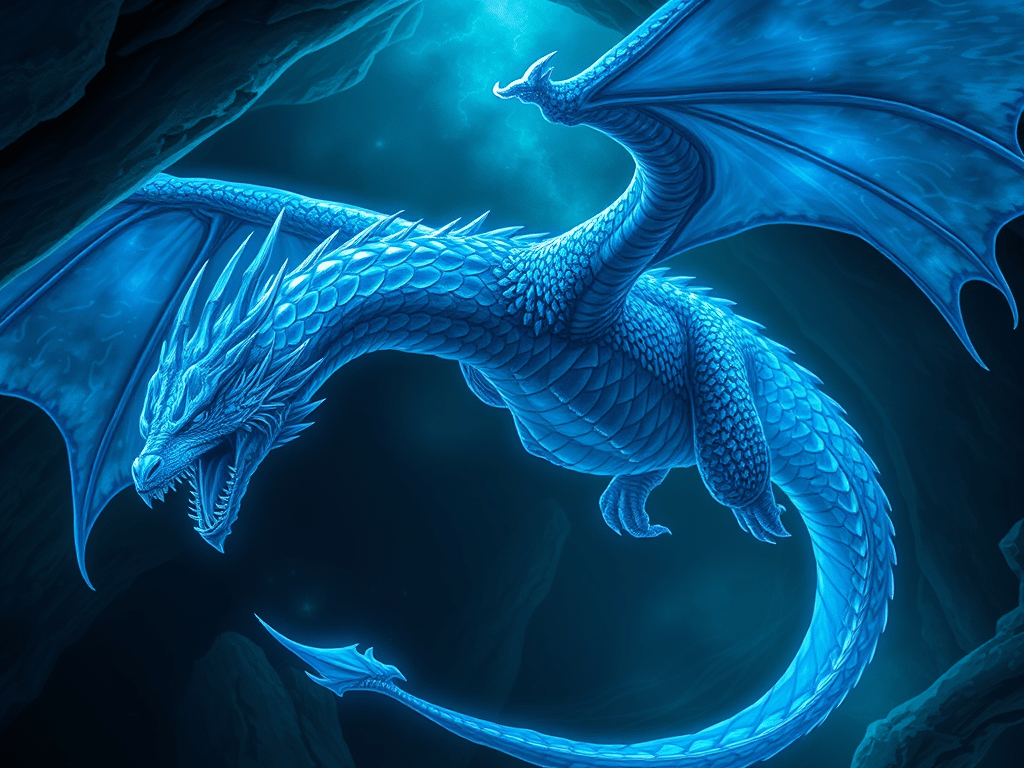
Sapphire Dragons: Key Points
-
Sapphire dragons are gems with crystalline blue scales, psionic powers, and a connection to the Underdark. Their scales become increasingly faceted with age, resembling carved gemstones.
-
These dragons are militant and highly territorial, aggressively defending their domains with strategic precision. They respect tactical thinking and can be negotiated with through direct communication.
-
They wield sonic or psionic breath weapons and possess telepathy, mental barriers, and earth manipulation abilities. Their combat style combines psionic control with physical attacks.
-
They maintain cautious relations with metallic dragons, disdain chromatic dragons, and clash with other Underdark species over territory. They prefer independence but form strategic alliances when needed.
-
Introduced in 1983, sapphire dragons were developed through multiple editions of Dungeons & Dragons, were absent from the fourth edition, and returned in 2021’s Fizban’s Treasury of Dragons. Their evolution reflects the game’s expanding approach to dragon diversity.
-
Sapphire dragons provide intellectually challenging encounters requiring combat skill and diplomacy. Their psionic abilities have normalized mental powers among dragons and inspired strategic campaign plots.

Introduction
One of the smartest and most intriguing types of dragons is the sapphire dragon. Its blue crystalline scales and profound connections to the Underdark’s subsurface regions set it apart from other dragons. These gem dragons are proficient at both martial arts and magic. Unlike their chromatic and metallic brethren, they focus on mental discipline and keeping their region under control, which allows them to maintain harmony and balance in their environment. Sapphire dragons are different from red dragons that spew fire or blue dragons that manipulate lightning. In fantasy literature, they are monsters that are both physically stronger and more intelligent than the other dragons. Adding them to the game has improved the draconic world by showing players and dungeon masters a species that values cunning tactics over brute force. Fighting them is a memorable way to test your fighting and diplomatic skills.
Physical Characteristics and Aesthetic Design
Sapphire dragons are massive, snake-like flying monsters with gem-like patterns on their scales. This makes sense because they are of the blue dragon family. The word “sapphire” corresponds with how many sourcebooks utilize visual language to stress a gem-like sheen and a desert-like look, which is in accordance with blue dragons’ mythology across editions (Snow, 2008; Linden et al., 2021; Gillespie & Crouse, 2012; Mariucci, 2023; Samuel et al., 2021).
Sapphire dragons are quite gorgeous. Their bodies are coated in scales that shimmer in all colors of blue, from light aquamarine to deep indigo. This design makes them look like the precious stone they are named after. Because these scales are see-through, light seems to capture and bend in intriguing ways, which makes the dragon’s movements nearly hypnotic. As old sapphire dragons grow older, their scales become shinier and more faceted, making them look like they were cut from a single big diamond. Because of how they shine inside, those who are psionic frequently describe that their eyes are like windows into immense pools of mental energy. Sapphire’s physique is more sleek and angular than other varieties of dragons. It has sharp ridges down its spine and wings that are more geometric and crystallized at the ends (Forgotten Realms Wiki, n.d.).
People know that dragons are aggressive and possessive and that their personalities are a mix of shrewd thinking and forceful defense of their territories. They are creatures that follow a set regimen. They make complicated patrol routines in their underground homes and become quite upset when those who don’t live there break these patterns. Sapphire dragons zealously seek and slay any threats they view as a challenge to their power. Many other dragon types, on the other hand, may allow smaller animals to pass through their territory undetected. The way they build their lairs, which often seem like guarded command centers with adequate escape routes and strategic views, indicates how military they are. Sapphire dragons are naturally aggressive, but they aren’t mindlessly cruel. If you treat them with respect and make your objectives clear, they will listen to you. They favor those who are direct and strategic, as this approach matches their tactical nature and boosts the chance for good communication and teamwork. Sometimes, they won’t hurt animals that display excellent strategic thought or useful military understanding (DnD Roll Wiki, 2022), as these qualities can be considered valuable traits that align with their own strategic mindset and objectives.
Powers and Combat Abilities
The powers of sapphire dragons demonstrate that they are both formidable combatants and adept at psionics. This makes them surprising and adaptable foes in any conflict (5etools, n.d.). Sapphire dragons use a breath weapon that resembles a sonic energy explosion or a confusing psionic scream, capable of piercing through stone and disrupting anyone’s thoughts, leaving them bewildered and vulnerable to attack. Sapphire dragons possess a powerful telepathic assault that intensifies with age. These include the ability to talk to each other without words, erect mental walls, and even manipulate the minds of weaker beings. Old sapphire dragons can effortlessly climb up and over walls and ceilings like spiders. They can also dig through solid rock like it’s water, and they may shock the ground to make their enemies less stable. They frequently utilize their telepathic skills to control the battlefield and confuse their adversaries before closing in with physical strikes. This feature demonstrates that they know a lot about how to use both mental and physical attacks together. Sapphire dragons are exceedingly difficult to trick or infiltrate their minds because they have to work diligently to learn these skills. This limitation makes it almost impossible to enchant them with many sorts of magic.

Relationships and Social Dynamics
Sapphire dragons and other types of dragons have relationships that are difficult to understand. There is professional respect, territorial tension, and disagreement about what dragons should accomplish in the world. Sapphire dragons are not very friendly with metallic dragons. They admire that metallic dragons obey the rules, but they think their brave assertions are a little too naive and unrealistic. They don’t like chromatic dragons because they think their chaotic and destructive behavior is a waste of time and shows a lack of strategic understanding. When it comes to their gem dragon friends, sapphire dragons are often the most fierce and aggressive. They sometimes fight with the smarter amethyst dragons for land or differences in how they think, often resulting in territorial disputes that can escalate into violent confrontations. Deep dragons, another type of creature that lives in the Underdark, are their enemies. This fact leads to battles every now and again over lucrative cave systems and resources found underground. Sapphire dragons prefer to remain independent and avoid involvement in wider draconic politics. But when it makes sense, they will ally with other dragon types or factions to secure their interests in these battles over lucrative cave systems and resources.
Historical Development and Cultural Impact
Sapphire dragons have evolved to show that D&D wants to add more dragon types than just colored or metallic ones. The 1983 version of the Monster Manual II for Advanced Dungeons and Dragons was the first to show gem dragons, such as sapphires. They were a brand-new kind of dragon with its own set of skills and features. In the second edition, these dragons got a lot more information, although they weren’t as well known as their more famous chromatic and metallic cousins. The Monster Manual II and the Draconomicon featured more information about gem dragons in the third edition of the game. These books talked more about how they act, where they live, and what part they play in campaign settings. But the fourth version’s core monster list didn’t have any gem dragons on it. Some fans were worried about their future in the game because they were only in the supplementary materials. The fifth edition kept this tendency going at first, and jewel dragons were not included in the main Monster Manual. But they came back in 2021 in Fizban’s Treasury of Dragons, with new rules and mythology that focused on their telepathic nature and incorporated them back into the main dragon family.
Sapphire dragons change the game in ways other than only their mechanical skills. They influence how players and dungeon masters think about the many kinds of dragons and how difficult they are to deal with in fantasy settings. Dungeon masters can make combat harder by adding sapphire dragons, a species that is strong both physically and mentally and prioritizes strategic thinking over brute force. They have improved the Underdark by adding a strong territorial force that can be an opponent or an uncomfortable ally, depending on how players confront them, which adds complexity to the narrative and challenges players to navigate their interactions carefully. The telepathic abilities of sapphire dragons have also served to make mental powers more common in the draconic world, influencing not only their interactions but also the dynamics of other dragon species and their relationships with adventurers. This ability has demonstrated that dragons are not merely lizards capable of flying and breathing fire. Their militaristic culture and strategic thinking have led to countless campaign storylines with armies like dragons, fights over land, and tough talks. Furthermore, the way gem dragons look, especially sapphire dragons, has offered artists and game makers more color options. They can now use more unusual and fanciful designs instead of only the traditional color-coded dragon varieties. Scholars point out how D&D and dragon mythology connect with ergodic literature and game design in a broader academic context. This interaction shows how players figure out their roles, their freedom, and how they help make the story in a fantasy world based on dragons. Even if it’s not only about dragons, looking at D&D through the lens of ergodic literature illustrates how complicated campaigns and settings focused on dragons can include both writing and copying (Hilton, 2023; Lechner, 2023; Dashiell, 2022), which allows for a rich narrative experience where players can engage in creative storytelling and character development.
Conclusion
Sapphire dragons show how deep and varied the Dungeons & Dragons universe can be. They show that dragons don’t have to fit into easy moral or elemental categories to be interesting and memorable. Sapphire dragons are a unique challenge that requires players to utilize both their combat and social skills due to their use of psychic power, territorial aggression, and complex tactics. The history of these creatures in the game shows how tabletop roleplaying has progressed over time to make monster creation more complicated and detailed. As the game grows bigger and better, sapphire dragons will probably still be one of the most essential types of dragons. They give dungeon masters many options for crafting fights that challenge all of their players’ talents and add depth to the story in any campaign world that is lucky enough to have them.
References
5etools. (n.d.). Ancient sapphire dragon. Retrieved March 15, 2026, from https://5e.tools/bestiary/ancient-sapphire-dragon-ftd.html
Advanced Dungeons and Dragons [Tabletop role-playing game]. (1977). TSR.
Dashiell, S. (2022). Chasing the Dragon (Magazine): Gender erasure through discourse in Dragon magazine, 1978–2005. Culture Studies ↔ Critical Methodologies, 22(6), 620-630. https://doi.org/10.1177/15327086221097635
DnD Roll Wiki. (2022, June 15). Adult sapphire dragon. Wikidot. http://dndroll.wikidot.com/creatures:adult-sapphire-dragon
Draconomicon [Game supplement]. (2003). Wizards of the Coast.
Dragon [Magazine]. (1976–2013). TSR/Wizards of the Coast.
Dungeons & Dragons [Tabletop role-playing game]. (1974). TSR.
Fizban’s Treasury of Dragons [Game supplement]. (2021). Wizards of the Coast.
Forgotten Realms Wiki. (n.d.). Sapphire dragon. Fandom. Retrieved March 15, 2026, from https://forgottenrealms.fandom.com/wiki/Sapphire_dragon
Gillespie, G., & Crouse, D. (2012). There and back again. Games and Culture, 7(6), 441-470. https://doi.org/10.1177/1555412012465004
Hilton, M. (2023). Winding path. The iJournal: Student Journal of the Faculty of Information, 9(1), 78-88. https://doi.org/10.33137/ijournal.v9i1.42238
Lechner, B. (2023). Psychodrama und Drachen: Die Verwendung von Pen & Paper-Rollenspielen in der Psychodrama-Psychotherapie mit Jugendlichen und jungen Erwachsenen. Zeitschrift für Psychodrama und Soziometrie, 22(1), 143-157. https://doi.org/10.1007/s11620-022-00706-4
Linden, R., Lopes, R., & Bidarra, R. (2021). Designing procedurally generated levels. Proceedings of the AAAI Conference on Artificial Intelligence and Interactive Digital Entertainment, 9(3), 41-47. https://doi.org/10.1609/aiide.v9i3.12592
Mariucci, A. (2023). From Dungeons & Dragons to Dragon Quest: Cultural dialogue and material shifts. Mutual Images Journal, (11), 27-50. https://doi.org/10.32926/2023.11.3
Monster Manual [Game supplement]. (2014). Wizards of the Coast.
Monster Manual II [Game supplement]. (1983). TSR.
Samuel, B., Ryan, J., Summerville, A., Mateas, M., & Wardrip-Fruin, N. (2021). Computatrum personae: Toward a role-based taxonomy of (computationally assisted) performance. Proceedings of the AAAI Conference on Artificial Intelligence and Interactive Digital Entertainment, 12(2), 79-85. https://doi.org/10.1609/aiide.v12i2.12900
Snow, C. (2008). Dragons in the stacks: An introduction to role-playing games and their value to libraries. Collection Building, 27(2), 63-70. https://doi.org/10.1108/01604950810870218


Leave a Reply