Pink Lady Ghosts: Key Points
-
Pink lady ghosts are distinctive feminine apparitions characterized by pink coloration and are associated with tragic romantic narratives.
-
These spirits display non-threatening behavior, wandering spaces as if replaying past events while conveying emotions of sadness and longing.
-
Famous pink lady hauntings include the Grove Park Inn in North Carolina, the Yorba Family Cemetery in California, and Stirling Castle in Scotland.
-
Theories range from psychological interpretations involving archetypal imagery to parapsychological explanations of residual hauntings or emotional energy imprints.
-
Pink lady legends significantly impact tourism and culture, with historic sites leveraging these stories to attract visitors and preserve properties.
-
These stories serve psychological functions by providing frameworks for processing grief, exploring mortality, and creating community connections with the past.

Introduction
One of the most intriguing and physically unique types of paranormal legend is the pink woman ghost. Ghost fans and skeptics alike have been fascinated by these ghostly beings, which have a feminine look and a pink tint that seems to float in the air, for hundreds of years. Pink lady ghosts are different from the more frequent white or gray ghosts that show up in ghost stories all around the world. They are known for their distinctive color and the romantic, often tragic storylines that go along with their presence. People from many countries and places have seen these beings, and each sighting adds to the rich fabric of supernatural legend that still fascinates people today.
Visual Characteristics and Behavioral Patterns of Pink Lady Ghosts
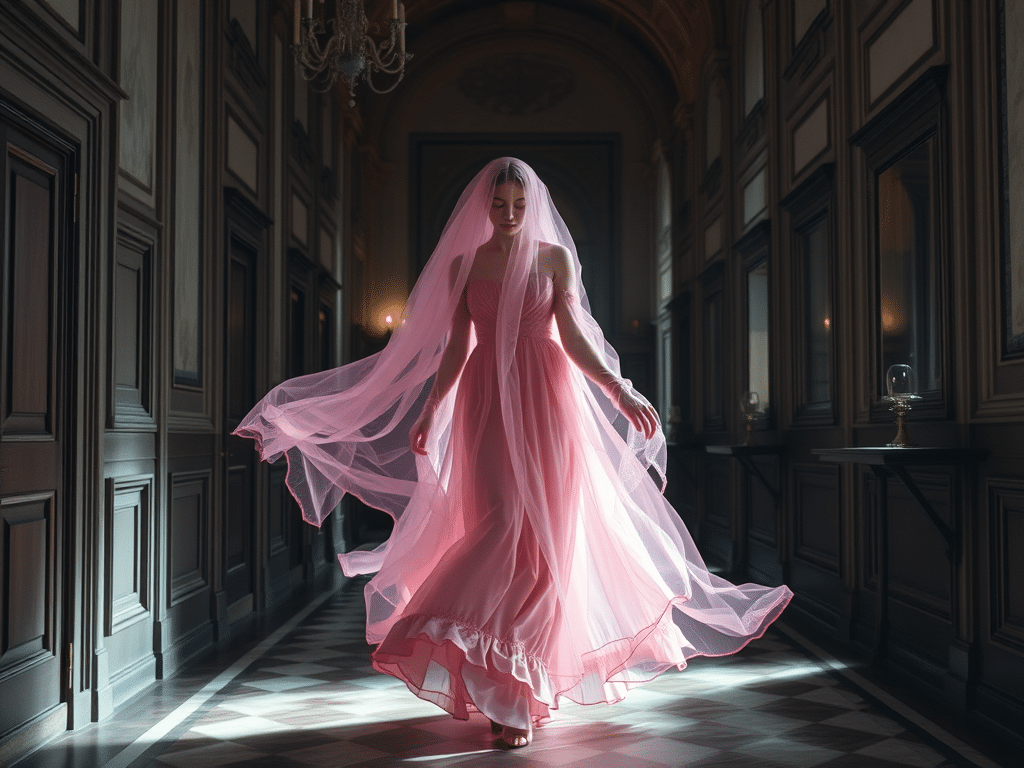
Pink lady ghosts usually look like women who are see-through or only partially see-through and are wearing flowing pink clothes or are surrounded by a pink aura or mist. Witnesses often say that these ghosts look like they are in colors from pale rose to deep magenta and that the color seems to pulse or shimmer as the ghost moves. People often say that the figures wear clothes from different historical periods, especially dresses or gowns. The pink color could be coming from the clothes themselves or from the spirit’s glow. Many stories say these beings are lovely or well-dressed, which adds to their romantic and sad reputation in ghost stories (Tice, 2020).
The way pink lady ghosts act is usually slightly different from other types of ghosts; they are frequently less scary or aggressive. People often say that these ghosts walk around hallways, show up in mirrors, or stand by windows as if they are waiting for someone or something (Love, 2009). Many people say that pink lady ghosts don’t seem to notice or care about living people. They go through places as if they are reliving experiences from their past lives. Some people say that these beings look sorrowful or melancholy and that they sometimes cry or reach out to people before disappearing. Witnesses have said that while they were around these ghosts, they felt tremendous sensations of melancholy, longing, or unrequited love.
Notable Pink Lady Ghost Accounts Across Locations
The Pink Lady of the Grove Park Inn in Asheville, North Carolina, is one of the most famous and well-known pink lady ghosts in American folklore. People think this kind spirit is a young woman who died in the 1920s after falling from a balcony on the fifth story. Some say she killed herself after an affair with a married man, while others say she fell by accident during a debutante function. She usually appears as a pink mist or a full figure of a woman in a pink ball gown. Unlike many other ghosts, she is recognized for being kind and fun instead of scary. The Pink Lady really likes kids. There have been many accounts of her calming sick kids at their bedsides, talking to them softly, and holding their hands all night. People also say she plays innocuous pranks like turning on and off electrical gadgets, moving things around in guest rooms, and sometimes tickling the feet of sleeping guests. The historic inn has been in business since 1913 and has hosted famous guests like George Gershwin and Harry Houdini. There have been sightings all over the inn, but the spirit seems to be especially attached to room 545, which is thought to be where she fell to her death (North Carolina Ghosts, n.d.). The crew of the Grove Park Inn has accepted the Pink Lady as part of the hotel’s charm and history. They see her as just another part of the historic past of their stately establishment.
The Pink Lady haunting at the Yorba Family Cemetery in Yorba Linda, California, shows how pink lady stories may turn into big events that bring together folklore, local history, and a shared sense of excitement about the unexplained. Legend has it that the Pink Lady shows up every two to five years on June 15th to visit the graves of her relatives, who are thought to be her children or her mother and aunt. She visits this cemetery, believed to be the oldest in California, established in 1858. The most common version of her biography says that she was a young woman who died in a carriage accident on Kellogg Road while wearing a pink dress and coming home from a dance, maybe her graduation ball at Valencia High School. About 200 people went to the cemetery on June 15, 1978, hoping to see her. They shared ghost stories and rumors of other sightings, such as pink clouds rising from the graveyard and the spirit appearing to the cemetery caretaker. At 11:40 p.m., the lights around the cemetery inexplicably went out, making the lamppost near her grave glow pink. This oddity made the gathering even more excited, but dubious psychic researcher Raymond Bayless said that the electrical interference had nothing to do with real psychic phenomena. Even though the atmosphere was tense and the lights went out for no reason, the Pink Lady never showed up that night. The crowd debated whether she had just decided to avoid the big gathering or whether the legend itself was false (Meier, 1978).
The phenomenon of pink lady ghosts goes beyond the United States to Scottish castles, where they are a big part of the rich tapestry of paranormal folklore that surrounds these medieval fortresses. The Pink Lady is one of two main ghost sightings that have been reported at Stirling Castle, one of Scotland’s most famous historical locations and the place where Mary, Queen of Scots, was crowned. There are different ideas about who this beautiful ghost in a pink garment is. Some say she is the ghost of Queen Mary herself, while others say she is a young widow who is constantly looking for her husband, who died in battle. The Pink Lady of Stirling Castle is different from many other castle ghosts since she is often seen following a certain path from the castle to the neighboring church. This suggests that she is still doing the same thing in death that she did in life. Her presence at Stirling Castle puts her in the company of other famous Scottish castle ghosts, such as the Green Lady, who is said to be a maid who died saving Queen Mary from a fire; different spectral pipers; and many gray ladies, who are linked to Scotland’s terrible and chaotic past. The fact that people have seen pink ladies in both the US and Scotland shows that this ghost type is common across cultures. However, the Scottish version seems to be less about romantic tragedy and more about royal history and loss on the battlefield (Scotland Welcomes You, 2017).

Theoretical Explanations and Cultural Significance
People that study and are interested in pink lady ghosts have come up with many different ideas on what they are, from psychological to otherworldly. Some paranormal researchers think that the pink color might have something to do with how the ghost felt, with the color standing for love, romance, or feminine energy that the soul brought with it from life to death. Some people think that the pink color can be an optical illusion, a way that the human mind interprets certain types of spiritual or electromagnetic energy. Skeptics argue that many sightings of pink lady ghosts are merely optical illusions, particularly during sunrise or sunset when natural light can create a pink or rose-colored appearance. They also say that the power of suggestion and societal preconceptions about how ghosts look might play a role in shaping people’s experiences and interpretations of these sightings, leading them to perceive the pink color as a ghostly presence rather than a natural phenomenon.
Psychological theories say that pink lady ghosts might be archetypal feminine entities that tap into images from the collective unconscious, especially when it comes to lost love and tragic romance. Many legends featuring female spirits who died young or in sad ways show how society thinks about women, virtue, and suffering in general. Some scientists believe that witnesses are more likely to interpret unclear visual events as pink lady ghosts when they occur in locations with well-known stories about them or in situations that lead people to expect to see them. People may report these ghosts more because they’re less scary and more romantic than other supernatural events.
Folklore and ghost stories sometimes include the “pink lady,” or pink-tinged female ghosts, who are gendered spirits that send moral or social messages. Several works in the corpus discuss how female ghosts often represent real-world problems such as violence against women, social justice, or fears in society. For instance, ghost stories often have hidden meanings regarding care, justice, and societal neglect. Studies have linked female ghost figures to discussions about care work and abuse of power (for example, long-term care advocacy and ghostly voices as political critique) (Pinto, 2023). These sources don’t only focus on the “pink lady” theme, but they do show how female ghosts can be used to criticize society and remember things as a group. Such behavior is a pattern that applies to pink lady ghosts in many different cultures (Heholt, 2014).
Some parapsychologists think that pink lady ghosts might be residual hauntings, which are like recordings of past events or feelings that are still present in the surroundings. This idea says that tragic or emotionally important experiences might leave an energetic mark that only certain people can see at certain times. The consistent appearance and behavior of the same pink lady ghosts in different hauntings support this concept. These spirits often repeat the same actions without addressing those present. Some scholars think that these beings could be intelligent hauntings, ghosts that are aware of their surroundings and stay in certain places because they have unfinished business or strong emotional links.
In folk tales from many cultures, female ghosts often come from experiences of being left out, being a victim of gender-based abuse, or being ignored by the government. They become symbols of collective memory and identity. The Felicitas Guerrero story from Argentina shows how a female ghost can turn gender-based violence into a cultural symbol and a place to produce legacy (the Felicitas Guerrero legend and the Santa Felicitas Historical Complex). This concept is an example of a bigger trend in which women’s ghost stories provide the basis for discussions about gender justice in local communities (Palleiro, 2021).
Economic and Social Functions of Pink Lady Legends
Pink lady ghost stories have influenced books, movies, and other popular entertainment. Romantic ghost stories frequently feature these ghosts, often portraying them in a more sympathetic light than other paranormal entities. Hotels and historic locations that say they have pink lady hauntings often use these stories in tours and marketing materials because they know that a romantic ghost story may make money. The pink lady archetype has inspired innumerable works of fiction, from Victorian gothic tales to modern paranormal romance. This trend shows how popular these mysterious female spirits are.
Many places use pink lady legends to get people to visit and show interest in old structures. These ghost stories have had a big impact on tourism and attempts to preserve history. The Greenbrier Resort, the Grand Hotel, and other places linked to pink lady hauntings have used these stories to set themselves apart from their competition and draw in customers. Ghost tours with stories about the pink lady have grown popular in many places. They help the local economy by attracting tourists and raising awareness about historical structures and events, which can lead to increased funding for preservation efforts. Some skeptics have questioned the truth of alleged hauntings because of this commercial aspect. They say that financial incentives can lead to the continuation or embellishment of ghost stories, which may distort the original narratives and impact the community’s understanding of its history.
Pink lady ghost stories serve important social and psychological purposes that show how much people require stories, meaning, and a connection to the past. These stories are typically ways for people to deal with their grief, think about lost love, and think about death in ways that don’t seem as scary as facing death directly. The romantic quality of pink lady legends allows us to discuss historical disasters while preserving some beauty and sadness in the stories, making them easier to read. Communities that keep and tell Pink Lady stories connect with the past and provide people a feeling of place and identity based on local history and tradition.
Conclusion
Pink lady ghosts are still a unique part of paranormal legend because of how they look and the romantic stories that go along with them. These beings show how deeply humans care about love, sorrow, and the idea that life goes on beyond death, whether they are considered real supernatural events, psychological projections, or cultural artifacts. The fact that pink lady legends have lasted through many countries and times implies that these stories have vital social and psychological purposes, even if they aren’t based on true events, such as providing comfort to the grieving or creating a sense of community among those who share similar beliefs. Pink lady ghosts will probably keep wandering through our minds forever, looking for what they lost in life, as long as people contemplate death and try to connect with the past.
References
Heholt, R. (2014). Science, ghosts and vision: Catherine Crowe’s bodies of evidence and the critique of masculinity. Victoriographies, 4(1), 46-61. https://doi.org/10.3366/vic.2014.0150
Love, D. (2009). Scottish ghosts. Amberley Publishing Limited.
Meier, G. (1978, June 24). Haunting lady stands up a crowd of 200 admirers. Yorba Linda Star, p. 2. http://www.yorbalindahistory.org/gsdl/cgi-bin/library?e=d-000-00—0tescol–00-0-0–0prompt-10—4——0-0l–1-en-50—20-home—00031-001-1-1utfZz-8-00&d=HASH07d520a2a8cd2648307d0b.1#start
North Carolina Ghosts. (n.d.). The Pink Lady of the Grove Park Inn. https://northcarolinaghosts.com/mountains/the-pink-lady-of-the-grove-park-inn/
Palleiro, M. (2021). Felicitas Guerrero, an Argentinian legendary character: History, tragedy, and femicide. https://doi.org/10.33422/3rd.icarss.2021.03.320
Pinto, L. (2023). Greetings from the Pink Palace: An architecturally, paranormally, and politically accurate ghost story. Studies in Social Justice, 17(3), 515-520. https://doi.org/10.26522/ssj.v17i3.4337
Scotland Welcomes You. (2017, March 8). Scottish castle ghosts: Green ladies, pink ladies and the ghostly piper! https://scotlandwelcomesyou.com/scottish-castle-ghosts/
Tice, M. O. (2020). Trapped on Earth in the Land of the Sky: Tellability and cultural impact in the ghostly legends of Zelda Fitzgerald and the Pink Lady in Asheville, North Carolina [Master’s thesis, The University of North Carolina at Chapel Hill].

Leave a Reply