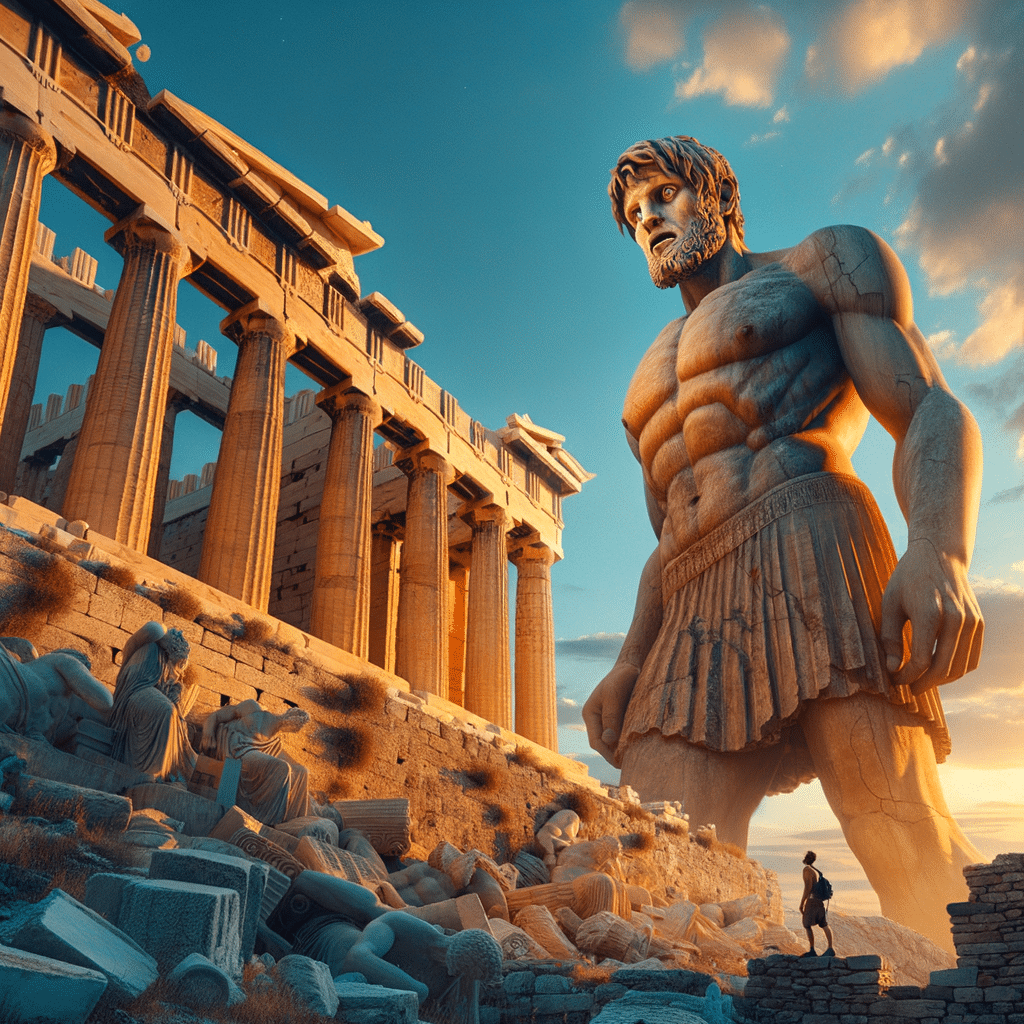
Stories of amazing creatures spanning the divine and mortal spheres abound in the ancient world. Among these enigmatic people are the Nephilim, cryptic beings referenced just fleetingly in biblical writings but whose legacy has spurred millennia of conjecture and interpretation. Often characterized as the result of divine and human pairings, these entities have striking resemblances to numerous Greek mythological personalities. This essay investigates the nature of the Nephilim as recorded in ancient texts and looks at possible links between these biblical giants and the heroes, monsters, and demigods that abound in Greek mythological traditions, implying a possible shared cultural memory or parallel mythological development spanning many ancient civilizations.

Nephilim
First mentioned in Genesis 6:4, the Nephilim are the descendants of the “sons of God” and the “daughters of men” who lived before the Great Flood. Throughout history, these fleeting references have been understood in different ways. Some traditions see them as fallen angels who mated with humans, while others view them as children of Seth’s virtuous line intermarrying with Cain’s corrupt progeny. Though not canonical in most traditions, the Book of Enoch goes into more detail on these people, characterizing them as the descendants of 200 fallen angels known as the Watchers who taught mankind forbidden knowledge and whose progeny grew powerful warriors and rulers in the antediluvian world. Though few, these stories create a picture of strong entities whose existence was considered a trespass of divine boundaries and whose presence finally helped to contaminate the earth, leading to the biblical flood (Routledge, 2015).
Physical accounts of the Nephilim repeatedly highlight their enormous height; biblical books call them “the giants” or “the mighty ones of old.” Numbers 13 implies remarkable stature by describing ordinary people as appearing like grasshoppers in relation. The Book of Enoch explores their commanding presence, characterizing them as having enormous height, strength, and appetites that would not be satisfied, finally prompting them to eat humans when other food supplies ran out. Many readings of their hybrid character show both supernatural qualities and human shortcomings, strong beyond mortal measure but defective in ways that reflect their dual ancestry. At the junction of the celestial and mortal realms, these people are intriguing because of their outstanding physical ability combined with sophisticated nature.
Ancient writings claimed that the Nephilim behaved violently and corruptly and introduced forbidden knowledge to mankind, therefore transforming human conduct. According to the Book of Enoch, they are ravenous creatures who ate all the acquisitions of mankind until humans could no longer support them; at that point they turned against people and started to eat them. They disrupted the natural order of creation by introducing battle, luxury, and many forbidden skills to mankind. People view their deeds as significantly contributing to the depravity that triggered divine judgment in the Great Flood. Though destructive, they are also shown as beings of immense wisdom and ability, credited with teaching people many skills and arts that changed prehistoric society, implying a complicated legacy combining both destruction and cultural development (Kosior, 2018).

Greek Mythology
The cornerstone of ancient Greek religious and cultural knowledge is the rich tapestry of tales Greek mythology portrays, including gods, heroes, monsters, and numerous hybrid beings. From their base on Mount Olympus, the Olympian gods—immortal entities that ruled many facets of the natural world and human life—are fundamental in these stories. These gods regularly interacted with people, occasionally creating demigods—that is, heroes with extraordinary talents beyond those of common people. Greek mythology often presents monsters and giants as offspring of primordial gods or as beings created by supernatural events. In ancient Greek society, these stories fulfilled several functions: they explained natural events, set cultural standards, and investigated basic issues about humanity’s interaction with the divine and the natural surroundings.
There are significant similarities between the Nephilim and several Greek mythological beings that point to possible common cultural influences or comparable mythological evolution. Described as massive entities challenging divine might, the Gigantes and Titans of Greek mythology reflect the Nephilim’s function as disruptive agents in the cosmic order. Born from couplings between gods and humans, Greek heroes such as Heracles, Perseus, and Theseus reflect the mixed divine-human character ascribed to the Nephilim (Nounanaki, 2024). Both customs have stories of divine wisdom being taught to mankind by boundary-crossing people; Prometheus teaches people fire and crafts just as the Watchers and their children provided different technology. Both civilizations include a theme of divine punishment for transgression; Zeus’s flooding of the earth during the time of Deucalion corresponds with the biblical flood dispatched to purify the earth of the corruption attributed somewhat to the impact of the Nephilim.
Greek legendary figures reflect the behavioral traits ascribed to the Nephilim rather remarkably. The violent and destructive impulses of the Nephilim fit the accounts of the Gigantes, who fought a war against the Olympian gods in a terrible conflict sometimes referred to as the Gigantomachy (Lindsay, 2018). Since the Nephilim were created when divine and human beings got together in the wrong way, their sin shows how difficult it was for Greek gods to deal with their dual nature and the demands of both worlds. The knowledge-bringing quality of the Nephilim tradition corresponds with the function of people like Prometheus, who disobeyed divine ban to provide mankind fire and other talents. In the end, these actions that cross boundaries are punished by God in both traditions. This suggests that there is a cultural worry about how to properly separate the divine and mortal realms that can be seen in many mythological systems.
These parallels create intriguing considerations regarding probable historical links or parallel mythological evolution between Greek and Hebrew traditions such as the Epic of Gilgamesh. Possible similarities could arise from overlapping cultural influences in the ancient Near East, with Mesopotamian stories like the Epic of Gilgamesh maybe providing common source material for later traditions. Others cite possible cultural interactions between Greek and Hebrew traditions during the Hellenistic era, when they came into closer proximity. Other ideas say that these similarities, especially when it comes to worrying about the limits between humans and gods, are caused by the fact that people have always liked making mythological characters that are like them. Although clear historical links are still challenging to prove, the thematic resonances across these civilizations point to a complicated relationship spanning more than just simple chance.
The Nephilim and its possible links to other legendary traditions captivate people even now because of their immense symbolic significance across civilizations and eras. Hybrid beings, which exist between the heavenly and mortal realms, represent basic human worries about boundaries, forbidden knowledge, and what happens when those boundaries are broken. Explore human curiosity about curiosity with remarkable creatures who transcend common constraints and act as warning tales about the perils of upsetting cosmic order. Whether considered historical entities, allegorical figures, or cultural memories changed across generations of storytelling, the Nephilim and their possible Greek counterparts still enthrall our imagination and call us to investigate the rich mythological traditions that have molded human perspective of our place in the universe (Doak, 2025).
Conclusion
In the end, there isn’t much historical evidence to suggest that the Nephilim and Greek mythological characters are related. However, the striking similarities between these cultures suggest that they knew about how the divine and mortal worlds are connected. Reflecting old concerns about cosmic order and the consequences of its disturbance, both religions struggle with the implications of boundary-crossing entities who bring both benefits and disaster to mankind. The Nephilim are similar to many Greek mythological characters, from the Gigantes to demigods and cultural heroes. This suggests that they may share common story structures that go beyond specific cultural settings. It doesn’t matter if these similarities come from direct historical influence, shared ancestral myths, or universal human psychological patterns. They show how ancient civilizations used mythological stories to explore basic questions about power, knowledge, and the right way for humans to relate to the divine. In this way, studying the Nephilim and their possible connections to Greek mythology gives us a look into the problems and ways of telling stories that people in ancient times had in common. This reminds us that stories can still speak to our deepest fears and desires.
References
Doak, B. R. (2025). Shocking Discoveries of Giants You Will Not Believe!!! Conspiracy Belief and Archaeological Interest in YouTube Videos about Biblical and Other Giants. The Journal of Religion and Popular Culture, 1-32.
Kosior, W. (2018). The Fallen (Or) Giants? The Gigantic Qualities of the Nefilim in the Hebrew Bible. Jewish Translation—Translating Jewishness, 17-38.
Lindsay, D. (2018). Giants, Fallen Angels, and the Return of the Nephilim: Ancient Secrets to Prepare for the Coming Days. Destiny Image Publishers.
Nounanaki, A. L. (2024). (Re) inventing a National Myth: A New Narrative on the Origin of the Greek Nation through Conspiracy Thinking. Contemporary Legend, 2, 1-21.
Routledge, R. (2015). The Nephilim: a Tall Story? Who Were the Nephilim and How Did They Survive the Flood? Tyndale bulletin, 66(1), 19-40.

Leave a Reply