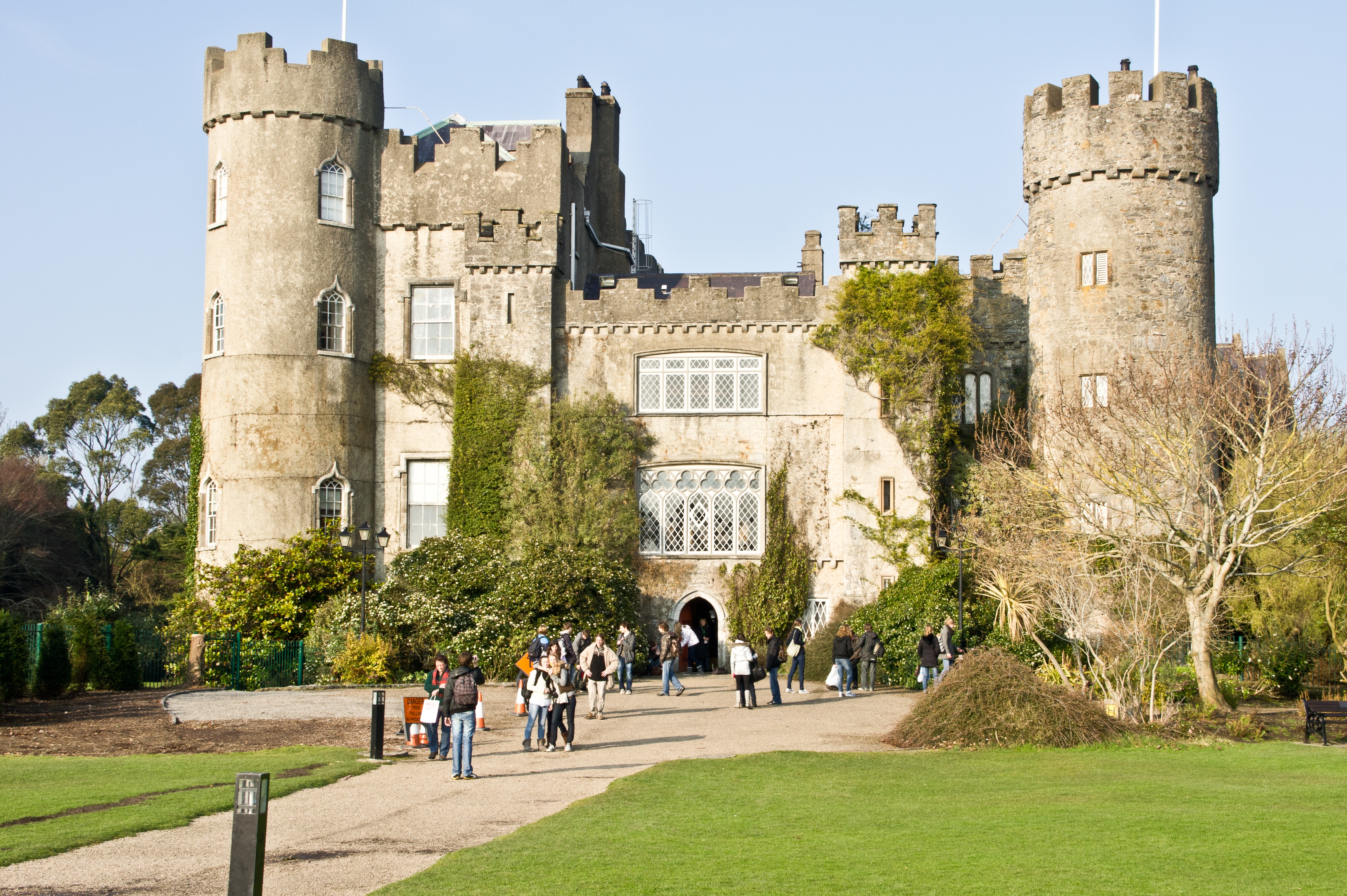
One of Ireland’s oldest and most evocative medieval fortifications, Malahide Castle’s stone walls hold not just centuries of history but also, according to many accounts, restless souls from past times. Hailing from the 12th century, this massive building sits in the lovely coastal town of Malahide, just north of Dublin, and has seen the whole range of human experience, from opulent parties to tragic sadness. With descriptions of experiences that defy conventional explanation, visitors, personnel, and locals have helped to slowly increase the castle’s reputation for paranormal activity over decades, establishing it among Ireland’s most notoriously haunted sites.

Description
Reflecting the countless changes made during its 800-year history, the castle itself is an architectural marvel combining several historical styles. Towering battlements and towers, which have endured centuries of Irish weather and historical disturbance, enhance its gray stone facade. Inside, the castle features rich period rooms decorated with rare antiques, ancestral portraits, and one of Ireland’s best collections of historical furniture. While the sitting rooms display beautiful Georgian and Victorian decoration, the Great Hall still looks much as it did centuries ago with its high timber ceiling and large fireplace. Surrounding the castle are 260 acres of verdant parkland boasting carefully maintained gardens, including the famous Butterfly House and botanical marvels gathered over ages by the castle’s former inhabitants (Tutty, 1978).
Inextricably tied to the Talbot family, who got the territory from King Henry II in 1185 and astonishingly kept ownership for almost 800 years until 1975, Malahide Castle’s history is one of Norman knight Richard Talbot built the first fortification, and subsequent generations gradually expanded it into the magnificent castle that still stands today. Influential people in Irish society, the Talbots advised monarchs and took part in turning points in history. The saddest family story may be when 14 members had breakfast at the castle before the Battle of the Boyne, where all but one died, leaving a lasting mark on the castle’s past. Some might say that the castle’s rich tapestry of stories and, especially, its ghostly ambiance have been shaped by this remarkable continuity of ownership over such turbulent years of Irish history (RA, 1834).
Among the most often mentioned paranormal events at Malahide Castle is the presence of Sir Walter Hussey, a 15th-century knight murdered in battle on his wedding day. Visitors have reported spotting a young guy in medieval clothing wandering the hallways, occasionally holding his side where he suffered his deadly injury. Arguably the most renowned ghostly tenant of the castle, Lady Maud Plunkett, known as the White Lady, has been spotted walking out of her portrait hanging in the Great Hall. Still looking for her third husband, who vanished under strange circumstances, Lady Maud is said to roam the castle grounds dressed in the same white gown she wears in the artwork, especially on moonlit nights. Among the many unexplained events recorded by castle personnel are doors opening and closing on their own, the sound of phantom footsteps reverberating down deserted halls, and unexpected, unexplainable temperature decreases that leave rooms chilly even on summer days (Baldwin, 2024).
Miles Corbet, a Cromwellian soldier who momentarily owned the castle after it was confiscated from the Talbots in the 17th century, may be the most disturbing ghostly resident. Corbet’s ghost is claimed to be a fully armored soldier who abruptly comes apart, his armor shattering to the ground in pieces, a gruesome echo of his execution by drawing and quartering. Another common spirit is Puck, the castle jester who fell in love with a kinswoman of the Talbot family and was discovered frozen to death beyond the castle walls. Often, his impish presence is felt in the castle’s tower, where personnel and guests say they hear playful laughter and feel someone pulling at their clothes in the absence of anyone else. Reportedly, phantom noises of celebration and banquet festivities drift from the Great Hall after hours as if the castle’s long history of feasting goes on in some unseen realm (Pickup, 2019).

Analysis
Ranging from scientific justifications to metaphysical notions, several theories have been put up to account for the paranormal events at Malahide Castle. According to some parapsychologists, the castle’s limestone base might be a natural recorder of historical events, holding emotional energy that sometimes replays under particular atmospheric conditions—a notion called the stone tape theory. Some cite the castle’s proximity to old ley lines, hypothesized alignments of many sites of geographical significance that allegedly funnel strange energies able to thin the boundary between worlds (Hardy, 2011). Skeptics contend that the castle’s drafty hallways, old plumbing, and settling foundations create noises and temperature changes that human psychology, primed by the castle’s gothic look and well-known ghost stories, interprets as supernatural. Visitors often come to the castle expecting a paranormal event; therefore, the power of suggestion cannot be ignored. This may make them more prone to interpreting routine events as exceptional.
More conventional interpretations emphasize the idea that tragic deaths, especially those involving intense emotions like the Talbot family’s mass death following the Battle of the Boyne, can leave spiritual impressions that last throughout time. Supporters of this belief claim that the castle’s lengthy and sometimes violent past has produced layers of spiritual energy now present in our physical world. Interestingly, many of the paranormal encounters at Malahide involve historical figures who faced unexpected, violent deaths or unresolved emotional issues, which supports the theory that strong emotional states at the time of death could potentially tether a ghost to a place. Often with unexpected results that challenge conventional wisdom, psychical researchers have run many studies at the castle, employing different scientific tools, including audio recording devices, infrared cameras, and electromagnetic field detectors.
Malahide Castle now offers particular ghost tours stressing its paranormal past, welcoming its standing as one of Ireland’s most haunted sites. People from all over the world are attracted to the castle not only for its historical relevance and architectural beauty but also for the chance of experiencing something beyond the usual. Staff personnel keep reporting fresh meetings, implying that whatever forces are operating inside the castle walls show no signs of fading with time. These events surely provide another depth to the complex tapestry of narratives that make Malahide Castle an exceptional site, whether one sees them as real expressions of the spirit realm or as byproducts of human psychology and imagination.
Conclusion
Ultimately, Malahide Castle is a fascinating crossroads where history and the supernatural meet, hence questioning our perception of reality and what could lie beyond it. From sorrowful knights and wandering women to playful jesters and dismembered warriors, the castle’s spectral inhabitants have grown to be as much a part of its identity as its architectural characteristics or historical relevance. For now, Malahide Castle is a site where the past refuses to keep mute, where centuries-old dramas continue to play out in shadowy corners and midnight gardens. While science may one day explain the odd events inside its walls, whether we see these events as real hauntings or as expressions of our shared curiosity about the unknown, they certainly enhance our encounter with this great historical treasure, reminding us that some locations really appear to be in the liminal space between the world we know and the domains we have yet to grasp.
References
Baldwin, P. J. (Ed.). (2024). Ghost Stories: Architecture and the Intangible. John Wiley & Sons.
Hardy, C. H. (2011). The Sacred Network: Megaliths, Cathedrals, Ley Lines, and the Power of Shared Consciousness. Simon and Schuster.
RA. (1834). Malahide Castle, County Dublin. The Dublin Penny Journal, 284-285.
Pickup, G. (2019). The 50 Greatest Castles and Palaces of the World. Icon Books.
Tutty, M. J. (1978). Malahide Castle. Dublin Historical Record, 31(3), 93-96.



Leave a Reply