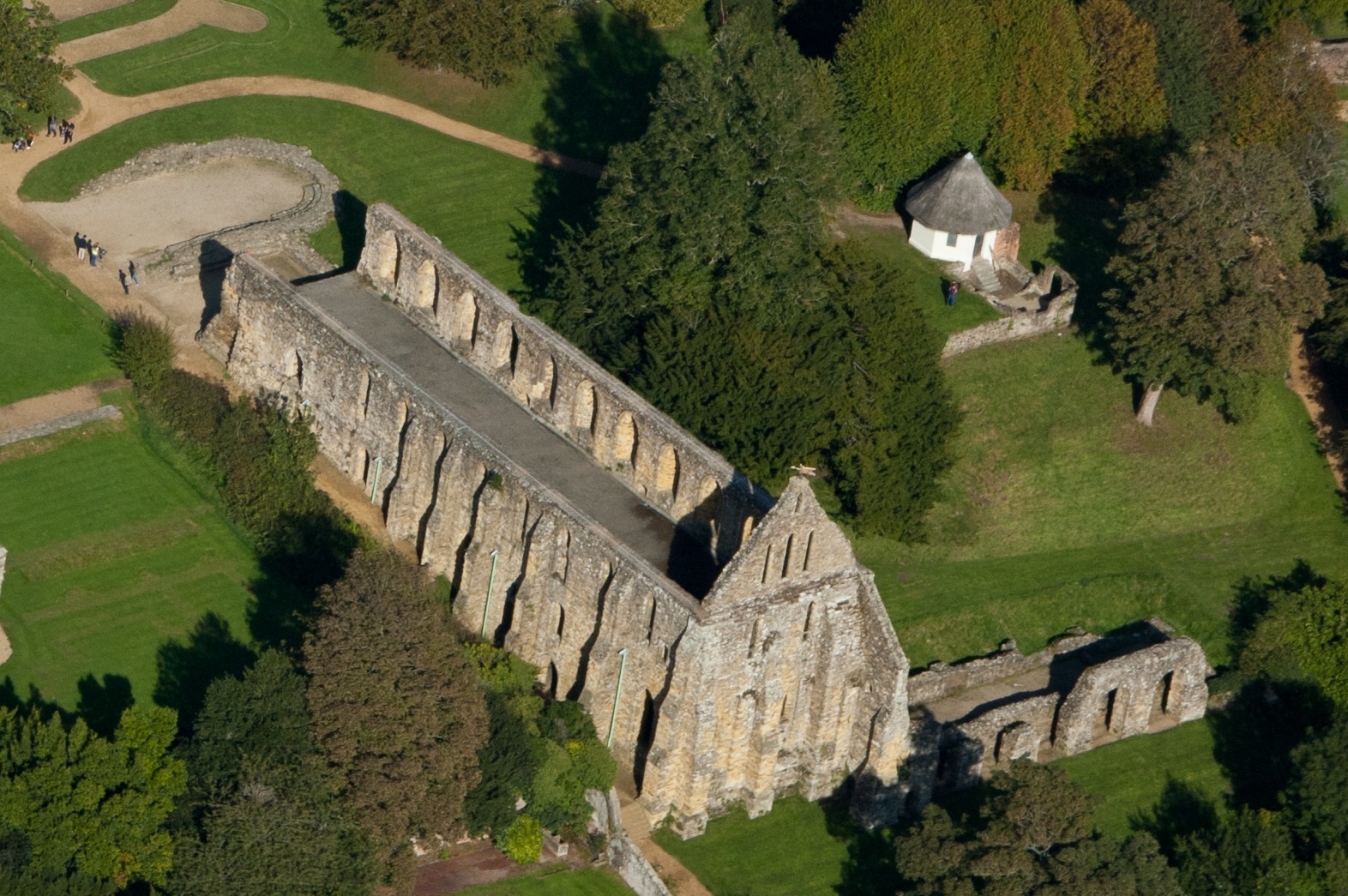
Silent witnesses to almost a millennium of English history, the old stones of Battle Abbey stand where the barrier between past and present seems unusually thin. Located on the site of the Battle of Hastings in East Sussex, England, this historical monument has garnered prominence not only for its crucial part in British history but also for the numerous unexplained phenomena reported within its grounds and remaining structures. Both visitors and employees have reported strange events, such as disembodied voices reverberating through deserted halls, spectral monks roaming the cloisters, and intense feelings of being watched by invisible forces. These ongoing stories throughout the ages have confirmed Battle Abbey as one of the most haunted sites in England, where the remnants of its troubled past seem to show up in ways that question our knowledge of reality.

Overview
Built as both a memorial to the Norman conquest and as penance for the violence that took place on these grounds, Battle Abbey was erected by William the Conqueror following his triumph at the Battle of Hastings in 1066. Reportedly, the high altar was located precisely where King Harold fell; construction started in 1070 and finished in 1094. Until Henry VIII’s Dissolution of the Monasteries in the 1530s, the Benedictine monastery thrived for centuries, growing into a hub for religious life and research. Following this turning point, the abbey went into private hands and served several functions, including a magnificent country house, a girls’ school, and finally a heritage site run by English Heritage. Though much damage during its post-monastic history has been done, the remaining buildings—including portions of the abbey church, the dormitory range, and the magnificent gatehouse—stand as architectural marvels (Davis, 1914).
Consistently recorded across decades, the paranormal activity at Battle Abbey covers a vast spectrum of events. Among the most well-known are sightings of spectral monks in conventional black Benedictine robes who seem to follow historic routes throughout the ruins and disappear when confronted. Particularly after dark or around major religious anniversaries, visitors have reported hearing Gregorian chants coming from the vacant abbey church. Reports of chilly places, disembodied footsteps, and the feeling of phantom hands stroking guests’ shoulders or pulling at their clothes suggest the dormitory area is particularly active. Most dramatically, witnesses have reported seeing ghost soldiers throughout the battlefield at the anniversary of the Battle of Hastings in October, complete with the sounds of clashing weapons and dying men booming across the otherwise vacant fields (Hippisley Coxe, 1973).
Staff call the gatehouse’s specific phenomenon the watcher, a suffocating presence perceived at the top of the stairs that has driven several guests to decline to climb alone. Objects moving without explanation, doors opening and closing on their own, and lights coming on in places where the electrical systems had been turned off have all been recorded by caretakers and nocturnal security staff. Visitor photographic evidence frequently shows unexplainable orbs, hazy images, and occasionally what seem to be faces staring from windows of vacant rooms. These experiences’ intensity usually rises on historically important days or when renovation work disrupts the physical structure, implying a link between the paranormal manifestations and the historical relevance of the site (Hole, 2010).

Analysis
With some more conventional than others, several ideas seek to account for the ongoing supernatural activity at Battle Abbey. The psychological explanation holds that guests, driven by the history and reputation of the site, undergo pareidolia and the power of persuasion, seeing ordinary environmental events as supernatural. Many of the claimed physical feelings and noises might be explained by the atmospheric conditions of the ancient structures, including temperature changes, strange acoustics, and aging materials expanding and contracting. Many encounters, according to skeptics, take place around transition times like nightfall when human perception is naturally less dependable, hence misleading guests on normal events (Underwood, 1971).
More metaphysical hypotheses suggest that the great emotional stress connected with the fight and decades of monastic dedication may have marked the surroundings themselves. The stone tape idea holds that under some circumstances, particular materials—especially limestone and quartz in ancient buildings—might record and repeat emotional or painful experiences, hence producing a psychic recording that sensitive people can detect. Some people accept the conventional perspective that ghosts of the deceased, especially those who died violently or with unfinished business, stay tied to sites of importance to them. While troops who died unexpectedly in combat might not know they have passed on, continuing to fight a centuries-old conflict, the monks who devoted their lives to the abbey may feel an eternal duty to its grounds.
Paranormal activity and site-related electromagnetic fluctuations have been linked by certain studies, which has prompted speculation about the link between spiritual manifestations and natural energy fields. Modern paranormal investigators have recorded odd electromagnetic readings that challenge conventional explanations as well as temperature decreases of up to ten degrees Fahrenheit in specific places where apparitions are later observed. With Battle Abbey acting as a natural laboratory for such events because of its particular history and geological location, these results have sparked concern about whether the spiritual and the scientific could be linked in ways not yet completely understood by modern science (Guiley & Taylor, 1992).
Reflecting our complicated relationship with history and death, the cultural relevance of Battle Abbey’s hauntings goes beyond simple ghost stories. The ongoing nature of these stories, across time and from witnesses of many backgrounds, points to something more substantial than straightforward folklore at work. Whether the events are real spirits of the dead or reflections of communal memory stamped on location, they are strong reminders of how the past shapes the present. The abbey’s paranormal reputation has helped it to be preserved as a heritage site since the spiritual aspects of the site provide more meaning beyond its architectural and historical value.
Conclusion
Ultimately, Battle Abbey is a crossroads where the paranormal, architecture, and history come together to form one of the most mysterious sites in England. Though they defy clear explanation, the ongoing accounts of supernatural events throughout millennia cannot be simply discounted. Whether one sees these events through the prism of skeptical rationalism or spiritual belief, the abbey keeps pushing our knowledge of the limits separating past and present, the living and the dead. Many say they feel something beyond the physical remains—a tangible link to events and people long gone but nevertheless strangely present as visitors wander the grounds where Norman and Saxon forces once battled, altering the course of English history. Maybe Battle Abbey’s greatest legacy is this ongoing enigma: a reminder that history is a living force that still shows in both normal and exceptional ways, not only a compilation of facts.
References
Hole, C. (2010). Haunted England: A survey of English ghost lore (1941 ed.). Kessinger Publishing.
Davis, H. W. C. (1914). The chronicle of Battle abbey. The English Historical Review, 29(115), 426-434.
Guiley, R., & Taylor, T. (1992). The encyclopedia of ghosts and spirits (pp. 277-279). New York: Facts on File.
Hippisley Coxe, A. D. (1973). Haunted Britain. Pan McMillan.
Underwood, P. (1971). A gazetteer of British ghosts. Pan Books Ltd.

Leave a Reply