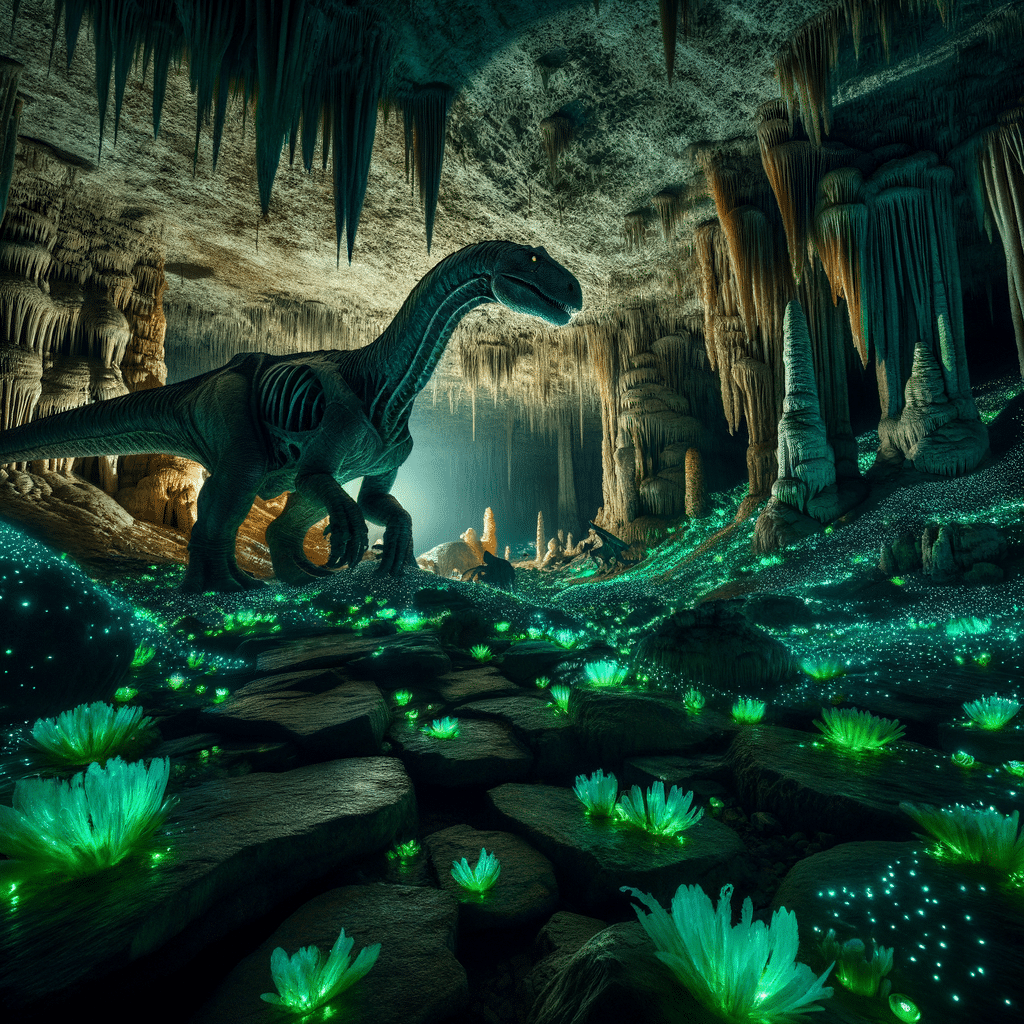
For decades, the idea that dinosaurs could still be hiding in the deep, hollow Earth has enthralled human imagination. This remarkable idea combines two intriguing theories: that prehistoric animals miraculously survived the horrific catastrophes that caused their alleged extinction and that our world has large interior areas where these old species still flourish beyond human sight. Although contemporary science categorically denies both theories, they remain in popular imagination, literature, and entertainment media as enticing substitutes for accepted scientific knowledge. Examining the origins of these ideas, their scientific rebuttal, and their lasting attraction in fiction and popular culture, this essay investigates the cultural fascination with living dinosaurs hidden under an Earth that is hollow instead of solid.

Overview
Ranging from the huge, long-necked sauropods to the fast, predatory theropods that featured the terrifying Tyrannosaurus rex, dinosaurs ruled Earth for over 165 million years, evolving into an incredible variety of shapes. From the defensive armor of ankylosaurs to the unique crests of hadrosaurs and the lethal sickle-clawed feet of dromaeosaurs, these wonderful animals adapted to practically every terrestrial environment, evolving specialized traits for various ecological niches. Conventional paleontology holds that most dinosaur lineages (except birds) vanished during the mass extinction event about 66 million years ago, most likely caused by an asteroid impact coupled with severe volcanic activity changing Earth’s temperature and ecosystems. Some find it difficult to comprehend their total departure from the living world, however, given the great size of their success and the very recent finding of their petrified remains (Barrett, McGowan & Page,2009).
The hollow Earth hypothesis suggests that rather than being solid all over, our world has significant internal voids that might one day host concealed organisms. With renowned supporters like Edmond Halley, who in 1692 proposed the Earth held concentric spheres that might support life, this idea has been around for centuries. Later developments of the hypothesis imagined enormous interior caves lit by a central sun, complete with oceans, continents, and atmospheres sufficient to sustain complicated life forms separated from surface circumstances. Hollow Earth fans say these inner worlds could be reached via polar openings or deep tunnel networks, yet such access points stay conveniently unknown or are said to be hidden by government conspiracies. Though contemporary geophysics has completely invalidated it, this hypothesis, which first became popular in the 19th century and was included in writings by Jules Verne, among others, still finds followers (Kollerstrom, 1992).
The combination of these two ideas—surviving dinosaurs and a hollow Earth—creates a fascinating story that solves the clear enigma of dinosaur extinction. Supporters say that some dinosaur populations may have withdrawn into enormous cave systems after the devastating events at the end of the Cretaceous period, finally adapting to live in these underground settings. These isolated communities could have kept evolving in their sheltered habitat for millions of years, away from the severe climate changes impacting surface life. This story preserves these magnificent animals in an unreachable but theoretically existing domain where they keep flourishing beyond human view or meddling, hence providing a gratifying substitute for extinction. The remoteness of this setting would account for the total lack of contemporary dinosaur sightings or tangible evidence on the surface world.
Among the most enduring stories in hollow Earth mythology are the supposed encounters of Admiral Richard E. Byrd during his polar missions, especially his 1947 Antarctic one referred to as Operation Highjump. Claims that surfaced years after his death say Byrd allegedly flew his plane beyond the South Pole and found an entry to an inner Earth inhabited by advanced societies and, astonishingly, living dinosaurs that had escaped annihilation by fleeing to this safeguarded domain. Contrary to the frigid wilderness known to exist at Antarctica’s surface, these narratives imply Byrd found a rich, temperate habitat where prehistoric animals wandered freely. Though no verified papers support such claims, advocates of this story sometimes cite Byrd’s supposed secret diary entries detailing these wonderful finds; the timing and practicalities of his actual recorded flights render such diversions practically impossible (Byrd, 2015).
Though there was no reliable evidence, the Byrd Antarctic stories became a mainstay of hollow Earth mythology in alternative literature in the 1950s and 1960s. Following Byrd’s alleged discovery, conspiracy theorists claim government institutions all across the world worked together to hide his results and limit access to polar areas to stop public awareness of the hollow Earth and its prehistoric people. The story says Byrd saw not just living examples of recognized dinosaur species but entirely new types formed in isolation over millions of years, tailored to the particular circumstances of the interior Earth ecosystem. Although legitimate historical records show Byrd was a successful explorer who greatly contributed to polar research and aviation, nothing in his verified writings or the vast records of his travels backs these wonderful assertions, which stay only in the domain of pseudoscientific speculation and conspiracy theory.
![By J. Allen St. John - [1], Public Domain, https://commons.wikimedia.org/w/index.php?curid=12732750](https://i0.wp.com/connectparanormal.net/wp-content/uploads/2025/04/At_the_Earths_Core_1922_Dusk_Jacket.jpg?resize=201%2C300&quality=89&ssl=1)
Analysis
For good reason, the scientific community dismisses both the hollow Earth theory and the idea of surviving non-avian dinosaurs. By means of earthquake wave research, modern seismology has completely mapped Earth’s interior to show a structure made up of a solid inner core, liquid outer core, and mantle with no signs of significant hollow areas. The fossil record likewise reveals a distinct extinction boundary for non-avian dinosaurs; no remnants have been discovered in rock strata created after the Cretaceous epoch. The idea of big, complicated creatures living for 66 million years without any physical proof challenges basic tenets of biology, ecology, and evolution (Raup, 1994). Notwithstanding these facts, the ideas remain attractive as thought experiments and creative inspirations just because they question conventional knowledge and provide alluring “what if” situations.
Popular culture has eagerly adopted the idea of surviving dinosaurs in secret worlds, producing several fictional works that investigate this fascinating idea. Depicting a South American plateau where dinosaurs remained immune from evolutionary stresses, Arthur Conan Doyle’s 1912 book The Lost World set the pattern for many subsequent works. Edgar Rice Burroughs’s Pellucidar series, beginning with At the Earth’s Core (1914), explicitly combined dinosaurs with a hollow Earth setting, creating an internal world where prehistoric creatures roamed beneath an eternal sun (Lupoff, 2005). From literature to film, television, and video games, these powerful works inspired many imitators in all other kinds of media. Modern examples include films like Kong: Skull Island that preserve the legacy of isolated ecosystems retaining primordial life and Michael Crichton’s Jurassic Park series, which expanded on the concept using genetic engineering.
The ongoing attraction of dinosaurs in hollow Earth stories reveals deeper psychological and cultural reasons beyond just entertainment value. These stories tap into fundamental human curiosity about the unknown and the desire to discover what remains hidden or mysterious in an increasingly mapped and understood world. They also express a certain reluctance to accept finality and extinction, reflecting a wish that magnificent creatures might somehow endure despite catastrophic events. For many, there is something profoundly appealing about the possibility that Earth still harbors undiscovered wonders, that not all mysteries have been solved, and that spectacular creatures from the distant past might still exist somewhere beyond our everyday experience. This sentiment explains why, despite scientific refutation, the concept continues to thrive in fiction and popular imagination.
Conclusion
While science firmly establishes that Earth is not hollow and non-avian dinosaurs have been extinct for 66 million years, the cultural fascination with dinosaurs surviving in a hollow Earth persists as a compelling narrative that satisfies deep human desires for mystery and continuity. This enduring concept demonstrates the power of imagination to create alternative explanations that, while scientifically untenable, provide creative inspiration and reflect fundamental aspects of human psychology. The hollow Earth populated by dinosaurs represents a perfect example of how scientifically refuted ideas can nevertheless maintain cultural significance as metaphors, creative frameworks, and expressions of the human desire to believe that not all wonders have been discovered or explained. As long as humans remain fascinated by the prehistoric past and yearn for undiscovered frontiers, dinosaurs will likely continue their imaginary existence in the fictional hollow spaces beneath our feet, roaming vast internal landscapes that exist not within the physical Earth, but within the boundless realm of human imagination.
References
Barrett, P. M., McGowan, A. J., & Page, V. (2009). Dinosaur diversity and the rock record. Proceedings of the Royal Society B: Biological Sciences, 276(1667), 2667-2674.
Byrd, R. E. (2015). Discovery: The story of the second Byrd Antarctic expedition. Rowman & Littlefield.
Kollerstrom, N. (1992). The hollow world of Edmond Halley. Journal for the History of Astronomy, 23(3), 185-192.
Lupoff, R. A. (2005). Master of Adventure: The Worlds of Edgar Rice Burroughs. U of Nebraska Press.
Raup, D. M. (1994). The role of extinction in evolution. Proceedings of the National Academy of Sciences, 91(15), 6758-6763.




Leave a Reply