One of Buenos Aires’ most mysterious sites, La Recoleta Cemetery is a city of the dead tucked inside Argentina’s thriving capital. Founded in 1822, this necropolis has not only been the last resting place for Argentina’s elite but also a hub of ghostly legend that still draws people from all around. Witnessing almost two centuries of history, the opulent mausoleums and marble paths have created an environment where the veil between worlds appears especially thin, which has led to many reports of paranormal activity ranging from ghostly sightings to strange sounds and sensations.

Overview
Featuring more than 4,500 above-ground vaults laid out in a grid pattern resembling a tiny city, this wonderful cemetery spans about 14 acres in the affluent Recoleta area. Adorned with statues of angels, religious characters, and symbolic depictions of sorrow and memory, elaborate mausoleums display architectural styles from Neo-Gothic and Art Nouveau to Art Deco. Narrow paths weave between high family tombs, forming shady passages where sunlight fights to enter even on the brightest days, thereby enhancing the cemetery’s always gloomy mood. Notable residents include Eva Perón, many Argentine presidents, Nobel Prize winners, and generations of the country’s most powerful families, creating La Recoleta, a chronicle of Argentine history set in stone (Mato, 2002).
The cemetery‘s beginnings come from the Order of the Recoletos, a group of Franciscan monks who built a convent and church in the region early in the 18th century. Under Governor Martín Rodríguez and Minister Bernardino Rivadavia, the garden next to the church was turned into the city’s first public cemetery in 1822 following the order’s dissolution. Originally small in scale, the cemetery expanded greatly during the 19th century because affluent families commissioned increasingly complex mausoleums, transforming La Recoleta into a display of architectural beauty and social standing. The cemetery saw a notable rise in burials during yellow fever outbreaks that devastated Buenos Aires in the 1870s, further compounding the sorrow of an already complicated past (Varchausky, 2006).

Haunted Cemetery
Among the most often mentioned ghostly events at La Recoleta is the story of David Alleno, a cemetery caretaker who toiled there for decades before acquiring his own plot. Local legend has it that Alleno ordered a statue of himself wearing his work uniform and keys, and after viewing the completed sculpture, he killed himself. As his restless soul goes on rounds among the graves he previously tended, visitors and security guards say they hear the jingling of his keys reverberating over the cemetery in the early morning hours. This story illustrates how the actual history of the cemetery interacts with spooky legend to produce stories that survive through several generations of witnesses.
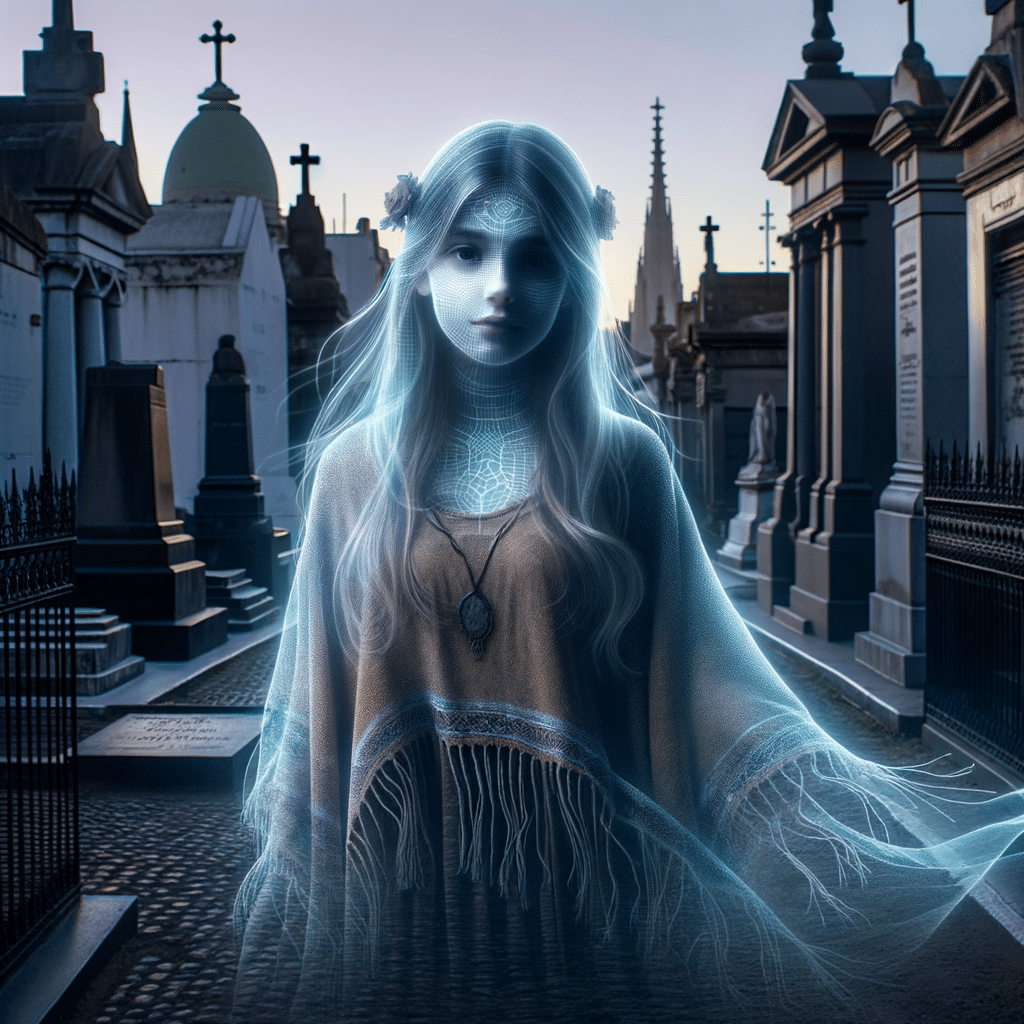
Rufina Cambaceres, a young woman said to have been buried alive in 1902 after entering a cataleptic state misjudged for death, is another well-known ghostly inhabitant. Reports say cemetery workers found signs of attempted escape inside her coffin and scratch marks indicating she had tried to flee after waking up. With reports of unexpected cold spots, disembodied voices, and the feeling of being watched, her stunning Art Nouveau tomb has become a center of paranormal activity. Many people relate to her sad tale, which may help to explain why interactions with her soul are among the most often reported at La Recoleta (Palleiro & Peltzer, 2023).
From orbs and mists showing in images to electrical devices acting strangely close to particular graves, many people have recorded unusual events all around the cemetery grounds. Night-shift security staff have claimed to hear conversations coming from vacant areas of the cemetery, footsteps following them during rounds, and sometimes see people who disappear when approached. Some guides focusing on cemetery tours gather these stories and highlight trends in the data indicating that some mausoleums and locations have more paranormal activity than others. These experiences are enhanced by the cemetery’s maze-like design and low night vision, which create a setting where the mind can readily turn normal sounds into otherworldly events (Palleiro, 2014).
Analysis
Many of the claimed events at La Recoleta are explained rationally by skeptics who highlight the power of suggestion in a naturally atmospheric environment. The intricate design of the cemetery produces unique acoustic characteristics that could account for disembodied voices and footsteps as sounds moving from faraway areas of the property or perhaps from outside the cemetery’s boundaries. The chilly regions usually read as spiritual energy could be explained by temperature differences between the short paths and wide areas as well as the thermal characteristics of marble and stone. Visiting a location linked with death has a psychological effect that, together with previous knowledge of ghost stories, predisposes people to see unclear stimuli as paranormal.
Scientific studies of alleged hauntings imply that environmental variables influencing human perception are the source of many ghostly experiences. Some allegedly haunted sites have reported infrasound—low-frequency sound waves below human hearing—which can cause discomfort, anxiety, and even hallucinations. The stone buildings and subterranean chambers of La Recoleta might one day produce such auditory abnormalities. Fluctuations in electromagnetic fields could also happen naturally in the graveyard owing to subsurface water supplies, electrical systems, or perhaps geological elements; some studies have connected such to paranormal events. These scientific theories provide different interpretations for events that could otherwise be ascribed to supernatural reasons.
Cultural and historical viewpoints offer yet another prism through which to see La Recoleta’s ghostly notoriety. Argentine culture combines aspects of both Catholic legacy and indigenous spiritual beliefs, thereby enriching the framework for reading death and the hereafter. Maintaining ties between the living and the dead, the habit of keeping intricate family mausoleums and making frequent visits to departed relatives shows a cultural view of death as a transition rather than an end. This cultural background fosters and supports ghost stories that flourish and survive, factual basis notwithstanding. The cemetery’s prominence in local folklore performs crucial social roles, preserving historical memory and strengthening cultural norms about death.
Tourism has undoubtedly influenced the spread of paranormal stories associated with La Recoleta, as supernatural tales attract many visitors. With guides stressing the cemetery’s most dramatic and spooky stories, ghost tours have grown more and more popular. This financial interest in paranormal events motivates the preservation and elaboration of ghost stories; hence, it changes isolated events or false narratives into apparently well-documented hauntings. Social media and the internet have accelerated this process by allowing anecdotes and alleged photographic evidence to spread globally, thereby reinforcing La Recoleta’s reputation as a paranormal hotspot, despite the lack of scientific investigation into these claims (Walker, 2022).
Conclusion
Approaching La Recoleta Cemetery as a believer in the paranormal or as a skeptic both emphasizes the profound testimony of the place to humanity’s intricate relationship with death and memory. The ornate tombs reflect an era’s views on death, prestige, and the afterlife as well as memorials to people. Whether considered cultural constructions or real spiritual events, La Recoleta’s ghost stories expose our ongoing need to stay linked to people who have died and our effort to grasp what is beyond life. Walking the quiet paths of this extraordinary necropolis, history, art, folklore, and maybe something beyond our knowledge mix to provide an experience that still inspires both awe and anxiety.
References
Mato, O. L. (2002). City of Angels: The History of Recoleta Cemetery: a Guide to Its Treasures. OLMO Ediciones.
Palleiro, M. I. (2014). Haunted houses and haunting girls: Life and death in contemporary Argentinian folk narrative. In Vernacular Religion in Everyday Life (pp. 223-241). Routledge.
Palleiro, M. I., & Peltzer, M. E. (2023). ‘The lady ghost’ in the Recoleta Argentinian graveyard: dark tourism and ghostly narrative itineraries. Journal of Tourism and Cultural Change, 21(2), 223-236.
Varchausky, N. (2006). Tertulia: Echoes in Eternity. A Polyphonic Labyrinth in the Recoleta Cemetery of Buenos Aires. Filigrane. Musique, Sons, Esthétique, Société, (4).
Walker, R. (2022). The Appeal and Acceptability of Necroheritage Tourism (Master’s thesis, ISCTE-Instituto Universitario de Lisboa (Portugal)).


Leave a Reply