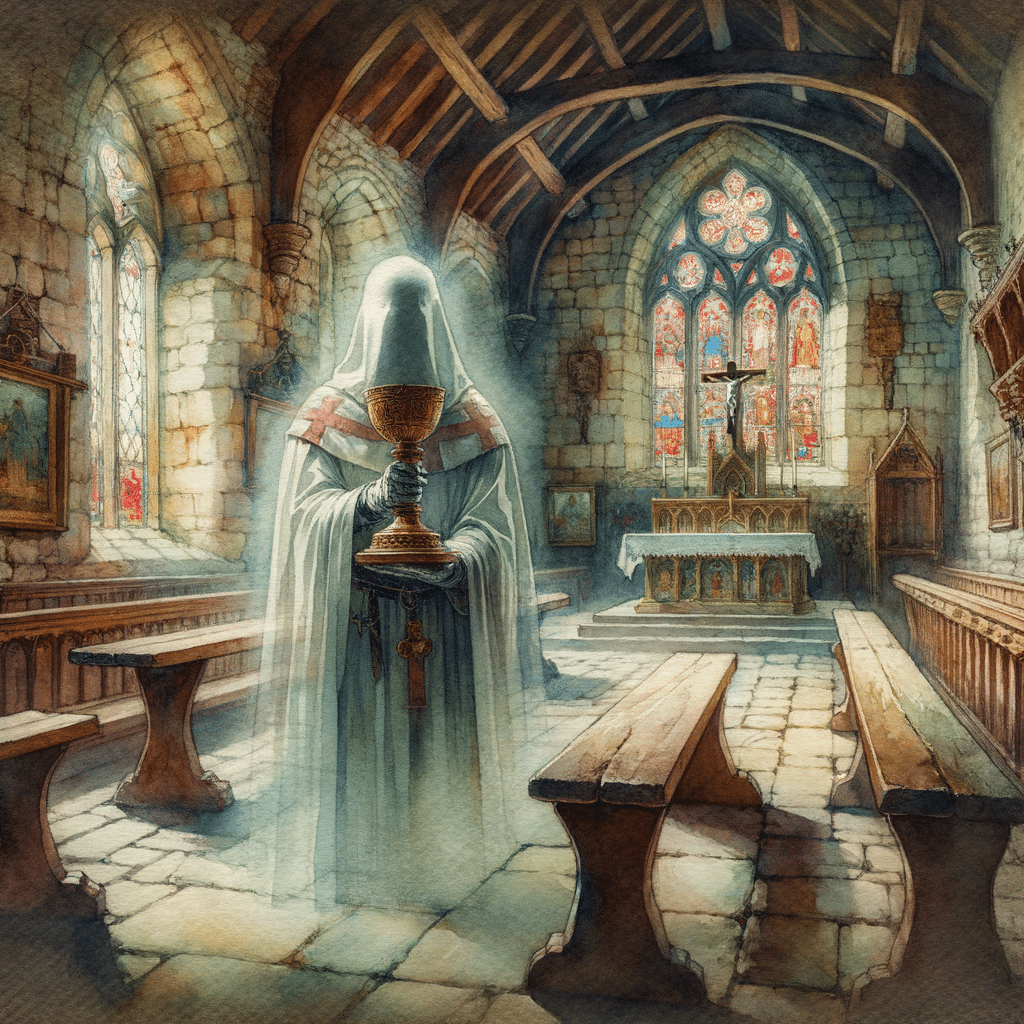
The Knights Templar were one of the most mysterious military orders in history. They came along during the medieval period, which was full of mystery and intrigue. These martial monks, who promised to be poor, chaste, and obedient, earned a legendary reputation that lives on even after they die. Ghosts, those strange beings that have fascinated people from all across the world and throughout history, are just as interesting. When these two enigmatic things come together, such as in stories of Templar knights who wouldn’t leave their earthly duties even after they died, we find a very intriguing component of supernatural literature. This essay looks at the Knights Templar, what ghosts are, and the stories that keep coming up about Templar ghosts that still haunt old buildings all around Europe. It suggests that some oaths go beyond the line between life and death.

Overview
Early in the 12th century, the Knights Templar formed to protect Christian pilgrims traveling to Jerusalem following the First Crusade. Hugh de Payens and eight other knights started the order in 1119. They took monastic vows and also served as a military force. This was a new idea that established warrior monks who were dedicated to both prayer and battle. As time went on, they became a complex group with special rights given to them by papal bulls. These included not having to follow local laws, not having to pay taxes, and being able to cross borders without restrictions. Their white mantles with red crosses on them made them easy to see on medieval battlefields. Their disciplined combat styles and unbreakable courage made them famous. Before King Philip IV of France planned their catastrophic demise in 1307, the Templars had built a huge network of preceptories, fortresses, and financial activities that stretched across Europe and the Holy Land (Howarth, 1991).
Ghosts, on the other hand, are one of the oldest and most common supernatural beliefs among mankind. They are ethereal remnants of people who used to live but are still connected to the physical world for some reason. Many cultures believe ghosts are souls that haven’t reached the afterlife. Individuals generally think that these ghostly beings appear because of unfinished business, violent deaths, broken promises, or deep feelings for individuals or locations. People say that physical manifestations can be everything from ghostly figures and hazy apparitions to less obvious things like chilly areas that can’t be explained, strange sounds, or objects that move for no reason. Ghost stories have had many cultural purposes over the years. They have been used as moral lessons, ways to explain the unexplainable, and ways to explore people’s deep fears about death and what might come after it (Morton, 2015).

Templar Ghosts
When the worlds of Templar history and ghostly appearances come together, a complex mosaic of strange stories comes to life. In places that used to be strongholds for the Templars, ghost stories about them are especially common. This is because the dramatic events that led to their downfall made the right setting for ghost stories to thrive. People typically describe these spectral knights as clad in full battle armor, often lacking heads due to the beheadings they suffered during their persecution. They patrol the walls and halls of castles and give off an ethereal radiance. People who have seen Templar knights in ancient chapels or doing strange rituals at midnight generally say that they saw them in quiet processions. Many ghost stories focus on malicious hauntings, while Templar ghosts are often shown as protecting spirits that keep their vow to safeguard holy places and innocent travelers even hundreds of years after they die (McMahon, 2025).
Perhaps the most well-known location for Templar ghost sightings is the Castle of Tomar in Portugal. The Order used the Castle of Tomar as its headquarters in Portugal from 1160 until its disbandment. Visitors and personnel have reported several experiences with ghostly knights inside its massive walls, especially in the famed Charola, which is a round church that looks like the Church of the Holy Sepulchre in Jerusalem. When the compound is vacant, some night guards report hearing armored footsteps and prayers. Others say they have observed individuals in white mantles kneeling in front of the altar in the early morning hours. The castle’s unusual eight-sided shape, which is full of mystical symbols and astronomical alignments, seems to make its supernatural reputation even stronger. Some paranormal researchers think that the Templars built the castle to keep their presence alive for centuries.
In addition to Tomar, the dramatic ruins of Chinon Castle in France are another important Templar site. There, Templar leaders faced imprisonment and interrogation. Witnesses say they heard screams of pain ringing through the dungeons on the anniversary of the Templars’ capture. People say that the unique knight statues at Temple Church in London sometimes move around. There have also been reports of ghostly processions going around the church’s round nave. In Scotland, the island of Mull has stories of Templar ghosts protecting secret treasures in caverns along the shore. Stories of ghostly knights performing nighttime rites with strange objects, purportedly the Holy Grail, abound in Spain’s castle of Ponferrada. The ghost stories from each place have some things in common, such as unfulfilled tasks, hidden treasures, and precious knowledge that the knights seem committed to protecting even after they die (Napier, 2011).
Analysis
There are a few ideas about why Templar knights could be more likely than other historical characters to be seen as ghosts. The most common interpretation is that the harsh and unfair end of the Templar knights—specifically, the mass arrests, torture, and executions they faced after King Philip IV accused them of heresy and blasphemy—contributed to their likelihood of being seen as ghosts. Paranormal literature often says that spirits are most likely to stay on Earth when people die suddenly and violently in situations of terrible injustice. Another idea is based on the strong oaths that Templar knights took, which, according to some historical records, tied them to their duty “until death and beyond death.” These serious vows, along with the secret knowledge many believe the Templars possessed, could establish spiritual duties that exceed what normal people can do. Some people think that the Templars’ purported connection to old mystical traditions, such as their possible finding of secret information in the Temple Mount excavations, may have given them special spiritual powers that let them stay awake after they die.
The fact that Templar ghost stories keep coming up may be more about psychological and cultural demands than real supernatural events. These stories came forth at times of enormous social upheaval, when the sudden collapse of such a powerful group caused a cultural trauma that needed to be explained and fixed. The concept of noble knights carrying out their sacred duties beyond death serves as a form of poetic retribution for the treatment they endured in the past. It shows that truth and righteousness will win out in the end, even if it takes longer than normal human time. These myths also preserve the mystery of the Templars by transforming their historical failure into a transcendent victory, where their spirits maintain a vigilant watch over their sacred trust for eternity. The idea of loyal soldiers continuing their holy task after death was both consoling and a warning about the repercussions of breaking sacred oaths for people in the Middle Ages and maybe even now (Haag, 2010).
Conclusion
The stories of Templar ghosts are still fascinating to us, whether we consider them to be real paranormal events or cultural expressions of unresolved historical trauma. These stories drive people to visit old places all over Europe. These legends are strong memories of a wonderful time in medieval history when warrior monks built a new religious and military institution that changed European society forever. The ghostly knights who are said to still patrol old walls and hold midnight ceremonies in abandoned preceptories are a sign of the lasting interest in the Templars’ intriguing ascent and tragic fall. In the dark halls of Templar castles, where the lines between history and mythology are difficult to see, we find stories that touch on timeless human themes like responsibility, sacrifice, injustice, and the idea that some promises may go beyond even death. In these stories about knights who refuse to break their sacred promise, we may see more than just fascinating folklore; we may also see a deep reflection on the lasting strength of human belief.
References
Haag, M. (2010). The Templars: History and Myth: From Solomon’s Temple to the Freemasons. Profile Books.
Howarth, S. (1991). The Knights Templar. Barnes & Noble Publishing.
McMahon, T. (2025). The Knights Templar: History & Mystery. Pen and Sword History.
Morton, L. (2015). Ghosts: A haunted history. Reaktion Books.
Napier, G. (2011). The Rise & Fall of the Knights Templar: The Order of the Temple 1118-1314-A True History of Faith, Glory, Betrayal. The History Press.
Leave a Reply