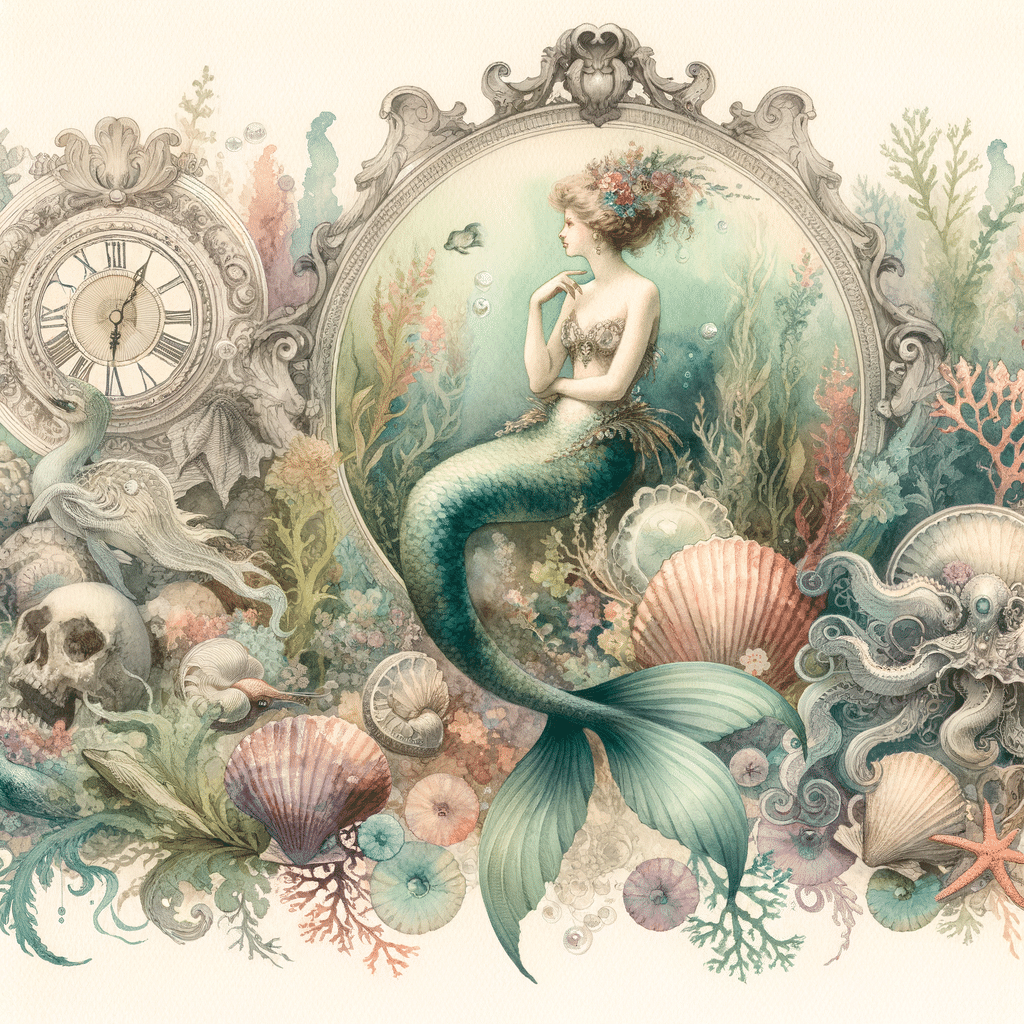
For thousands of years, people have been fascinated by mermaids, who are half-human, half-fish creatures that occur in stories from many civilizations. Many people consider mermaids to be characters from Greek mythology or Hans Christian Andersen’s fairy tales; however, some theories say they come from old religious books, especially the Book of Enoch. This apocryphal Jewish scripture contains intriguing stories about fallen angels known as Watchers, their offspring with human women, and a heavenly punishment related to the creation of mermaids. Looking at how this old literature has been read throughout the years gives us a better idea of how mythological creatures have changed over time and how religious stories mix with folklore.

Overview
Enoch, Noah’s great-grandfather, is believed to have penned the Book of Enoch, an ancient Jewish holy book. However, experts suggest that Enoch wrote it in the 3rd century BC. Despite its exclusion from the Hebrew Bible and most Christian canons, the Ethiopian Orthodox tradition held this text in high regard. The book tells us things about heaven and earth, like the stories of fallen angels, how they rebelled against God, and what happened as a result of their acts. These stories are the basis for readings that link the text to mermaid mythology. The Book of Enoch’s detailed descriptions of supernatural beings and divine wrath made it easy for myths to grow (Stone, 1978).
The narrative of the Watchers is at the heart of the Book of Enoch. Samyaza led this group of 200 angels, drawn to Earth by the beauty of human women. These Watchers left their jobs in heaven and married human women. They taught people various prohibited practices, including astrology, the use of weapons, cosmetics, and different forms of magic. Their sins were a serious breach of the divine order because they breached the line between the heavenly and terrestrial realms. People thought that the Watchers were corrupting humanity by giving them knowledge and activities that God did not want them to have. Their choice to mix with humans started off a chain of events that would have terrible results.
The Watchers and human women got together and had children called the Nephilim. People described them as giants, possessing immense appetites and power. The Book of Enoch says that these hybrid creatures used up many resources and then turned on humans, eating them when there was no other food available. God was saddened by the Nephilim’s violence and wickedness, which spread across the world and caused chaos and pain. They were neither wholly human nor fully angelic, which meant that their existence was a fundamental perversion of the established order. The scripture shows these beings as evil and destructive, which led God to decide to wipe up the earth with the Great Flood (Gimbel, 2011).

Mermaids
A “siren curse” came up in the Book of Enoch stories as a retribution from God for some of the women who had sex with the Watchers. These stories say that God punished these ladies by turning their lower bodies into fish tails and keeping their upper bodies human. This penalty was a constant reminder of how they had gone against the natural order. People thought that these cursed women were bound to lure sailors to their deaths and could never truly return to shore or find rest in the depths. This story connects fallen angels, forbidden relationships, and the transformation into fish, providing a religious explanation for the mermaid myths that emerged in folklore (Alexander, 2012).
Accounts related to the Book of Enoch say that mermaids were evil and would cause shipwrecks deliberately by singing and looking beautiful. During storms, these sirens would stand on rocky outcroppings and sing with voices so lovely that they could be heard over the howling winds and crashing seas. Their singing would enchant mariners. Ship captains and crew would sail their ships toward the dangerous rocks because they were mesmerized by the mermaids’ songs and the glances of their lovely bodies. This caused terrible wrecks. The mermaids would then swim among the wreckage, picking up useful things and sometimes pulling sailors who were still alive down to watery graves in caves where they were thought to collect human souls. People observed their planned and cruel actions, revealing the anger and vengeance these once angelic lovers harbored toward humanity.
Another scary thing these Enochian mermaids did was lure fishermen and people who lived along the coast into their traps. These stories say that mermaids would sometimes come up to men who were alone on beaches or in quiet coves and look like gorgeous women who needed help. After earning the trust of their captives, they would reveal their true forms and pull them under the water to drown them. Some stories say that the mermaids kept these men alive in air pockets in underwater caves, where they had to have half-human children who would eventually be liberated to sneak into coastal towns. People believed that these children could predict storms and manipulate the weather in unusual ways, but they also inherited their mothers’ disdain for pure humans. Coastal settlements devised intricate rituals and protective charms to locate and prevent these mermaid-human hybrids, as they were believed to bring misfortune and death.
The most horrifying stories were about mermaids going after kids who were playing along the shore. According to these myths, mermaids hated human mothers because they reminded the cursed ladies of what they had lost when they changed. People say that mermaids would lure kids into deeper waters by offering them beautiful shells, pearls, or promises of jewels found underwater. When the mermaids caught these kids, they claimed that black magic transformed them into beings that were neither fully human nor entirely fish. They were forced to gather souls for their mermaid masters. Some people thought that the creepy noises of waves hitting hulls on quiet nights were the cries of these abducted children, telling other people to stay away from the water’s edge. These legends aimed to frighten coastal children, instilling in them a fear of the ocean and a respect for its dangers. They also reinforced the idea that mermaids were not beneficial creatures but frustrated beings cursed by God for their sins.
Analysis
Many nations have stories about mermaid-like creatures in their maritime folklore, yet they all have different traits. Greek myths talk of sirens who sang lovely songs to sailors to get them to come to them, while Norse myths tell of beautiful but dangerous sea maidens (Brink-Roby, 2008). In Middle Eastern folklore, aquatic spirits known as jinn occasionally looked like mermaids. These many stories show that the idea of humanoid creatures living in water came up in many societies, probably because people reacted in similar ways to the sea’s enigmatic and frightening nature. The Book of Enoch’s view on mermaids is an attempt to provide these common tales a single theological source that ties them to stories from the Bible.
The way mermaid stories have changed over time shows how religious stories and folk tales can come together to establish new traditions. In ancient mythology, early mermaid-like figures were typically hazardous and caused bad luck. But by the Middle Ages, mermaids started to show up in church carvings in Europe as emblems of vanity and temptation. Mermaids became more idealized throughout the Renaissance. They sometimes stood for the two sides of humanity: the divine (upper body) and the animal (bottom body). The mermaid image became even softer throughout the Victorian era, reaching its peak in Andersen’s sad Little Mermaid, who wanted a human soul. Religious ideas often accompanied these changes, providing explanations for their origins and characteristics. The Book of Enoch interpretation was an essential component to this changing mythical landscape (Fanthorpe & Fanthorpe, 2010).
The connection between mermaids and the Book of Enoch demonstrates the influence of ancient religious texts on mythology. These links are an intriguing example of how myths alter over time through the mixing of cultures and religions. The story has become popular in some groups, especially among people who are interested in other religious history or supernatural events. This reading shows how ancient books are still alive and well today, inspiring mythological connections even thousands of years after they were written.
Part of the attractiveness of connecting mermaids to the Book of Enoch is that people want to discover explanations that make sense of comparable stories in different civilizations. These theories link mermaids to the biblical story of fallen angels and divine punishment. The connection gives us a way to view different folk tales as a whole. This method meets the human need to find patterns and links in mythological systems. The link between mermaids and Enoch also gives moral meaning to mermaid mythology, turning these sea creatures from simple fancies into emblems of cosmic wrongdoing and heavenly justice. This moralization of mythology shows how religious ideas continue to shape how cultures think about and understand the supernatural.
Conclusion
The Book of Enoch’s detailed stories of fallen angels, forbidden relationships, and divine punishment have inspired many myths about mermaids. The story of the Watchers and their children has grown to include the idea that women can be turned into water creatures as a punishment from God. This progression shows how religious scriptures and folklore traditions always affect one another, making up stories that answer basic questions about the supernatural world. The fact that mermaid myths have persisted across cultures and throughout history shows that people are still interested in the line between human and non-human, natural and supernatural, and divine and monstrous. These are themes that the Book of Enoch explores and that continue to be relevant in its interpretations.
References
Alexander, S. (2012). Mermaids: the myths, legends, and lore. Simon and Schuster.
Brink-Roby, H. (2008). Siren canora: the mermaid and the mythical in late nineteenth-century science. Archives of natural history, 35(1), 1-14.
Fanthorpe, L., & Fanthorpe, P. (2010). The Big Book of Mysteries (Vol. 14). Dundurn.
Gimbel, J. J. (2011). Spiritual Descent: A Study of Semi-Divine Beings and Non-Human Species in European Mythologies (Doctoral dissertation, Wesleyan University).
Stone, M. E. (1978). The Book of Enoch and Judaism in the Third Century BCE. The catholic biblical quarterly, 40(4), 479-492.
Leave a Reply