
The tiny coal mining town of Van Meter, Iowa, became the heart of one of America’s most unusual and long-standing cryptozoological riddles in the fall of 1903. For about a week, several esteemed residents claimed horrific encounters with a strange, wing-bearing creature that defies common sense explanation. The Van Meter Visitor, a remarkable chapter in American legend, continues to captivate both cryptid enthusiasts and detractors alike. This nightly visitor scared the people of the village, spurred wild conjecture, and then disappeared as inexplicably as it had shown, leaving behind a legacy of unresolved questions and ongoing mystery.

The Story
Modern stories say the monster first showed itself on September 29, 1903, when well-known local merchant U.G. Griffith noticed something remarkable on the top of his brick building. Griffith initially believed that a brilliant light moving across the rooftop indicated a robber carrying a flashlight. He was shocked to see a big, wing-bearing creature with a horn-like protrusion on its head blasting a blinding light when he fired a warning shot. The local doctor, Dr. Alcott, came upon the beast the next night and also noted its beak, wings, and unique light-emitting horn. Other revered town residents, including bank cashier Clarence Dunn, hardware store owner O.V. White, and Sidney Gregg, had their own horrific experiences with the creature over the next few evenings, each added consistent elements to the developing account (Dougherty-Maulsby, 2017).
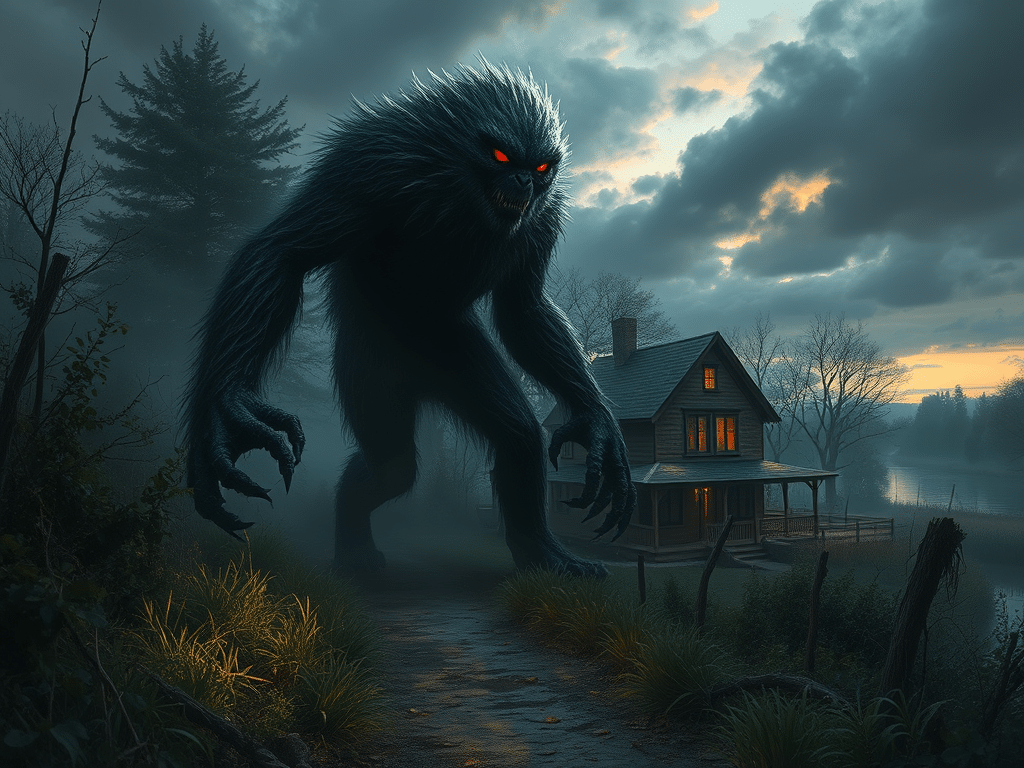
The Van Meter Visitor’s physical appearance was shockingly consistent across several eyewitness reports, which gave the sightings frightening credence. The creature was said to have a wingspan of about eight feet and to be eight to nine feet tall. Several witnesses reported its most unique characteristic—a horn-like protrusion on its forehead or beak—as “blinding,” projecting an extremely brilliant light. Despite its weight, the beast allegedly moved with startling speed and possessed huge, bat-like wings. While some told of a body covered in fur or feathers, others indicated leathery skin. Witnesses said the monster could hop like a kangaroo and move with amazing agility, scaling buildings and apparently effortlessly reaching great distances (Ocker, 2022).
The actions of the Van Meter Visitor complemented its enigmatic and terrifying presence in the society. The creature appeared only after darkness had fallen and vanished before morning; it was nocturnal. Often seen on rooftops or close to the town mine, it showed an unusual fascination with the buildings of the town, especially those recently built. Variously referred to as “screeches,” “walls,” or “terrible shrieks,” several witnesses claimed to hear unusual, high-pitched sounds resonant through the night. The creature’s response when confronted was perhaps most disturbing: it seemed unaffected by the bullets even though terrified townsfolk had shot it several times. This immunity to traditional weapons added much to the mounting anxiety and conjecture among Van Meter’s citizens (Godfrey, 2014).
October 3, 1903, saw the most dramatic chapter in the Van Meter Visitor story when a group of well-known residents armed with weapons set out to stop the terror, following the creature to an abandoned mine entrance at the outskirts of town. Their story claims that they saw not one but two creatures squealing their unique sounds as they entered the mining hole. The crew stayed on alert all night, then went into the mine in the morning but discovered no sign of the unidentified guests. No more sightings were recorded following this pivotal meeting, and the creatures seemingly disappeared as inexplicably as they had first shown. The sudden cessation of the sightings without explanation or resolution has simply accentuated the ongoing enigma of the Van Meter Visitor.

Analysis
American cryptid tales that originated in the late 19th and early 20th centuries abound in folklore around the Van Meter Visitor. From the Jersey Devil in the Pine Barrens to the Mothman of West Virginia decades later, this age saw many stories of unusual species all throughout the American continent. The Van Meter incident is also noteworthy for the trustworthiness of its witnesses—respected members of the community instead of people prone to exaggeration or attention-seeking behavior. Modern newspaper reports, especially in the Des Moines Daily News, which regarded the sightings as genuine news rather than simple sensationalism, added credibility to the narrative. Unlike many folklore stories that change over years via oral tradition, the Van Meter Visitor story was recorded in print during the real events, giving scholars priceless original materials (Freeburg & Fowler, 2016).
From modern news to forgotten curiosity to rediscovered cryptid legend, the growth of the Van Meter Visitor tale over time follows an intriguing path. Although the event generated much attention in 1903, it soon disappeared from public awareness since no more sightings took place. For many years, the tale stayed mostly forgotten outside of Van Meter, kept mostly in newspaper archives and local memory. The story had a major comeback in the 1970s as the paranormal field of inquiry gained increasing appeal from cryptozoology. Rediscovering the newspaper reports, authors and scientists started adding the Van Meter Visitor to compendia of inexplicable species together with more well-known cryptids. With the 2013 book The Van Meter Visitor: A True and Mysterious Encounter with the Unknown by Chad Lewis, Noah Voss, and Kevin Lee Nelson bringing the most thorough modern analysis of the case, the narrative has attracted even more attention in recent years through internet communities devoted to paranormal events.
Theories regarding the actual identity of the Van Meter Visitor range in their simplicity from the ordinary to the fanciful. The most sensible theory holds that the witnesses came upon a big bird—probably a sandhill crane or blue heron—that was misidentified in the darkness and then inflated in narrative. Psychological theories link mass hysteria brought on by first misidentifications and driven by the atmospheric stress of a small, remote mining town. Pointing to the description of leathery wings and extraordinary mobility, some cryptozoologists have suggested the creature might be a surviving pterosaur or other prehistoric flying reptile that somehow escaped extinction. More outlandish ideas include interdimensional entities, alien visitors, or perhaps demonic forms. Connecting the creature to the adjacent coal mines, a particularly intriguing theory suggests that it may have been an underground organism disturbed by recent mining activities.
Conclusion
Still a striking illustration of American folklore that defies simple classification or rejection is the Van Meter Visitor incident. This narrative transcends basic campfire stories or urban legends with the believability of the witnesses, consistency of the descriptions, and documentation seen in modern newspapers. Whether the people of Van Meter came upon an unidentified creature, misidentified natural events, or underwent a group delusion, their narrative has found a place in the pantheon of American cryptozoology. The Van Meter Visitor is a tantalizing mystery from America’s past that reminds us that even in an era of scientific knowledge and technological advancement, our planet may still harbor secrets beyond our comprehension, waiting in the shadows to be unearthed in the absence of physical evidence or modern sightings.
References
Dougherty-Maulsby, D. (2017). Dallas County. Arcadia Publishing.
Freeburg, J., & Fowler, N. (2016). Monsters of the Midwest: True Tales of Bigfoot, Werewolves & Other Legendary Creatures. Adventure Publications.
Godfrey, L. S. (2014). American Monsters: A History of Monster Lore, Legends, and Sightings in America. Penguin.
Lewis, C., Voss, N., & Nelson, K. L. (2013). The Van Meter Visitor: A True and Mysterious Encounter with the Unknown. On the Road Publications.
Ocker, J. W. (2022). The United States of Cryptids: A Tour of American Myths and Monsters. Quirk Books.



Leave a Reply