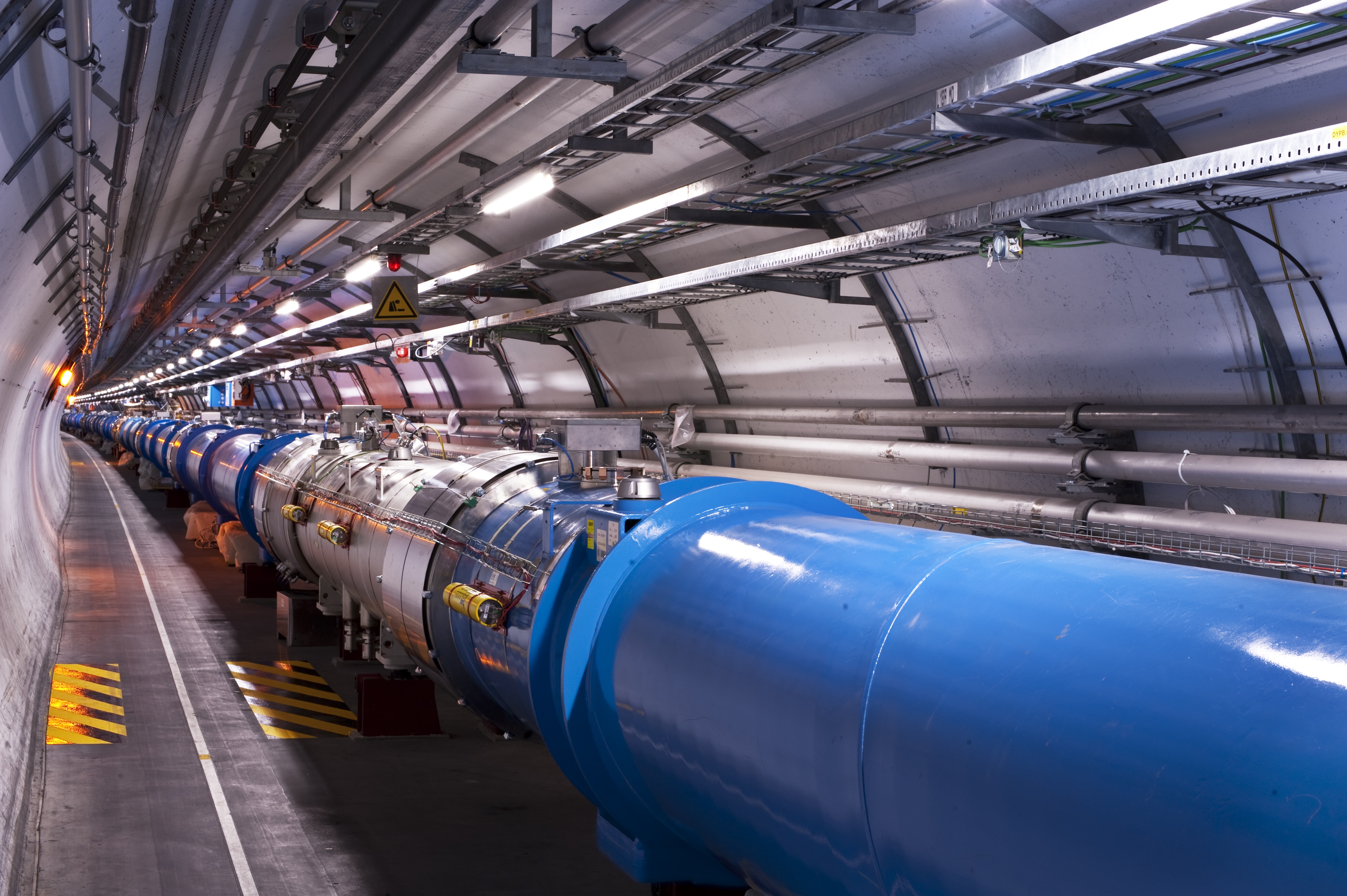
A little weasel made news globally in the spring of 2016 when it broke into one of the most advanced scientific facilities and caused major damage and a temporary closure. Though it would have appeared like just a funny anecdote in the annals of science, this event at the Large Hadron Collider (LHC) has subsequently inspired a detailed paranormal theory implying that this furry invader unintentionally changed the fabric of reality itself. This theory holds that the weasel’s involvement with the LHC produced a branch in our chronology that moves humanity into another universe, explaining the apparently growing strangeness of world events since 2016. Although discounted by mainstream science, this hypothesis provides an intriguing window into how people construct stories to justify apparent discontinuities in their common reality.

The Weasel Timeline
One of mankind’s most ambitious scientific projects, the 27-kilometer circular tunnel under the Franco-Swiss border near Geneva, Switzerland, is the Large Hadron Collider. Run by the European Organization for Nuclear Research (CERN), this enormous particle accelerator drives subatomic particles almost the speed of light before crashing them together, enabling scientists to view basic particles and forces existing shortly following the Big Bang. The most well-known accomplishment of the LHC came in 2012 when the Higgs boson—the long-theorized particle giving mass to other particles—was confirmed. Using superconducting magnets chilled to temperatures colder than outer space and producing data requiring a worldwide computing grid to process and analyze, the LHC is shockingly large (Brüning, Burkhardt, & Myers, 2012).
Delays, technical difficulties, and even public concerns over LHC safety have periodically punctuated its development. After over twenty years of planning, construction started in 1998; the first beam did not circulate until September 2008. Shortly later, a year-long delay for repairs resulted from a helium leak brought on by a failed electrical connection among many superconducting magnets. Once the LHC started running, it soon became the target of apocalyptic worries; some claimed it may produce minuscule black holes capable of swallowing the planet. Though physicists discount these issues, they highlight the mixture of wonder and dread sophisticated scientific initiatives can elicit in the public imagination. The LHC has continuously advanced our understanding of the fundamental nature of matter and energy in spite of these challenges (Dimopoulos & Landsberg, 2001).
CERN officials said on April 29, 2016, that a small weasel—sometimes identified as a marten or ferret in different sources—had penetrated an electrical transformer at the LHC site and produced a short circuit, resulting in power disruptions all throughout the complex. Despite the animal’s death during the encounter, its behavior led to the temporary closure of the world’s most powerful particle accelerator. Before the machine could run once again, technicians had to do major repairs. This event happened just as the LHC was getting ready to gather information that would have exposed evidence of a possibly new fundamental particle displaying tempting signals in earlier studies. The timing of this interruption—occurring just as physicists were potentially on the verge of a significant discovery—has become a key element in the paranormal timeline theory that later emerged (Watkinson, 2016).
Advocates of the “weasel timeline” idea claim that the animal’s intervention with the LHC happened at a pivotal point when the accelerator was running at hitherto unheard-of energy levels, therefore perhaps influencing the quantum fabric of reality itself. According to the idea, the weasel’s bad interaction with the transformer set off an unintended quantum effect in the accelerator that branches our reality into a new timeline marked by ever less likely and unpredictable events. Advocates cite political upheavals, surprising election results, odd weather patterns, and overall society’s weirdness post-2016 as proof we are now living in another “weasel timeline.” Some even contend that since most individuals are instinctively aware that reality has veered from its natural path, most people experience a faint but constant sense of wrongness or displacement (Multiverses, 2024).

Analysis
Online communities devoted to debating the Mandela Effect—a phenomenon whereby many individuals share erroneous recollections of past events—have embraced the theory, with some speculating that the weasel incident may explain these collective memory inconsistencies. To offer a quasi-scientific basis for their views, supporters frequently reference ideas from quantum physics, such as superposition and the many-worlds interpretation. From this vantage point, the strong magnetic fields and high-energy particle collisions of the LHC produced the ideal environment for a quantum-level reality shift disturbed by the interference of the weasel. Some members have created detailed stories outlining how our present chronology deviates from the “original” one, hypothesizing about how events may have turned out had the weasel never entered the transformer that fateful day.
Pointing out various basic misconceptions regarding how the LHC and quantum mechanics really operate, skeptics and scientists strongly deny these paranormal interpretations. Operating at energies considerably below those of natural cosmic ray collisions that continuously bombard Earth, the LHC simply lacks the energy needed to influence macroscopic reality in the manner the theory implies, despite its remarkable powers. While unusual, physicists explain that quantum effects do not scale up to influence the macro world in such dramatic ways, and the energies involved in the electrical short circuit generated by the weasel were small relative to the planned operational energies of the accelerator itself. Critics also point out that the theory functions as a handy narrative to explain complicated sociopolitical developments through a single, basic cause and exhibits traits of apophenia—the inclination to see significant links between unconnected occurrences.
The weasel timeline theory appeals to psychologists because it offers a clear justification for a world that sometimes seems to be growing more chaotic and unpredictable. Through its simplicity of causality, the theory offers a peculiar kind of solace by turning difficult worldwide occurrences into results of a single, recognizable moment of cosmic accident. Those who yearn for a supposed “better” past will also find attraction in the story since it helps them to envision that the present situation really deviates from how things “should” have been. The weasel hypothesis has components in various conspiracy theories that link world events to secret forces instead of human actions, social movements, and historical events. Its tenacity shows how deeply humanity yearns for trends and purpose in apparent chaos (Larsen, 2017).
Though mainstream science rejects the weasel timeline idea, it has evolved into a cultural benchmark that inspires memes, fiction, and even artwork examining issues of parallel worlds and cosmic mishaps. While some embrace the ridiculousness of a small mammal unintentionally changing reality, others approach the hypothesis more seriously as a thought experiment about causality and the nature of time. The hypothesis also captures more general cultural fears about advanced scientific study and technology maybe having unanticipated effects outside human control or knowledge. Notwithstanding its scientific accuracy, the story has become ingrained in online folklore and keeps changing as people include fresh occurrences into the framework of the “post-weasel timeline.”
Conclusion
Ultimately, the idea that a weasel’s 2016 contact with the Large Hadron Collider transported humanity into anothertimeline reflects a remarkable junction of digital-age mythology, psychological coping strategies, and scientific misinterpretation. Although rational analysis and physicists completely refute the idea that a small mammal might unintentionally change the fabric of reality by interacting with a particle accelerator, the persistence of this theory reveals much about human nature and our shared need to make sense of a complicated, often confusing world. Whether that reality is original or alternative, the real relevance of the weasel timeline theory is probably not in its factual accuracy but rather in what it tells us about ourselves—our fear of chaos, our search for meaning, and our ongoing capacity to create narratives that enable us to negotiate an increasingly complex reality.
References
Brüning, O., Burkhardt, H., & Myers, S. (2012). The large hadron collider. Progress in Particle and Nuclear Physics, 67(3), 705-734.
Dimopoulos, S., & Landsberg, G. (2001). Black holes at the large hadron collider. Physical Review Letters, 87(16), 161602.
Larsen, K. (2017). ALICE and the apocalypse: Particle accelerators as death machines in science fiction. MOSF Journal of Science Fiction, 2(1).
Multiverses, F. L. (2024). Black 13 Mirror. The Multiverse as Theory in Postmodern Speculative Fictional Narratives, 154.
Watkinson, W. (2016). Weasel shuts down CERN Large Hadron Collider after being electrocuted on transformer (No. PRESSCUT-H-2016-253, pp. 1-p).




Leave a Reply