
Summary of Loveland Frogman
-
The Loveland Frogman is a cryptid reported near Ohio’s Little Miami River for decades.
-
Witnesses describe a three-foot tall creature with amphibian skin and frog-like features.
-
The creature observes humans before retreating to water, emitting shrieks when startled.
-
The legend began in 1955 and gained fame after 1972 police encounters.
-
Theories range from misidentified animals to unknown species or hoaxes.
-
The Frogman became Loveland’s mascot, boosting tourism and local culture.

Introduction
For more than 70 years, the Loveland Frogman has been one of Ohio’s most famous cryptozoological mysteries, drawing in both residents and researchers. This amphibious humanoid creature is a big part of local folklore. It is a mix of urban legend, eyewitness accounts, and people’s natural curiosity about the unknown. Some people think the stories are fake or that people are just seeing things, but the fact that there have been so many sightings and that the witnesses are honest has kept the legend alive. It is now an important part of southwestern Ohio’s culture.
Overview
People say that the creature lives in a small city called Loveland, Ohio, which is about twenty miles northeast of Cincinnati along the Little Miami River. Most of the sightings have happened near the Loveland Madeira Road bridge and along the banks of the Little Miami River, especially where the river goes through wooded areas. Witnesses have consistently reported seeing the creature near creeks, the river itself, or during times of high humidity and rain. This suggests that being close to water sources is very important to its habitat. Many people think that if the creature does exist, it probably uses the river as its main way to get around because most of the sightings are in a small area along the river corridor (Hasken-Wagner, 2021).
The story of the Loveland Frogman comes from a 1955 report by businessman Robert Hunnicutt, who said he saw three frog-like creatures standing under a bridge on the Little Miami River. Hunnicutt said that one of the creatures had a device that made sparks, which made some people wonder if the creature was smart or had advanced technology. In 1972, the legend gained a lot of traction when two different Loveland police officers reported seeing the creature within weeks of each other. This gave official credibility to what had previously been dismissed as folklore. These police reports turned the Loveland Frogman from a local legend into a well-known cryptid across the country. They sparked many investigations and became a key part of Ohio’s paranormal history.
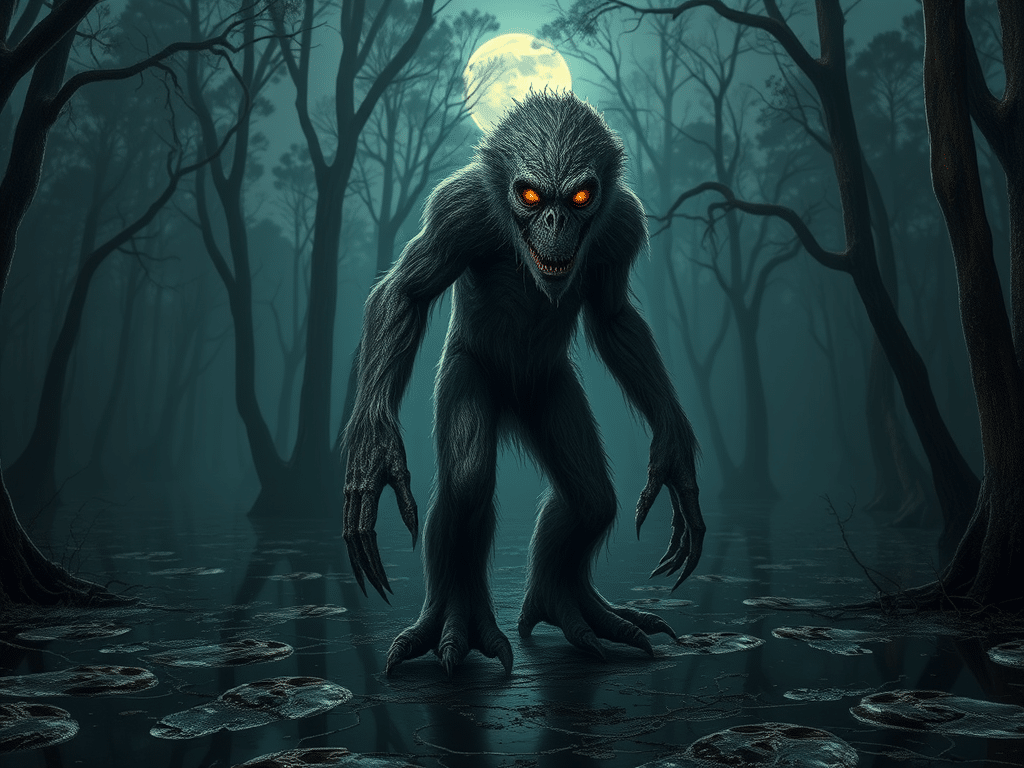
Eyewitness accounts of the Loveland Frogman paint a very consistent picture of a creature that walks on two legs and is between three and four feet tall. People say that the creature has skin that looks like leather and is greenish or grayish in color. It often looks like it just came out of the water because it is wet or shiny. One of its most unique features is its frog-like head with big, noticeable eyes. Some people say it has webbed hands and feet. People say that the creature’s body is muscular and compact, with long arms that almost reach its knees. It moves in a strange way that combines walking and hopping (Estep & Wayland, 2025).
The Loveland Frogman’s behavior patterns suggest that it is both curious and hard to catch, often watching people from a distance before hiding in the safety of nearby water. Witnesses often say that the creature stands still on roads or riverbanks, as if it is studying its surroundings before realizing that people are there. People say that when they are startled or approached, the being lets out a high-pitched scream or whistle and then quickly runs away to the nearest body of water with surprising speed. Some stories say that the creature seems to talk to other creatures of its kind in strange ways, but it’s rare to see more than one of them at a time (Johnson, B. (2023).

Similar Creatures Worldwide
Folklore and eyewitness accounts from all over the world describe amphibian humanoid creatures that look like people. This could mean that there is a widespread cryptid phenomenon or that people are just really interested in creatures that live in water. The Lizard Man of Scape Ore Swamp in South Carolina is a lot like the Loveland Frogman, which is a reptilian creature with scaly skin that walks on two legs and lives in wetlands. People have been seeing it since the 1980s. Japan’s Kappa is probably the most culturally important amphibian humanoid. It comes from folklore that goes back hundreds of years. Kappa are usually shown as turtle-like creatures that live in water and interact with people in both good and bad ways.
The Fouke Monster from Arkansas is more like an ape, but it likes to live in swamps and rivers like the Frogman. Since the 1970s, there have been similar patterns of eyewitness reports and official investigations. The Bunyip of Australia is a water-dwelling creature with features of both amphibians and mammals, according to Aboriginal folklore. This shows how legends of humanoid creatures in water go beyond modern cryptozoology and connect to ancient cultural traditions. The Beast of Busco in Indiana is said to be a huge snapping turtle with human-like features. It is another amphibian mystery in the Midwest that is similar to Ohio’s Frogman phenomenon.
European folklore includes the Vodník from Slavic tradition and the Neck from Scandinavian mythology. Both are water spirits with amphibian traits that are said to live in lakes and rivers. These international parallels indicate that amphibian humanoids occupy a distinctive position in global cryptozoology, potentially mirroring humanity’s ancient connection with water sources and the enigmatic organisms that arise from aquatic habitats. The uniformity of these reports across various cultures and continents provokes compelling inquiries regarding whether these sightings signify misidentified familiar animals, unidentified species, or fundamental fears and fascinations ingrained in human consciousness.
Analysis
There are a lot of different ideas about what the Loveland Frogman is. Some say it’s just a case of people mistaking it for a known animal, while others think it could be something more unusual, like an unknown species or beings from another dimension. Skeptics often say that witnesses probably saw big frogs, salamanders, or escaped exotic pets in low light, and that fear and excitement made ordinary animals seem bigger and more interesting. Some scientists think the creature could be a living group of prehistoric amphibians or a new species that has learned to live in cities. Some more far-fetched ideas suggest that the Frogman could be an alien visitor, a failed genetic experiment, or even a sign of people’s deep-seated fears about how human development is harming the environment and taking over natural habitats (Offutt, 2025).
The Loveland Frogman has an effect on more than just monster hunting; it has a measurable effect on tourism, popular culture, and the identity of the community. The creature has become an unofficial mascot for Loveland. It can be seen on signs for local businesses, it has inspired annual festivals, and it has brought cryptozoology fans from all over the world to the area to look into it. Local business owners have made money from the legend by offering guided tours, selling souvenirs, and hosting themed events that honor the town’s one-of-a-kind claim to fame. The Frogman has also had an impact on bigger conversations about biodiversity, protecting the environment, and the need to protect natural habitats along Ohio’s waterways. It has become an unexpected spark for ecological awareness (Budd, 2020).
Conclusion
The Loveland Frogman story is more than just another cryptid story; it shows how people are always interested in mystery and how complicated our relationship with nature is. The creature’s effect on the culture and identity of the community is real and important, whether it is a real thing or just something that people made up. The story of the Frogman will live on in Ohio folklore for many years to come because it keeps changing with each new group of people who see it or investigate it. As cities grow and technology improves, the Loveland Frogman reminds us that we can still find mystery and wonder in the most unlikely places. It challenges us to be open to things that go beyond what we normally think we know.
References
Budd, D. W. (2020). The Weiser Field Guide to Cryptozoology: Werewolves, Dragons, Skyfish, Lizard Men, and Other Fascinating Creatures Real and Mysterious. Weiser Books.
Estep, R., & Wayland, T. (2025). Mothman: Sightings and Investigations of the Iconic Flying Cryptid. Llewellyn Worldwide.
Hasken-Wagner, E. (2021). Eleanor Hasken-Wagner-Review of Midwestern Strange: Hunting Monsters, Martians, and the Weird in Flyover Country. Journal of Folklore Research Reviews.
Johnson, B. (2023). The Big Book of Cryptid Trivia: Fun Facts and Fascinating Folklore About Bigfoot, Mothman, Loch Ness Monster, the Yeti, and More Elusive Creatures. Simon and Schuster.
Offutt, J. (2025). Chasing North American Monsters: A Guide to Over 250 Creatures from Greenland to Guatemala. Llewellyn Worldwide.

Leave a Reply