Ghosts in Abandoned Factories: Key Points
-
Abandoned factories are associated with ghost sightings of shadowy workers performing routine tasks, phantom machinery sounds, temperature drops, and overwhelming sadness.
-
Famous haunted locations include the Triangle Shirtwaist Factory, Sloss Furnaces with its brutal foreman “Slag,” and English mills where child laborers died.
-
Paranormal theories suggest traumatic events leave energetic imprints on physical spaces, while electromagnetic fields and metal construction enable supernatural activity.
-
Skeptics attribute experiences to environmental factors like toxic materials, wind sounds, light patterns, pareidolia, and the power of suggestion.
-
Ghost stories serve as folk memory preserving working-class histories and have become central to horror culture, urban exploration, and industrial tourism.
-
The fascination reflects anxieties about deindustrialization while honoring past lives and addressing fears about being forgotten in industrial progress.

Introduction
In modern folklore, the intersection of ghosts and abandoned factories is a strange place where industrial decay meets supernatural belief. These enormous buildings used to be full of the sounds of machines and people working, but now they are quiet and empty, which makes the place seem like it could be haunted. The phenomenon reflects a profound aspect of human psychology—our inclination to imbue voids with significance and our difficulty in reconciling a location’s dynamic history with its barren present.
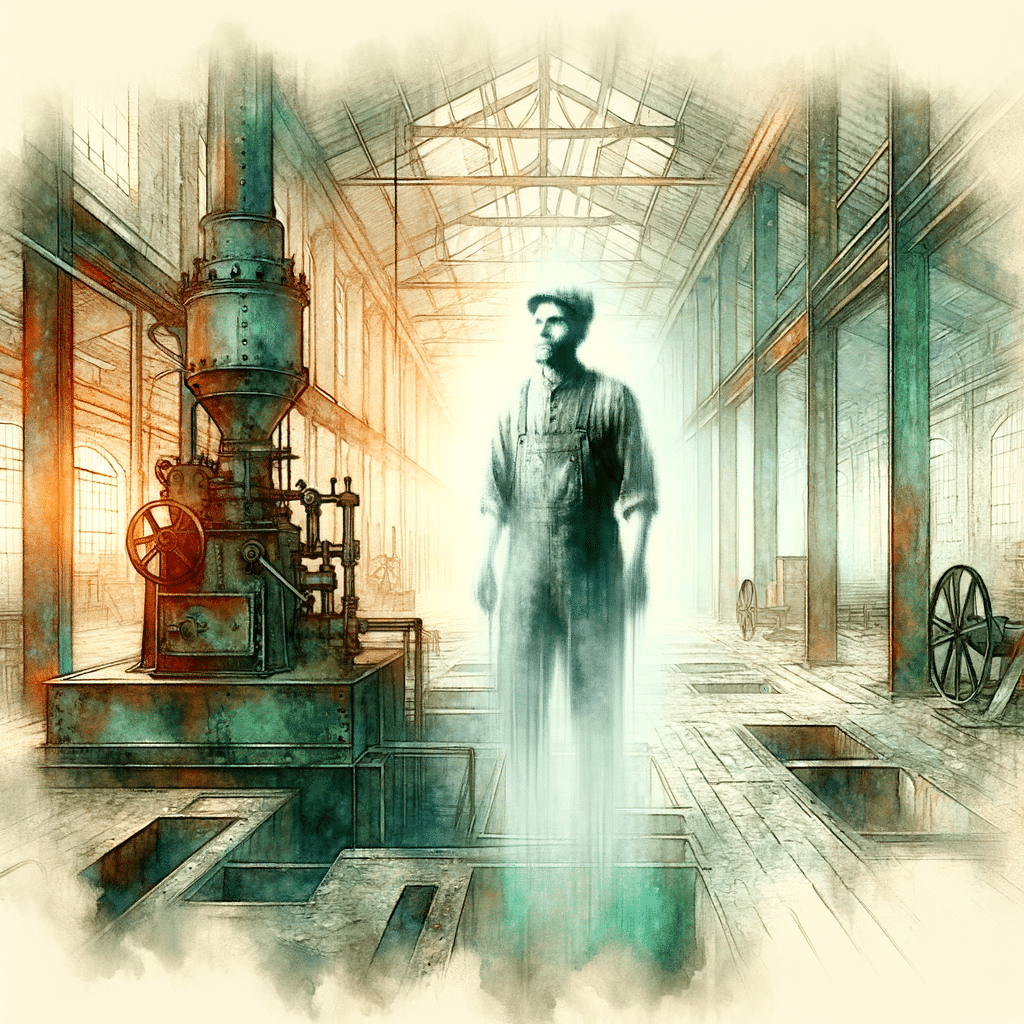
When people talk about seeing ghosts in old factories, there are certain patterns that show up in different places and cultures. People who have seen these shadowy figures moving along catwalks or near machinery that hasn’t worked in decades say they were wearing work clothes from a different time. The ghosts usually seem to be going about their daily lives, walking familiar paths or working at stations that are no longer there, as if they don’t know that the factory has been closed for a long time. Some people say they hear ghostly sounds, like the clang of metal on metal, the hiss of steam, or the rhythmic pounding of machinery, in empty halls where there should be silence. People who have these experiences often feel like they are being watched, feel sudden drops in temperature, or feel an overwhelming sense of sadness that seems to fill certain parts of these buildings (Lewis, 2017).
The stories about haunted factories are based on sad stories from the past about factories and the people who worked in them. The Triangle Shirtwaist Factory fire in New York City in 1911 killed 146 garment workers. Since then, there have been many ghost stories about the building and the area around it. People have said they saw young women in period clothing or smelled smoke where there was none (Kazek, 2025). People know about the Sloss Furnaces in Birmingham, Alabama, because of stories about “Slag,” a cruel foreman named James Wormwood who is said to have died in the early 1900s and now scares visitors near the furnace where he died. The old mills in Manchester and Yorkshire tell stories of child workers who died in accidents with machines. People report seeing their small ghostly bodies moving between the looms and spinning frames. These stories often keep alive memories of real tragedies and remind us of how dangerous work used to be.

Analysis
Paranormal believers and researchers disagree on the causes of these events, which often involve energy and consciousness. The stone tape theory posits that traumatic events or repetitive actions can be inscribed in the physical environment—such as walls, floors, or objects—and subsequently reproduced under specific conditions, akin to a psychic recording. Some theorists suggest that the strong feelings that come with workplace accidents, factory closings that hurt the economy, or the demanding, repetitive work of thousands of people over many years leave an energetic mark on these places. Some people think that the spirits of workers stay in the places where they spent most of their waking hours because their work was such a big part of who they were. Some people say that the electromagnetic fields created by old electrical systems, along with the metal and stone construction of factories, make it easier for paranormal activity to happen or at least for people to notice it.
But skeptics have strong alternative explanations based on psychology and the environment. Abandoned factories are inherently dangerous, dark, and disorienting places filled with decaying materials, unstable structures, and toxic substances that can affect brain function and perception. People who go into these places expecting to see ghosts are more likely to see normal things as supernatural. This effect is because of the power of suggestion. Urban explorers have recorded how wind blowing through broken windows makes sounds that sound like voices or footsteps, how changing temperatures make strange sounds, and how light coming through broken roofs can make shadows that look like people. The psychological phenomenon of pareidolia leads our brains to identify familiar patterns, particularly faces and human forms, within random visual noise, a tendency that is especially heightened in low-light environments laden with industrial debris (Hanks, 2025).
The idea of ghosts in abandoned industrial sites is not just about the supernatural; it is also very much a part of the social and cultural fabric of post-industrial societies. Eisenbruch’s study of garment factories in Cambodia illustrates how workers undergo mass fainting incidents, which may signify unresolved tensions related to cultural and spiritual beliefs— invoking ‘old ghosts’ that jeopardize their well-being (Eisenbruch, 2017). This theme of cultural haunting is present in talks about industrial ruins, where memories of past work and group identities still affect how people interact today. This idea reinforces the idea that the echoes of the past still have a lot of power over people’s lives today (Astley, 2024).
Astley’s research on Sunderland also shows how the physical remains of industry, like torn-down buildings and forgotten spaces, can carry the weight of lost lives and histories. These spectral geographies poignantly illustrate the enduring economic disparities and social inequalities in these areas, underscoring the necessity of acknowledging these layers to contextualize contemporary issues (Astley, 2024). McEwan’s postcolonial discourse makes this spectral legacy even more complicated. It says that the haunting of industrial spaces can be seen through the lens of national identity and cultural narrative, where the industrial ghost stands for both loss and strength (McEwan, 2008).
In urban contexts, the specter of industrialization can be elucidated through the concept of ‘social haunting,’ a term coined by Spence to denote the reverberations of historical sociopolitical conflicts that influence collective memory and identity formation, especially in post-industrial communities (Spence, 2019). The specters in these narratives represent not only the vestiges of labor but also the lived experiences of marginalized populations, especially women who faced the repercussions of industrial decline during events such as the Miners’ Strike (Spence, 2019). The intertwining of gender and class in these haunting narratives exemplifies how the spectral remnants of the past can influence modern perceptions and anticipations of social roles.
The analysis of narrative forms, whether in literature or visual media, illustrates how these haunted spaces provoke reinterpretation and discourse. Hill’s analysis of the archaeological and geospatial dimensions of post-industrial landscapes elucidates how the remnants of former industries elicit profound inquiries regarding memory and identity, prompting a reassessment of space as not solely historical but as a dynamic participant in the creation of new significations (Hill, 2013). These kinds of conversations about ghosts really make us question what we think of as “real” or “imagined.” They also support the idea that the stories we tell—ghostly or not—affect how we interact with the spaces around us.
Ghost stories about abandoned factories have a cultural impact that goes beyond just being entertaining. They also serve as social commentary and a way to keep history alive. These stories are a kind of folk memory that keeps alive the stories of working-class people whose lives might otherwise be lost in the flow of industrial history. The haunted factory is now a common theme in horror fiction, photography, and urban exploration. Some places have even become pilgrimage sites for people who love the paranormal and history. Some cities have used these ghost stories to attract tourists by offering guided tours of supposedly haunted industrial sites. This method makes money for the cities and teaches visitors about the history of labor. The phenomenon also shows how worried people are about deindustrialization, the economy going down, and how quickly technology changes, leaving once-important buildings as empty shells.
Conclusion
The persistent intrigue surrounding ghosts in deserted factories elucidates a fundamental aspect of our processing of loss, recollection of the past, and the search for meaning in spaces rendered obsolete by time. These stories are important for culture because they honor the lives that were once lived within those walls and confront the sometimes brutal history of industrial progress. It’s not clear whether the supernatural claims are real or just the result of suggestion and environmental factors. The picture of a ghostly worker endlessly repeating their tasks in a deserted factory is scary because it makes us contemplate being forgotten, the disposability of work, and what happens when the machines stop and the people who used to give the place meaning are gone. Ultimately, it may be less significant whether ghosts physically inhabit these forsaken edifices than the insights these narratives provide regarding our identities and the legacies we aspire to establish.
References
Astley, T. (2024). Ghosts in the coalfields: the spectral geographies of post-industrial spaces in sunderland. Cultural Geographies, 32(3), 407-414. https://doi.org/10.1177/14744740241298969
Eisenbruch, M. (2017). Mass fainting in garment factories in cambodia. Transcultural Psychiatry, 54(2), 155-178. https://doi.org/10.1177/1363461517703918
Hanks, M. (2025). Doubting Ghosts: Paranormal Investigation and the Paradoxes of Belief. Taylor & Francis.
Hill, L. (2013). Archaeologies and geographies of the post-industrial past: landscape, memory and the spectral. Cultural Geographies, 20(3), 379-396. https://doi.org/10.1177/1474474013480121
Kazek, K. (2025). Some Nightmares Are True: Ghosts of America’s Deadliest Disasters. University of Alabama Press.
Lewis, B. (2017). Ghosts at work: Notes on workplace hauntings. Interface: A Journal for and about Social Movements, 9(2), 380-388. https://www.interfacejournal.net/wordpress/wp-content/uploads/2017/12/Interface-9-2-Lewis.pdf
McEwan, C. (2008). A very modern ghost: postcolonialism and the politics of enchantment. Environment and Planning D: Society and Space, 26(1), 29-46. https://doi.org/10.1068/d460t
Spence, J. (2019). Twisted seams: a gendered social haunting. Journal of Working-Class Studies, 4(2), 5-24. https://doi.org/10.13001/jwcs.v4i2.6223



Leave a Reply