Hidebehind: Key Points
-
The Hidebehind is a distinctly American folkloric creature that originated in nineteenth-century logging camps to explain lumberjack disappearances.
-
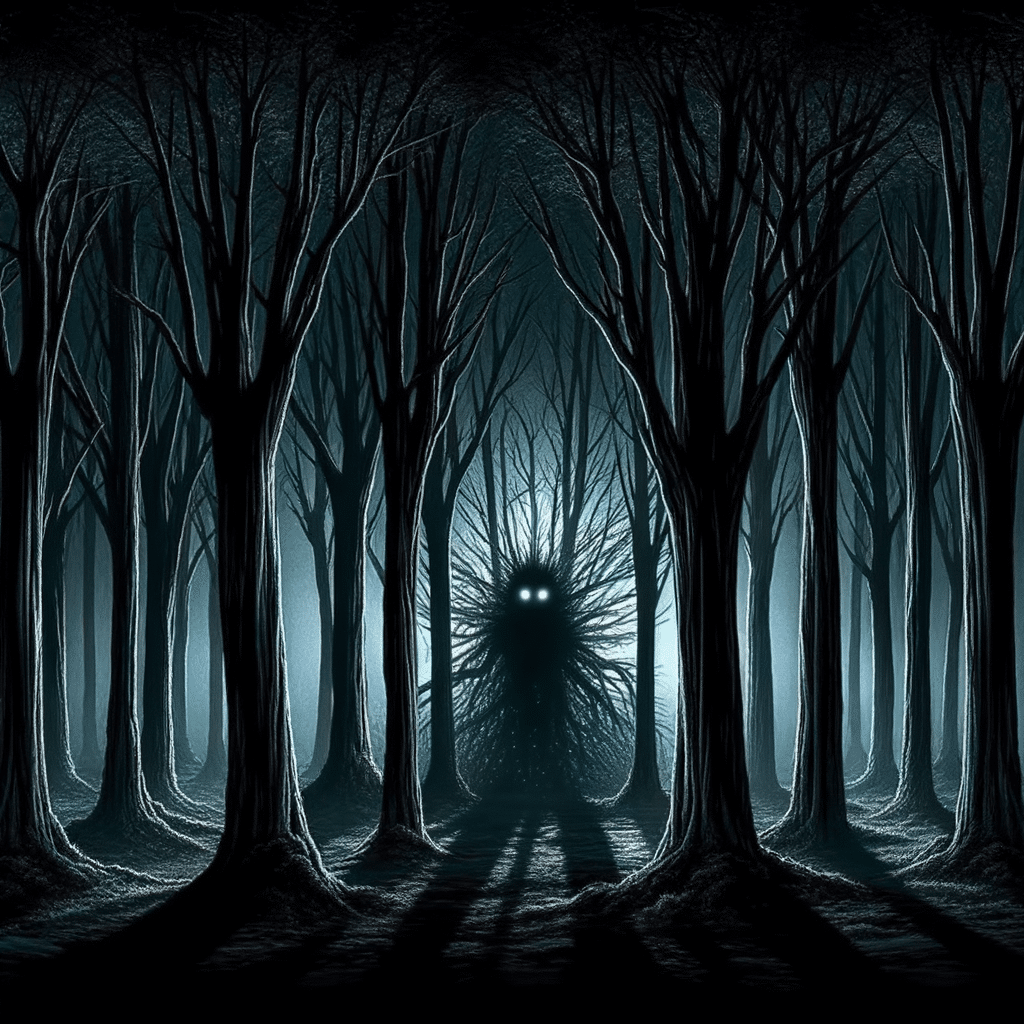
The creature is described as a tall, gaunt figure with dark, shadow-like appearance that remains perpetually hidden just outside its victim’s direct sight.
-
The Hidebehind stalks solitary lumberjacks through the forest, moving to stay behind them, before attacking and causing them to vanish.
-
The creature demonstrates intelligent predatory behavior by targeting isolated humans during twilight hours and waiting patiently to strike.
-
Theories suggest the legend served as a cautionary tale against wandering alone while representing isolation anxiety and Native American folklore influences.
-
The Hidebehind appears in modern popular culture including the Harry Potter series and resonates with the fear of being watched.

Introduction
The Hidebehind is one of the scariest creatures in American folklore. It was created by lumberjacks who worked in the thick forests of North America in the late 1800s and early 1900s. This hard-to-find monster represents the fear of being alone and the real dangers that loggers faced while working in remote areas of the wilderness far from civilization. The Hidebehind is not like many other folkloric creatures that come from old stories or other cultures. It is very American. It came from the unique culture of frontier logging camps, where telling stories was both fun and a way to explain the strange disappearances that sometimes happened in the vast woods.
Overview of a Monster
The Hidebehind folk tale usually starts with a lumberjack who is alone in the woods or who wanders away from his coworkers during the day. The worker would feel like something was following him, and he would see movement out of the corner of his eye and hear strange noises behind him. But whenever he turned to look directly at the thing that was following him, he couldn’t see it because it was so good at moving in perfect sync with him and always staying just out of sight. The story usually ends with the lumberjack either disappearing completely, leaving only his tools behind, or barely making it back to camp, where he tells his coworkers about how scary it was. Some tellings of the story say that the Hidebehind waits for a lumberjack to be completely alone before attacking, while others say that it stalks its prey for hours or even days, feeding on the victim’s growing fear before finally attacking (Botkin, 1977).
Most descriptions of the Hidebehind don’t give a clear picture of what it looks like, which is probably appropriate for a creature that can’t be seen directly. This trope is similar to the larger group of cryptids and legendary creatures that are common in North American folklore. For example, Bigfoot is an example of a creature that is hard to find and see (Regal, 2009). Most accounts say that it is a tall, skinny figure with an unnaturally thin body that lets it hide behind trees that should be too narrow to hide anything of significant size. Some people say it has dark skin or fur that looks like shadows and helps it blend in with the forest, while others say it can become almost invisible. People often say that its face is blank or has big, glowing eyes that give away its presence in the dark. People say the creature’s arms and legs are long and thin, and its clawed hands can grab victims surprisingly quickly, even though it looks weak.
The way the Hidebehind acts shows that it is a smart and patient predator, not a mindless beast. Folklore says that the creature only goes after people who are alone, and it is smart enough to wait for the right time to attack when no one is around to see it. It can move through brush and fallen leaves without making a sound, which would give away the presence of any other animal. People say that the Hidebehind is most active in the late afternoon and early evening, when the shadows get longer and the forest becomes a more confusing place. Some stories say that the creature eats human flesh, while others say that it eats fear itself or maybe even the life force of its victims, leaving behind only empty clothes and tools (Wyman, 1978).
The stories about the Hidebehind go beyond just monster stories. They also include different ways to protect yourself and find it. Lumberjacks thought that drinking alcohol could keep the creature away because it supposedly didn’t like the smell of liquor. This made it easy for them to drink in the camps. Some people believed that the Hidebehind couldn’t cross running water, while others said that the only real protection was to stay in groups and always be on the lookout. Some logging camps came up with rituals like always working in pairs or looking behind trees before passing them. These were probably good for safety, even if there were no supernatural threats. The creature was also linked to explaining the disappearances of lumberjacks who wandered off and were never found. This story was probably more comforting than the truth about fatal accidents, getting lost in huge forests, or giving in to the elements.

Analysis
There are a lot of different ideas about where the Hidebehind legend came from and why it has lasted so long in American folklore. The most sensible explanation is that the creature was meant to scare lumberjacks into not going off on their own, since working in the woods can be very dangerous because of falling trees, dangerous animals, and the chance of getting lost in an area you don’t know. From a psychological standpoint, the Hidebehind may symbolize the externalization of anxiety and paranoia that inherently arise from prolonged engagement in isolated and perilous environments. Some folklorists think that the legend is based on earlier Native American stories about forest spirits and dangerous creatures. They think that stories from Native Americans influenced the logging camp folklore as different cultures mixed on the frontier. The creature’s defining trait of always staying just out of sight also taps into a basic human fear of being watched and followed by an unseen presence, which is based on our instincts about predators and being weak.
Folklorist analysis can help us understand the Hidebehind’s character. These kinds of creatures often stand for fears and the unknown in society, and they tell stories that help communities confront the dangers they can’t see (Bullard, 2023). This narrative is very similar to other folktales about creatures that show hidden dangers or moral problems, like the stories of vampires and other supernatural beings. For example, the complexity of vampire folklore shows how morality and the monstrous can cross cultural lines, similar to how the hidebehind represents societal fears that are both visible and hidden.
The Hidebehind reflects the thematic issues of different cryptids studied in folklore research, where the conflict between belief and doubt makes it even harder to understand these beings. Researchers contend that these narratives substantially enhance our comprehension of folklore, as they embody the cultural beliefs, fears, and values of the societies that generate them (Puglia, 2023). The study of the Hidebehind, situated within the larger framework of cryptids and their significance in folklore, transforms into an inquiry into identity, morality, and the complexities of human culture as understood through collective narratives.
The Hidebehind’s influence and legacy go far beyond the logging camps of the 1800s, where it was first used. Folklorists who study American occupational folklore have written about the creature, and it has been included in collections of American tall tales and legendary creatures with characters like Paul Bunyan and Pecos Bill. The Hidebehind has made a comeback in popular culture in the last few years, showing up in books, games, and other media that draw on American folklore and cryptozoology (DisneyXDUK, 2014). J.K. Rowling’s Harry Potter books introduced the Hidebehind as a magical creature to readers all over the world. These works showed how regional folklore can be changed and adapted for use in new situations (Duane, n.d.). The story still resonates with people who have felt uneasy being alone in the woods, showing that the psychological elements that made it work for lumberjacks are still strong today.
Conclusion
The Hidebehind is a unique American addition to world folklore. It comes from the specific historical context of frontier logging culture and the fact that all people can tell stories when they are in danger or don’t know what’s going to happen next. This creature represents both the real worries that come with dangerous jobs and the deeper psychological fears that come up when people go into wild places where they are no longer the top predators. The Hidebehind has been a part of American logging camp stories for over a century, and it still captures people’s imaginations today. Some people see it as a warning story with real safety benefits, others see it as a psychological expression of isolation and paranoia, and still others see it as a fun story to tell around the campfire. This mysterious monster’s lasting appeal shows us that folklore is important in human societies because it helps us deal with our fears, pass on useful knowledge, and make stories that bring people together through the power of storytelling.
References
Botkin, B. A. (1977). The American people: Stories, legends, tales, traditions and songs. Transaction Publishers.
Bullard, E. (2023). North american monsters: a contemporary legend casebook, edited by david j. puglia. Journal of Scientific Exploration, 36(4), 816-824. https://doi.org/10.31275/20222723
DisneyXDUK. (2014, April 25). Gravity falls – Dipper’s guide to the unexplained – the hide behind [Video]. YouTube. Archived from the original on 2021-12-13. Retrieved April 1, 2017.
Duane, D. (n.d.). The errantry concordance: The online encyclopedia of the young wizards universe. Retrieved October 8, 2009.
Puglia, D. J. (2023). The (mostly) unseen world of cryptids: legendary monsters in north america. Humanities, 13(1), 1. https://doi.org/10.3390/h13010001
Regal, B. (2009). Entering dubious realms: grover krantz, science, and sasquatch. Annals of Science, 66(1), 83-102. https://doi.org/10.1080/00033790802202421
Wyman, W. D. (1978). Mythical creature in the USA and Canada. University of Wisconsin Riverfalls Press.

Leave a Reply