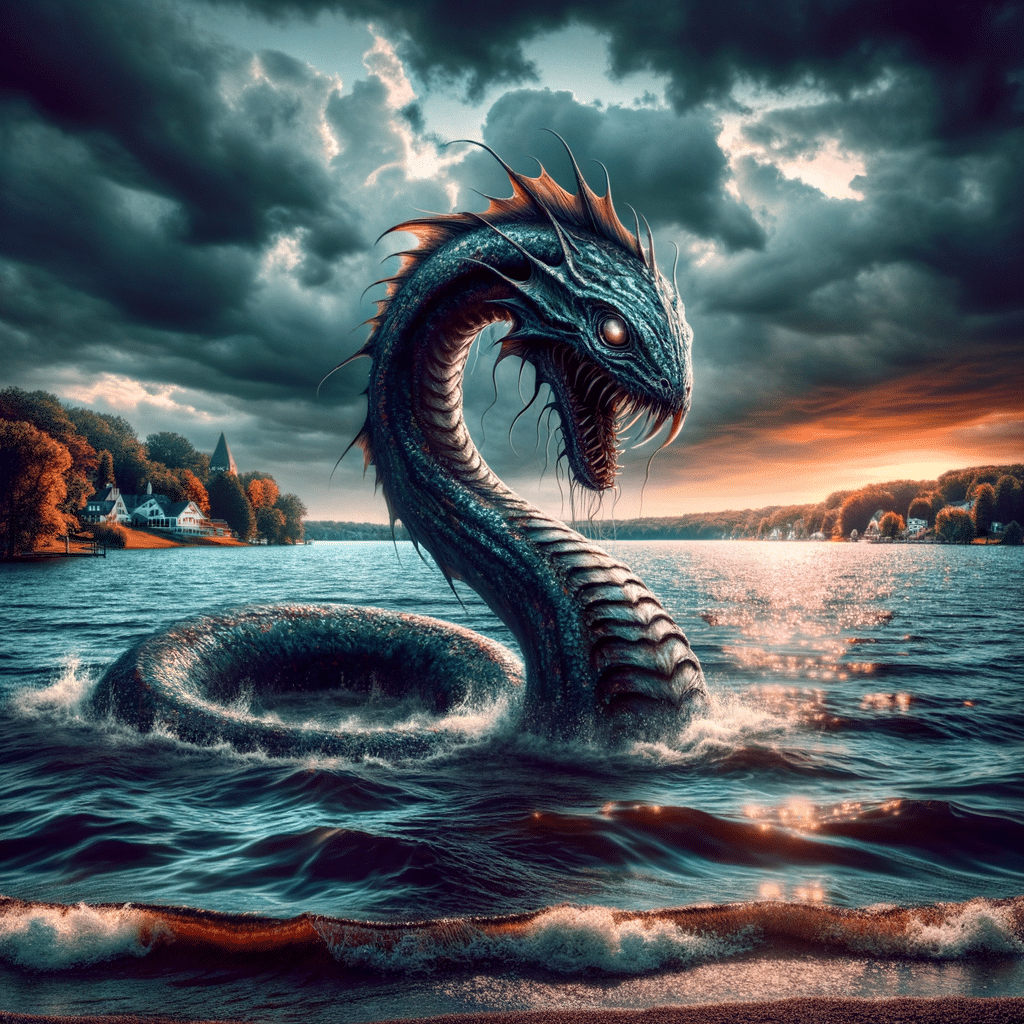
Lake Monona Monster: Key Points
-
The Lake Monona Monster is a Wisconsin cryptid legend, with most sightings occurring in the 1960s and 1970s.
-
The creature is described as serpentine, fifteen to thirty feet long, with dark coloration.
-
Witnesses report it as elusive and fast-moving, with no aggressive behavior toward humans.
-
The folklore portrays it as a guardian spirit or prehistoric survivor, inspiring local culture and storytelling.
-
Theories range from misidentified sturgeon and debris to undiscovered species or supernatural entities.
-
The legend enhances Madison’s quirky reputation and contributes to American lake monster folklore.

Introduction
For a long time, people in Madison, Wisconsin, have told stories about a strange creature that lives in Lake Monona’s waters. The Lake Monona Monster is not as well-known as other American lake monsters like Champ, who is a cousin of the Loch Ness Monster in Lake Champlain, or Tessie, who is a cousin of the Loch Ness Monster in Lake Tahoe. However, it is an intriguing part of Midwestern folklore that has fascinated people for generations. This strange creature, which some people call “Monona” or “the Monster,” is a symbol of how people are drawn to the unknown and how we tend to fill unexplored waters with strange creatures. The story is a reminder that myths and legends can live on even in cities. Lake Monona is right next to Wisconsin’s capital city, showing that the strange and unexplained are always close to home.
Overview
The story of the Lake Monona Monster really starts to take shape in the middle of the twentieth century. However, some researchers and folklore fans say that Native American tribes that lived in the area before the lake may have had their stories about strange creatures living there (Smith, 1995). The 1960s and 1970s were the years when most people said they saw something strange move through the water. In 1967, a group of fishermen gave one of the more detailed accounts. They reported seeing a large, dark shape moving through the water near their boat, creating waves that appeared too large for any known fish species in the lake. People walking along the lakefront paths or looking out at the water from the city’s parks also reported seeing something big and strange breaking the surface before quickly disappearing back into the depths. These sightings often happened in the early morning or at dusk, when it was difficult to see, but witnesses were sure about what they had seen (Godfrey, 2011).
Witnesses have different ideas about what the Lake Monona Monster looks like, which is common with cryptid sightings, but some features show up in many accounts. Most people who saw it say it had a body that looked like a snake or eel and was between fifteen and thirty feet long. Its dark greenish-brown or black color would have made it blend in perfectly with the murky lake water. Some people have said they saw what looked like humps or coils breaking the surface, which suggests a body that is flexible and moves like other lake monsters around the world. Some accounts discuss a head that looks like that of a big fish or snake. Some people say they saw eyes that reflected light or a mouth that looked too big for the head. People have said that the creature’s skin is smooth and slippery like an eel’s or rough and scaly like a fish, but most sightings are too short to get a good look at it. The most common thing that people say about the reports is that they saw something big, strong, and very different from the normal fish species that live in Lake Monona (Zimm, 2015).
The behavior of the Lake Monona Monster suggests that it is hard to find, is mostly active at night or in the early morning and generally stays away from people. Witnesses say that the creature moves through the water with surprising speed and agility, making big wakes and disturbances before disappearing beneath the surface in a matter of seconds. Some lake monster legends say that the creature is aggressive or threatening, but the Lake Monona Monster is usually described as shy or not caring about people. There have been no reports of it attacking boats or swimmers. Some stories say that the creature might be drawn to places where there are a lot of fish, which makes people think it could be a predator that eats the fish in the lake. Most saw them in clear water and calm weather, but some saw them in storms or high waves. The fact that the creature appears to be able to stay hidden for long periods of time, sometimes years between reported sightings, has made it more mysterious and made it harder to prove that it exists (Lardinois, 2022).
People who tell stories in the area have added to the basic legend by saying that the monster is a guardian spirit of the lake or a remnant from prehistoric times that has lived in the lake’s depths. Some versions of the story say that the creature only shows up during important events in the city’s history, acting as a sign or warning of change. Others say that it is a kind spirit that looks out for swimmers and boaters. Families have passed down the legend, with parents telling their kids about the monster as both a warning to be careful around the water and an exciting mystery that makes the lake seem more exotic and unknown.
The Lake Monona Monster is an intriguing case in American folklore that shows how anthropologists are interested in cryptids and monsters as reflections of local culture, environmental interactions, and societal fears. This idea is based on the bigger picture of cryptozoology, which studies the existence of creatures that mainstream science says are hidden or not documented (France, 2022). The Lake Monona Monster shares many similarities with other well-known cryptids, such as the Loch Ness Monster. These creatures are often considered cultural artifacts that bring people together and connect them to their mythological past (Puglia, 2023).

Analysis
Theories about the Lake Monona Monster sightings range from those that are scientifically sound to those that are completely made up. This shows how people try to make sense of things that don’t have an explanation. The most skeptical explanations say that witnesses may have mistaken large sturgeon, which can become enormous, or swimming deer, whose movements through water might look strange from a distance. Some researchers propose that witnesses may have observed floating logs or debris that, under certain lighting conditions and when swept by wind or current, could be mistaken for a living organism. Some more creative theories say that there could be an undiscovered species or a group of prehistoric animals that somehow survived in the lake’s ecosystem. However, this possibility is unlikely because Lake Monona is not massive and has a well-known history. Some paranormal enthusiasts think the creature is a supernatural or interdimensional being that only occasionally appears in our world. Some theorists think that some sightings could be fake or the result of mass hysteria, especially when monster sightings were widely reported in the news and in people’s minds.
Eyewitness accounts and anecdotal evidence are still crucial to the story of the Lake Monona Monster, just like the stories of the Loch Ness Monster that go back to the 7th century (Smith, 2023). These stories contribute to the folklore of Lake Monona, often illustrating a conflict between belief and doubt that reflects the values and environmental awareness of the local residents (France, 2022). The monster can be considered a symbolic representation of the ecological dynamics that control the lake, which makes for intriguing parallels with local environmental conditions that could explain sightings or encounters (Puglia, 2023).
Cultural stories and environmental conditions interact to shape the depiction of these mythical creatures. Studies indicate that the attributes of Lake Monona, particularly its comparatively shallower mean depth, may create conditions favorable for the fabrication of myths concerning unidentified creatures (Walsh et al., 2017). For example, Lake Monona is managed as a “panfish” or zooplanktivore lake, while Lake Mendota, which is next to it, is managed for gamefish. This management affects the area’s biodiversity and the kinds of stories that come out of it (Walsh et al., 2017). This facet of folkloric evolution highlights the influence of local ecological characteristics on the creation and perpetuation of narratives concerning fantastical beings (Walsh et al., 2017).
Furthermore, the Lake Monona Monster can be contextualized within a larger framework of how folklore functions as a medium for confronting ecological issues and societal anxieties. Lake monsters are often linked to problems with environmental degradation and human interference in aquatic ecosystems (López-Díaz et al., 2019). The evolution and endurance of this folklore may function not solely as a source of amusement but also as a cautionary narrative concerning the overexploitation and contamination of natural resources, which bear considerable consequences for local biodiversity and the health of lakes, including Monona (Lathrop & Carpenter, 2014).
The Lake Monona Monster exemplifies how folklore can embody community issues, ecological interactions, and cultural identity, reflecting the complexities of local narratives interwoven with the environment. The examination of these cryptids is crucial, offering understanding of cultural values, environmental concerns, and the human inclination for storytelling in the context of ecological consciousness (Puglia, 2023).
The Lake Monona Monster legend has had a small but important effect on the local community and American folklore as a whole, especially when it comes to regional identity and cultural heritage. The legend has benefited Madison’s reputation as a quirky, creative city that welcomes the strange instead of ignoring it. This aspect fits perfectly with the community’s open-minded and progressive nature. The monster legend adds an extra level of interest to the lake for tourists, encouraging them to learn about the area’s folklore while having fun on the water. The story has also been used to teach critical thinking, evidence, and how folklore spreads in communities. Local cryptozoology fans and amateur researchers have put together trips and monitoring efforts from time to time. This phenomenon has gotten people in the community involved and sparked scientific interest, even if they still haven’t found any solid evidence. The story has also added to the larger body of American lake monster lore by giving it a Midwestern twist. People often associate such an event with remote wilderness areas or ancient European lakes.
The stories about the Lake Monona Monster go beyond just seeing it; they have become a part of the culture of Madison and the nearby towns. Sometimes, local businesses have used the legend to their advantage, like when restaurants, beer labels, and tourist souvenirs use the monster’s name. Folklore has also inspired local artists, writers, and musicians, who have used the monster in their work. This aspect keeps the legend alive and relevant for new generations.
Conclusion
The Lake Monona Monster is more than just a local story about an unexplained creature in the water; it shows how people have always been interested in the unknown and mysterious, even in our modern, urbanized world. The legend has made Madison’s culture richer and given generations a sense of wonder about the waters in their backyard, whether the sightings are of natural events that were misidentified, wishful thinking, or something that really can’t be explained. The story reminds us that folklore is still changing and growing in modern times, not just in the past or in far-off places. It also serves as a reminder of the delicate boundary between our understanding and ignorance. As long as people can see Lake Monona’s waters and they keep flowing, the idea of seeing something strange will probably stay in people’s minds. These developments will keep the story of the Lake Monona Monster alive as a beloved part of American folklore and local culture.
References
France, R. (2022). From folkloric belief to fishery bycatch: contrasting cryptozoological and euhemeristic interpretations of australian sea serpents. Anthropozoologica, 57(3). https://doi.org/10.5252/anthropozoologica2022v57a3
Godfrey, L. S. (2011). Monsters of Wisconsin: Mysterious Creatures in the Badger State. Stackpole Books.
Lardinois, A. (2022). Madison Ghosts and Legends. Arcadia Publishing.
Lathrop, R. G. and Carpenter, S. R. (2014). Water quality implications from three decades of phosphorus loads and trophic dynamics in the yahara chain of lakes. Inland Waters, 4(1), 1-14. https://doi.org/10.5268/iw-4.1.680
López-Díaz, D. C., Yi-cheng, H., Chan, W., Ponce‐Ortega, J. M., & Zavala, V. M. (2019). Systems-level analysis of phosphorus flows in the dairy supply chain. ACS Sustainable Chemistry & Engineering, 7(20), 17074-17087. https://doi.org/10.1021/acssuschemeng.9b03129
Puglia, D. J. (2023). The (mostly) unseen world of cryptids: legendary monsters in north america. Humanities, 13(1), 1. https://doi.org/10.3390/h13010001
Smith, T. S. (1995). The island of the Anishnaabeg: Thunderers and water monsters in the traditional Ojibwe life-world. University of Idaho Press.
Smith, O. (2023). Nessie and noctilucent clouds. Coolabah, (34), 25-45. https://doi.org/10.1344/co20233425-45
Walsh, J. R., Lathrop, R. C., & Zanden, M. J. V. (2017). Invasive invertebrate predator, bythotrephes longimanus, reverses trophic cascade in a north‐temperate lake. Limnology and Oceanography, 62(6), 2498-2509. https://doi.org/10.1002/lno.10582
Zimm, J. (2015). Blue Men and River Monsters: Folklore of the North. Wisconsin Historical Society.


Leave a Reply