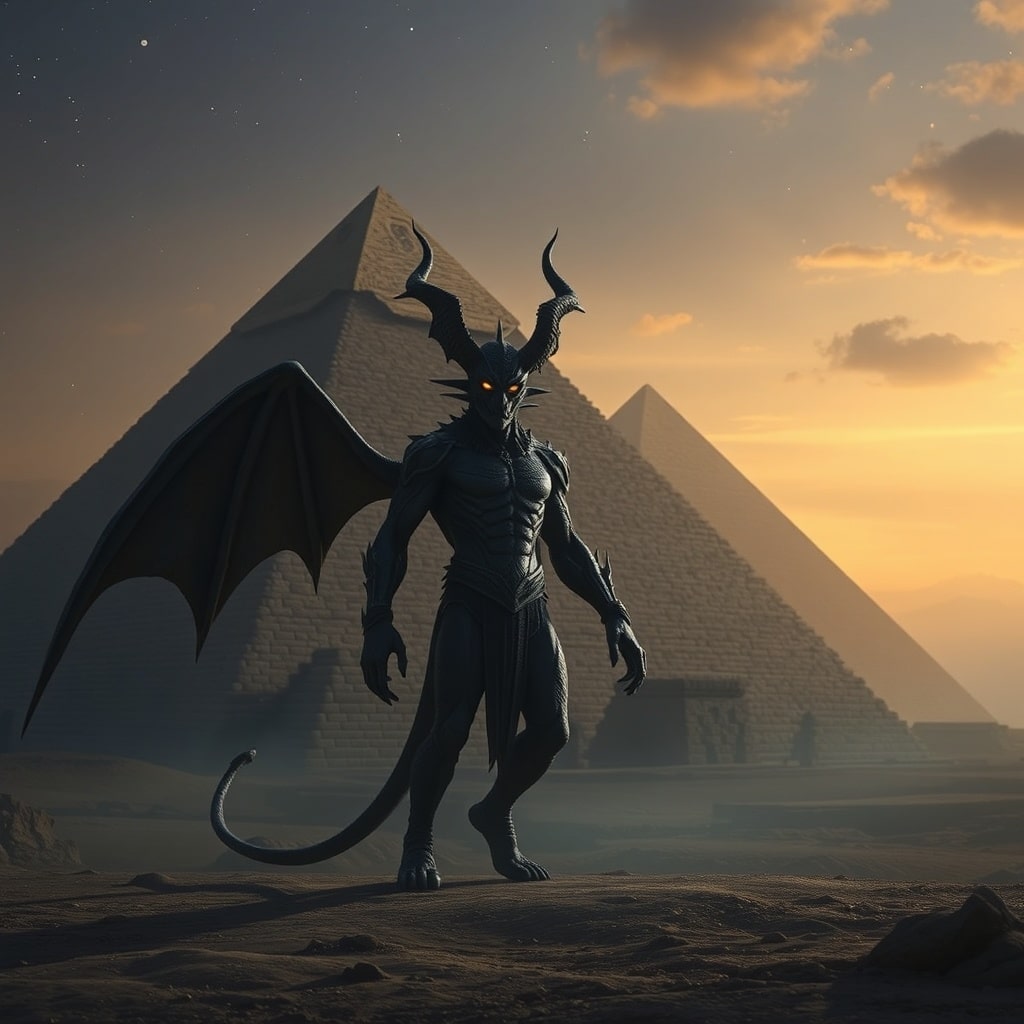
Demons in Ancient Egypt: Key Points
-
Ancient Egyptian demons were supernatural entities between gods and mortals that could both harm and protect humans, requiring control rather than being purely evil.
-
Notable Egyptian demons included Ammit the soul-devourer and Apep the chaos serpent, while lesser demons caused diseases and threatened children, prompting extensive protective magical practices.
-
Egyptian demons represented chaos or isfet rather than absolute evil and sometimes served divine purposes, operating in a different moral framework than modern Western demons.
-
Scholars theorize demons explained misfortune, personified natural dangers and psychological fears, and reinforced priestly authority through specialized knowledge of controlling them.
-
Egyptian demonology influenced Greek, Roman, and Christian thought, shaping Western magical traditions through protective practices, visual imagery, and concepts of controllable supernatural forces.
-
Studying Egyptian demons reveals sophisticated theological reasoning regarding chaos and order, demonstrating that supernatural beliefs are culturally constructed rather than universal.

Introduction
The ancient Egyptians lived in a world full of supernatural forces, where the lines between the divine, the demonic, and the natural were much less clear than they are now. Their understanding of demons was deeply ingrained in their religious beliefs, medical practices, and everyday life, but these beings were very different from the evil beings that people in the West think of today. To understand Egyptian demons, we need to stop contemplating morality and evil in the way we do now and start thinking about how cosmic balance, not moral absolutes, guided the actions of supernatural beings. The demons of ancient Egypt were complicated beings who could be either protective guardians or dangerous threats. Studying them shows that there was a complex theological system that has shaped religious thought for thousands of years.
Demons in Egyptian Mythology
The ancient Egyptians thought that demons were supernatural beings that lived in a space between gods and people. They had powers that could help or hurt people. Demons were more immediate and personal than the major gods, who had temples and organized cults. Demons could directly affect human affairs without the need for ritual worship. In the Christian sense, these beings were not necessarily evil. Instead, they were considered potentially dangerous forces of chaos that needed to be controlled, appeased, or used for protection. The Egyptians believed that demons could cause illness, bring misfortune, or even cause death. They could also be called upon to protect against evil spirits or punish enemies. Numerous depictions of demons showcased a blend of human, animal, and monstrous characteristics. These features showed how they were in between worlds and connected to the chaotic forces that were at the edges of the ordered world (Hammad, 2018).
Egyptian demons were many and different. Some had names and identities, while others were just anonymous sources of ill luck (Lucarelli, 2010). One of the most famous demons was Ammit, the “Devourer of the Dead.” She was a mix of a crocodile’s head, a lion’s body, and a hippopotamus’s back end, and she was waiting to eat the hearts of people who failed the judgment in the afterlife. Apep, the huge snake of chaos, was the personification of the forces of disorder that could destroy creation itself. Every night, the sun god Ra had to fight him to make sure the sun would rise again. The “slaughterers,” who lived on the desert’s edge, and the “wandering demons,” who caused disease and nightmares, were lesser-known. Female demons were especially linked to threats to kids and pregnant women, which showed how dangerous childbirth and infant death were in the past. The Egyptians created complex magical texts, amulets, and rituals to protect themselves from these evil forces, showing how seriously they took these threats in everyday life.
The moral framework of ancient Egyptian demons was very different from that of demons that modern people know about, which are based on Judeo-Christian traditions. Modern Western thought often sees demons as evil servants of Satan who are fighting God and his angels in a cosmic war. However, Egyptian demons were not on the side of any one evil god or force of ultimate evil. Instead, they were examples of isfet, which is the Egyptian idea of chaos and disorder. Isfet wasn’t harmful in and of itself; it was just a necessary counterbalance to maat, which is the idea of order, truth, and justice. These concepts meant that demons could sometimes do what the gods wanted them to do, like protect people or enforce the law when their chaotic energy was directed in the right way. The Egyptians didn’t believe in a single cosmic battle between good and evil. Instead, they believed that there was always a struggle to keep order and balance in a world where chaos was always threatening to break through. The personal nature of Egyptian demons stands in stark contrast to the more systematic demonology that emerged in subsequent Christian theology, wherein demons were classified into hierarchies and categories, and assigned distinct roles within the infernal realm.

Theories
Scholars have posited diverse theories to elucidate the evolution and role of demons in ancient Egyptian religion, utilizing anthropological, psychological, and historical frameworks. Some researchers propose that demons functioned as explanatory constructs for the arbitrary misfortunes and inscrutable suffering inherent in human existence, offering individuals a framework to comprehend the occurrence of adverse events and, crucially, equipping them with ritualistic instruments to counteract these forces. Personifying disease, disaster, and death as demonic beings made these threats that were difficult to understand easier to confront through magic and ritual. Other researchers have observed that numerous Egyptian demons appear to personify elements of the perilous natural realm, especially predatory fauna and the severe desert climate encircling the fertile Nile valley, indicating that demons symbolized the wild forces existing beyond the confines of civilization. Psychoanalytic interpretations suggest that demons externalize internal psychological states, particularly fears and anxieties regarding vulnerability, mortality, and the fragility of the social order. Recent academic work has focused on how demons helped keep social hierarchies and religious authority in place. Only trained priests and magicians had the knowledge to control and manipulate these dangerous forces, which made them an important part of society.
Studies show that these entities were not all the same; instead, they were divided into different groups, each linked to a certain illness or condition. Szpakowska emphasizes that enduring spells and protective artifacts, employed as safeguards against these antagonistic entities, substantiate this classification (Szpakowska, 2009). This viewpoint corresponds with Lucarelli’s analysis of demonology in the late Pharaonic and Greco-Roman eras, during which particular guardian demons surfaced, illustrating the Egyptians’ efforts to organize and comprehend the supernatural dangers they perceived (Lucarelli, 2011).
Szpakowska talks a lot about the idea of demonic paraphernalia, which shows the material culture that goes along with these beliefs, like figurines made to look like demons. This provides us a better idea of how they worked and what they meant in ancient Egyptian thought (Szpakowska, 2013). The corporeal aspect of demonology underscores a pragmatic methodology for addressing perceived threats, wherein rituals and artifacts functioned as safeguards.
Furthermore, the study of demonology encompasses comparative analyses with other ancient cultures, notably Mesopotamia. Lucarelli’s comparative methodology elucidates the resonance of these demonic representations across adjacent civilizations, thereby enhancing our comprehension of ancient convictions regarding malevolent spirits and safeguarding deities (Lucarelli, 2013). This comparative framework is essential for identifying the distinctive features of Egyptian demonology within the broader ancient Near Eastern milieu.
Literature indicates the incorporation of demonological concepts into the extensive magical practices of ancient Egypt, where spells were utilized to summon power and expel malevolent forces. Zinn notes that magic and religion were constantly changing in ancient Egyptian thought. He says that what we think of as demonic was often mixed in with religious beliefs and practices that tried to control the supernatural (Zinn, 2012).
Ancient Egyptian demonology had a profound influence that transcended Egypt’s borders, shaping the evolution of demonological thought in subsequent Mediterranean and Near Eastern cultures (Lucarelli, 2013). Greek and Roman authors encountered Egyptian demons through their engagement with Egyptian religion, and aspects of Egyptian demonology were integrated into Greco-Roman magical papyri and philosophical writings. Early Christian monks residing in the Egyptian desert utilized pre-existing Egyptian notions to formulate their intricate demonologies, notably the concept of demons as entities of spiritual testing and temptation inhabiting untamed, transitional realms. Egyptians used protective amulets and magical spells to keep demons away. These practices were similar to those used by Christians, Jews, and Muslims later on, showing that these protective strategies have lasted across cultural lines. The visual representations of demons, characterized by their hybrid forms and grotesque features, significantly impacted artistic portrayals of demons in medieval and Renaissance Europe. The Egyptian view of demons as forces that could be controlled through knowledge and ritual also helped shape Western magical traditions, such as the complicated demonological systems found in medieval grimoires and the complicated spirit hierarchies used by ceremonial magicians.
Conclusion
The legacy of ancient Egyptian demons continues to fascinate modern scholars and the general public alike, offering insights into how ancient peoples understood the precarious nature of existence and the unseen forces that shaped their lives. These beings were not merely manifestations of superstition; they were intricate theological constructs that assisted the Egyptians in navigating a world replete with authentic perils and uncertainties. By studying Egyptian demons, we learn more about how complicated ancient religious thought was and how different cultures have dealt with basic questions about suffering, chaos, and the line between order and disorder. The difference between Egyptian demons and modern ones shows us that our ideas about righteousness, evil, and the supernatural are shaped by our culture, not by universal truths. Learning about the demons of ancient Egypt helps us understand how people have always needed to name, understand, and ultimately control the things that threaten our health and safety.
References
Hammad, M. (2018). Demonic Beings in Ancient Egypt. International Academic Journal Faculty of Tourism and Hotel Management, 4(4), 1-27.
Lucarelli, R. (2010). Demons (benevolent and malevolent). UCLA Encyclopedia of Egyptology, 1(1).
Lucarelli, R. (2011). Demonology during the late pharaonic and greco-roman periods in egypt. Journal of Ancient Near Eastern Religions, 11(2), 109-125. https://doi.org/10.1163/156921211×603904
Lucarelli, R. (2013). Towards a Comparative Approach to Demonology in Antiquity: The Case of Ancient Egypt and Mesopotamia. Archiv für Religionsgeschichte, 14(1).
Szpakowska, K. (2009). Demons in ancient egypt. Religion Compass, 3(5), 799-805. https://doi.org/10.1111/j.1749-8171.2009.00169.x
Zinn, K. (2012). Magic, pharaonic egypt. The Encyclopedia of Ancient History. https://doi.org/10.1002/9781444338386.wbeah15250



Leave a Reply