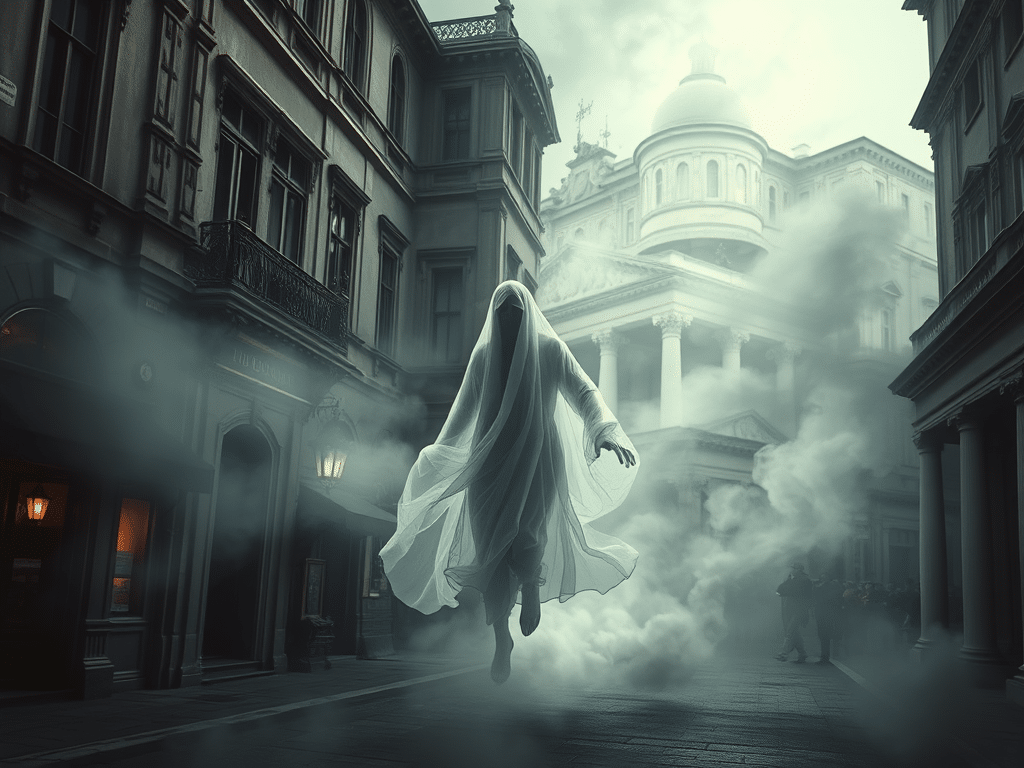
Temporal Hauntings: Key Points
-
Temporal hauntings involve ghosts existing outside normal time, with events or people from different eras manifesting in the present or causing witnesses to slip into past periods.
-
The Stone Tape Theory suggests materials like stone can record emotionally charged events and replay them like recordings, offering a quasi-scientific explanation for repetitive hauntings.
-
Time slips are dramatic cases where witnesses temporarily experience another time period in the same location, with famous examples including the Versailles time slip and Bold Street in Liverpool transforming into past eras.
-
Folklore includes the Roman soldiers of York marching at ancient road levels, Lincoln’s ghost appearing during crises, and period-dressed figures unaware of modern observers appearing across cultures and centuries.
-
Skeptics attribute temporal hauntings to psychological factors like false memories and expectation bias, noting the lack of physical evidence and that experiences typically occur where paranormal activity is already expected.
-
Temporal hauntings have significant cultural impact by exploring humanity’s relationship with time and mortality while raising questions about consciousness and whether our understanding of time remains incomplete.

Introduction
Paranormal temporal hauntings are one of the most intriguing places where the supernatural and theoretical physics meet. They make us question what we know about consciousness and time itself. Unlike regular ghost sightings, which suggest that spirits are stuck in one place in the present, temporal hauntings suggest that paranormal beings exist outside of the normal flow of time, appearing in different eras or getting stuck in loops. This idea makes us think again about whether ghosts are just echoes of people who have died or something much more complicated. They may be conscious beings who can move through time in ways that living people cannot, or they may be recordings imprinted on spacetime.
Overview
To comprehend temporal hauntings, it is essential to investigate the essence of ghosts and their connection to time. Traditional ghost stories often say that spirits are stuck on Earth after they die, usually in places where they had strong feelings or went through traumatic events (Guiley & Taylor, 1992). However, temporal hauntings imply a more complex framework in which these entities do not merely persist in the present but inhabit a realm where past, present, and future become indistinct or irrelevant. Within this framework, what we interpret as a ghost may actually be an individual or occurrence from a different temporal context intruding upon our current reality, or conversely, we may be temporarily transported into their time. This model challenges the linear view of time that we use in our daily lives and suggests that certain things, like where we are, how we feel, or things we don’t know about the physical world, could make these time barriers less solid.
Paranormal activity associated with temporal hauntings exhibits characteristics that differentiate it from typical ghostly experiences. Witnesses frequently describe encountering individuals attired in period clothing, appearing entirely corporeal and oblivious to contemporary observers, engaged in ordinary activities as if they inhabit their own temporal context rather than recognizing the present. These apparitions often disappear instantly, as if a window into another time has suddenly closed. Furthermore, places where people are haunted by time often have sounds that don’t fit with the time, like horse-drawn carriages on roads that have been paved for decades, the sounds of medieval battles in quiet fields, or the music and conversation of parties that happened generations ago (Morton, 2015). Some people who saw it say they felt a sudden change in temperature, air pressure, or even the quality of the light. They also said they felt like they had stepped into a different time, with smells that were appropriate for the time, like coal smoke, cooking fires, or flowers that are no longer common in the area.
There are many intriguing stories about temporal ghosts from different cultures and times. One of the most famous cases is the Roman soldiers in York, England. In 1953, a plumber named Harry Martindale said he saw a line of dirty Roman legionaries marching through the basement of the Treasurer’s House. Their legs were cut off at the knees until he realized they were walking on the original Roman road, which was below the current floor level. Many people have seen the ghostly monks of Beaulieu Abbey in Hampshire over the years. They always take the same path through the ruins at the same times, and they seem to be unaware of the modern world around them and the fact that their monastery has long since crumbled. People in America have said that the ghost of Abraham Lincoln wanders around the White House and shows up during times of national crisis. Their claim suggests that his presence may be linked to decisive moments in American history rather than just being a regular haunting. Two English academics, Charlotte Anne Moberly and Eleanor Jourdain, experienced a time slip in Versailles in 1901. They said they walked through the gardens of the Petit Trianon and saw people and buildings from the time of Marie Antoinette, with details that were later confirmed by historical research. This report is still one of the most detailed accounts of a temporal haunting.

Time Slips
Among the most prominent and dramatic forms of temporal haunting are time slips. They happen when people or groups say they have traveled to a different time while staying in the same physical location. These experiences are different from regular ghost sightings because the people who see them seem to cross timelines instead of just seeing things from another time. The phenomenon usually happens all at once, when the surroundings change completely. New buildings disappear, old ones appear, cars and clothes change to look like they did in another time, and occasionally the people who see them can even talk to people from that time. The Bold Street time slip in Liverpool is a well-known case. Over the years, many people have said that the shopping street suddenly changed into how it looked in the 1950s or 1960s, with stores like Cripps and a bookstore that closed decades ago. Often, these events occur abruptly, leaving witnesses perplexed and questioning their sanity. However, the fact that details are consistent across different accounts confers the phenomenon more credibility.
T. C. Lethbridge, an archaeologist who became a ghost hunter, came up with the Stone Tape Theory. Lethbridge’s theory, which gained popularity after a BBC TV play in 1972, offers a scientific-sounding explanation for ghostly events that happen at certain times (Lethbridge, 1961). It has become very popular among paranormal researchers. This theory posits that materials in edifices and terrains, especially stone and other minerals with crystalline formations, can document intense emotional or physical occurrences akin to how magnetic tape captures sound and images. This theory says that traumatic or emotionally charged events leave some kind of energy imprint on the environment around them. This imprint can then be replayed under certain conditions, like when someone with a certain sensitivity is there or when environmental factors like electromagnetic fields or weather conditions are just right. The theory tries to explain why hauntings often seem like recordings instead of intelligent interactions, with the same scenes playing out over and over again without any changes or awareness of the people watching. The Stone Tape Theory is not yet proven by science, and it doesn’t explain how recording and playback would work, but it does connect paranormal experiences with materialist science. It suggests that what we think of as ghosts might just be natural events that we don’t yet understand, rather than supernatural events.
The ramifications of temporal hauntings for our comprehension of time travel are simultaneously intriguing and profoundly concerning for established physics. If temporal hauntings are real events of people from the past showing up in the present, or if people from the present are going back in time, then time might not be a one-way river like we think it is. Instead, it might be more like a landscape where different times exist at the same time in different layers or dimensions. This notion implies that time travel, at least in a perceptual or consciousness-based manner, may already transpire naturally under specific conditions, despite our inability to control or replicate it technologically. The phenomenon of witnesses in time slip cases occasionally reporting sightings by individuals from the past era they have entered prompts significant inquiries regarding the essence of causality and the potential for paradoxes—if an individual from 2025 manifests in 1875, what implications does such an event hold for the historical record and the capacity to modify past occurrences? If these cases are real, they could suggest that time is more resistant to paradoxes than we currently believe, or that the multiverse theories proposed by some physicists are correct, indicating that each instance of time travel creates or accesses a different timeline.
Theories
Different theories try to explain time hauntings from both paranormal and skeptical points of view, and each has its pros and cons. Paranormal researchers frequently reference quantum mechanics, proposing that consciousness may engage with quantum phenomena in manners that facilitate perception or even temporal travel; however, this often constitutes a misapplication of quantum theory that physicists predominantly dismiss. Some theorize that emotional energy or trauma can induce disruptions in the fabric of spacetime, facilitating glimpses into alternate temporal dimensions, despite the absence of a recognized mechanism to substantiate this phenomenon. Psychological theories postulate that temporal hauntings arise from confabulation, wherein the brain constructs false memories from incomplete sensory data, cultural knowledge, and suggestion, thereby engendering the illusion of experiencing a different temporal context. Skeptics assert that temporal ghost sightings usually lack period-accurate details beyond what the witness could have acquired from literature, cinema, or general cultural knowledge. Furthermore, the “verification” of purportedly unknown historical details often reveals either their documentation in accessible sources or their ultimate historical accuracy. The issue of expectation bias is substantial; individuals visiting historically significant sites frequently anticipate encountering ghosts and may interpret ambiguous sensory experiences accordingly, while the absence of temporal hauntings in ordinary locations where they are not anticipated indicates a pronounced psychological influence.
The convergence of spectral entities within cultural narratives often transmutes conventional folklore into a conduit for articulating societal values and historical continuity. Suprayitno, for example, talks about how Indonesian ghost movies are not only fun to watch but also a way to keep and study ghostly figures that carry on collective memory from ancestral stories. The result shows how they help us understand the past in new ways (Suprayitno, 2020). Additionally, the transformative nature of these narratives emphasizes that ghosts exist in a liminal space beyond temporal confines, igniting our imaginations and reflecting the ongoing cultural dialogues surrounding mortality and existence. This approach corresponds with the overarching view of folklore as a reservoir of collective memory, as articulated by Iskandarovna, who underscores that folklore embodies the spiritual wealth and identity of the community, connecting historical events and individual experiences (Iskandarovna, 2025).
Seeing ghosts can also cause time slips, which are when people say they have experiences that don’t seem to be happening right now. Academic inquiry in this domain examines how these experiences contest our comprehension of time itself. Taje discusses the ongoing debate about whether or not ghosts exist and how this debate fits into cultural discussions about life, death, and the separation of body and spirit. Taje says that seeing ghosts may make people question their ideas about reality and the flow of time (Taje, 2025). Discussions like these help build a framework that aims to validate eyewitness accounts and cultural reports. Such evidence is important for understanding ghostly phenomena from different points of view.
Additionally, the convergence of folklore and cultural identity expression offers a substantial framework for the analysis of time slips. Dubey posits that various myths and legends stem from shared experiences that defy temporal clarification, indicating that these narratives possess significance beyond their immediate cultural contexts (Dubey, 2022). The cyclical nature of folklore, as illustrated by Nasution et al., suggests that traditional narratives reflect historical significance and evolve in response to societal transformations, paralleling the continuous process of identity formation over time (Nasution et al., 2022). This flexibility shows how folklore and ghost stories interact in a dynamic way, letting people understand the past while still being interested in the present.
Moreover, the intricacies of ghosts in folklore can incite critical examinations of temporal perceptions in various cultures. Zeng’s research on “ghost transients” connects the idea of ghosts to things that can be seen, like the effects of an earthquake, that make time seem to move differently. This study illustrates the interplay between spectral and physical realities (Zeng, 2022). The study indicates that physiological sensations and historical narratives frequently coalesce unconsciously within individual experiences of temporal dislocation, thereby cultivating a collective yet distinct comprehension of existence across varied populations.
Skeptical examination of temporal hauntings uncovers various patterns that diminish their validity as authentic anomalous occurrences. Usually, slips and reports of temporal ghosts happen in places that are already known for their historical importance or ghost stories. This phenomenon suggests that prior knowledge and expectations shape these experiences rather than those arising independently of cultural context. When looked into, many well-known cases show inconsistencies, exaggerations, or even outright lies. For example, the Versailles time slip has been criticized for having historical inaccuracies and for the fact that Moberly and Jourdain’s story changed and got more detailed over time, which is a sign of false memory formation. The lack of physical evidence from time slips is also significant; individuals asserting to have visited the past do not return with artifacts, photographs inadequately capture the experiences described by witnesses, and there are no recorded instances of messages or objects from time-slip experiencers being discovered in historical documentation. Moreover, the phenomenon appears to be distinctly confined to pre-photographic or pre-video periods; there are no accounts of ghosts from 2020 manifesting in 2025, nor instances of individuals advancing into the future and returning with verifiable information, indicating that these experiences are likely reconstructions of fabricated pasts rather than authentic temporal occurrences.
Conclusion
Even though some people are skeptical, temporal hauntings have had a big effect on how we perceive time, memory, and even the nature of reality itself. These narratives and experiences, whether authentic anomalies or psychological phenomena, engage profound human anxieties regarding mortality, the permanence of the past, and our aspiration to believe that significant moments and individuals are not wholly obliterated by time. The ongoing prevalence of temporal haunting reports across various cultures and historical epochs suggests that they serve essential psychological or social functions, possibly acting to preserve history’s relevance or offering solace by implying that the distinction between life and death and past and present is not definitive. In literature, film, and popular culture, temporal hauntings have inspired countless works that explore themes of regret, historical trauma, and the weight of the past on the present, from ghost stories to time travel narratives that grapple with similar questions about the nature of temporal experience. The emotional impact of these stories—the sudden nostalgia and the creepy feeling of coming across something that shouldn’t be there right now—shows how complicated our relationship with time is and how difficult it is for us to fully accept that it only goes one way.
Temporal hauntings epitomize a captivating convergence of folklore, psychology, theoretical physics, and the human perception of time that resists straightforward classification or rejection. Whether these phenomena signify authentic disruptions in the temporal continuum, intricate psychological experiences, or merely captivating narratives that expose our aspirations and anxieties regarding time and mortality, they compel us to reevaluate our assumptions about the essence of reality and the potential incompleteness of our scientific comprehension. The consistency of certain elements across cultures and centuries—the sudden environmental shifts, the period-accurate details, the sense of having stepped outside normal time—suggests that even if temporal hauntings are not what they appear to be, they reflect something significant about human consciousness and perception that merits serious investigation. As our comprehension of quantum mechanics, consciousness, and the essence of time advances, we may ultimately establish frameworks that either conclusively elucidate these phenomena in conventional terms or, more audaciously, reveal that time is more peculiar and permeable than our quotidian experiences imply, thereby unlocking possibilities that presently reside in the domain of speculation and awe.
References
Dubey, S. (2022). Factual origins of myths. International Journal of Social Science and Human Research, 05(10), 4491-4493. https://doi.org/10.47191/ijsshr/v5-i10-11
Guiley, R., & Taylor, T. (1992). The encyclopedia of ghosts and spirits (pp. 277-279). New York: Facts on File.
Iskandarovna, Y. K. (2025). Folklore as spiritual wealth and great value. European International Journal of Philological Sciences, 5(6), 81-85. https://doi.org/10.55640/eijps-05-06-22
Lethbridge, T. C. (1961). Ghost and ghoul. Routledge and Kegan Paul.
Morton, L. (2015). Ghosts: A haunted history. Reaktion Books.
Nasution, F. M., Harahap, R., & Wuriyani, E. P. (2022). Tradisi lisan sumur tua daerah labuhan batu utara. Pedagogika: Jurnal Ilmu-Ilmu Kependidikan, 2(1), 79-83. https://doi.org/10.57251/ped.v2i1.354
Suprayitno, S. (2020). Seeing indonesian ghost films through document theory. Proceedings From the Document Academy, 7(1). https://doi.org/10.35492/docam/7/1/5
Taje, M. (2025). The existence of ghostly-spirits: debunking paranormal skepticism.. https://doi.org/10.33774/coe-2025-7qd4h
Zeng, Y. (2022). A fault-based crustal deformation model with deep driven dislocation sources for the 2023 update to the u.s. national seismic hazard model. Seismological Research Letters, 93(6), 3170-3185. https://doi.org/10.1785/0220220209


Leave a Reply