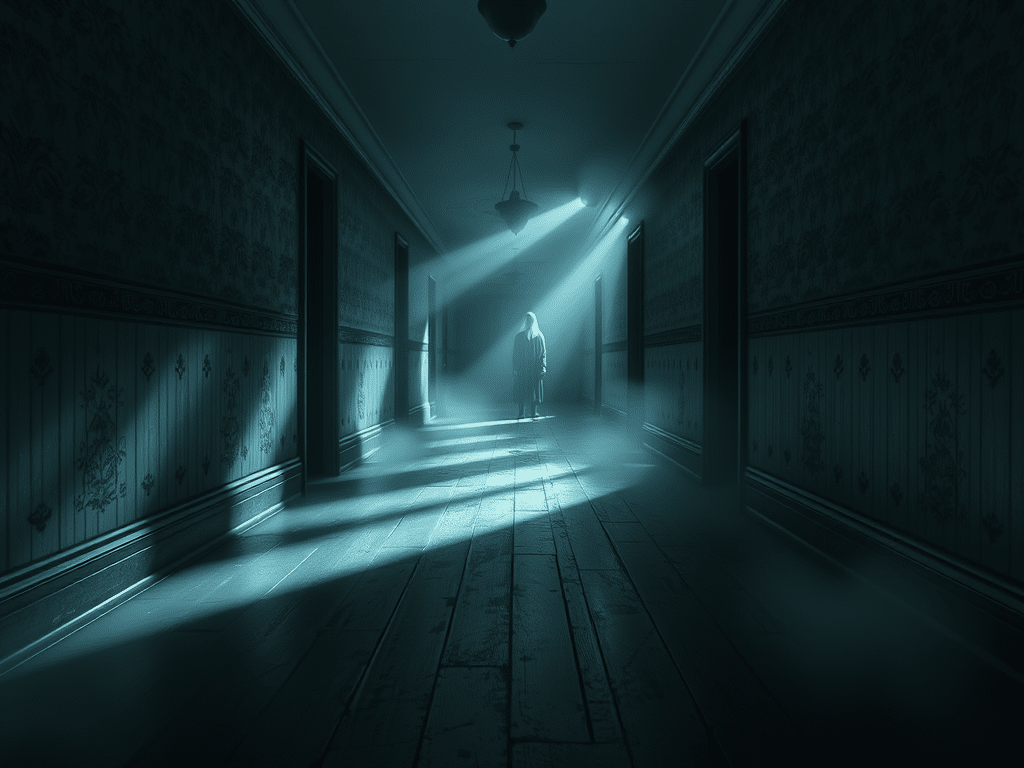
Ghosts and Liminal Spaces: Key Points
-
Liminal spaces like hallways lack inherent meaning and exist only for passage, creating an unsettling emptiness our brains feel compelled to fill.
-
Our minds project ghosts onto these empty spaces to explain the eerie feelings and provide context where none exists.
-
Ancient folklore identified thresholds and boundaries as spirit-dwelling places due to their transitional nature and lack of human presence.
-
Poor lighting, shadows, infrasound, and pareidolia create conditions that cause people to misperceive natural phenomena as supernatural.
-
Reflective surfaces, acoustic distortions, and dramatic lighting in liminal spaces contribute to their reputation as haunted locations.
-
Ghost stories in liminal spaces reveal our psychological need to create meaning in environments that offer none.

Introduction
Over the course of human history, some places have caught our attention as possible homes for the supernatural. One of the most common places to hear about such phenomena is liminal spaces, which are areas that appear between destinations rather than as destinations themselves. Seeing ghostly figures in halls, stairwells, and doorways has happened across cultures and generations. Such behavior suggests that there is something basic about how people see and interact with places that are changing. This article looks at the psychological reasons, cultural traditions, and the unique qualities that make liminal spaces naturally unsettling in order to explain why ghosts are so often linked to these spaces in between.
Liminal Spaces and Ghosts
In both traditional folklore and modern paranormal stories, ghosts are usually thought of as the souls or leftovers of people who have died but have not fully left the physical world. These ghostly beings are often shown as see-through or translucent figures. They can show up as full-body apparitions or as shadows, orbs, or just a presence that can be felt but not seen. Ghost stories all have one thing in common: the souls are said to be stuck or trapped between worlds, unable to move on to whatever lies beyond death. This makes the places they are said to live fascinating. When people see what they think are ghosts, they often feel suddenly cold, hear sounds like footsteps or words that they can’t explain, and have a strong feeling of being watched.
As the name suggests, liminal spaces are places that are only meant to help us move from one place to another, not stay there for long amounts of time. There are hallways that connect rooms, stairwells that connect floors, doorways that split inside from outside, and corridors that help people move around buildings. These places usually lack personal touches, comfort, or signs of human habitation that make other places feel warm and comfortable. Because liminal places are empty and impersonal, they create an atmosphere of uncertainty. Our brains don’t pick up on the normal cues from our surroundings that help us feel safe. The absence of structure and defined space in architecture facilitates psychological projection, leading us to assign meaning to empty spaces that lack inherent significance.
There is a complicated state of liminality that ghosts inhabit; they move back and forth between the living and the dead. Anthropological studies define liminality as periods of transition during which individuals or groups find themselves in between. This situation often leads to life-changing events (Wang & Shen, 2024.02). People worry about death and the afterlife, and ghosts are a sign of this state of transition. Baker and Bader look into the idea of hauntology and say that ghosts are more than just beliefs; they are a part of modern culture’s philosophical questions (Baker & Bader, 2014).
Fiction also reflects this eerie presence, blurring the boundaries between reality and ghostly existence. According to Hac-Rosiak (2024), liminal places in works by Edgar Allan Poe and Zygmunt Miłoszewski are like crypts, which represent the links between the past and the present and become “haunted” by the memories and traumas of the people who lived there before (Hac-Rosiak, 2022). Furthermore, the rebirth and rewriting of literary figures like Charles Dickens bring up similar hauntological themes, where they live two lives as authors and ghosts (Holt, 2020).
Theories
The psychological reason for ghosts appearing in liminal areas has to do with how our brains process information about our surroundings and react to uncertainty. Hallways and stairs are transitional spaces. This state makes us slightly anxious and more aware. These empty spaces make our brains feel uneasy due to their lack of background or meaning, prompting us to fill them in with imagination and projection. This way of thinking can turn a shadow into a figure, a sound that settles into the sound of footsteps, or the feeling of being empty into a sense of being present. A lot of the time, when we move through these spaces, we feel temporarily alone between crowded areas. Shifting our attention from outward focus to internal awareness amplifies this effect even more, increasing our likelihood of misinterpreting unclear stimuli.
Folklore and cultural practices have long known that threshold spaces have supernatural meanings. This suggests that the link between ghosts and liminal spaces goes back before modern psychological knowledge. Many cultures perceive places like riverbanks, entrances, crossroads, and other boundary points as places where the veil between worlds thins. Folklore from the past often told people how to safely cross thresholds by doing things like bringing protective charms or saying prayers. This was because people thought these places were spiritually dangerous. They believed ghosts liked these transitional zones because they were uninhabited and not part of normal human life. People today who say they’ve seen ghosts in hallways and stairwells are following a practice of liminal space anxiety that goes back thousands of years.
When ghosts and liminal spaces meet, they show deep truths about the human mind and our need for meaning and context in the places we live. Because they only serve a practical purpose—to transport us from one place to another—transitional areas make us think about our sense of place and purpose. Our minds are constantly looking for meaning, so this existential emptiness makes us feel bad. To ease this discomfort, our brains fill these empty areas with stories and meaning, even if those stories involve the supernatural. The story of the ghost in the hallway provides meaning to a place that wouldn’t have any other meaning. It turns an empty space into something that makes sense, even if it’s scary. This psychological process shows how much people need their surroundings to make sense and how we can make meaning where there is none.
Not only are liminal places physical, but they are also mental. Piironen examines the experiences of participants in LEGO Serious Play classes as liminal spaces, demonstrating that these environments can serve as pivotal moments for both individuals and collectives (Piironen, 2022). These kinds of places let the inner self and outer events talk to each other, which is similar to how ghostly presences can make you think and feel.
People who don’t believe in ghosts in liminal places offer several logical explanations based on psychology, neuroscience, and the environment. People with pareidolia, the tendency to see patterns in random things, may see faces or figures in shadows and hazy shapes that are common in halls that aren’t well lit. Infrasound is low-frequency sound waves that humans can’t hear. It can be made by ventilation systems, traffic, or building movements, and it has been shown to make people feel uneasy and anxious and even see things that look like ghostly apparitions. Lack of sleep, stress, and expectation all play big parts. People who believe in ghosts or are feeling very emotional are more likely to think that strange things they are experiencing are magical. These scientific explanations make the experiences people have in liminal places real, and they give us new ways to think about them.

Impact
The architecture and lighting of liminal areas play a big role in making them feel creepy and making them desirable places to see ghosts. Many hallways and stairwells aren’t well lit, leaving dramatic shadows and deep dark spots that are hard for the human eye to see clearly. Reflective surfaces, like mirrors, windows, or polished floors, are common in these places. They can make it hard to see, like when you see movement in your peripheral vision or images that you didn’t expect to see. The hard surfaces and empty spaces in these places make the sounds echo and distort in ways that make it hard to tell where they are coming from or what they are. All of these things in the environment make it easy to misunderstand and experience sensory overload, which can lead to reports of ghosts even when nothing strange is actually happening.
People who believe that ghosts live in liminal spaces have an impact on architecture, culture, and how we all think about where we fit in with society as a whole. Many people say they feel unsafe or uncomfortable in certain halls, stairwells, or corridors. As a result, they avoid these areas or move quickly through them, which reinforces the idea that these are places to endure rather than enjoy. Because of this psychological reaction, modern buildings try to make transitional areas feel friendlier by adding better lighting, artwork, windows, and other features that make people feel more at ease. Culturally, ghost stories have a place in liminal areas. They also serve a social purpose by giving us shared stories that acknowledge our shared fears about emptiness, change, and the unknown.
Many types of art and stories reflect the cultural effects of ghosts and liminal places. Lundberg and Geerlings (2017) talk about how monsters, like ghosts, appear in certain urban and rural landscapes that represent the edges of society. These landscapes are used as metaphors for greater existential fears about the “other.” These places, like empty buildings and graves, act as gateways to other states of being, similar to how Derrida thought of hauntology, in which the past constantly affects the present (Baker & Bader, 2014).
Similar ideas come up when people travel, where liminality is thought to improve well-being through memorable events. Wang and Shen (2024) say that liminal experiences connected to organic agricultural tourism have a big effect on tourists’ mental health. They stress the importance of these kinds of places in creating important, life-changing moments. This view supports the idea that ghosts are unfinished stories from the past that haunt modern life and make us think about who we are and where we belong.
On a different cultural level, researchers like Elferen say that the Gothic genre uses ghosts as a metaphor for the “absent presence” of historical stories, showing how society works today through its use of shadowy figures (Elferen, 2009). When authors draw ghosts in literature, they often make readers think about their transition experiences, as the characters move between their physical worlds and spiritual encounters.
Conclusion
In the end, ghosts in liminal places tell us more about how people think and feel about their surroundings than they do about the supernatural. The consistent link between ghosts and transitional spaces suggests a deeper truth about how we feel and make sense of our surroundings, no matter if you believe in ghosts as real beings or only psychological explanations. These places in between test us because they don’t provide us anything—no destination, no purpose other than passage, and no context for interpretation. Our minds fight this emptiness by making up stories, feeling presences, and filling the void with meaning. The ghost in the hallway represents how uncomfortable we are with meaninglessness; it shows how we need to discover meaning even in the most practical and short-lived places.
The common belief that ghosts haunt liminal spaces is caused by a complicated mix of human behavior, the way places are designed, and our basic need to identify meaning and context in our surroundings. Hallways, stairwells, and other transitional spaces are ideal for ghostly experiences because they have no value on their own and only get us from one important place to another. The link between ghosts and liminal spaces has been very consistent across cultures and times. Such an association could be because of folklore that sees threshold spaces as spiritually important, psychological processes that fill in gaps in our knowledge through projection and imagination, or environmental factors that make it straightforward for people to make mistakes. Figuring out why we see ghosts in these empty, transitional spaces can teach us a lot about the mind, our connection to the world around us, and the stories we tell ourselves to make sense of places that won’t assign themselves meaning.
References
Baker, J. and Bader, C. (2014). A social anthropology of ghosts in twenty-first-century America. Social Compass, 61(4), 569-593. https://doi.org/10.1177/0037768614547337
Elferen, I. (2009). Dances with Spectres: Theorising the Cybergothic. Gothic Studies, 11(1), 99-112. https://doi.org/10.7227/gs.11.1.10
Hac-Rosiak, B. (2024). Widmo wychodzi z podziemi. „Domofon” Zygmunta Miłoszewskiego a „Zagłada domu Usherów” Edgara Allana Poego. Literatura I Kultura Popularna, 29, 255-278. https://doi.org/10.19195/0867-7441.29.16
Holt, S. (2020). Dickens “was dead: to begin with”: Charles Dickens’s Ghostly Afterlife in Neo-Victorian Narratives. Dickens Studies Annual, 51(2), 375-410. https://doi.org/10.5325/dickstudannu.51.2.0375
Lundberg, A. and Geerlings, L. (2017). Tropical Liminal: Urban Vampires & Other Blood-Sucking Monstrosities. Etropic Electronic Journal of Studies in the Tropics, 16(1). https://doi.org/10.25120/etropic.16.1.2017.3574
Piironen, S. (2022). Producing liminal spaces for change interventions: the case of LEGO serious play workshops. Journal of Organizational Change Management, 35(8), 39-53. https://doi.org/10.1108/jocm-03-2021-0073
Wang, D. and Shen, C. (2024). Impact of Liminality in Organic Agricultural Tourism on Well-Being: The Role of Memorable Tourism Experiences as a Mediating Variable. Agriculture, 14(9), 1508. https://doi.org/10.3390/agriculture14091508




Leave a Reply