Faeries and the Hollow Earth: Key Points
-
Faeries are supernatural beings from global folklore, depicted as magical humanoid creatures of varying sizes with powers over nature and capricious temperaments toward humans.
-
Hollow earth theory proposes that vast caverns or internal worlds exist beneath the Earth’s surface, though modern geology has disproven these pseudo-scientific hypotheses.
-
Folklore worldwide consistently places faeries in underground realms, with Celtic, Scandinavian, and British traditions describing elaborate subterranean kingdoms and tunnel systems.
-
Nineteenth and twentieth-century occult movements connected faerie folklore with hollow earth theory, proposing that mythical beings were actually members of advanced subterranean civilizations.
-
The combined mythology has profoundly influenced mainstream culture through literature, games, and films that depict underground kingdoms and serve as vessels for environmental messages.
-
Despite scientific disproof, these traditions persist because they address fundamental human needs for enchantment and mystery beyond purely factual understanding.

Introduction
The intersection of faerie folklore and hollow earth theory represents a fascinating convergence of mythological tradition and speculative cosmology that has captivated human imagination for centuries. While fairies have been woven into the cultural fabric of societies worldwide through oral tradition and literary works, the hollow earth theory emerged as a pseudoscientific attempt to explain mysterious phenomena and ancient legends. Both concepts share a common thread in their depiction of hidden realms beneath our feet, populated by beings fundamentally different from surface-dwelling humans. This essay explores the rich tapestry of faerie lore, examines the development of hollow earth theories, and investigates how these two distinct traditions have become intertwined in the human quest to understand what might exist in the unseen spaces of our world.
Faeries and the Hollow Earth
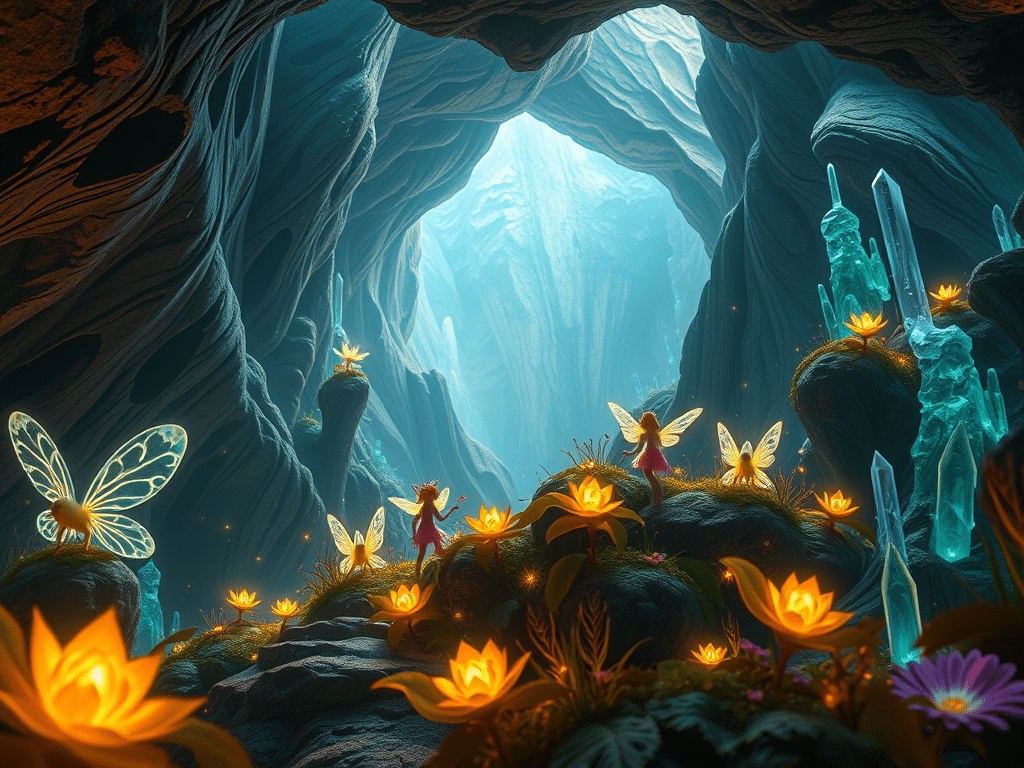
Faeries, also known as fae, fairy folk, or the good neighbors, are supernatural beings that appear in the folklore of cultures across the globe, though they are most prominently featured in Celtic, Germanic, and Scandinavian traditions. These entities are typically described as possessing human-like forms but with distinctive otherworldly characteristics such as unusual beauty, pointed ears, translucent or luminescent skin, and the ability to manipulate natural forces or practice powerful magic. The size of fairies varies dramatically across different cultural accounts, ranging from tiny winged sprites no larger than insects to human-sized or even giant beings of terrible power and majesty (Rowland, 2020). Their temperament is equally variable, with some traditions portraying them as benevolent helpers who aid humans in times of need, while others depict them as capricious tricksters or malevolent spirits who kidnap children, lead travelers astray, and bring misfortune to those who offend them. Common traits attributed to fairies include immortality or extraordinarily long lifespans, aversion to iron and Christian symbols, and the requirement that humans follow specific protocols when interacting with them to avoid supernatural retribution.
Fairies are not merely whimsical creatures but represent complex cultural significations that have evolved over centuries. Fairies have often been understood as representations of both natural phenomena and the interactions between humanity and the environment. Across numerous mythologies, these beings are depicted as protectors of concealed realms, paralleling the stories associated with the Hollow Earth, where they are believed to exist in uncharted territories beneath the planet’s exterior (Mills, 2010).
The Hollow Earth theory posits that the Earth is not a solid entity; rather, it encompasses extensive hollow areas, caverns, or even entire internal worlds situated beneath its outer crust. This idea has a long history, appearing in different forms throughout time. It can be seen in the Greek underworld and Norse mythology, and it later appeared in scientific theories in the seventeenth and eighteenth centuries (Standish, 2025). Early supporters, like Edmond Halley, suggested that the Earth was made of hollow spheres. Later, theorists such as John Cleves Symmes Jr. proposed that large openings at the poles led to a livable world inside the Earth. These theories often incorporated ideas about internal suns, advanced civilizations, and prehistoric creatures surviving in subterranean environments protected from the cataclysms that shaped the surface world. Although modern geology and seismology have definitively disproven the hollow earth hypothesis through evidence of the planet’s solid and molten layers, the theory persists in fringe circles and is still the subject of speculative fiction. The enduring appeal of hollow earth ideas stems partly from their ability to accommodate various mythological traditions about underworld realms and underground kingdoms that appear across human cultures.
The idea of the Hollow Earth posits that there are extensive networks of underground tunnels and societies, often described as populated by ethereal beings such as fairies. This mirrors historical notions of the world as layered, both physically and spiritually, where the underground could represent a realm of magical creatures and otherworldly experiences. Conversely, it is crucial to acknowledge that the Hollow Earth hypothesis is not supported by significant scientific validation and is, in essence, a peripheral theory (Küppers, 2009).
Folklore and Theories
Global folklore traditions are replete with references to faeries residing in subterranean domains, thereby establishing a natural link to hollow earth notions. Celtic mythology, for instance, recounts the Sidhe, formidable faerie entities who, following their displacement by human populations, withdrew into hollow hills and ancient burial mounds, thereby establishing intricate kingdoms beneath the earth’s exterior. Scandinavian legends, on the other hand, depict Svartalfheim, an underground world populated by dark elves or dwarves, who are said to extract valuable metals and fabricate magical artifacts within their subterranean forges. Furthermore, Germanic narratives feature the Erdluitle or earth folk, who inhabit caves and mountain hollows, occasionally interacting with humans who inadvertently discover their concealed entrances. In British and Irish tradition, certain geographic features such as Glastonbury Tor, Newgrange, and various fairy mounds are believed to serve as gateways between the human world and the underground faerie realm. These folklore accounts consistently describe elaborate underground palaces filled with unimaginable wealth, timeless feasting halls where a single night might equal years in the human world, and intricate tunnel systems connecting various faerie kingdoms beneath the earth. The prevalence of these underground faerie dwelling narratives across disparate cultures suggests either a common human psychological tendency to imagine hidden worlds beneath our feet or possibly shared ancient memories of actual subterranean spaces used for ritual purposes.
The representation of these creatures often reflects human anxieties and societal constructs. For instance, in modern literature, transformations like that of Laszlo into a pig slave reflect societal fears surrounding bodily autonomy and identity. This transformation can resonate with themes in narratives regarding conceiving the underground, suggesting that deeper explorations of self and society often lead one to uncover the ‘other”—potentially representing other civilizations or forms of life existing unnoticed beneath our feet (Moore & Moore, 1906).
Moreover, such representations may evoke discussions surrounding kinship and identity in subterranean mythologies. In works such as The Universal Kinship (Mercieca, 2017), the exploration of life forms and biological structures within different communities highlights the interconnectedness present not just on the surface but also in imagined underground societies, where kinship transcends perceived boundaries.
Exploring the philosophy of place and identity further recontextualizes our understanding of these mythical beings and their habitats. Urban settings and natural landscapes frequently shape our perceptions of fairies; however, subterranean realms prompt a reevaluation of space as a dynamic construct that can encompass both fear and intrigue (SAYILIR, 2021). Each depiction of fairy interactions within these contexts can function as a critique of societal conventions and the shared understanding of human experience or the limitations we place on the natural world and cultural practices.
The relationship between faerie folklore and hollow earth theory becomes evident in diverse occult and theosophical movements of the nineteenth and twentieth centuries, which sought to integrate mythology with unconventional scientific perspectives. Figures such as Helena Blavatsky and later theosophists posited that sophisticated ancient societies and supernatural entities, including those akin to conventional fairies, could reside within subterranean cavern systems or hollow areas of the earth. Certain advocates of hollow earth theory proposed that faerie encounters documented throughout history represented interactions with members of technologically advanced underground civilizations, reinterpreting magical phenomena as advanced scientific principles misinterpreted by less developed surface populations. This combined approach allowed people to keep believing in both folklore and pseudo-scientific ideas, suggesting these different viewpoints described the same basic reality. The Nazi regime’s interest in hollow earth theory and Aryan origin stories complicated these connections. Some occult researchers in that movement looked for ancient Teutonic gods and mythical races in imagined underground worlds. Today, conspiracy theories and fringe beliefs continue this pattern, often combining faerie lore, hollow earth ideas, alien encounters, and other paranormal events into complete alternative worldviews.
Several different theories have emerged to explain the connection between faerie traditions and the idea of underground realms. Psychological analysis posits that faerie folklore and hollow earth theories both arise from the human propensity to ascribe enigmas and aspirations to unfamiliar realms, with subterranean locations naturally functioning as repositories for imagined alternate existences. Furthermore, the anthropological perspective suggests that faerie narratives could represent fragmented cultural recollections of displaced groups who sought refuge in caves and secluded regions, thereby transforming into enigmatic “others” within the folklore of later inhabitants. The interdimensional hypothesis, which is popular in some new age and ufology circles, suggests that fairies and other mythical beings exist in parallel dimensions. These dimensions occasionally interact with our own, particularly at specific locations. Underground places are thought to be weak points or gateways between these dimensions. In contrast, the cryptozoological approach views faerie stories as possible evidence of undiscovered hominid species or isolated populations that have evolved in hidden underground environments. Each of these theoretical perspectives endeavors to explain the enduring global tendency to link supernatural entities with subterranean realms, despite lacking widespread scientific endorsement.

Impact
The cultural influence of merging faerie folklore with hollow earth theories permeates beyond marginal belief systems, permeating mainstream literature, entertainment, and artistic endeavors. J.R.R. Tolkien’s Middle-earth, although not explicitly supporting hollow earth theory, significantly incorporates traditions of underground realms populated by dwarves and other imaginary races, thereby establishing one of the most impactful fictional universes in contemporary literature. Modern fantasy literature often incorporates intricate underground civilizations, ranging from the drow cities in Dungeons & Dragons to the goblin kingdoms depicted in various young adult novels. Films and television frequently leverage the visual and narrative possibilities inherent in subterranean faerie realms, employing contemporary special effects to vividly realize these imagined environments. Video games have, in particular, capitalized on these concepts, enabling players to navigate intricate underground kingdoms populated by magical beings and ancient enigmas. This cultural output both mirrors and strengthens public intrigue regarding the possibility of extraordinary concealed worlds existing beneath our quotidian existence, even among viewers who acknowledge these portrayals as purely fictional rather than literal veracity (Childress & Shaver, 1999).
Furthermore, the enduring nature of these interconnected mythologies illuminates significant facets of human psychology and our engagement with the unknown. Underground environments inherently elicit associations with enigma, peril, and metamorphosis, as they physically embody a descent from the commonplace into obscurity and the unfamiliar. Faeries, as entities straddling the thresholds between the mundane and the extraordinary, the familiar and the enigmatic, are ideally suited to inhabit these subterranean liminal spaces. The hollow earth hypothesis, notwithstanding its scientific deficiencies, fulfills a fundamental human inclination to posit that our planet still harbors undiscovered marvels and that the processes of investigation and understanding remain unfinished. Consequently, these traditions collectively enable individuals to preserve a sense of wonder and potential within a world that is increasingly defined by mapping, measurement, and explanation. These narratives offer imaginative realms where the extraordinary could manifest, where the impossible could become tangible, and where humanity’s comprehension of reality might be inherently limited.
The persistent fascination with faerie folklore and hollow earth mythology resonates with wider themes of ecological consciousness and our connection to the natural environment. Numerous traditional fairy tales convey potent environmental messages, portraying the fae as protectors of nature who penalize those who disregard the land and reward those who coexist harmoniously with their environment. The subterranean domains of faerie folklore frequently symbolize pristine, untainted nature, contrasting with the progressively developed surface world, thus functioning as a fantasy of environmental conservation. Modern adaptations of these myths frequently position faerie encounters and hollow earth theories as critiques of environmental degradation, the displacement of indigenous populations, and the ramifications of perceiving the Earth solely as a resource to be exploited, rather than a living entity deserving of reverence. This ecological perspective imbues ancient narratives with contemporary significance, enabling new generations to derive meaning from traditional stories by interpreting them as allegories concerning humanity’s connection to the planet that sustains us.
Conclusion
The intersection of faerie folklore and hollow earth theory transcends a mere fusion of mythology and pseudoscience. These interconnected traditions illuminate core facets of human imagination, our psychological inclination towards mystery and awe, and our cultural methodologies for encoding environmental knowledge and societal values within narrative structures. Although contemporary scientific understanding has irrefutably disproven the existence of a hollow Earth and the literal reality of fairies, the allure of these ideas persists in literature, art, and popular culture. These concepts continue to fuel creative endeavors, influence cultural discussions concerning humanity’s connection to the natural world and the enigmatic, and offer structures for articulating concerns and hopes regarding the human condition. The persistent appeal of narratives depicting faerie realms beneath the Earth’s surface illustrates that a narrative’s worth is not solely determined by its factual accuracy and that myths can convey significant insights into human experience, even when they do not reflect physical reality. Consequently, as long as people continue to search for meaning, wonder, and enchantment in their lives, the concealed realms beneath our feet will remain a source of fascination for our collective imagination.
References
Childress, D. H., & Shaver, R. S. (1999). Lost continents & the hollow earth. Adventures Unlimited Press.
Küppers, P. (2009). “your darkness also/rich and beyond fear”: Community performance, somatic poetics and the vessels of self and other. M/C Journal, 12(5). https://doi.org/10.5204/mcj.203
Mercieca, P. (2017). ‘Southern’ Northern Soul: Changing senses of direction, place, space, identity and time. M/C Journal, 20(6). https://doi.org/10.5204/mcj.1361
Mills, B. (2010). Those pig-men things. M/C Journal, 13(5). https://doi.org/10.5204/mcj.277
Moore, J. H. (1906). The universal kinship. https://doi.org/10.5962/bhl.title.19974
Rowland, A. (2020). Finding faeries: Discovering sprites, pixies, redcaps, and other fantastical creatures in an urban environment. Simon and Schuster.
Sayılır, Ş. B. (2021). Türklerin ağaç ile mitolojik ve tarihi bağları üzerine bir değerlendirme. Genel Türk Tarihi Araştırmaları Dergisi, 3(6), 187–198. https://doi.org/10.53718/gttad.940879
Standish, D. (2025). Hollow Earth: The long and curious history of imagining strange lands, fantastical creatures, advanced civilization. Hachette+ ORM.
Leave a Reply